


When emotions run high in a relationship, there are two very different directions things can go. You can regulate — noticing what you’re feeling and finding a way to express or reframe it before it takes over. Or you can suppress — pushing the feeling down, keeping it out of sight, and hoping it doesn’t surface later.
The difference between these two approaches isn’t just psychological. It shows up in communication patterns, physical stress responses, and relationship satisfaction over time. Research consistently shows that couples who regulate emotions together build stronger connections — while those who habitually suppress tend to drift apart, even when things look fine on the surface.
Understanding that distinction is the first step toward changing it.
Before diving into how each approach affects relationships and health, the video below offers a useful starting point on why suppressing emotions — even with good intentions — tends to work against you:
Understanding Emotional Regulation and Emotional Suppression
The distinction between emotional regulation and suppression lies in timing: regulation works proactively to adjust emotions early, while suppression steps in after emotions have already peaked. This timing shapes how both personal feelings and relationships are affected. Let’s break down what each approach involves and how it impacts us.
What is Emotional Regulation?
Emotional regulation is all about managing your emotions – deciding which feelings to experience, when to experience them, and how to express them. This process is proactive, relying on awareness and mental strategies, guided by the brain’s prefrontal cortex, to adjust emotional responses.
For example, imagine your partner forgets an important date. Instead of jumping to conclusions or feeling hurt, you might remind yourself that they’ve been overwhelmed with work. This mental reframing, known as cognitive reappraisal, helps you shift your perspective to reduce the emotional sting. While it requires effort, this approach doesn’t just mask negative feelings – it actively reduces them. The result? Better emotional balance, greater resilience, and healthier responses to relationship hurdles.
What is Emotional Suppression?
“Emotional suppression is the conscious inhibition of emotional expressive behavior while emotionally aroused.” — James J. Gross & Robert W. Levenson, Journal of Personality and Social Psychology
Suppression, on the other hand, kicks in after emotions have already taken hold. When you’re upset, frustrated, or angry, suppression involves deliberately keeping those emotions under wraps – hiding them to avoid immediate conflict or discomfort. Outwardly, you might seem calm, but internally, your emotional intensity often remains high or even escalates. Research shows suppression is common, appearing in 41% of daily diary entries — nearly as often as acceptance (44%).
People suppress their emotions for various reasons. Some aim to maintain harmony in their relationships, while others want to protect their partner’s feelings or manage how they’re perceived. Interestingly, a study of 1,179 married participants found that individuals focused on avoiding risks or conflicts reported higher marital satisfaction when they suppressed emotions — but only if their spouse also practiced suppression. This doesn’t mean suppression is ideal; instead, it highlights how people use it strategically, depending on their relationship goals and dynamics.
Recognizing these contrasting processes helps us understand how emotions influence communication and intimacy. Each approach shapes how emotions function as tools within our relationships.
How Emotions Function in Relationships
Emotions as Communication Tools
Emotions act as powerful signals, helping partners understand each other’s needs, concerns, and feelings. When you share emotions like frustration, happiness, or worry, you’re essentially giving your partner a glimpse into your inner world – what you’re going through and what matters to you.
“Emotion plays an important role in our relationships, and a close relational context in particular shapes our experience of emotion.” – Wan-Lan Chen and Wan Ting Liao, Department of Human Development and Psychology, Tzu Chi University
Studies show that expressing emotions openly in everyday interactions can lead to stronger relationships. It fosters acceptance, deeper connection, and greater satisfaction between partners. For example, when you share feelings about a challenge you’re facing, it allows your partner to validate your experience – perhaps by acknowledging your worries or offering support. This kind of emotional openness, especially during conflicts, encourages healthier communication and makes tough conversations more productive. How you engage with emotions today can shape both the quality and longevity of your relationship over time.
What Happens When Emotions Are Ignored or Suppressed
While sharing emotions strengthens intimacy, suppressing them can create walls between partners. When emotions are hidden instead of communicated, their ability to connect and inform is lost. Suppression often signals emotional distance, which can lead to less acceptance and lower relationship satisfaction. Without knowing what you’re feeling, your partner can’t respond to your needs effectively.
The effects go beyond emotional disconnection. Research on emotional suppression in couples shows that when one partner distances themselves emotionally during conflicts, the other partner’s stress levels often rise — measurable through physiological indicators like skin conductance and heart rate. Suppression doesn’t just hinder connection; it can amplify tension in ways that impact both partners. Suppressing emotions doesn’t just hinder connection; it can also amplify tension in ways that impact both partners.
sbb-itb-23f89d4
Effects on Physical, Mental, and Relationship Health
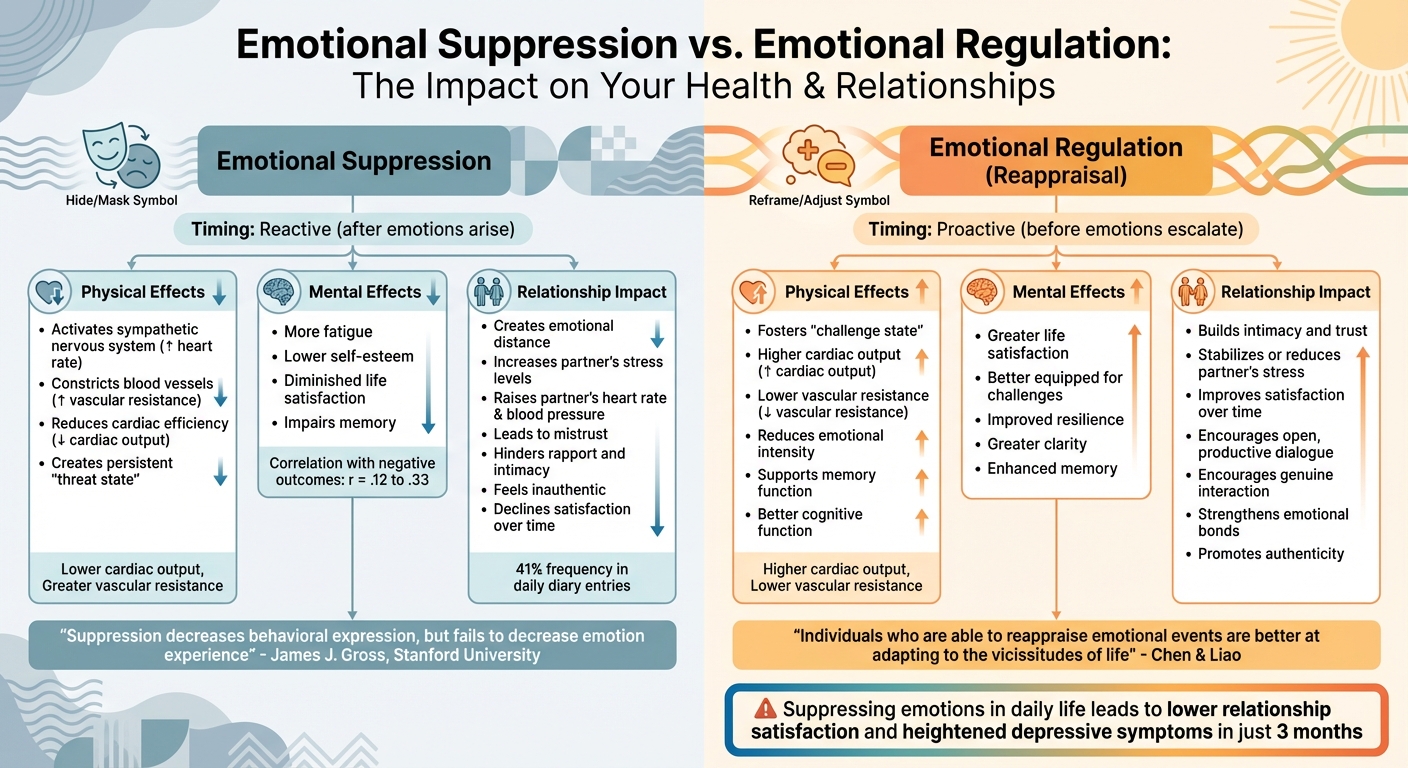
Emotional Regulation vs Suppression: Effects on Relationships and Health
Health Consequences of Emotional Suppression
When emotions are suppressed, the body reacts as if it’s under threat. This activates the sympathetic nervous system, increasing heart rate, constricting blood vessels, and reducing cardiac efficiency. Unlike a normal stress response, emotional suppression creates a persistent “threat state”, characterized by lower cardiac output and greater vascular resistance. Over time, this takes a toll on overall health.
People who habitually suppress their emotions often experience more fatigue, lower self-esteem, and diminished satisfaction in daily life. Research consistently supports these findings, with studies showing correlations between emotional suppression and negative outcomes ranging from |r| = .12 to .33.
“Suppression decreases behavioral expression, but fails to decrease emotion experience, and actually impairs memory. Suppression also increases physiological responding for suppressors and their social partners.”
– James J. Gross, Professor of Psychology, Stanford University
What’s more, suppression doesn’t just affect the individual – it impacts those around them. For example, when someone suppresses emotions during a conversation, their partner’s stress levels can spike, leading to higher heart rates and blood pressure.
Health Benefits of Emotional Regulation
Emotional regulation, on the other hand, offers clear mental and physical advantages. Instead of hiding emotions after they arise, reappraisal involves reframing how you perceive a situation before emotions fully develop. This approach reduces both the intensity of the emotional experience and its outward expression, without triggering the physiological stress associated with suppression.
The physical benefits are striking. While suppression induces a threat response with reduced cardiac efficiency, regulation fosters a “challenge state” – marked by higher cardiac output and lower vascular resistance. Additionally, emotional regulation supports memory and cognitive function, unlike suppression, which can impair recall.
On a mental level, those who practice reappraisal often report feeling more satisfied with life and better equipped to handle emotional challenges. By addressing emotions directly instead of bottling them up, you can build resilience and gain greater clarity. These benefits naturally extend to relationships, fostering stronger connections and healthier dynamics.
Impact on Relationship Dynamics and Intimacy
The advantages of emotional regulation also shine through in relationships. Suppression, by contrast, can create emotional distance. When feelings are hidden, partners may sense a lack of acceptance, which can erode trust and connection. This absence of emotional cues can amplify stress during conflicts, making it harder to resolve issues.
| Feature | Emotional Suppression | Emotional Regulation (Reappraisal) |
|---|---|---|
| Connection | Leads to distance and mistrust | Builds intimacy and trust |
| Partner’s Stress | Increases due to heightened tension | Stabilizes or reduces stress |
| Relationship Satisfaction | Declines over time | Improves over time |
| Communication | Hinders rapport and intimacy | Encourages open, productive dialogue |
| Authenticity | Feels inauthentic | Encourages genuine interaction |
In contrast, emotional regulation promotes authenticity. Using reappraisal allows individuals to express their emotions constructively, fostering understanding instead of defensiveness. This openness strengthens trust and deepens emotional bonds, creating a foundation for relationships to thrive rather than deteriorate.
How to Develop Emotional Regulation Skills
Learning how to regulate emotions can improve your quality of life and strengthen your relationships. The best part? These skills can be developed with practice.
Cognitive Reappraisal Techniques
Cognitive reappraisal is a proactive strategy that involves reframing how you view a situation. For instance, instead of interpreting a partner’s sharp comment as a personal attack, you might see it as a sign of their stress . This shift in perspective can lower the emotional charge and help you respond in a calmer, more constructive way.
When you feel triggered, pause and ask yourself, “Could there be another explanation for this?” Maybe your partner didn’t respond to your text because they’re swamped at work, not because they’re ignoring you. This subtle change in perspective can turn a potential argument into an opportunity for empathy.
“The usage of cognitive reappraisal allows to implement and produce interpersonal behavior that is appropriately focused on social interaction and is perceived by the others as emotionally engaging and responsive.”
– Debora Cutuli, Department of Psychology, University “Sapienza” of Rome
Unlike suppression, which can be mentally draining and even harm your memory, reappraisal does not impair memory — and may even enhance it — unlike suppression, which consistently reduces recall of emotional events.
Pairing reappraisal with mindfulness techniques can take your emotional regulation to the next level.
Mindfulness and Self-Awareness Practices
Mindfulness teaches you to experience emotions in the moment without being overwhelmed by them. Instead of suppressing feelings or letting them control you, mindfulness encourages you to observe them, much like watching waves rise and fall. This approach creates a pause between the trigger and your reaction, giving you the chance to respond thoughtfully.
As Margaret Cullen, a Licensed Marriage and Family Therapist, puts it:
“Suppression doesn’t make the emotion go away, it just stays inside you causing more pain”
Trying to push emotions aside can sometimes lead to overthinking, which only makes things worse. Programs like Mindfulness-Based Emotional Balance (MBEB) combine mindfulness with practices like compassion and forgiveness to help you regulate emotions more effectively. Even simple techniques, such as deep breathing or stepping away from a heated situation, can make a big difference.
Getting Professional Support
If self-help methods don’t seem to be enough, working with a professional can provide additional tools and guidance. Therapy offers a safe space to explore your emotions and learn healthier ways to manage them.
Evidence-backed approaches like Cognitive Behavioral Therapy (CBT), Dialectical Behavior Therapy (DBT), and Emotionally Focused Therapy (EFT) are particularly effective for building emotional regulation skills . For example, DBT introduces “TIP” skills – temperature change, exercise, and paced breathing – to quickly calm intense emotions.
Professional support — through approaches like CBT, DBT, and Emotionally Focused Therapy — can provide a structured space to explore emotional patterns and develop healthier ways of managing them. For people dealing with mood swings, emotional dysregulation, or unresolved trauma, working with a therapist who integrates emotional, lifestyle, and nutritional factors tends to produce more complete outcomes than addressing any one piece in isolation.
“Regulating emotions is not about suppressing or pretending they do not exist but rather about acknowledging and finding healthy ways to express and manage them.”
– Staff Clinician, Council for Relationships
Conclusion
The distinction between emotional regulation and suppression boils down to this: regulation helps you process and respond to emotions constructively, while suppression simply pushes them out of sight. Using strategies like cognitive reappraisal, you can shift how you interpret a situation before it overwhelms you. Suppression, on the other hand, just masks feelings, often leading to negative long-term effects.
Research shows that suppressing emotions in daily life can lead to lower relationship satisfaction and heightened depressive symptoms in as little as three months. Those who practice cognitive reappraisal tend to enjoy better mental health, greater life satisfaction, and closer relationships.
“Individuals who are able to reappraise emotional events or take positive actions to deal with problematic situations are better at adapting to the vicissitudes of life.”
– Wan-Lan Chen and Wan Ting Liao
These findings highlight the far-reaching benefits of emotional regulation. When you manage your emotions in a healthy way, it encourages deeper connection. Your partner feels more understood, conversations flow more smoothly, and disagreements become less stressful for both of you. Suppression, however, can drive a wedge between partners, increase physiological tension, and gradually weaken intimacy.
If breaking the habit of emotional suppression feels daunting, professional support can make a meaningful difference. A therapist who works with both the psychological and lifestyle factors behind emotional dysregulation — not just the surface symptoms — gives you the best foundation for lasting change. Emotional regulation is a skill. It takes practice, but progress is possible.
Emotional Patterns Can Change — With the Right Support.
If emotional suppression has become a default in your relationship — or if you’re ready to build something more connected — that’s worth exploring with someone who can help you get there. At Modyfi, our network of providers brings psychiatry, therapy, nutrition, and exercise together to support the whole picture, not just the symptom.
👉 Explore Providers to Book an Appointment and Start Your Care Plan
(Note: Modyfi proudly accepts most major commercial insurance plans. We do not accept Medicare or Medicaid.)
FAQs
What are some practical ways to improve emotional regulation in daily life?
Improving how you handle emotions begins with developing awareness of what you’re feeling and learning to respond thoughtfully instead of reacting on impulse. Start by noticing your emotions as they arise and try to name them – this simple step can help you make sense of what you’re experiencing.
To manage emotions more effectively, you can explore techniques like mindfulness, which focuses on staying present and observing your feelings without judgment, or reappraisal, where you shift your perspective to see a situation in a more positive light. Other approaches might include deep breathing exercises, practicing acceptance of your emotions, or finding a healthy distraction when feelings become too intense.
By working on these strategies consistently, you can navigate emotional challenges more smoothly, build stronger connections with others, and handle conflicts with greater confidence.
How does suppressing emotions affect long-term relationships?
Suppressing emotions over time can take a toll on both your well-being and the strength of your relationships. When emotions – especially negative ones – are consistently bottled up, it often leads to lower satisfaction in relationships and a growing emotional gap. This distance can make resolving conflicts more challenging and hinder the development of emotional closeness.
Over time, this pattern of emotional suppression can contribute to stress, misunderstandings, and a breakdown in open communication, all of which can strain the bond between partners. Learning to manage emotions in a constructive way – like expressing feelings openly and finding healthy ways to regulate them – can go a long way in building deeper, more rewarding connections.
How does cognitive reappraisal help in managing emotions effectively?
Cognitive reappraisal is a powerful tool for managing emotions. It works by changing the way you interpret situations that spark intense feelings. By looking at things from a different angle, you can respond in a calmer, more balanced way, which helps to ease negative emotions and build emotional strength.
Studies have found that cognitive reappraisal leads to better emotional, social, and mental well-being than strategies like emotional suppression. It can also strengthen relationships by encouraging positive communication and minimizing conflicts, making it an excellent approach for handling emotional challenges in personal interactions.
Can emotional suppression cause physical health problems?
Yes — and the mechanisms are well documented. When emotions are suppressed, the body responds as if under threat. The sympathetic nervous system activates, increasing heart rate, constricting blood vessels, and reducing cardiac efficiency. Unlike a stress response that resolves when the stressor passes, suppression creates a sustained physiological state — lower cardiac output, greater vascular resistance, and ongoing activation of stress pathways.
Over time, this pattern is associated with increased fatigue, higher blood pressure, and reduced immune function. Research also shows that suppression affects the people around you — when one partner suppresses emotions during a conflict, the other partner’s physiological stress markers often rise as well.
The body keeps score even when the mind is trying not to.
How do I know if I’m suppressing my emotions?
Suppression often doesn’t feel like a conscious choice — it can feel like staying calm, being mature, or avoiding unnecessary conflict. Some signs worth paying attention to:
You feel fine during a difficult conversation but exhausted or irritable afterward. You frequently push thoughts away before fully processing them. You notice physical tension — jaw clenching, shallow breathing, tight shoulders — without a clear reason. You find yourself thinking “it’s not worth it” or “it doesn’t matter” when it actually does. Your partner or close friends tell you they don’t know what you’re feeling, even when you think you’re being open.
Suppression is most visible in the gap between what you express and what you actually feel — and often in what surfaces later, in a different context, with greater intensity than the original situation warranted.
Is it ever okay to suppress emotions in a relationship?
Sometimes — context matters. The research doesn’t say suppression is always harmful in every situation. Temporarily modulating emotional expression in a high-stakes moment — a tense work conversation, a public setting, a situation where expressing a feeling would cause disproportionate harm — can be adaptive.
What the research consistently shows is that habitual suppression across most interactions is where the damage accumulates. When suppression becomes the default strategy in a relationship, it creates emotional distance, physiological stress in both partners, and a gradual erosion of trust and intimacy.
The distinction worth making is between strategic, contextual modulation of expression — which is part of healthy social functioning — and chronic suppression of genuine emotional experience, which prevents the kind of authentic connection that sustains relationships over time. One is a tool used intentionally; the other is a pattern that runs automatically, often outside awareness.