

Acupuncture is gaining attention as a complementary approach to mental health treatments. While antidepressants like SSRIs can help with emotional symptoms, they often leave physical issues – like chronic pain, sleep disturbances, and fatigue – unaddressed. Acupuncture offers a way to tackle both emotional and physical symptoms with fewer side effects.
Key points to know:
- Two-thirds of patients with depression don’t respond to their first antidepressant, and side effects often lead to discontinuation.
- Acupuncture works by stimulating neurotransmitters, balancing stress hormones, and reducing inflammation, which can improve symptoms like depression, anxiety, and insomnia.
- Studies show combining acupuncture with SSRIs improves depression scores more effectively than medication alone, with faster symptom relief and fewer side effects.
- It also helps with physical symptoms such as chronic pain, sleep issues, and fatigue, which are often overlooked in standard treatments.
This approach bridges gaps in mental health care by addressing both emotional and physical needs, offering patients a more integrated treatment option.
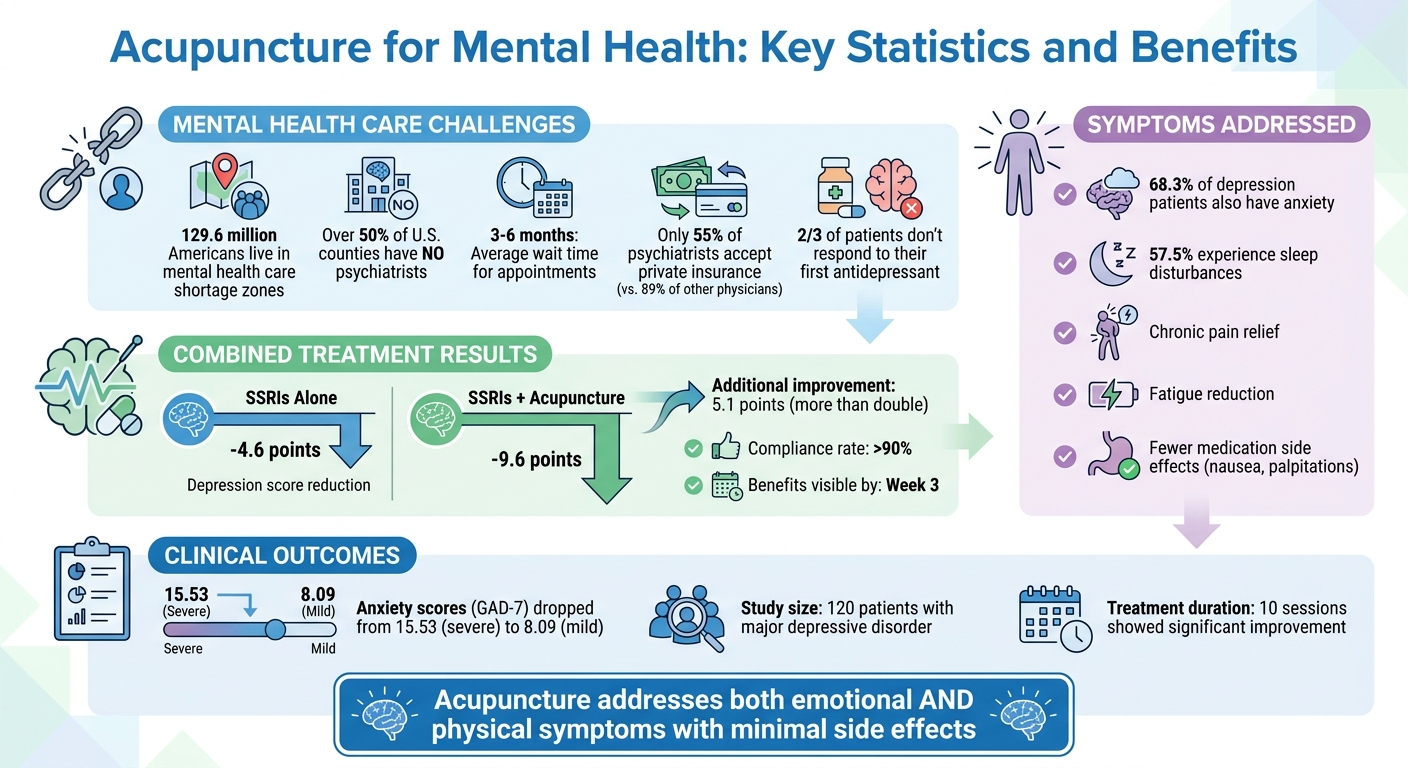
Acupuncture for Mental Health: Key Statistics and Benefits
Acupuncture and herbal medicine for psychiatric disorders by Dr. Zhang-Jin Zhang
sbb-itb-23f89d4
Limitations of Conventional Mental Health Treatments
SSRIs and SNRIs, while effective at tackling emotional symptoms, often fall short when it comes to addressing other issues like chronic pain, sleep problems, fatigue, and gastrointestinal discomfort. These lingering symptoms are linked to more severe depression outcomes, leaving many patients without full relief.
Access to mental health care is another significant challenge. As of September 2021, roughly 129.6 million people in the U.S. lived in areas officially designated as mental health care shortage zones. Shockingly, over half of all U.S. counties lack even a single practicing psychiatrist. For those who do manage to locate a provider, the wait can be daunting – appointment backlogs often stretch from three to six months. On top of that, insurance hurdles further complicate access. In 2014, only 55% of psychiatrists accepted private insurance, compared to 89% of physicians in other specialties.
Treatment resistance adds another layer of difficulty. About two-thirds of patients don’t respond to their first prescribed antidepressant, and the delayed onset of therapeutic effects can be discouraging. Side effects like nausea, weight fluctuations, and drowsiness make sticking to treatment even harder.
These barriers – whether related to access, treatment effectiveness, or adherence – drive both patients and healthcare providers to explore adjunctive therapies. Many patients are now turning to complementary options like acupuncture, aiming for a more well-rounded approach to mental health care.
How Acupuncture Supports Mental Health
Acupuncture provides a complementary approach to mental health by addressing both emotional and physical symptoms. Through the stimulation of specific acupoints using fine needles, it activates the body’s natural healing processes and induces changes in the central nervous system.
The Science Behind Acupuncture
Acupuncture influences key neurotransmitters like serotonin, dopamine, and norepinephrine, while also increasing serotonin receptor expression in areas of the brain such as the cortex, hippocampus, and hypothalamus. These effects resemble those of certain antidepressants. Additionally, it may work through mechanisms like the miRNA-16-SERT pathway, which helps improve receptor sensitivity.
It also plays a role in balancing the hypothalamic-pituitary-adrenal (HPA) axis by reducing stress hormones like cortisol and adrenocorticotropic hormone. This helps lower the body’s stress response, making it particularly effective for conditions like chronic stress, depression, and anxiety.
Acupuncture further supports mental health by promoting neuroplasticity. It boosts the production of brain-derived neurotrophic factor (BDNF), which is essential for repairing and forming new neural connections. Additionally, it reduces neuroinflammation by suppressing pro-inflammatory cytokines that trigger systemic and brain inflammation.
These biological effects form the foundation for clinical studies that highlight acupuncture’s potential in mental health treatment.
Research on Acupuncture for Mental Health
Recent clinical trials have built on these mechanisms, demonstrating acupuncture’s effectiveness in mental health care. For instance, a landmark 2024 multicenter randomized controlled trial involving 120 patients with major depressive disorder (MDD) found that adding 10 sessions of intradermal acupuncture to standard SSRI treatment reduced Hamilton Depression Rating Scale scores by an average of 9.6 points, compared to 4.6 points with SSRIs alone. MRI scans from the study revealed improved connectivity between the striatum and prefrontal cortex.
Other studies provide further evidence. A trial with 247 patients suffering from depression and insomnia, along with a pilot study involving 60 adolescents, showed significant and sustained improvements. Notably, benefits often appeared as early as the third week of treatment and continued with ongoing sessions.
“Acupuncture treatment represented by electroacupuncture [EA] has multiple mechanisms to play a role by regulating neurotransmitter balance, improving neuroplasticity, reducing inflammatory responses, and regulating the neuroendocrine system.” – Chinese Medicine
Acupuncture also addresses physical symptoms that frequently accompany mental health conditions, such as chronic pain, sleep disturbances, fatigue, and gastrointestinal issues – symptoms that are often not fully managed by conventional medications. This dual approach makes acupuncture a promising option for holistic mental health support.
Acupuncture for Specific Mental Health Conditions
Acupuncture has shown promise in addressing a range of mental health conditions, especially when paired with traditional treatments. One area where it stands out is major depressive disorder (MDD), targeting both emotional and physical symptoms that are often overlooked by standard medications.
Research backs this up: clinical trials reveal that combining acupuncture with SSRIs can more than double the reduction in depression scores compared to SSRIs alone. It also alleviates common medication side effects like nausea and palpitations. Beyond depression, acupuncture proves effective for symptoms often linked to it. For instance, nearly 68% of individuals with depression also experience anxiety, and over 57% report sleep disturbances.
Certain groups see particularly strong benefits. A pilot study involving 60 adolescents found that 8 weeks of acupuncture significantly reduced depression severity. For individuals dealing with post-stroke depression, acupuncture not only lifts mood but also aids in repairing hippocampal neuronal damage. Women navigating perimenopausal depression report relief from mood swings as well as physical symptoms tied to hormonal changes.
“Acupuncture’s appeal lies in its safety profile, minimal side effects, and potential to modulate multiple biological pathways implicated in depression, including neurotransmission, neuroplasticity, neuroinflammation, and neuroendocrine regulation.” – Middle East Current Psychiatry
Acupuncture for Anxiety and Depression
The World Health Organization recognizes acupuncture as a treatment option for over 100 conditions, including depression. Clinical studies have shown that it can be effective either on its own or when combined with conventional medications. These endorsements have paved the way for more detailed clinical investigations.
“AIA as adjunctive therapy provides clinical efficacy and safety for MDD, and it may exert antidepressant effects by modulating striatal functional connectivity.” – Nature, Multicenter Randomized Controlled Trial
Acupuncture’s minimal side effects make it especially appealing for groups like pregnant women or those sensitive to medications, with compliance rates exceeding 90%. While most clinical data focus on depression, new research suggests it may also help alleviate anxiety symptoms. For the estimated two-thirds of MDD patients who do not respond well to initial medications, cupuncture offers a promising and powerful adjunctive pathway to achieve complete remission.
Acupuncture for Sleep Problems and Stress
Sleep issues and chronic stress often feed into each other, creating a cycle that’s tough to break. Insomnia triggers the body’s “fight or flight” response, keeping you alert when you should be winding down. Acupuncture helps disrupt this cycle by encouraging your nervous system to shift from survival mode to a state of recovery and relaxation. This transition is key to improving sleep quality.
Acupuncture is also known to enhance your body’s production of melatonin, the hormone responsible for regulating your sleep-wake cycle. At the same time, it helps balance the HPA axis, bringing down cortisol levels that can interfere with restful sleep. Many people notice better sleep as early as the first night after treatment.
Clinical studies back up these effects. A 2013 double-blind study involving 180 participants found that traditional acupuncture improved both sleep quality and daytime functioning more effectively than estazolam. Another study from 2020 focused on 90 individuals dealing with depression and insomnia. It found that three weekly electroacupuncture sessions over eight weeks significantly enhanced sleep quality, efficiency, and total sleep time compared to a placebo group. These improvements offer a powerful, non-pharmacological route to deep restorative sleep without the common side effects of sleep medications.
“Many of my patients communicate a sense of calm after acupuncture that helps them sleep better for several days.” – Tony Chon, MD, Mayo Clinic
Practitioners generally recommend starting with an initial clinical course of 6 to 12 consistent sessions to achieve lasting metabolic and neurological shifts. For long-term results, acupuncture often pairs well with CBT, addressing the underlying causes of insomnia. A 2017 study highlighted that acupuncture reduced sleep disturbances and anxiety levels even weeks after the treatment ended. For those with stress-related conditions like PTSD, acupuncture’s ability to lower inflammation and improve connectivity between the amygdala and prefrontal cortex offers additional benefits. These combined effects on sleep and stress make acupuncture a valuable part of a broader mental health treatment plan.
Adding Acupuncture to Your Mental Health Treatment Plan
Working With Multiple Providers
Bringing acupuncture into your mental health care requires teamwork from all sides. It’s about creating a bridge between your psychiatrist, therapist, and acupuncturist to ensure your treatment is both effective and seamless. A direct referral from your mental health provider can go a long way in making the process less intimidating. As Crystalin Montgomery, MAc, ND, from the University of Minnesota Medical School explains:
“When they’re referred to me by their psychiatrist or psychologist, it means a lot to them and helps put them more at ease about the process”.
Acupuncture doesn’t just stand on its own – it works alongside psychiatric medications. By stimulating the central nervous system, it enhances the effects of these medications while also addressing any side effects you might experience. This means your acupuncturist can tackle both your mental health challenges and medication-related symptoms in a single session.
A great example of this integrated approach comes from the British Acupuncture Council’s collaboration with a Primary Care Network in Inner Gloucester in 2022. This program brought together GPs, nurses, counselors, and social prescribers to create a unified mental health care pathway. The clinically published results were impressive: patients’ GAD-7 anxiety scores plummeted from a severe average of 15.53 down to a mild 8.09 upon completing the integrated program. This kind of teamwork shows how combining efforts across disciplines can lead to real, measurable improvements.
This cross-discipline synergy is exactly why Modyfi Health leads the way in modern integrative care—pioneering a streamlined system where multi-provider collaboration is built directly into your treatment plan.
How Modyfi Health Can Help
Modyfi Health’s integrated telehealth model is designed to support and amplify the benefits of neuro-focused therapies like acupuncture. By focusing on root biological causes rather than just masking symptoms, our virtual platform creates a comprehensive medical anchor for your entire healing journey.
When you begin care with Modyfi, your initial 60-minute evaluation maps out your complete biological profile. From there, we actively coordinate with your local acupuncturist to align your clinical treatments. Furthermore, Modyfi’s advanced functional testing—including targeted nutrient panels and hormone level assessments—uncovers the underlying cellular deficiencies that both psychiatric care and acupuncture can address simultaneously for maximum therapeutic impact.
Conclusion
Acupuncture works alongside conventional mental health treatments to provide faster relief from symptoms, minimize side effects, and tackle physical issues like sleep problems, chronic pain, and fatigue. For example, a 2024 multicenter randomized trial found that combining intradermal acupuncture with SSRIs led to a massive 5.0-point greater drop in depression scores, with compliance rates exceeding 90%.
It achieves this by activating various biological pathways – balancing neurotransmitters, enhancing neuroplasticity, and lowering inflammation – to support long-term mental health. Neuroimaging studies also reveal that acupuncture influences brain circuits tied to emotional regulation, contributing to lasting benefits. These findings highlight a significant evolution in how mental health care is approached.
“Integrating acupuncture into psychiatric care is not merely a trend, but a transformative shift toward a truly holistic, patient-centered model of mental health.”
This move toward treating the whole person redefines mental health care. It shifts the focus from just managing chemical imbalances to addressing physical symptoms, lifestyle choices, and deeper root causes. In this model, you play an active role in your recovery rather than being a passive participant in treatment.
FAQs
How many acupuncture sessions do I need to see results?
The number of sessions depends entirely on your specific symptoms and treatment goals. For chronic mental health challenges like depression or anxiety, clinical protocols typically require 6 to 12 consistent weekly sessions to achieve meaningful, long-term neurochemical changes.
Can acupuncture be done safely with antidepressants like SSRIs?
Yes. Clinical research confirms that combining acupuncture with conventional antidepressants is not only safe, but it also improves overall treatment outcomes. This integrated approach delivers faster symptom relief and can significantly lower common medication side effects like nausea and fatigue.
How do I coordinate acupuncture with my psychiatrist or therapist?
True healing happens when your care team communicates. Always inform both your mental health provider and your acupuncturist about all ongoing treatments. Sharing your progress, lab markers, and symptom changes across your care network ensures a safe, unified, and far more effective treatment plan.
