

Can a ketogenic diet for depression and anxiety fundamentally stabilize mood? Neurobiological research demonstrates that it can. By shifting the body’s primary energy source from glucose to fat-derived ketones, this high-fat, low-carb protocol directly enhances brain function and supports emotional regulation. Here is what modern clinical studies reveal:
-
Brain Energy Boost: Ketones provide an alternative fuel, actively bypassing glucose metabolism issues frequently correlating with depression.
-
Reduced Inflammation: A ketogenic diet lowers systemic markers like TNF-α and IL-6, which often spike during mood disorders.
-
Neurotransmitter Balance: This metabolic shift increases GABA (the primary calming neurotransmitter) and decreases excess glutamate.
-
Improved Neuroplasticity: Preclinical models report up to a 32% rise in BDNF, directly aiding neuroplastic adaptability.
-
Gut-Brain Link: Positive adjustments in beneficial gut bacteria directly optimize neuro-signaling pathways.
While promising, a ketogenic diet isn’t a one-size-fits-all solution. Success depends on achieving and maintaining ketosis, individual metabolic health, and proper medical supervision. It is best utilized alongside traditional treatments like therapy and medication , while larger randomized controlled trials continue to expand and validate its full therapeutic potential.
What Are Ketogenic Diets and Why Do Researchers Study Them for Mental Health?
Defining Ketogenic Diets
A ketogenic diet (KD) is a high-fat, very low-carbohydrate, and moderate-protein eating plan. The goal is to shift the body’s energy source from glucose to fat by triggering nutritional ketosis. When carbohydrates are restricted, the liver takes over by generating ketone bodies—such as beta-hydroxybutyrate (BHB), acetoacetate, and acetone—which the brain and body efficiently utilize as an alternate fuel source.
The classic ketogenic diet follows a strict 4:1 ratio: 4 grams of fat for every 1 gram of combined protein and carbohydrates, with about 90% of daily calories coming from fat. Researchers also explore less rigid versions, such as the Well-Formulated Ketogenic Diet (WFKD). This version caps carbohydrates at less than 50 grams per day while allowing moderate protein intake, making it more practical for long-term adherence in clinical settings.
| Nutrient | Classic Ketogenic Diet | Standard Healthy Diet |
|---|---|---|
| Fat | ~75% to 90% of calories | 20–30% of calories |
| Protein | ~8% to 15% of calories | 10–15% of calories |
| Carbohydrates | Up to 5% of calories | 45–65% of calories |
| Primary Fuel | Ketone bodies | Glucose |
This biochemical shift is crucial for understanding how KD might directly influence brain function.
How Ketogenic Diets May Affect the Brain
The brain’s energy demands are enormous, and its efficiency in processing fuel is vital for maintaining mood and cognitive function. Clinical research indicates that certain individuals experiencing depression or anxiety exhibit signs of impaired glucose metabolism in the brain—a phenomenon often categorized as brain energy failure. This condition prevents neurons from effectively utilizing glucose. Ketone bodies, however, can bypass these dysfunctional pathways, providing a more efficient energy source. Beyond fueling the brain, a ketogenic diet impacts several systems closely tied to mental health:
- Neurotransmitter balance: A ketogenic diet increases GABA (a calming neurotransmitter) while reducing glutamate, which helps to quiet neural overactivity.
- Inflammation: The diet lowers levels of pro-inflammatory markers like TNF-α and IL-6, both of which are often elevated in individuals with depression.
- Neuroplasticity: In a 10–12 week pilot study involving college students with Major Depressive Disorder, those following a WFKD saw a 32% increase in BDNF – a protein critical for neuron growth and brain adaptability.
- Gut-brain axis: KD also alters the gut microbiome, increasing beneficial bacteria such as Akkermansia, which has been associated with antidepressant-like effects.
These biological effects highlight why KD is being studied as a potential complementary approach for managing depression and anxiety.
“Ketone bodies provide the brain with an alternate fuel source to glucose… this reduces glycolytic energy production and consequently lactate accumulation.” – Current Treatment Options in Psychiatry
sbb-itb-23f89d4
Can Ketogenic Therapy Help Depression & Anxiety? Real-World Evidence from Clinical Practice
What Recent Research Says About Ketogenic Diets, Anxiety, and Depression
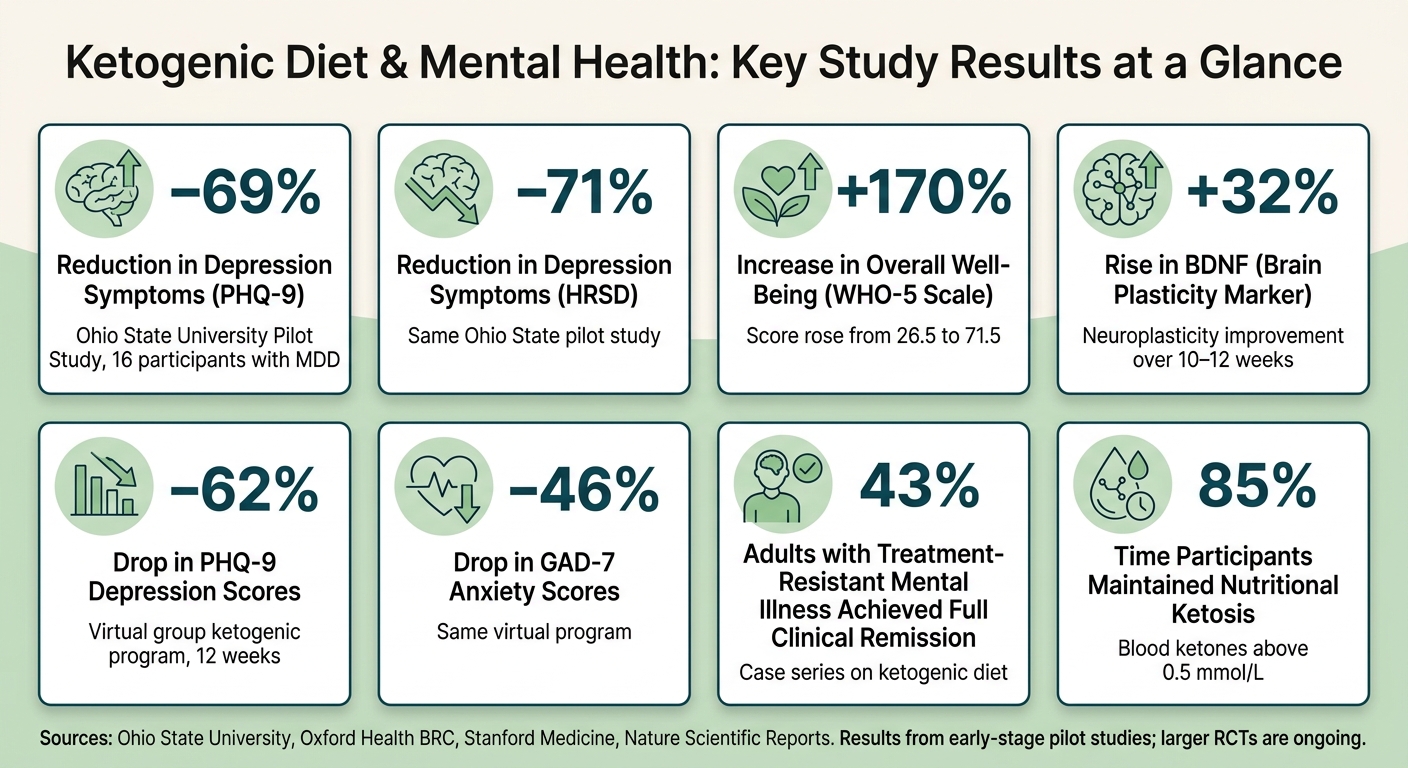
Ketogenic Diet & Mental Health: Key Study Results at a Glance
Findings from Randomized Controlled Trials
Recent randomized controlled trials are revealing how ketogenic diets can positively impact mental health. In early 2024, an Oxford University study with 88 adults suffering from treatment-resistant depression compared a ketogenic protocol against a high-fruit-and-vegetable “Phyto” diet. While both groups noticed improvements within two weeks, those following the ketogenic diet showed greater, more sustainable progress by the sixth week.
“Our findings suggest that a ketogenic diet, delivered with structured support, may help some people with severe depression achieve greater improvements.” — Min Gao, PhD, Senior Researcher, University of Oxford
Another landmark study published in JAMA Psychiatry also explored the power of the ketogenic diet in psychiatric care, highlighting its ability to restore metabolic and mental health in severe conditions. Interestingly, because most recent clinical trials rely heavily on standard depression metrics, the direct impacts of ketosis specifically on anxiety disorders remain less documented, opening doors for further research.
Findings from Observational Studies
Observational research has added more context to the potential benefits of KDs. Between January 2023 and April 2024, researchers at The Ohio State University conducted a single-arm prospective pilot study with 24 college students diagnosed with Major Depressive Disorder. Sixteen participants completed the study, following a well-formulated ketogenic diet (WFKD) with fewer than 50 grams of carbs daily for 10–12 weeks, alongside standard therapy and medication.
The results were impressive. Depressive symptoms dropped by 69% on the PHQ-9 scale and by 71% on the HRSD scale. By the end of the study, none of the participants had moderate or severe depression. Overall well-being scores, measured by the WHO-5 scale, nearly tripled, increasing from 26.5 to 71.5.
| Outcome Measure | Baseline | Post-Intervention | Change |
|---|---|---|---|
| PHQ-9 (Depression) | 15.9 | 4.9 | −69% |
| HRSD (Depression) | 18.1 | 5.3 | −71% |
| WHO-5 (Well-being) | 26.5 | 71.5 | +170% |
| BDNF (pg/dL) | 2,434 | 3,218 | +32% |
| Leptin (pg/mL) | 15,444 | 7,413 | −52% |
Notably, depressive symptoms improved by 37% as early as the second week of the study. Dr. Ryan Patel, a psychiatrist involved in the research, highlighted the significance of these results:
“The average effect size for medications and counseling after 12 weeks is about 50%, and we saw a substantially greater result.” – Ryan Patel, DO, Psychiatrist, Ohio State University
These findings align with the “metabolic psychiatry” model, which suggests that addressing metabolic issues like insulin resistance and chronic inflammation can help alleviate the biological factors contributing to depression.
Factors That Shape How Ketogenic Diets Affect Mental Health
Research continues to highlight how individual metabolic responses and adherence levels significantly influence the mental health benefits of ketogenic diets.
Why Reaching and Maintaining Ketosis Matters
The key to the ketogenic diet’s impact on mental health lies in achieving and maintaining ketosis. Ketosis produces ketone bodies, an alternative energy source for the brain, which may help regulate neurotransmitter activity. Specifically, ketosis can shift the balance between GABA, a calming neurotransmitter, and glutamate, which is excitatory. This balance may help address the neural overactivity often linked to anxiety and mania.
The research backs this up. For instance, a 2023–2024 University of Edinburgh study involving 20 participants with bipolar disorder found that 91% of daily blood ketone readings fell within the nutritional ketosis range. Higher ketone levels were directly tied to improved mood, increased energy, and reduced anxiety. Similarly, a Stanford pilot study published in April 2024 revealed that participants who stayed in ketosis 80%–100% of the time experienced clinical recovery.
“I realized it was actually the ketone level that was making this shift in my symptoms in a way that nothing else ever had.” – Iain Campbell, Baszucki Research Fellow in Metabolic Psychiatry, University of Edinburgh
To confirm nutritional ketosis, blood testing with a βHB meter is used. Nutritional ketosis is defined by βHB levels between 0.5 mM and 5.0 mM.
Diet Composition and How the Diet Is Followed
A well-formulated ketogenic diet (WFKD) adheres to specific macronutrient ratios and requires careful monitoring. Medical ketogenic therapy typically requires a much stricter macronutrient breakdown, consisting of approximately 75% to 90% fat, 8% to 15% protein, and less than 5% to 10% carbohydrates to reliably sustain therapeutic ketosis. This clinical approach differs significantly from more relaxed, higher-protein versions of the diet often used for casual weight loss.
Adherence is a common challenge, but tailored support can make a significant difference. For example, in a pilot study at Ohio State University, researchers personalized food choices based on participants’ preferences.
“Personalized food choices boost adherence.” – Drew Decker, MS, First Author and Graduate Student
This personalized approach helped participants maintain nutritional ketosis 73% of the time over a 10–12 week period, which is an impressive adherence rate for such a demanding dietary intervention.
These details underscore how critical both dietary composition and adherence are to achieving the desired mental health outcomes.
How Individual Factors Influence Outcomes
Your personal metabolic health plays a massive role in how effectively a ketogenic diet works for your mind. Interestingly, conditions like insulin resistance or obesity often amplify the mental health benefits of the diet. If you struggle with these issues, you might experience even greater improvements because the protocol directly repairs the biological pathways driving your depression or anxiety. This connection is staggering when you consider that over 40% of people with severe mental illness also face metabolic syndrome.
“Metabolic dysfunction certainly exacerbates symptoms of mental illness… but evidence indicates it might often be an underlying cause as well.” > — Shebani Sethi, MD, Psychiatrist and Obesity Specialist, Stanford Medicine
Because of this, the ketogenic diet functions as what doctors call a transdiagnostic treatment. Instead of just masking symptoms, it goes after the shared root causes—like mitochondrial dysfunction and chronic inflammation—that sit beneath major depressive disorder (MDD), bipolar disorder, and schizophrenia alike.
Here is a quick breakdown of how these specific factors shape your results:
| Individual Factor | Effect on Ketogenic Outcomes |
|---|---|
| Insulin resistance | Strong benefit; diet bypasses impaired glucose processing |
| Obesity | Positive; reduced leptin levels and weight loss correlate with mood improvements |
| APOE ε4 genotype | Benefit observed, as ketones help mitigate brain glucose uptake deficits |
| Type 1 diabetes | High risk; potential for diabetic ketoacidosis (DKA) |
| History of eating disorders | High risk; restrictive nature of the diet may worsen symptoms |
Age is another important consideration. The diet has shown benefits across different age groups, from young adults, such as those in the Ohio State study (average age 24), to older adults dealing with mild cognitive impairment or early-stage Alzheimer’s. While the underlying mechanisms remain consistent, the metabolic demands and practical challenges can vary significantly depending on the individual’s life stage.
Clinical Use and Care Strategies for Ketogenic Diets in Mental Health
Safety, Side Effects, and Monitoring
Starting a ketogenic diet for mental health requires close oversight. One of the initial hurdles is the “keto flu”, a collection of symptoms like headaches, fatigue, muscle cramps, constipation, and drowsiness. These occur as the body transitions from using glucose to burning fat for energy. Managing these symptoms involves replenishing electrolytes – like sodium, magnesium, and potassium – through supplements or broths, especially during the first week. For patients taking SGLT2 inhibitors, commonly prescribed for diabetes, there’s a serious risk of euglycemic ketoacidosis. These individuals should avoid the diet or only proceed with strict medical supervision.
Regular monitoring is essential throughout the process. Clinicians track key health metrics, including blood ketone levels, fasting glucose, lipid profiles, liver enzymes, and physical measurements like blood pressure and waist circumference.
| Monitoring Parameter | Frequency | Purpose |
|---|---|---|
| Blood Ketones (R-BHB) | Daily or weekly | Ensure nutritional ketosis (target > 0.5 mM) |
| Fasting Glucose | Daily or weekly | Detect hypoglycemia |
| Electrolytes | During keto-flu | Address muscle cramps and headaches |
| Lipid Panel | Baseline & follow-up | Monitor triglycerides and cholesterol changes |
| Medication Review | Ongoing | Adjust psychiatric drug dosages as symptoms improve |
Using Ketogenic Diets Alongside Standard Treatments
The ketogenic diet works best as an addition to standard care, not a replacement. Research highlights it as a complementary approach alongside psychotherapy and medication. In practice, clinicians usually maintain steady medication levels initially to observe the diet’s effects, making adjustments later if symptoms improve.
The results can be impressive. A pilot study at The Ohio State University involved 24 college students with Major Depressive Disorder (MDD) who were already receiving counseling or medication. They added a ketogenic diet to their treatment plan for 10–12 weeks. Of the 16 participants who completed the study, 73% achieved nutritional ketosis. Depression scores on the PHQ-9 dropped by 69%, and brain-derived neurotrophic factor (BDNF) – a marker of brain health – increased by 32%. One participant reduced their psychiatric medication dosage from 10 mg/day to just 5 mg/day.
“A WFKD [well-formulated ketogenic diet] is a feasible and synergistic strategy adjunctive to a counseling and consultation treatment program for young adults with MDD.” – Nature, Scientific Reports
The diet also helps counteract some of the more frustrating side effects of psychiatric medications, such as weight gain, sedation, and insulin resistance. When combined with coordinated care, these benefits can be applied more effectively and consistently.
How Virtual and Multidisciplinary Care Models Support Ketogenic Diet Implementation
Adopting a ketogenic diet for mental health involves more than just following a meal plan. It requires ongoing support from a team that includes psychiatrists, dietitians, and health coaches – something that’s hard to manage on your own.
Virtual care models are proving to be effective in providing this kind of support. A review of an online group ketogenic program showed a 62% drop in mean PHQ-9 depression scores and a 46% drop in mean GAD-7 anxiety scores over 6 weeks. In the same program, 71% of participants saw meaningful improvement in depression, 79% in anxiety, and 47% reached full remission for both conditions. Participants also maintained blood ketone levels above 0.5 mmol/L 85% of the time, demonstrating better adherence compared to self-directed efforts.
Clinics like Modyfi Health are designed to deliver this integrated care. As a fully virtual practice, Modyfi Health combines the expertise of board-certified psychiatrists, clinical nutritionists, and therapists into one seamless system. This allows for coordinated psychiatric medication management, functional lab testing, and personalized nutrition therapy – including ketogenic meal planning – all in one place. For patients juggling anxiety, depression, and metabolic challenges, this kind of comprehensive oversight can make a real difference.
“Keto therapy can interact dangerously with some anti-psychotic medications… so an experienced physician and trained nutritionist should guide and monitor it.” – Shebani Sethi, MD, Stanford Psychiatrist
Conclusion: Key Takeaways and Next Steps
Early studies suggest that ketogenic diets may play a role in reducing symptoms of anxiety and depression. In various pilot studies and clinical trials, one landmark case series of hospitalized patients with treatment-resistant mental illness showed that 100% experienced symptom improvement, and an impressive 43% achieved full clinical remission while following a ketogenic diet.
However, the results aren’t uniform. While some individuals experience full remission, others see only slight improvements or face challenges in maintaining ketosis long enough to see benefits. Research emphasizes the importance of tailoring the approach to each person and closely monitoring progress to achieve the best outcomes:
“These findings underscore the necessity for individualized assessment and monitoring when considering the ketogenic diet as a treatment for mood disorders.” – Springer, Current Treatment Options in Psychiatry
The field is still in its early stages. Most studies have been small, and larger randomized controlled trials are needed to confirm the promising trends seen so far. Researchers also highlight several unanswered questions: how the diet affects men and women differently, which biomarkers might predict success, and how it interacts with psychiatric medications over time. These areas are critical for shaping future research and clinical practices.
While the ketogenic diet shows potential as an additional tool in mental health care, it’s not a standalone solution and won’t work for everyone. With proper guidance, it can complement traditional therapies effectively. Success often depends on close clinical supervision, personalized nutrition plans, regular ketone tracking, and coordination with psychiatric care. Integrated care models, such as those offered by Modyfi Health, combine psychiatry, nutrition therapy, and functional lab testing to provide a comprehensive and individualized approach to ketogenic interventions.
FAQs
How long does it take keto to affect mood?
Research indicates that initial improvements in mood can appear as early as the first two weeks, with significant reductions in psychiatric symptoms like anxiety and depression solidifying over a two-to-four-month period.
How do I know I’m in ketosis?
You can check if you’re in ketosis by measuring ketone levels in your blood, urine, or breath. While some common signs of ketosis include feeling more energetic, experiencing sharper mental focus, and having a reduced appetite, these alone aren’t always reliable. Testing is the most accurate way to confirm ketosis.
Who should avoid a ketogenic diet for mental health?
While the ketogenic diet is highly effective for severe conditions like bipolar disorder or treatment-resistant depression, it should never be attempted alone. Because metabolic shifts directly alter medication levels, individuals with these diagnoses should embark on this therapy under the specialized clinical monitoring and continuous medical supervision offered by integrated practices like Modyfi Health.
How Modyfi Guides Your Journey Safely
Implementing a medical ketogenic diet for mental health is a powerful biological intervention, but because it alters your brain chemistry, it can drastically change how your body responds to psychiatric medications. At Modyfi Health, you don’t have to navigate these complex shifts alone.
Our fully virtual, integrated care model brings together specialized psychiatrists and clinical nutritionists to seamlessly manage your medication dosages, track your metabolic biomarkers through functional lab testing, and build personalized nutrition plans tailored to your lifestyle. If you are ready to treat the root causes of your depression or anxiety with professional medical supervision, schedule a virtual consultation with the Modyfi Health team today.
