


Understanding how the nervous system processes trauma recovery is essential for true healing, as trauma impacts the body more than the mind, disrupting the autonomic nervous system and leaving it stuck in survival mode. Recovery starts with achieving somatic safety – a calm, regulated state where the body feels secure.
Key takeaways:
- Trauma alters the nervous system, causing hyperarousal (anxiety) or hypoarousal (numbness).
- Somatic safety involves a steady heart rate, calm breathing, and relaxed muscles.
- Techniques like vagus nerve exercises, breathwork, and movement can help restore balance.
- Neuroplasticity allows the nervous system to “relearn” safety through repeated calm experiences.
- Recovery is most effective when combining somatic work with tailored, multidisciplinary care.
Trauma and the Nervous System: A Polyvagal Perspective
How Trauma Affects the Nervous System
When danger arises, the nervous system kicks into action almost instantly. A part of the midbrain called the superior colliculus detects threats and triggers defensive responses within milliseconds – often before you’re even aware of the danger. This rapid reaction is crucial for survival, but when trauma is involved, it can lead to a prolonged state of heightened alertness. Let’s break down how the body’s stress responses work and how trauma disrupts them.
The Stress Response: Fight, Flight, and Freeze
The autonomic nervous system handles threats through a sequence of responses, often explained using polyvagal theory. Initially, it tries to resolve the situation through social engagement – like making eye contact or using calming vocal tones. If this doesn’t work, the body shifts into fight-or-flight mode, releasing adrenaline to prepare for action by increasing heart rate and sharpening focus. But when escape isn’t an option, the system may default to a freeze response.
Freeze isn’t about doing nothing – it’s a state where the body’s alarm systems remain active while shutdown mechanisms kick in. This can lead to sensations of paralysis, shock, or dissociation. Annie Wright, LMFT, puts it this way:
“Your body has a built-in alarm system that runs 24/7 without you thinking about it. When trauma has rewired that system, your body keeps reacting to danger that isn’t there anymore.”
One critical moment in this process is referred to as “the wall” – the point where the nervous system decides fight-or-flight won’t work and shifts entirely into survival mode.
How the Body Stores Trauma
After the immediate stress response, the body encodes traumatic experiences in ways that shape future reactions.
Trauma disrupts the hippocampus, leading to memories being stored as sensorimotor fragments – disconnected sensations, sounds, or images. This explains why certain smells or tones of voice can trigger intense emotional responses seemingly out of nowhere.
These fragments are stored in procedural memory, the same system that helps you remember how to ride a bike. Over time, they manifest as physical habits like a clenched jaw, tense shoulders, or guarded posture – reactions that initially offered protection but linger long after the threat is gone. The nervous system’s neuroception, or threat-detection process, becomes overly sensitive, interpreting even neutral stimuli as potential danger.
This can leave the system stuck in one of two states: chronic hyperarousal (marked by anxiety and hypervigilance) or hypoarousal (characterized by numbness and disconnection). Studies show that heart rate variability (HRV), a measure of autonomic flexibility, is significantly reduced in individuals with PTSD (SDNN: Hedges’ g = -0.64). In the U.S., approximately 3.6% of adults – or 12 million people – live with PTSD each year, with over a third experiencing serious disruptions in daily life.
This highlights the importance of somatic practices in helping the nervous system return to a state of safety.
| Nervous System State | Biological Branch | Common Signs |
|---|---|---|
| Social Engagement | Ventral Vagal | Calm, connected, clear thinking, steady heart rate |
| Fight-or-Flight | Sympathetic | Anxiety, racing heart, shallow breathing, muscle tension |
| Freeze/Shutdown | Dorsal Vagal | Numbness, dissociation, brain fog, chronic fatigue |
Understanding these states is a crucial first step in using somatic techniques to restore balance to the nervous system.
The Foundations of Somatic Safety
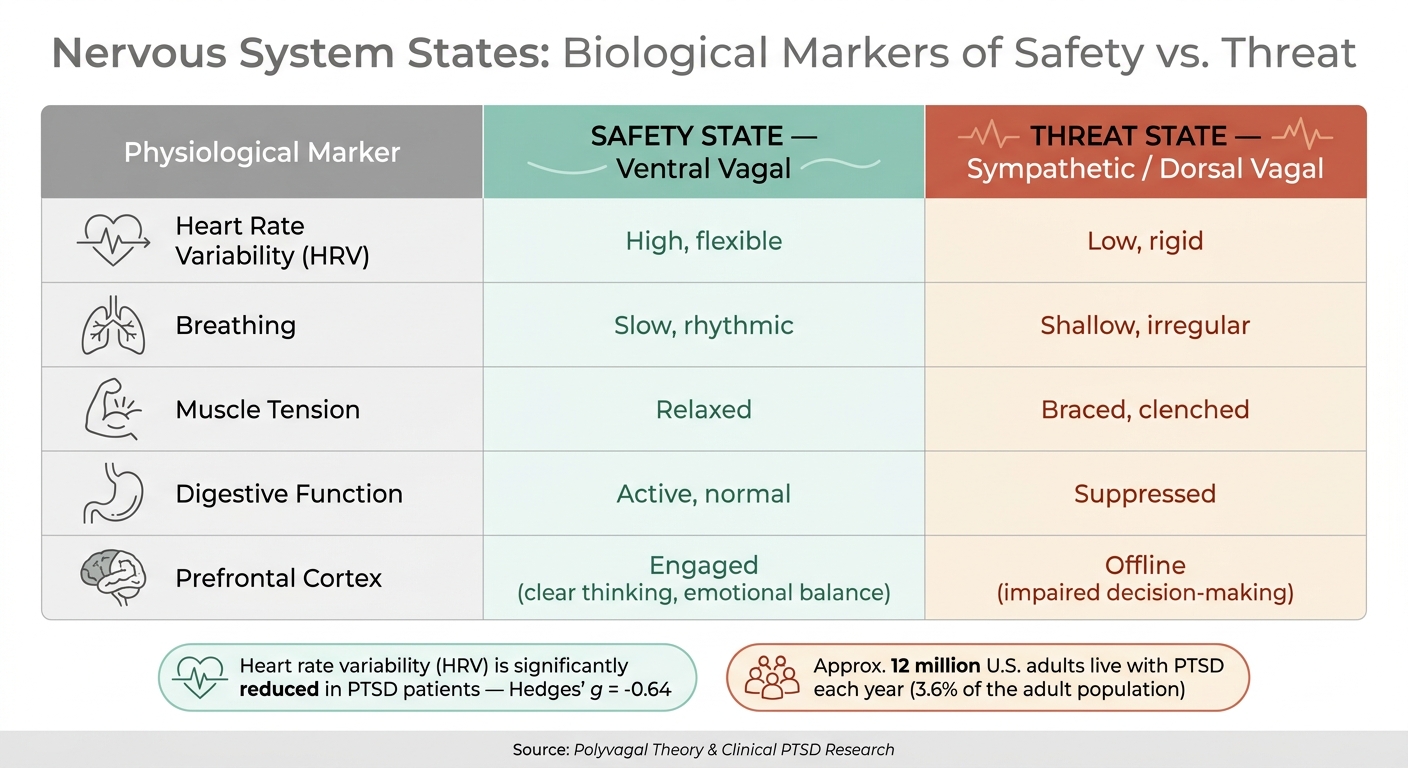
Nervous System States in Trauma: Safety vs. Threat Biological Markers
What Is Somatic Safety?
Somatic safety refers to the body’s ability to enter a calm, regulated state, often linked to the ventral vagal system. This state is characterized by a steady heart rate, smooth breathing, and relaxed muscles. Dr. Maria Niitepold, PsyD, emphasizes:
“Somatic safety is a physiological state, not an intellectual concept.”
In simpler terms, it’s a physical experience of calmness that starts in the body – a “bottom-up” process. This state is essential for trauma recovery because, without it, the nervous system tends to either overreact or shut down entirely. Neither extreme allows for genuine healing or processing. Achieving somatic safety lays the groundwork for recognizing the body’s signals of safety or danger.
Biological Markers of Safety and Threat
Your body is constantly sending out signals about how safe or threatened it feels. One of the most reliable indicators is heart rate variability (HRV), which measures the slight time differences between heartbeats. A high HRV indicates a well-regulated nervous system, while a low HRV, often seen in conditions like PTSD, suggests the system is stuck in a defensive mode.
Other markers include breathing patterns, muscle tension, digestion, and the activity level of the prefrontal cortex. When the body feels safe, breathing becomes steady, muscles relax, digestion functions normally, and the prefrontal cortex remains active – helping with clear thinking and emotional balance. On the other hand, when the body perceives danger, these systems shift into survival mode.
| Physiological Marker | Safety State | Threat State |
|---|---|---|
| Heart Rate Variability (HRV) | High, flexible | Low, rigid |
| Breathing | Slow, rhythmic | Shallow, irregular |
| Muscle Tension | Relaxed | Braced, clenched |
| Digestive Function | Active, normal | Suppressed |
| Prefrontal Cortex | Engaged | Offline |
These responses are governed by neuroception, which acts as the nervous system’s internal radar for detecting safety or danger. For trauma survivors, this radar often becomes overly sensitive, misinterpreting neutral or positive situations as threats. The goal of somatic safety work is to recalibrate this system through repeated experiences of genuine calm and security. Recognizing these signals is a key step toward reshaping the nervous system’s responses.
Neuroplasticity and Healing
The nervous system doesn’t change just because you understand it – it changes through new, lived experiences. As Annie Wright, LMFT, explains:
“The nervous system learns through experience, not through insight. It doesn’t update its predictions because you understand why it’s miscalibrated. It updates its predictions because it has new experiences that contradict the old ones.”
Trauma creates rigid patterns in the nervous system, making it overly focused on threats. However, each authentic moment of calm introduces a “prediction error” that challenges these trauma-based patterns. This process of neuroplasticity allows the nervous system to adapt and form new, healthier responses over time.
Repeated experiences of safety gradually expand your window of tolerance – the range in which you can manage stress without becoming overwhelmed or shutting down. Building resilience happens through these consistent, body-level experiences of security, not through sheer determination. It’s about showing your nervous system, again and again, that safety is possible.
sbb-itb-23f89d4
Somatic Practices for Trauma Recovery
Using body-centered techniques can help shift the nervous system out of survival mode. As mentioned earlier, achieving a state of somatic safety is a key part of the healing process. These practices directly work with the body’s systems to restore balance and calm.
Vagus Nerve Regulation
Think of the vagus nerve as your body’s reset button. It’s the longest cranial nerve, acting like a two-way communication bridge between your brain and organs. Interestingly, about 80% of its signals travel upward – from the body to the brain – which means what you do with your body directly affects how your brain perceives safety and threat.
Vagal tone, which can be measured by heart rate variability (HRV), reflects how well the body recovers from stress. Trauma often lowers vagal tone, leaving the body stuck in a defensive state.
“The vagus nerve that carries the imprint of your trauma is the same nerve through which your healing can travel.” – Annie Wright, LMFT
Simple practices like humming, cold exposure, and slow exhale breathing can improve vagal tone:
- Humming or singing: These activate throat and larynx muscles connected to the vagus nerve’s ventral branch.
- Cold exposure: Splashing cold water on your face triggers a reflex that slows the heart rate, activating vagal tone.
- Slow exhale breathing: Breathing in for 4 counts and exhaling for 6–8 counts stimulates the calming parasympathetic response, boosting HRV.
These techniques work because they engage the nervous system through sensation, rhythm, and repetition – tools that help the body return to a sense of safety. Layering in breathwork can further deepen this regulation.
Breathwork for Nervous System Regulation
Breathing is unique because it’s an automatic process you can consciously control. When done intentionally, it activates the parasympathetic system, signaling safety to your brain. This connection, known as respiratory sinus arrhythmia (RSA), explains why exhaling is so effective in calming the body.
Practicing coherent breathing – about 5–6 breaths per minute – aligns your respiratory and cardiovascular rhythms, boosting HRV. A 2023 study even found that just 5 minutes of daily breathwork improved mood and reduced anxiety more than mindfulness meditation. For moments of acute stress, extended exhale patterns (4-count inhale, 6–8-count exhale) encourage a quicker shift into calm.
Here’s a breakdown of common breathwork techniques and their benefits:
| Technique | Pattern | Best For |
|---|---|---|
| Coherent Breathing | 5–6s Inhale / 5–6s Exhale | Baseline regulation & HRV improvement |
| Extended Exhale | 4s Inhale / 6–8s Exhale | Managing anxiety & hyperarousal |
| Box Breathing | 4-4-4-4 (Inhale-Hold-Exhale-Hold) | Stress resilience & grounding |
| Cyclic Sighing | Deep Inhale / Prolonged Exhale | Boosting mood & reducing stress |
For those with complex trauma, structured breathwork might feel overwhelming at first. Starting with simple breath awareness – noticing your breath without trying to change it – can be a gentler way to begin.
Movement-based approaches add another layer to the healing process by releasing stored tension and energy.
Movement and Grounding Techniques
Trauma often leaves unresolved survival energy trapped in the body, and movement is a direct way to release it. Both yoga and resistance training have been shown to reduce PTSD symptoms. Yoga, in particular, enhances emotional regulation and body awareness by increasing gray matter in the insular cortex. It also lowers inflammatory markers, further supporting the body’s sense of safety.
Research suggests committing to 3 sessions per week, lasting 30–60 minutes, over at least 12 weeks to see meaningful symptom relief. Additionally, moderate-to-high intensity aerobic exercise stimulates Brain-Derived Neurotrophic Factor (BDNF), which aids in repairing memory and stress-response circuits damaged by trauma.
Grounding techniques work well alongside movement. Gradually approaching difficult sensations (a process called titration) helps you stay within your comfort zone and avoid feeling overwhelmed. Focusing on internal body sensations (interoception) allows the nervous system to update its perception of safety from within. Together, movement and grounding offer corrective experiences that rewire the nervous system, building on the foundation of safety created through vagal and breathwork practices.
Integrating Somatic Practices into Trauma-Informed Care
Somatic practices, such as breathwork and movement, become even more effective when they are part of a well-coordinated care plan. Trauma doesn’t just affect the mind – it disrupts the nervous, endocrine, and cellular systems all at once. Addressing only one area limits the potential for full recovery.
“Trauma and chronic stress are more than psychological memories; they are physiological imprints on the nervous system.” – Modyfi Health
A Multidisciplinary Approach to Trauma Recovery
To tackle trauma’s complex effects, a multidisciplinary approach is key. This includes:
- Somatic regulation: Calming the nervous system to reduce its heightened alarm response.
- Neuro-endocrine support: Balancing stress hormones, such as cortisol, that are often dysregulated by trauma.
- Biochemical stabilization: Correcting metabolic issues caused by chronic stress.
For example, a care team might include a psychiatrist, a trauma-informed therapist, and a clinical nutritionist, all working together using shared data. Even gut health – often overlooked – is a priority, as the gut contains more neurons than the spinal cord, making it a critical factor in trauma recovery. This collaborative approach ensures every aspect of the patient’s health is addressed.
Personalized, Data-Driven Care Plans
This approach relies on precise diagnostic tools to create tailored care plans. Modyfi Health uses nutrient panels, hormone analysis, and inflammation markers to pinpoint the biological drivers of a patient’s symptoms. Issues like cortisol imbalances, nutrient deficiencies, and systemic inflammation can worsen trauma responses, but addressing them directly can open new possibilities for recovery.
Exercise therapy is also tailored with the same level of precision. Each session is designed to support both metabolic and neurological health, with programs structured into Beginner, Intermediate, and Advanced levels. These sessions are offered via secure video to ensure clinical oversight. Research highlights the effectiveness of structured exercise: clinical improvements are typically seen after 13–36 sessions. A January 2026 review in the Cochrane Database of Systematic Reviews analyzed 73 randomized trials involving about 5,000 participants and found that structured exercise reduces depressive symptoms as effectively as antidepressants or psychotherapy.
The ultimate goal is a care plan that evolves over time, where somatic practices, psychiatric care, nutrition, and movement work together seamlessly. This integrated, data-driven approach offers a more targeted path to sustainable trauma recovery.
Modyfi Health integrated team works collaboratively. Utilizing advanced functional diagnostic testing—including cortisol mapping, nutrient panels, and systemic inflammation markers—we address the biological roots that keep your nervous system in survival mode. We turn your unique biomarkers into a personalized plan blending targeted somatic regulation, evidence-based therapy, and expert medication management.
👉Schedule your FREE discovery call with Modyfi Health today.
Conclusion: Building Resilience Through Somatic Safety
Trauma isn’t just a memory stored in your mind – it’s a physical imprint embedded in your autonomic nervous system. This imprint keeps your body stuck in survival mode, even long after the original threat has disappeared. That’s why recovery isn’t something you can simply think your way through – it has to begin with the body.
Somatic safety is the foundation of this process. This state, often referred to as the ventral vagal state, is marked by a steady heart rate and a sense of grounded awareness. It’s the biological groundwork that allows healing to take place. As Dr. Staci Braun explains:
“Health is not calm. Health is range.”
True resilience isn’t about staying calm all the time – it’s about having a nervous system that can adapt. It’s the ability to gear up when needed and then return to a stable baseline. This return helps expand your window of tolerance, making it easier to handle challenging emotions without spiraling into panic or shutting down. Techniques like resonance breathing (5–6 breaths per minute), the physiological sigh, and slow environmental orienting aren’t just ways to relax – they’re tools that help train your nervous system’s flexibility over time.
What’s essential to remember is that healing is deeply personal. Trauma responses are shaped by a mix of genetic, epigenetic, and metabolic factors, meaning no two recovery journeys are exactly alike. Focusing only on the emotional or psychological aspects of recovery, while ignoring physical factors like cortisol imbalances, nutrient deficiencies, or inflammation, leaves the biological roots of trauma unaddressed.
Modyfi Health’s integrative approach tackles this complexity head-on. By blending Precision Psychiatry, functional diagnostics, somatic regulation, and movement therapy into a unified care plan, it addresses trauma on every level – neurological, hormonal, and metabolic. This comprehensive model helps guide individuals out of survival mode and into a state where real progress becomes possible.
FAQs
How do I know if I’m in hyperarousal or shutdown?
You can identify the state of your nervous system by observing patterns in your body, emotions, and mind.
When you’re in hyperarousal, it can feel like you’re running on overdrive. You might experience racing thoughts, heightened anxiety, irritability, or even panic. Physically, your heart rate may speed up, your breathing could become shallow, your muscles might tense, and you may feel a strong urge to act or react.
On the other hand, shutdown feels like hitting a mental and physical brick wall. This state often brings numbness, extreme fatigue, emotional detachment, or a sense of disconnection. You might feel weighed down, mentally foggy, and find it hard to make decisions or connect with others.
What’s the safest somatic practice to start with if I get overwhelmed easily?
If you often feel overwhelmed, consider starting with gentle, low-intensity techniques that help your nervous system feel at ease without adding stress. One effective method is orienting: sit comfortably, take your time to scan your surroundings, and let your gaze settle on something neutral or pleasant. Another approach is resourcing, where you recall a calm or neutral memory and pay attention to how your body reacts. These straightforward practices provide subtle signals of safety without feeling overwhelming.
How long does it take to “retrain” the nervous system to feel safe again?
There’s no fixed timeline for retraining the nervous system because it hinges on neuroplasticity – the body’s natural ability to create new neural pathways. Recovery from trauma requires sending consistent signals of safety to the body through gentle, daily practices. Over time, these repeated efforts help the nervous system restore balance and build resilience, strengthening its ability to associate with safety and regulate itself more effectively.