


Unexplained bloating, headaches, skin flares, or brain fog can be incredibly frustrating—and often, the root cause lies in what we eat. If you are wondering how does the elimination diet work to pinpoint these triggers, it is best understood as a structured, short-term investigative tool.
Instead of guessing, our structured elimination method involves temporarily removing common inflammatory foods, tracking your body’s responses, and methodically reintroducing them to decode your unique gut-brain baseline.
Before beginning, it is essential to understand a few foundational medical facts about the process:
- The Gut-Brain Connection: Food sensitivities often manifest as a combination of digestive discomfort and immediate or delayed mood changes.
- Precision is Mandatory: Absolute consistency is required; even a minor, accidental dietary slip during the elimination phase can obscure your tracking data.
- Delayed Inflammatory Responses: Symptoms do not always appear immediately—reactions can take up to 72 hours to become clinically apparent.
- Strictly Temporary Timeline: The comprehensive protocol is designed to be short-term, typically lasting between 6 to 10 weeks in total.
- When to Seek Medical Supervision: Professional clinical guidance is strictly required before starting if you are pregnant, breastfeeding, or managing celiac disease, Inflammatory Bowel Disease (IBD), a history of disordered eating, or if your symptoms begin to worsen.
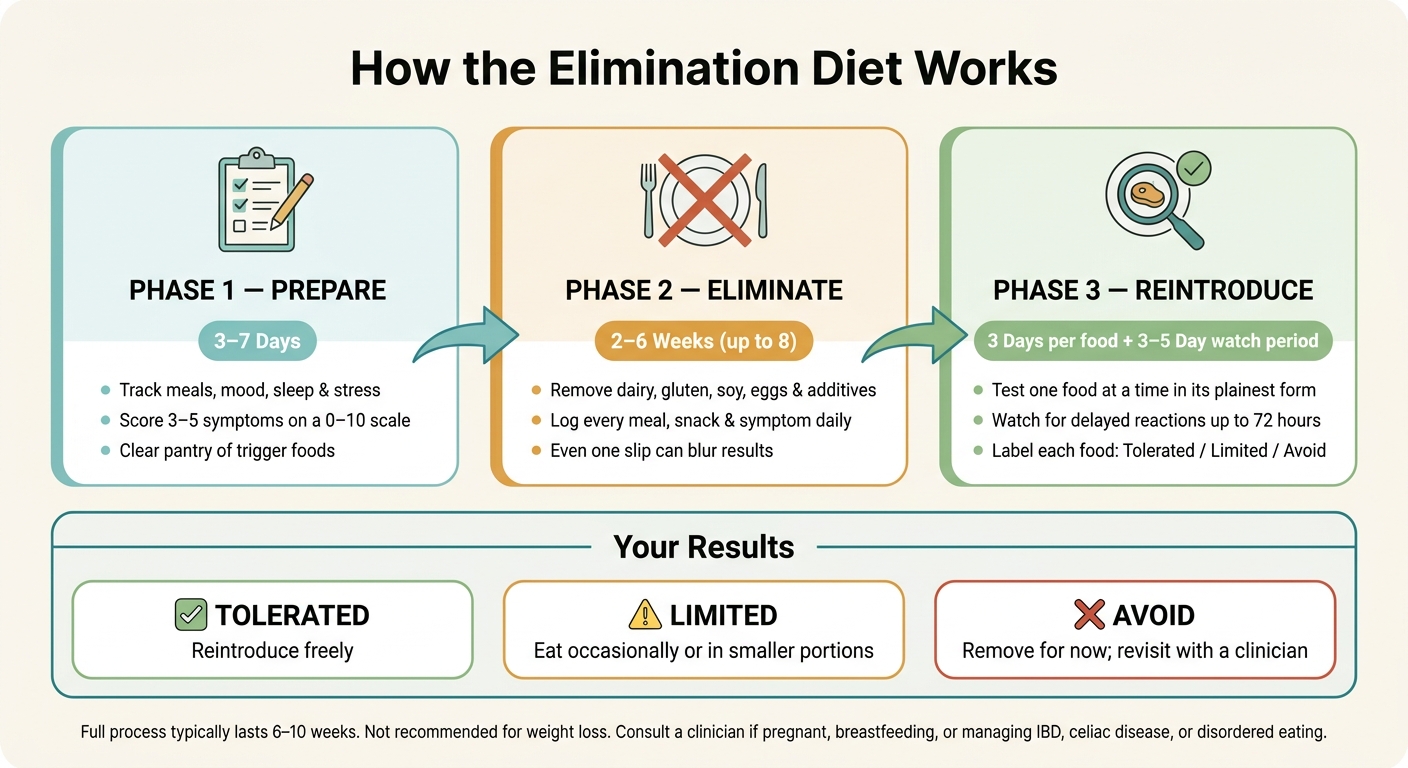
How the Elimination Diet Works: A Step-by-Step Timeline
What Is an Elimination Diet? (A Doctor Explains)
sbb-itb-23f89d4
Step 1: Prepare before you remove any foods
The preparation phase provides the essential point of comparison needed to interpret your final results.
Setting Your Clinical Baseline
Before cutting anything out, spend 3 to 7 days documenting what you eat and exactly how you feel. Focus on tracking no more than 3 to 5 primary symptoms (e.g., bloating, fatigue, brain fog, or mood shifts) on a 0–10 severity scale.
Because food reactions can take up to 72 hours to manifest, adding timestamps to your entries is critical. Granular documentation helps distinguish true food sensitivities from symptom spikes caused by poor sleep, stress, or day-to-day life.
Prepping Your Environment
Clear your kitchen of the foods you plan to remove to prevent accidental slip-ups. Standard clinical eliminations include:
-
Dairy (milk, cheese, yogurt, butter).
-
Gluten-containing grains (wheat, rye, barley, spelt).
-
Soy and Eggs.
-
Processed additives (artificial sweeteners, MSG).
⚠️ Clinical Alert: Always read labels closely. Hidden derivatives often lurk under vague terms like “natural flavors,” “spices,” or “emulsifiers”.
For the first week, keep your meals boring in the best way. Plain proteins, cooked vegetables, and compliant grains make it less likely that hidden ingredients will sneak in. Read every label. Terms like “natural flavors”, “spices,” or “emulsifiers” can hide dairy or soy derivatives in packaged foods.
When to involve a Modyfi Health clinician

Bring in a clinician if you are pregnant or breastfeeding, have IBD (Inflammatory Bowel Disease) or celiac disease, are a child or older adult, have a history of disordered eating, or take medications that could mask symptoms or affect digestion.
A Modyfi Health clinician can help rule out underlying issues, review your medications, and build a more focused plan around your most likely triggers instead of removing everything at once. That can reduce the risk of nutrient gaps, help avoid a missed diagnosis, and keep your results easier to interpret.
Once your baseline is set and your kitchen is ready, move into the elimination phase and stay consistent with the plan.
Step 2: Follow the elimination phase consistently
Once you have your baseline, move into a strict elimination window and stick with it. That consistency is what makes the results easier to read. In most cases, the elimination phase lasts 2 to 6 weeks, though some people need up to 8 weeks based on their symptoms and clinician guidance.
Cut out common trigger foods completely
Clearing your system needs to be all-or-nothing. Even a single slip can muddy the picture and keep symptoms hanging around.
Read labels closely. Hidden dairy, gluten, and soy often show up in ingredients like whey, casein, malt, thickeners, lecithin, and flour. If you’re eating at a restaurant, use extra caution with marinated meats. They can hide garlic, onions, or soy-based sauces.
Log your meals, symptoms, and daily stressors
A food journal helps you connect what you ate with how you felt afterward. Write down every meal, snack, and drink, then track symptom scores, sleep, stress, cycle changes, and mood.
Don’t stop at digestion. Track mental and emotional symptoms too, like brain fog, irritability, anxiety, or mood swings, along with skin changes and energy levels. That’s how you sort out a food reaction from stress, poor sleep, or normal day-to-day shifts.
| Tracking Category | What to Record |
|---|---|
| Diet | All meals, snacks, portions, hidden ingredients (e.g., malt, whey) |
| Symptoms | Bloating, gas, headaches, skin rashes, mood swings, brain fog, energy |
| Lifestyle | Sleep quality, stress levels, menstrual cycle patterns |
Watch for signs the plan needs to change
Your symptoms will tell you a lot. Within 2 to 4 weeks of sticking to the plan, you may start to notice a clear drop in your main symptoms, such as clearer skin, better energy, or steadier digestion.
If you’ve followed the plan closely for 4 full weeks and nothing has changed, it’s time to check in with a clinician. The foods on your trigger list may not be the right ones, or the plan itself may need to shift.
Stop the diet and contact a clinician right away if you notice dizziness, rapid weight loss, worsening depression, or panic around eating.
Once your symptoms settle down, you can start adding foods back in, one at a time.
Step 3: Reintroduce foods one at a time
Once your symptoms are back at baseline, start adding foods back one at a time.
This is the part where patterns usually get a lot easier to spot. If you test one food in its plainest form and keep the rest of your diet steady, each reaction is much easier to read. If too many things change at once, it gets muddy fast.
Follow a clear challenge schedule for each food
Give each food its own 3-day challenge:
-
Day 1: Begin by testing a small, bite-sized portion of the food group.
-
Day 2: Scale up to a standard, full-sized serving if no symptoms occurred.
-
Day 3: Incorporate a normal portion twice during the day to confirm tolerance.
-
Observation Window: Stop eating the food completely and watch for delayed physical or cognitive reactions for 3 to 5 days.
Start with the food you removed that seems least likely to cause a reaction. Save common trigger foods like dairy, gluten, soy, and eggs for later. If the result isn’t clear, wait 5 to 7 days and then test that food again by itself.
Record physical and mental reactions for each food
Don’t just track digestive symptoms. Pay attention to headaches, skin flares, anxiety, irritability, brain fog, and sleep problems after each test food.
If a reaction shows up, remove the food right away and give yourself a 2- to 3-day washout period using safe foods before you move on. Wait until your symptoms have fully returned to baseline before testing the next food.
Use a reintroduction tracking table
A simple log can save you a lot of second-guessing later. Fill out each row as you go so you can look back and see which foods you handle well, which ones you may need to limit, and which ones are better left out.
| Food Tested | Dates & Portions | Digestive Symptoms | Skin Changes | Mood or Anxiety Changes | Decision |
|---|---|---|---|---|---|
| Eggs | |||||
| Gluten | |||||
| Soy |
Use the Decision column to label each food as tolerated, limited, or avoided. Some foods may only cause symptoms in larger amounts. That can mean you don’t have to cut them out completely – you may just need to eat them less often or in smaller portions.
Use the table to compare patterns before deciding what to eat often, what to limit, and what to avoid.
How to use your results and plan next steps
Sort foods into tolerated, limited, and avoid
Now you’ve got something useful: your own food-symptom record.
Go back through your reintroduction notes and look for distinct patterns. Identify the specific foods that caused no symptoms at all, noting which ones seemed perfectly fine until your portion sizes increased. You will also want to highlight items that triggered the exact same physical or mental problem more than once. This systematic review is the exact point where you sort each ingredient into its proper category.
Your notes should help you decide what stays in your regular meals, what needs smaller portions or less frequent use, and what’s better left out for now.
| Category | What It Means | What to Do |
|---|---|---|
| Tolerated | No symptoms during the 3-day challenge or the 3–5 day observation window | Reintroduce freely into your regular eating pattern |
| Limited | Mild symptoms or subtle shifts in well-being, often only at larger amounts | Eat occasionally or in smaller portions; watch for symptoms that build over time |
| Avoid | Repeatable reactions such as migraines, hives, or severe bloating after the challenge | Remove for now; revisit with a clinician for long-term guidance |
A food in the limited group isn’t always a hard no. It may just mean your body handles it better in smaller amounts or less often.
Weigh the benefits and limits of the process
A structured elimination diet can help you spot your own trigger foods. That’s the upside. The harder part is that it also takes time, planning, and a bit of patience.
| Pros | Cons |
|---|---|
| Identifies personal triggers for IBS, migraines, and skin issues | Risk of nutrient gaps – like low calcium, fiber, or iron – if major food groups are cut |
| Moves toward more tailored eating | Time-consuming and socially inconvenient |
| Empowers you to collect your own health data | May trigger or worsen food anxiety without proper support |
| Results can be ambiguous without strict adherence |
One point matters a lot here: keep the process short-term. The full process – from elimination through reintroduction – usually lasts 6 to 10 weeks. Staying in the restriction phase longer than needed can increase the risk of nutritional gaps and can push food habits in an unhealthy direction.
Think of the results as a guide. Not a lifelong rulebook. Not a moral scorecard for food. Just information you can use.
Conclusion: Take the key lessons forward and get support when needed
The basic process is simple: remove common triggers, track symptoms closely, reintroduce foods one at a time, and use the pattern you find to shape a more personal way of eating. The aim was never to build a forever list of foods to fear. It was to learn something specific about your body.
Use what you found to sort foods into three buckets: what you can eat freely, what you may want to limit, and what you should avoid for now. If your results point to chronic digestive issues or mood changes that keep showing up, that’s worth bringing to a clinician instead of trying to solve it only by tightening your diet further.
Healing the Whole Person 🧠✨
At Modyfi Health, we connect psychiatry, specialized therapy, and evidence-based nutrition into a single, fully virtual care network. If your gut symptoms are deeply tied to your mental well-being, let us help you build a safe, personalized protocol.
👉 Schedule an Evaluation with a Modyfi Health Clinician Today
FAQs
What if I accidentally eat a restricted food during the elimination phase?
If an accidental exposure occurs, consistency is temporarily disrupted, but the protocol does not need to be abandoned completely. Because even a small bite can trigger a localized inflammatory response, you should document the slip-up, note any immediate or delayed symptoms, and extend the elimination phase by an extra 3 to 5 days to allow your gut baseline to stabilize before moving to the reintroduction phase.
Can I stay on the elimination phase permanently if I feel much better?
No. The elimination phase is strictly a short-term diagnostic tool, not a long-term lifestyle. Staying on a highly restrictive diet for longer than 6 to 8 weeks can inadvertently compromise your gut microbiome diversity and lead to nutritional deficiencies, such as low calcium, fiber, or iron. The ultimate goal is to reintroduce as many whole foods as possible to maintain a resilient and diverse digestive system.
Is an elimination diet safe for everyone?
While it is a powerful tool for identifying food triggers, it is not safe for everyone to navigate alone. This protocol is clinically counter-indicated or requires strict medical supervision for individuals who are pregnant, breastfeeding, managing a history of disordered eating (or active eating disorders), or diagnosed with chronic conditions like Celiac Disease or Inflammatory Bowel Disease (IBD).
What is the difference between a food allergy and a food sensitivity?
The core difference lies in how your immune system responds:
-
Food Allergy: Involves an immediate, IgE-mediated immune response. It can be life-threatening (anaphylaxis) and triggers reactions almost instantly, even with microscopic exposure.
-
Food Sensitivity: Involves a delayed, non-IgE or digestive tract reaction. Symptoms (like brain fog, joint pain, or bloating) are often dose-dependent and can take up to 72 hours to appear, which is precisely why we use a structured tracking timeline to isolate them.