

Dark chocolate may support mood and stress response — but it is not a treatment for anxiety or depression.
The effect is real, but modest. Dark chocolate may support blood flow to the brain, add mild stimulation from theobromine and caffeine, and supply compounds linked to reward and stress response. But the impact is usually small, gradual, and different from person to person.
What the evidence actually shows:
- Dark chocolate has more cacao than milk chocolate, often 50% to 90% cacao
- More cacao usually means more flavonoids and less sugar
- 2 ounces of 70% dark chocolate can have about 50 to 60 mg of caffeine
- 1 ounce of 70% to 85% dark chocolate has about 6.8 grams of sugar
- A 50-gram serving can provide about 15% of daily magnesium needs
- A 2024 trial found 12 grams of 78% dark chocolate daily for 8 weeks was linked to a small drop in depression scores in 60 menopausal women who ate approximately 12 grams of 78% dark chocolate daily for eight weeks
What it may do:
- Help take the edge off stress a bit
- Support focus for a short time
- Give a mild lift in alertness
- Help some people feel calmer
Where it can backfire:
- Jitters
- Poor sleep
- Palpitations
- Worse anxiety in people sensitive to stimulants
For most people, the practical starting point is simple: choose dark chocolate with 70% cacao or more, keep the portion around 1 to 1.5 ounces (30 to 40 grams), and eat it earlier in the day. If caffeine tends to be a problem, dark chocolate may not feel calming at all.
| Topic | What the article says |
|---|---|
| Mood | May support mood a little, but not in a major way |
| Anxiety | May help some people, but may make others more tense |
| Brain chemistry | Flavonoids, magnesium, theobromine, caffeine, anandamide, and PEA all play a part |
| Best type | Dark chocolate, usually 70%+ cacao |
| Best amount | About 1 to 1.5 oz per day |
| Best timing | Morning or early afternoon |
| Main risk | Sleep trouble and stimulant side effects |
Dark chocolate can be a small support tool, not the main answer. If the goal is a small mood or focus boost, it may help. If anxiety, sleep issues, reflux, or stimulant sensitivity are already present, it may do the opposite.
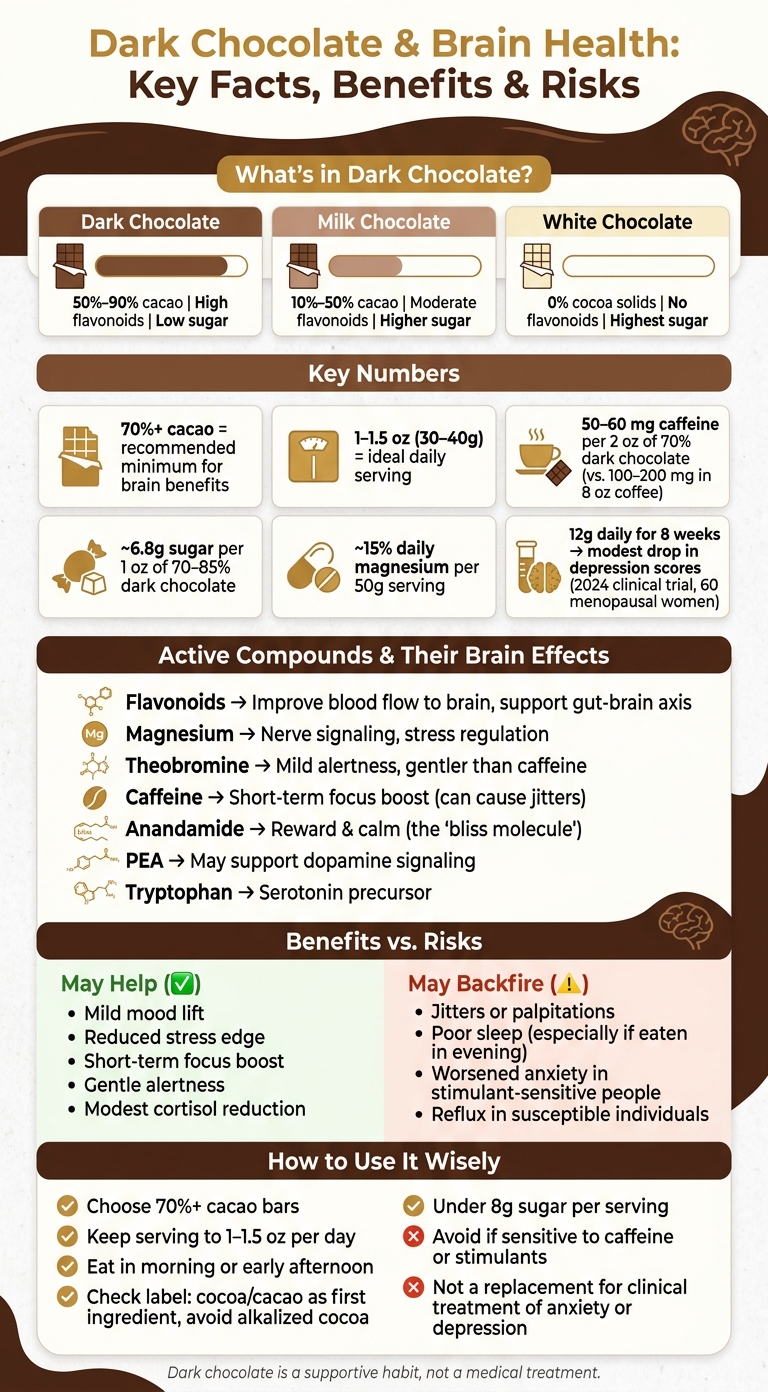
Dark Chocolate & Brain Health: Key Facts, Benefits & Risks at a Glance
Why Dark Chocolate Makes You More Focused
sbb-itb-23f89d4
Why Dark Chocolate and Mental Health Are Connected
Dark chocolate is more likely to affect mood-related pathways because it has more cacao packed into each bite. That means a higher amount of the compounds linked to blood flow, stress response, and neurotransmitter activity. Put simply: the more cacao solids in the bar, the more likely it is to influence the systems tied to mood.
How dark chocolate differs from regular chocolate candy
Dark chocolate usually contains 50% to 90% cacao. Milk chocolate usually contains 10% to 50%. White chocolate contains no cocoa solids at all, only cocoa butter. That gap matters because cocoa solids hold most of the flavonoids and other bioactive compounds.
As cacao content goes up, flavonoids go up too, while sugar usually goes down. Milk and white chocolate have less cacao and more sugar, so they provide fewer of the compounds linked to brain and blood vessel effects. For example, 1 ounce of 70% to 85% dark chocolate has about 6.8 grams of sugar, which is often much less than milk chocolate.
Those ingredient differences help explain why dark chocolate gets most of the attention here.
The main brain and stress pathways involved
Dark chocolate contains several compounds that may shape brain chemistry in different ways.
- Flavonoids may increase nitric oxide production, which helps relax blood vessels and improve blood flow to the brain.
- Magnesium helps with nerve signaling and stress regulation.
- Theobromine is a mild stimulant that may support alertness and circulation without hitting as hard as caffeine.
Caffeine is in dark chocolate too, just in smaller amounts. 2 ounces of 70% dark chocolate contain roughly 50 to 60 mg of caffeine, compared with 100 to 200 mg in an 8-ounce cup of coffee. So if coffee feels like a jolt, dark chocolate is more like a nudge.
Two other cacao compounds add to the mood link. PEA may support dopamine signaling, though most of it breaks down during digestion. Anandamide is an endocannabinoid tied to reward and calm, and cacao may slow its breakdown.
That mix of blood flow support, mild stimulation, and signaling effects sets up the mood, stress, and focus links covered next.
How Dark Chocolate Affects Brain Chemistry and Stress
Dark chocolate works on a few systems at the same time. That’s why its effect on mood tends to be mild, not dramatic. The main routes are blood flow, stress signaling, and stimulation level.
Flavonoids, blood flow, and brain function
Cocoa flavanols may help support circulation and brain function, which can shape mood and mental clarity. In plain English, better blood flow can help the brain do its job a bit more smoothly. That may mean clearer thinking and a steadier mood during stressful moments.
Flavanols may also support the gut-brain axis. That matters because the gut and brain are in constant communication, and that back-and-forth helps shape both mood and stress response.
Magnesium, serotonin, endorphins, and reward signals
Magnesium helps with nerve signaling and stress regulation. A 50-gram serving of dark chocolate provides roughly 15% of the recommended daily magnesium intake for an adult. For some people, that may show up as less stress reactivity.
Dark chocolate also contains tryptophan, an amino acid precursor to serotonin. On top of that, it has compounds that slow the breakdown of anandamide – sometimes called the “bliss molecule” – which is linked to emotional tone and lower fear reactivity.
There’s also the simple reward side of eating chocolate. It’s tied to a small bump in feel-good chemicals. But it’s worth keeping expectations in check: these effects are usually subtle, not dramatic.
Theobromine and caffeine: alertness versus anxiety
Theobromine is a mild stimulant, and it tends to feel gentler than caffeine. So dark chocolate often feels more like a lift than a jolt.
Still, dark chocolate does contain caffeine. For some people, that can feel activating, even while it helps with alertness and calm in others. If caffeine tends to make you jittery, dark chocolate may not be the best fit.
Timing matters too. Morning or early afternoon is usually the safer window for people who are sensitive to stimulation. Dose matters as well, especially if you get jittery easily.
What Dark Chocolate May Realistically Help With
Mood, stress, and anxiety: modest support, not a cure
Dark chocolate may help take the edge off stress a little, but let’s keep it in proportion: it’s not a fix. The same brain and stress pathways people talk about do seem to show up in daily life, just in small ways. Research also points to cocoa polyphenols helping lower cortisol in some contexts.
Human trials suggest this effect is there, but it isn’t dramatic. In a 2024 triple-blind clinical trial, 60 menopausal women who ate 12 grams of 78% dark chocolate daily for eight weeks had a modest but significant reduction in depression scores versus milk chocolate. That kind of benefit usually builds over time, not overnight. It can also differ a lot from one person to another, and it depends on the cacao percentage and the rest of the diet.
Dark chocolate is not a treatment for generalized anxiety disorder, major depression, PTSD, or ADHD. If you’re dealing with any of those, think of dark chocolate as a background habit, not the main event.
Focus, attention, and cognitive performance
Dark chocolate may also give a small lift in focus and mental energy, especially when you’re doing work that asks a lot from your brain. Theobromine tends to feel gentler than caffeine, and it usually doesn’t kick the body’s stress-response system the way coffee can. For people who get jittery from coffee, that can make dark chocolate a decent midday option.
Still, this is a short-term effect. It’s more like a nudge than a brain upgrade.
What the research does and does not show
This is where the fine print matters. Most studies on dark chocolate and mental health are small, short, and often use concentrated cocoa extracts or cocoa drinks instead of the chocolate bars people buy at the store. So while the research is promising, it doesn’t mean every bar on the shelf will do the same thing.
The clearest findings point to:
- modest mood support
- mild short-term help with focus
- small effects linked to blood flow and stress regulation
So yes, the effects seem real. But they’re also small and gradual.
Those limits matter when you’re trying to pick the right cacao percentage and portion size. The next step is the practical part: how much to eat, which bars to buy, and who may want to be more careful.
Limits, Risks, and How to Use Dark Chocolate Wisely
Using dark chocolate well comes down to a simple idea: get the upside without drifting into jitters, poor sleep, or too much sugar.
Who may be more sensitive to dark chocolate
Dark chocolate can help some people and make symptoms worse for others. A lot depends on how your body handles stimulants. The caffeine and theobromine in dark chocolate may worsen anxiety, palpitations, or sleep issues in people who are already sensitive to them. If caffeine tends to hit you hard, it’s smart to avoid dark chocolate.
Timing matters too. Evening intake is the clearest risk, because even a moderate amount can interfere with sleep. So it’s not just about cacao percentage. Portion size and timing matter just as much.
Some groups should be more careful, including children, pregnant individuals, and people with reflux or heart rhythm concerns. And if you take stimulant medications or MAOIs, check with your clinician before making dark chocolate a daily habit, since cocoa can interact with both.
For people with a history of calcium oxalate kidney stones specifically, dark chocolate deserves extra caution — its oxalate content is high enough that even a standard serving can approach or exceed the daily limit recommended for stone-prone individuals
How much to eat and how to choose a better bar
For most healthy adults, about 1 to 1.5 ounces per day – roughly 30 to 40 grams – is a reasonable upper range.
When you’re picking a bar, aim for 70% cacao or higher. In general, a higher cacao percentage means more flavonoids and less sugar.
A few quick checks can help:
- Choose bars with less than 8 grams of sugar per serving
- Make sure cocoa or cacao is the first ingredient
- Avoid alkalized cocoa if you want flavanol benefits, since that processing cuts these compounds
If 70% tastes too bitter at first, start with 50% and work your way up over time. That’s a lot more doable than forcing yourself to like a bar you don’t enjoy. Pairing a square with nuts or another protein source may also help steady blood sugar.
How dark chocolate fits into a broader mental health plan
Dark chocolate makes the most sense as one small part of the picture, not the main event. Any effects on mood or stress tend to be subtle and build over time. It doesn’t replace sleep, exercise, therapy, or medical care when those are needed.
Here’s the trade-off at a glance:
| Factor | What dark chocolate may support | Where it falls short |
|---|---|---|
| Mood | May modestly support serotonin, endorphins, and lower cortisol | Not a substitute for treatment of clinical anxiety or depression |
| Stimulants | Gentle alertness from theobromine | Can trigger jitteriness, palpitations, or insomnia in sensitive people |
For people dealing with anxiety or mood concerns, dark chocolate tends to work best as a small, steady habit inside a broader care plan with the right clinical support.
Conclusion: A Useful Support, Not a Stand-Alone Treatment
Dark chocolate can affect the brain in a few ways. It may support blood flow, provide mild stimulation, and trigger reward signaling. Put together, that can lead to a small lift in mood, a bit more calm, or better focus.
The main takeaway is simple: the effect is real, but small. Dark chocolate is not a treatment for anxiety or depression.
For most people, a higher-cacao bar in a small serving, eaten in the morning or early afternoon, gives the best mix of upside and fewer downsides. Your own sensitivity to caffeine, stimulants, or reflux can decide whether dark chocolate helps or ends up backfiring.
In day-to-day life, dark chocolate tends to work best as a small, occasional habit within a broader mental health plan. That plan may also include proper clinical care when needed. The bottom line is straightforward: think of dark chocolate as a small support tool, not a treatment.
Symptoms Are Signals. Let’s Find the Source.
If mood, focus, or anxiety are affecting your daily life, a square of dark chocolate is a small piece of a much larger picture. At Modyfi, our Root-Cause Psychiatry approach brings psychiatry, therapy, nutrition, and exercise together to find what’s actually driving what you’re feeling.
👉 Explore Providers to Book an Appointment and Start Your Care Plan
(Note: Modyfi proudly accepts most major commercial insurance plans in MD, DC, VA, and WV; currently, we do not accept Medicare or Medicaid.)
FAQs
Can dark chocolate actually reduce anxiety?
Possibly. Research suggests that dark chocolate may help lower anxiety and improve mood, in part because it can reduce cortisol, a stress hormone.
It may also help in a few other ways. Compounds like magnesium, flavonoids, and theobromine may support brain function, neurotransmitters, and blood flow. Some studies also link daily intake to changes in the gut microbiota, which may help ease negative emotional states.
For the best shot at these effects, choose dark chocolate with at least 70% cocoa and keep portions modest, such as 30 grams a day.
How much dark chocolate is too much in a day?
Most research points to 10 to 30 grams of dark chocolate per day as a sensible range for possible mood and health perks.
That works out to about one to three small squares.
Go past that, and it may be too much for some people. Dark chocolate packs a lot of calories into a small amount, so bigger portions can add up fast. It may also contribute to weight gain, higher uric acid, or sleep problems due to its caffeine content. And one more thing: stimulant sensitivity differs from person to person, so what feels fine for one person might leave someone else wide awake.
Who should avoid dark chocolate?
People with caffeine sensitivity, anxiety or panic disorder, acid reflux, migraines, sleep problems, or a history of kidney stones should be careful with dark chocolate. Its caffeine, theobromine, and oxalates can make symptoms worse.
That same caution applies to people with hypertension, those taking MAOIs (monoamine oxidase inhibitors) or stimulant medications psychiatric medication, children, pregnant individuals, and anyone with preexisting health conditions. Before making major diet changes, it’s smart to talk with a healthcare provider.
Is dark chocolate good for anxiety?
It depends on your sensitivity to stimulants. For some people, dark chocolate may help take the edge off mild stress — its flavonoids support blood flow, magnesium helps with nerve signaling, and theobromine provides a gentler lift than caffeine. Some research also links cocoa polyphenols to lower cortisol levels.
But for people who are already anxious, the caffeine and theobromine in dark chocolate can backfire — triggering jitteriness, palpitations, or worsening the physical symptoms of anxiety rather than easing them. The effect isn’t universal, and it depends heavily on your baseline sensitivity to stimulants.
The honest answer is this: dark chocolate may offer modest support for everyday stress in people who tolerate stimulants well. It is not a treatment for anxiety disorders. If anxiety is significantly affecting your sleep, your focus, or your daily functioning, that’s worth addressing with professional support — not a square of chocolate.
What percentage of dark chocolate is healthiest for the brain?
The research most consistently points to 70% cacao or higher as the threshold where flavonoid content is meaningful enough to potentially affect brain chemistry. Below that, the cacao concentration drops and sugar content rises — which works against the mood and blood flow benefits.
That said, higher isn’t always better in practice. A 90% bar that tastes too bitter to eat regularly doesn’t help anyone. The most effective percentage is the one you’ll actually stick with. If 70% is where you are, that’s a solid starting point. If you prefer something milder, starting at 50–60% and gradually working up is a reasonable approach.
What matters beyond percentage: check that cocoa or cacao is listed as the first ingredient, avoid alkalized (Dutch-process) cocoa if flavanol content is the goal since that processing reduces these compounds significantly, and aim for less than 8 grams of sugar per serving.
Does dark chocolate help with focus and ADHD?
Dark chocolate is not a treatment for ADHD. That distinction matters, because the mechanisms that make it mildly interesting for focus — theobromine’s gentle stimulation, flavonoids’ effects on blood flow — are not the same as what ADHD actually involves neurologically.
For people without ADHD, dark chocolate may offer a small, short-term lift in alertness and mental clarity. Theobromine tends to feel gentler than caffeine, which makes it a reasonable midday option for people who get jittery from coffee.
For people with ADHD specifically, the picture is more complicated. Some may find the mild stimulation helpful for focus in a low-stakes way. Others — particularly those already sensitive to stimulants, or those on stimulant medications — may find it activating in an unhelpful direction. If ADHD symptoms are significantly affecting your daily life, that conversation belongs with a clinician, not a chocolate bar.