


If stress is taking over, guided imagery can help you calm down in as little as 2–5 minutes. It uses simple mental pictures to slow breathing, ease tension, and shift attention away from rumination. It can also support sleep, pain, low mood, and medical stress – but if you have PTSD, dissociation, psychosis, or suicidal thoughts, do not use intense imagery on your own.
Here’s the short version:
- I use guided imagery to help my body move out of fight-or-flight and into a calmer state.
- I can do a micro session (2–5 minutes) for a fast reset or a standard session (10–20 minutes) for deeper relaxation.
- I get the best results when I keep it simple: pleasant scenes, slow breathing, and a clear ending.
- I should track mood, stress, and sleep after each session to see what changes over time.
- I should stop if I notice panic, flashbacks, intrusive memories, racing heart that won’t settle, or feeling unreal.
A few facts stand out from the guide:
- Short sessions can take just 2–5 minutes
- Longer sessions often run 10–30 minutes
- A basic stress check uses a 0–10 scale before and after practice
- Grounding can be as simple as naming 5 things I see after I open my eyes
| What I need to know | Quick answer |
|---|---|
| What it is | A mind-body practice that uses mental scenes to change how I feel |
| What it may help with | Stress, anxiety, low mood, sleep, pain, and treatment-related stress |
| Best beginner approach | Calm, neutral places like a beach, garden, or forest |
| When to be careful | PTSD, dissociation, psychosis, trauma history, or suicidal thoughts |
| How to measure results | Log minutes, imagery type, mood, stress, sleep, and notes |
In other words: guided imagery is a simple tool, not a fix-all. I’d use it for everyday stress, keep sessions short at first, and get clinical help if the images bring up heavy distress.
Guided Meditation for Emotional Healing & Trauma Support | Container Practice
Note : The Container Practice is a technique commonly used by therapists to help manage overwhelming thoughts or emotions. The video below offers a clinician-guided introduction — best used for everyday stress or as a complement to professional care, not as a replacement for it.
Who Can Use Guided Imagery and When It May Help
Guided imagery can work for children, teens, adults, and older adults. The key is to match the scene, pace, and session length to the person. A child may do better with a short, simple prompt. An adult under heavy stress may want more time and a calmer, slower pace.
Common Situations Where Guided Imagery May Be Useful
People often use guided imagery during everyday stress, such as work pressure, caregiving, family strain, and major life changes. It can also help with health-related worry, grief, sleep problems, and pain that gets worse under stress. In plain terms, it gives the mind somewhere else to go when stress starts taking over. These situations may be addressed through self-guided, clinician-led, or audio-based sessions.
Ways People Practice Guided Imagery
People practice guided imagery in a few common ways:
- Self-guided scripts
- Clinician-led sessions
- Audio recordings
Short sessions of 2–5 minutes can work well for a quick reset. Longer sessions of 10–30 minutes may be better when someone wants to settle in and go deeper. Of course, not every case is that simple.
When Clinical Guidance Matters More
Guided imagery is generally safe for everyday use, but it is not the right fit for everyone. People with PTSD, dissociation, psychosis, or active suicidal thoughts need clinical guidance before using intense imagery. Strong mental images can sometimes stir up distress if the pace is too fast or the content hits a nerve. In those cases, a coordinated care team can help decide whether guided imagery fits your diagnosis, symptoms, and medication plan.
How to Run a Safe Guided Imagery Session
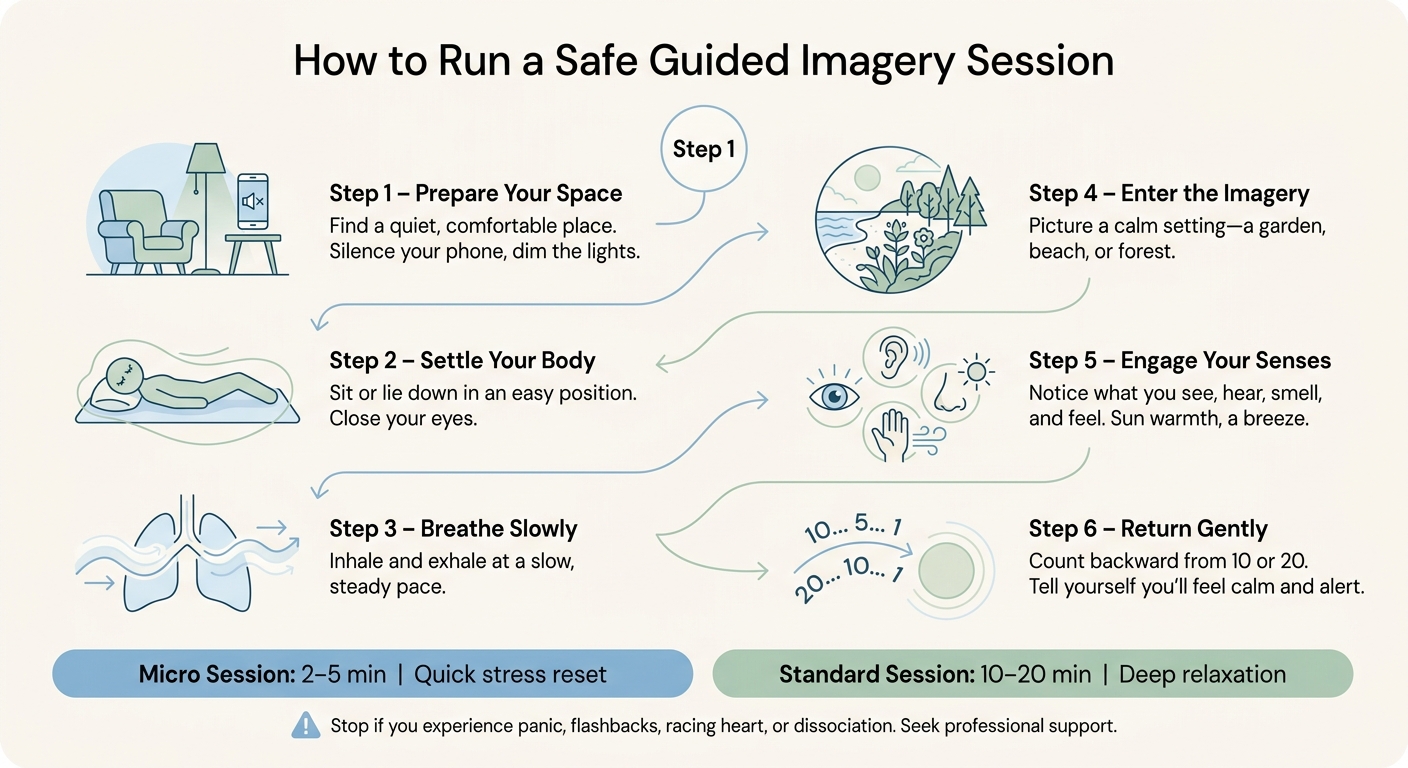
How to Run a Safe Guided Imagery Session: 6-Step Visual Guide
A safe session needs a clear beginning, middle, and end. If you’re using guided imagery on your own for everyday stress, not trauma work, this simple structure works well.
A 6-Step Session Structure to Save and Reuse
Here’s a simple flow you can come back to anytime:
- Prepare your space. Find a quiet, comfortable place. Silence your phone and turn off the TV. If possible, dim the lights.
- Settle your body. Sit or lie down in a position that feels easy, then close your eyes.
- Breathe slowly. Inhale and exhale at a slow, steady pace.
- Enter the imagery. Picture a calm setting, like a garden, beach, or forest.
- Engage your senses. Notice what you see, hear, smell, and feel. Maybe it’s the warmth of the sun or a breeze on your skin.
- Return gently. Count backward from 10 or 20 and tell yourself you’ll feel calm and alert at one.
If you want to stay with it a bit longer, aim for 10–30 minutes. During that time, you can move through the scene, imagine a wise guide, or play nature sounds or music to help you stay immersed. Start with pleasant or neutral scenes. If painful material starts to surface, that’s better handled with a clinician.
Micro Session vs. Standard Session: A Quick Comparison
Use the session length that fits your setting and goal.
| Feature | Micro Session | Standard Session |
|---|---|---|
| Duration | 2–5 minutes | 10–20 minutes |
| Primary Goal | Quick stress reset or midday break | Deep relaxation or bedtime wind-down |
| Ideal Setting | Desk, parked car, or quiet corner | Private room, recliner, or bed |
| Best Time to Use | Before a stressful meeting or during a lunch break | Before sleep or after a long, draining day |
| Cautions | May be less effective for deep-seated anxiety | Risk of falling asleep; set an alarm |
How to End a Session and Check Your Response
When the imagery feels complete, open your eyes slowly. Then name five things you can see in the room. It’s a small step, but it helps you come back to the present.
Next, rate your mood and stress on a 0–10 scale. If anything stood out, jot down one short note in a simple log. You can track mood, sleep, and stress before and after sessions.
Use the prompts below when you want a script to follow.
sbb-itb-23f89d4
Pocket Prompts for Emotional Healing
Use these short prompts during the session flow above, or as a fast reset when you need one. Pick the prompt that fits your state, then notice how your body and mood respond.
Safe Place Imagery for Grounding and Anxiety
Use this when your heart is racing, your thoughts are spiraling, or you feel boxed in by your surroundings. The aim is simple: give your nervous system a moment to settle.
Picture one place that feels safe. Then add one detail for each sense: sight, sound, smell, touch, and taste. Try to return to the same image each time you practice so your brain starts linking it with safety and calm.
Compassionate Guide and Healing Light Prompts
Use these for self-criticism, shame, grief, or a harsh inner critic, especially after hard conversations or before sleep.
For a compassionate guide, imagine a wise, kind, protective presence offering support without judgment. For healing light, picture a warm light or liquid moving through your body to soften tension, ease pain, and bring compassion to an area that feels tense or hurt.
Emotional Weather Imagery for Shifting Moods
When you feel stuck in anger or sadness, this prompt can help you notice the feeling without being swept away by it.
Picture a wide-open sky. Your emotion is the weather moving through it – a gray cloud, a gust of wind, or a rain shower. The sky stays in place even as the weather shifts. The feeling is real, but it is not the whole picture, and it will pass.
Safety Notes, Tracking, and Key Takeaways
Signs to Pause and Seek Professional Support
Use the prompts above only if these stop signs are absent.
Guided imagery is generally safe for most people. But vivid imagery can spark real physical and emotional reactions — research on mental simulation shows the brain activates many of the same regions whether an experience is real or imagined. That matters even more when the imagery touches grief, trauma, or painful memories.
The table below shows the difference between responses that are usually okay to notice and responses that mean it’s time to stop and get help.
| Response Area | Usually Safe to Observe | Pause and Seek Support |
|---|---|---|
| Emotional | Mild tears, relief, sense of calm | Overwhelming grief, panic, intense overwhelm |
| Physical | Slower breathing, muscle relaxation, mild sleepiness | Racing heart or breathlessness that won’t settle, sweating |
| Mental | Drowsiness, vivid positive imagery, improved focus | Flashbacks, intrusive memories, nightmares, false memories |
| Perceptual | Feeling immersed in a peaceful scene | Feeling unreal (dissociation), numbness, feeling trapped in the imagery |
Do not use grief- or trauma-focused imagery without clinical support. If anything in the right-hand column shows up, stop the session. Then contact a licensed mental health professional before you continue.
One important distinction: The Container Practice supports stabilization, not processing. Feeling calmer after a session does not mean the underlying material has been resolved. If imagery is bringing up trauma-related content, that work belongs in a clinical setting.
A Simple Log to Track Mood, Sleep, and Stress
After each session, write down only the basics so you can spot patterns later.
Fill out the log right away, while the session is still fresh in your mind. Rate mood and stress on a 1–10 scale, where 1 = very low and 10 = very high. For sleep, log bedtime and wake time in standard U.S. format – like 10:30 p.m. and 6:30 a.m. – so your notes stay easy to review and easy to share with a clinician if needed.
Review the log once a week for patterns in stress, mood, and sleep. Over time, those patterns can show what’s helping and what may need to change.
Conclusion: Key Points to Take Away from This Guide
The most useful approach is also the simplest: short sessions, clear stop signs, and weekly tracking.
When you track mood, sleep, and stress over time, a subjective practice starts to become something you can measure. You may notice that one prompt helps you sleep better, another lowers stress, or a certain type of imagery helps you feel more grounded. That kind of pattern makes it easier to decide what’s worth repeating.
Guided Imagery Is One Tool. We Can Help You Build the Full Picture.
If what you’re carrying feels bigger than a breathing exercise can hold, that’s worth paying attention to. At Modyfi, our network of providers brings psychiatry, therapy, nutrition, and exercise together — so guided imagery, when appropriate, becomes part of a real care plan, not just a coping tool.
👉 Explore Providers to Book an Appointment and Start Your Care Plan
(Note: Modyfi proudly accepts most major commercial insurance plans in MD, DC, VA, and WV; currently, we do not accept Medicare or Medicaid.)
FAQs
How often should I practice guided imagery?
A daily guided imagery practice is usually the best place to start. Doing it on a regular basis helps your brain get better at forming mental pictures without needing prompts every time.
You can also use guided imagery whenever you need stress relief or a reset. But beginning with a daily habit often makes it much easier to tap into during tense moments.
What if I can’t visualize clearly?
If visualization feels hard, that’s okay. Guided imagery isn’t only about what you see in your mind.
Sometimes it works better to focus on other senses, like sound, touch, or smell. You might notice the warmth of the sun on your skin, the rustle of leaves, or the feel of fresh air.
And you don’t need a sharp mental image for this to help. Give it time. Like most skills, it can get easier with practice. A recorded script can also help keep your attention in one place.
When should I stop and get professional help?
Guided imagery can help you relax, but it’s not a substitute for professional care. If you’re dealing with serious concerns or distress that doesn’t let up, get help from a qualified professional.
If you’re living with PTSD, a dissociative condition, or any diagnosis that involves trauma, check in with your provider before starting — even with a practice that feels gentle.
Can guided imagery replace therapy?
No — and it’s worth being direct about that distinction. Guided imagery is a tool that can support emotional regulation, stress relief, and relaxation. Therapy is a clinical process guided by a trained professional who can assess, diagnose, and treat underlying conditions.
The two aren’t in competition. In fact, guided imagery is often used within therapy — particularly in trauma-informed care, cognitive behavioral therapy, and integrative treatment approaches. It works best as a complement to professional support, not a stand-alone solution.
If you’re using guided imagery to manage everyday stress, that’s a reasonable starting point. But if what you’re dealing with involves trauma, persistent anxiety, depression, or anything that’s significantly affecting your daily life, guided imagery alone won’t get to the root of it. That’s where professional care makes the difference.
How is guided imagery different from meditation?
They overlap, but they’re not the same practice.
Meditation typically involves training attention — focusing on the breath, a word, or simply observing thoughts as they pass through. The goal is often to cultivate present-moment awareness without directing the mind anywhere specific.
Guided imagery is more intentional. It actively directs the mind toward a specific scene, feeling, or outcome — a peaceful place, a healing sensation, a compassionate inner presence. Where meditation asks you to observe, guided imagery asks you to construct.
Both can reduce stress and support emotional wellbeing. The difference is mostly in how active the mental engagement is. Some people find guided imagery easier to start with because the direction gives the mind somewhere specific to go, which can be helpful when thoughts are racing or concentration feels difficult.