


Adolescent depression rarely signals its presence through simple sadness; it constructs a restrictive cycle of social withdrawal, profound energy depletion, irritability, and fragmented sleep patterns. When a teenager pulls away from daily life, they experience short-term relief, but they inadvertently enter a dangerous withdrawal-reward trap that strips away vital environmental milestones.
Behavioral activation for adolescent depression serves as an active, evidence-based intervention designed to disrupt this paralysis from the outside in. By decoupling daily movement from temporary emotional states, this methodology challenges adolescents to complete small, highly intentional tasks before waiting for internal motivation to strike.
The Baseline Verdict
Behavioral activation functions as a highly structured, practical therapeutic approach that directly targets clinical avoidance by anchoring teenagers back into stable daily routines and rewarding lifestyle activities. Rather than asking a depressed adolescent to wait for their motivation to improve, this framework proves that executing a small action first allows their mood to naturally recover second.
When evaluating how this behavioral framework operates in practice, several operational milestones shape the recovery trajectory:
-
Objective Tracking Metrics: Treatment begins by tracking mood variances and daily activities on concrete scales, allowing adolescents to spot negative loops and systematically replace avoidance triggers with measurable actions tied strictly to their personal values.
-
Manageable Graded Milestones: Stuck days are broken down into micro-steps, focusing exclusively on observable behaviors rather than abstract cognitive concepts. Common targets include restoring consistent school attendance, time with peers, self-care routines, and stable sleep hygiene.
-
Predictable Treatment Structures: A standard course of care spans 8 to 14 weekly sessions, lasting approximately 30 to 60 minutes each. Adolescents collaborate with their professional network to execute 1 to 3 targeted, values-based activities between their appointments.
-
Strategic Caregiver Coaching: Parents are guided to act as collaborative coaches rather than authoritative enforcers. Support maps into daily life through offering structured choices, actively praising minor functional efforts, and avoiding behaviors that accidentally make long-term isolation comfortable.
Recognizing clinical boundaries is essential for adolescent safety. While behavioral activation safely resolves mild to moderate anhedonia, instances involving active suicidal ideation, self-harm, mania, acute psychosis, or rapid diagnostic degradation demand immediate, intensive clinical evaluation and psychiatric intervention.
The subsequent clinical data blocks analyze exactly how these mechanics translate into sustainable day-to-day recovery and interface with multi-disciplinary depression protocols:
| Area | What BA focuses on |
|---|---|
| Daily pattern | Spotting withdrawal and avoidance |
| Main tools | Mood/activity logs, values-based planning, graded tasks |
| Weekly plan | Specific actions with set times and places |
| Parent support | Choice, structure, praise, and calm follow-through |
| Safety limits | Get urgent help for suicide risk, psychosis, mania, or sharp decline |
How Behavioral Activation Disrupts the Teen Depression Cycle
When a teenager enters a depressive episode, their biological instinct is to retreat. They may stop attending sports practices, skip academic classes, or turn down direct connection with friends because they feel chronically exhausted, emotionally flat, or down.
In the immediate short term, pulling back brings temporary relief from overwhelming stress. However, the systemic tradeoff is heavy: it strips away protective daily structures and cuts off any chance to experience spontaneous, positive moments. This behavioral retreat removes access to the environmental rewards that naturally stabilize mood, causing their emotional baseline to drop even further into severe anhedonia.
The structural overview below details how targeted behavioral activation breaks this avoidance pattern by showing adolescents the exact loop they are navigating, giving them the concrete tools needed to step out of it:
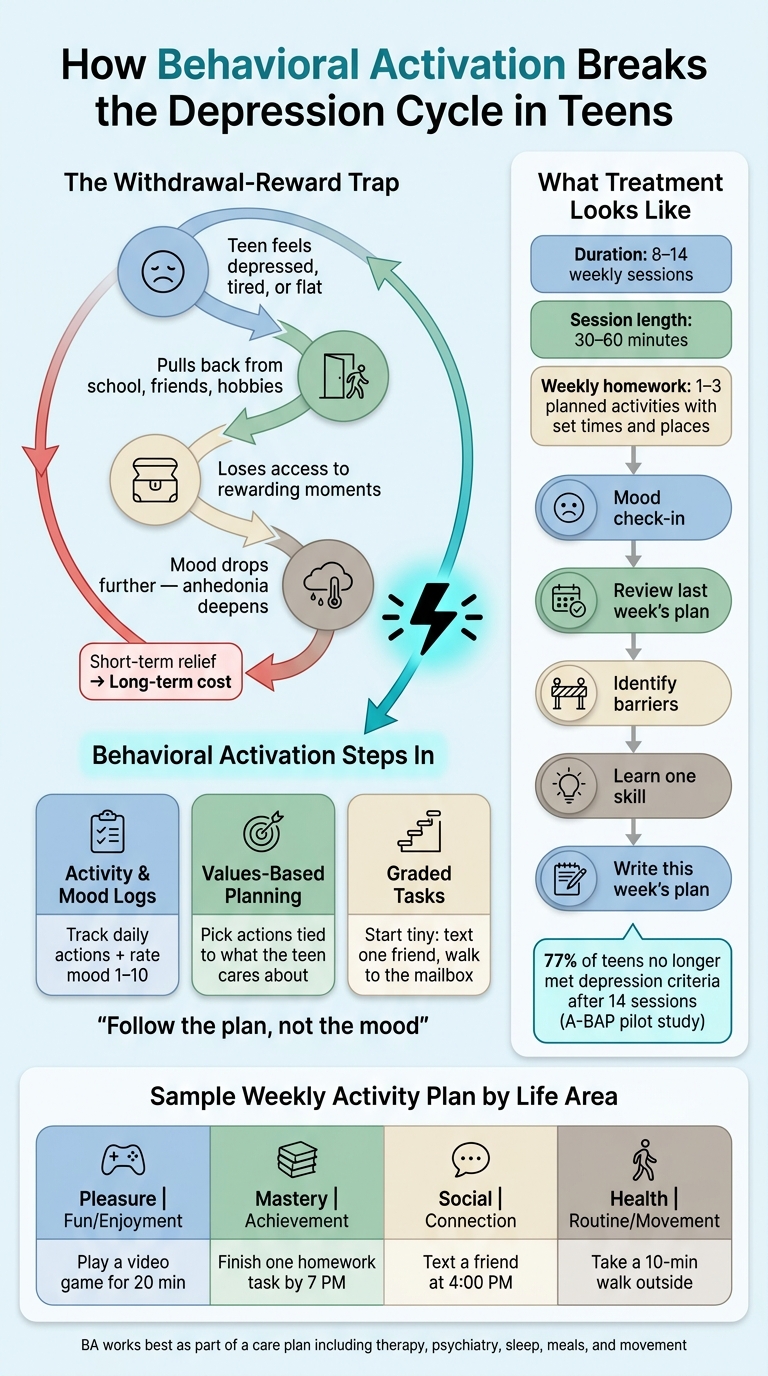
How Behavioral Activation Works for Depressed Teens: The Step-by-Step Cycle
Breaking the Withdrawal-Reward Trap
When an adolescent retreats from their daily activities, they lose direct access to the small, ambient rewards that naturally help steady and regulate human mood. This retreat creates a profound biological vulnerability: clinical data indicates that the presence of prolonged anhedonia—the inability to feel pleasure from previously loved activities—strongly predicts a slower rate of symptom remission in youth.
While avoiding stressful environments like social gatherings or academic obligations brings short-term emotional relief to an overloaded teenager, the transactional cost is heavy. It shuts the door on subsequent opportunities for reinforcement, causing their emotional baseline to drop further into structural stagnation.
Behavioral activation targets this precise systemic bottleneck by focusing entirely on concrete, observable actions rather than internal emotional motivation. Because it targets what an adolescent actively does across their daily environment rather than trying to fix what they abstractly think, it provides a clear, actionable pathway out of clinical paralysis that perfectly fits the teenage cognitive profile.
Three Practical Steps for Daily Tracking
BA starts with behavior, not feelings. The idea is simple: take small actions first and watch what happens. To do that, BA leans on three main tools.
This methodology begins directly with behavior rather than feelings. The framework relies on three essential applications:
-
Activity and Mood Logs: Teenagers track their daily routines and rate their emotional state on a 1 to 10 scale. Over time, these records help families spot exact behavioral patterns—revealing which specific actions align with better days and which ones triggers a drop in mood.
-
Values-Based Activity Selection: Instead of assigning random tasks, our network of providers collaborates with teens to identify what truly matters to them, such as friendship, health, or academic progress. They then pick tailored activities that directly anchor into those core values.
-
Graded Tasks: Stuck days can make even minor routines feel impossible. Breaking down goals into tiny, concrete steps—like walking to the mailbox, texting one peer, or sitting outside for five minutes—serves as a safe test to observe how action gently moves mood upward.
Taken together, these tools turn a vague pattern into something a teen can try, track, and adjust in daily life.
Behavioral activation compared with cognitive therapy styles
BA and Cognitive Behavioral Therapy (CBT) both treat depression, but they begin in different places. CBT starts with thoughts. BA starts with behavior.
That gap matters for adolescents. When depression is heavy, abstract thinking skills can be hard to use. BA’s focus on concrete, observable actions can make it easier to get moving.
| Feature | Behavioral Activation (BA) | Cognitive Behavioral Therapy (CBT) |
|---|---|---|
| Primary Focus | Observable behavior, routine, and environmental reinforcement | Internal thought patterns and cognitive distortions |
| Session Tasks | Identify avoidance triggers; schedule activities | Identifying automatic thoughts; cognitive restructuring |
| Homework | Trying new behaviors and tracking their impact on mood | Completing thought records and testing the validity of beliefs |
| When Helpful | High withdrawal, anhedonia, or “shutting down” | High rumination, intense self-criticism, or identifiable thinking traps |
For teens who are highly withdrawn, BA is often the best place to begin. In practice, that usually means simple homework, small actions, and a clear plan between sessions.
sbb-itb-23f89d4
The Structural Timeline of Care
Standard adolescent interventions typically span 8 to 14 weekly sessions lasting approximately 30 to 60 minutes each. Every appointment maintains a focused, predictable flow.
A session usually follows a simple pattern: a mood check-in, a review of last week’s plan, a short look at barriers, one new skill, and a written plan for 1 to 3 specific activities with set times and places. That setup helps keep the work focused. The point is to turn avoidance into action for the next week.
In one pilot study of the Adolescent Behavioral Activation Program (A-BAP), 77% of participants no longer met criteria for depression after 14 sessions.
Common goals for teens with depression
After the weekly plan is set, BA focuses on the routines depression often throws off. Early goals often include:
- Consistent school attendance.
- Social connection with peers.
- Resuming a dropped hobby or creative outlet.
- Basic self-care and daily hygiene milestones.
Cutting back on screen time that replaces in-person contact is also a common target.
The main idea is simple: follow the plan, not the mood.
Behavioral activation activities by life area
Activities usually come from four life areas so the weekly plan doesn’t lean too hard in just one direction. Here’s the kind of menu teens and therapists often build in session:
| Life Area | Goal Type | Example |
|---|---|---|
| Pleasure | Fun/Enjoyment | Playing a video game for 20 minutes |
| Mastery | Achievement | Finishing one homework assignment before 7:00 p.m. |
| Social Connection | Being with people | Texting a friend to say hi |
| Health & Self-Care | Routine/Movement | Taking a 10-minute walk outside |
Specificity matters here. “Text one friend at 4:00 p.m.” works better than “reach out more.” Therapists pick tasks that are realistic and measurable. These small, concrete plans tend to work best when teens and caregivers keep them visible and stick with them from week to week.
Who behavioral activation fits and how parents can help
When behavioral activation is a good fit
Once a teen starts tracking activity and mood, the next step is figuring out whether BA fits what they’re dealing with.
BA tends to work best for teens with mild to moderate depression, anhedonia, avoidance, or low motivation. It can help a lot when a teen has slowly pulled away from activities they used to like, spends long stretches on mood-lowering habits like social media, or gets stuck replaying negative events in their mind.
Some cases need more than BA on its own. Teens with suicidal thinking, self-harm, psychosis, manic symptoms, or depression that is getting worse fast need immediate safety planning and a psychiatric evaluation. Teens dealing with school refusal, acute substance use, severe agitation, or major changes in sleep and eating need broader care too, with BA used as one part of treatment.
How parents and caregivers can help without taking over
A parent’s role here is more like steady coaching than control. The goal is to help the teen follow a plan instead of letting mood make every decision. That can mean offering choices rather than commands: “Do you want to take your walk before or after dinner?” It also means noticing and praising small wins, even if mood doesn’t shift right away.
In day-to-day life, that may look like keeping a steady wake time, offering a ride or joining the first walk, and making the weekly activity plan easy to see in a shared phone calendar. Collaborative planning matters because teens are more likely to stick with schedules they helped build. It can also help to frame a new routine as a two-week experiment instead of a forever rule, which may lower resistance.
Parent behaviors that support progress versus those that maintain avoidance
The gap between helping and accidentally feeding avoidance can be small. This table shows what that looks like in practice:
| Supportive Patterns | Patterns That Maintain Avoidance |
|---|---|
| Offering choices and co-creating the weekly plan | Giving orders or dictating the schedule without teen input |
| Praising effort and small wins, regardless of mood outcome | Focusing only on missed goals or what didn’t get done |
| Keeping consistent wake times and basic daily structure | Allowing the teen to stay in bed or skip responsibilities without a plan |
| Linking device access to completing a planned activity | Providing unlimited screen time during periods of withdrawal |
| Asking “What made today’s step feel too big?” to problem-solve | Removing every challenge to avoid upsetting the teen |
The right amount of support depends on the teen’s age, temperament, and relationship with the caregiver.
BA often works best when paired with psychiatry, therapy, and daily routines around sleep, meals, and movement.
How behavioral activation pairs with psychiatry, sleep, food, and movement
Behavioral activation alongside psychiatric care and therapy
This methodology functions best as one component within a unified network of providers, ensuring that therapy works in direct loop with psychiatry, sleep structure, and movement. When symptoms are severe, precision psychiatric support frequently manage baseline intensity, making it clinically safe and physically accessible for an adolescent to actively engage with daily therapy.
Medication frequently helps manage symptom intensity, creating an accessible baseline for engagement in behavioral activation and therapy. BA can also be used alongside medication when needed. Once symptoms feel more manageable, teens are often better able to follow through on the plan.
BA also fits naturally within broader therapy models like CBT and Interpersonal Therapy (IPT), where it often serves as a main treatment component.
Using behavioral activation to support sleep, meals, and physical activity
BA can also help lock in the daily basics: sleep, meals, and movement. A fixed wake time, morning light, regular meals, and breakfast within a set time window give the day structure. That structure can help treatment gain traction.
For movement, start small. A short walk counts. So does another brief, low-pressure activity. The point isn’t to do a lot at once. It’s to make the action easy enough to repeat.
One pilot study found that teens who combined BA with micronutrient support (Vitamin D and omega-3s) saw a 50% greater reduction in depressive symptoms than those receiving BA alone.
Conclusion: Key points for families to remember
In day-to-day life, the goal is pretty simple: make the plan small enough to do and steady enough to help. BA works from the outside in – small, structured actions help teens reconnect with daily life before motivation or mood improves.
Parents usually help most when they offer choices, use gentle accountability, keep routines steady, and let the teen help shape the plan. BA tends to work best as part of a coordinated approach that includes psychiatric support when needed, evidence-based therapy, and daily habits around sleep, food, and movement.
FAQs
How quickly can BA start helping?
Behavioral activation is structured, but it’s not rigid. In many cases, treatment runs for 12 to 14 sessions, giving teens enough time to build momentum without feeling locked into a one-size-fits-all plan.
Progress looks different from one teen to the next. That said, research shows clear gains in depression symptoms, overall functioning, and activation by the end of treatment.
There’s also good news for families looking for a shorter option. 8-session versions have shown strong results too, along with high patient and parent satisfaction.
Can BA work if my teen has no motivation?
Yes. Behavioral activation (BA) is built to help with low motivation, which is a common part of adolescent depression.
Depression often creates a tough cycle: feeling down leads to pulling back from people and activities, and that withdrawal can make mood worse. BA works to interrupt that pattern by helping teens plan meaningful, rewarding activities. The idea is simple but powerful: instead of waiting to feel motivated first, teens learn that action can come first – and that taking small steps can improve how they feel over time.
How do I know if BA is enough?
Whether behavioral activation is enough depends on the teen’s clinical needs and how they’re doing over time. For some adolescents with depression, it can work well on its own. In many cases, though, it fits into a broader treatment plan.
At Modyfi, we embrace patient and parent autonomy, allowing families to directly explore our network of providers to select the perfect specialist for their adolescent’s specific daily situation. Our network integrates evaluations with ongoing therapy, medication management, and functional nutrition under one virtual roof.
You Don’t Have to Navigate This Alone
Navigating your teenager’s depression—or watching them slowly pull away from the life they loved—requires a coordinated, whole-person strategic response. Modyfi dismantles fragmented, confusing healthcare by bringing precision psychiatry, specialized therapy, functional nutrition, and restorative movement under one unified virtual roof. Our expert network of providers guides families away from generic diagnostic treatments, treating your teen as an ecosystem to be balanced so they can build sustainable resilience for the future.
👉 Explore Providers to Book an Appointment and Start Your Care Plan
Note: Modyfi proudly accepts most major commercial insurance plans in MD, DC, VA, and WV