


If you’ve ever sat in a therapy session and felt like the therapist just didn’t quite get your world — your family dynamics, the way you talk about stress, what actually matters to you day to day — you’re not imagining it. That gap is real, and it has a name.
Culturally adapted therapy is the practice of shaping mental health treatment to fit the person receiving it — their language, their values, their family structure, their faith, and the practical realities of their daily life. It doesn’t change what therapy is trying to do. It changes how it’s delivered so it actually reaches you.
Research consistently shows that when therapy is adapted to a patient’s cultural context, engagement improves, dropout rates fall, and outcomes get better. The treatment works harder because it fits better.
This post explains what culturally adapted therapy looks like in practice — specifically through an approach called Behavioral Activation — and what to look for when you’re choosing a provider.
For a closer look at how cultural adaptation works in practice — including real examples of how therapists adjust their approach for different backgrounds — the video below offers a useful overview:
Cultural Adaptation of Cognitive Behavioral Therapy
sbb-itb-23f89d4
What Changes in Culturally Adapted Therapy — and What Stays the Same
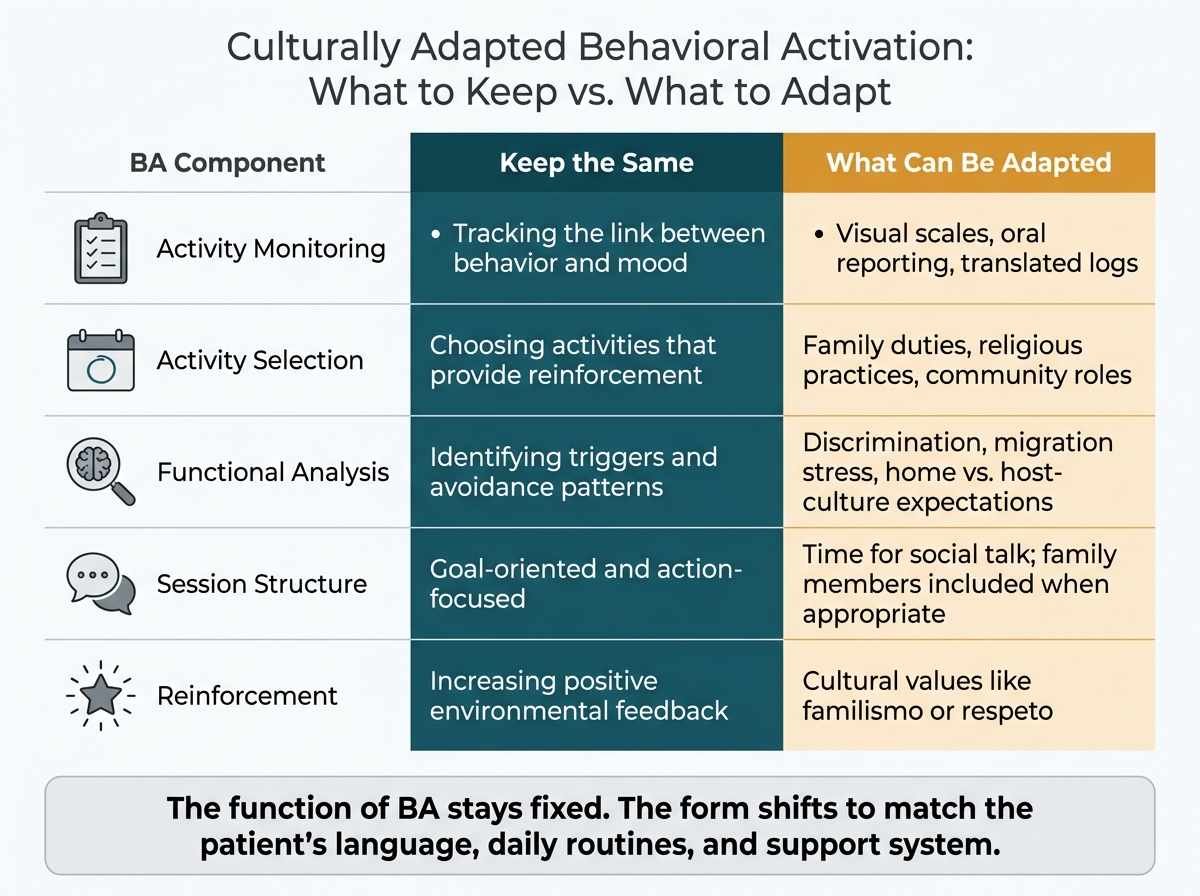
Culturally Adapted Behavioral Activation: What to Keep vs. What to Adapt
What Culturally Adapted Therapy Actually Looks Like
Good therapy keeps its core purpose fixed — helping you understand the link between what you do and how you feel, and gradually building activities that bring more meaning or pleasure into your day. What changes is how that process is shaped around you.
That might mean your therapist uses the words you naturally use to describe what you’re going through — not clinical terms that feel foreign. It might mean sessions leave room for family input if that’s how you make decisions. Or that the activities you’re asked to try fit your actual schedule, budget, and community — not a generic list designed for someone else’s life.
Your Words Matter in Therapy
Not everyone uses the word “depression” to describe what they’re going through. Many people talk about “thinking too much,” “nervios,” a heaviness they can’t shake, or simply feeling far from themselves. Those phrases aren’t imprecise — they’re often the most accurate description of the experience.
A culturally responsive therapist will ask you what name you, your family, or your community gives to what you’re going through. And then they’ll use that language — in sessions, in worksheets, in the way they frame your progress. Research shows that when therapy uses a patient’s own words for distress, engagement improves and the process feels less foreign.
If a therapist has never asked you this question, it’s worth asking them directly: “Can we use the language that actually makes sense to me?”
What a Good Therapist Will Ask Before Suggesting Anything
Before a culturally responsive therapist suggests any activity or homework, they’ll want to understand your actual life — not a generic version of it.
That means asking about what matters most to you right now. Your roles — whether you’re a caregiver, a student, a provider, a community member, or all of these at once. How you make sense of what you’re going through, in your own words. Whether faith or spirituality is part of your daily life. Whether there are practical realities — cost, transportation, work schedule, child care, neighborhood safety — that would make certain activities impossible to follow through on.
This isn’t small talk. It’s the foundation of a plan that actually works. When a therapist skips this step and jumps straight to assigning tasks, the activities often don’t fit — and when they don’t fit, it’s easy to feel like the problem is you. It isn’t. The problem is the plan.
A good therapist treats you as the expert on your own life. They ask before they prescribe.
Real Life Comes First
A therapy plan that looks good on paper but doesn’t fit your actual day isn’t a good plan. A culturally responsive therapist knows this — and will ask about the practical realities of your life before suggesting anything.
That includes your work schedule, child care responsibilities, transportation, and whether your neighborhood feels safe enough for outdoor activities. If you’re using telehealth, it means checking whether you have a private space to talk and a reliable internet connection — and adjusting the plan if you don’t.
Cost matters too. Not every suggested activity has to be expensive or time-consuming. Low-cost options, community spaces, faith communities, and family-based activities are all valid — and a good therapist will build those into the plan rather than assuming you have unlimited time and resources.
If something on your plan feels impossible given your actual life, say so.
That information doesn’t derail therapy — it makes the plan better. That includes your work schedule, child care responsibilities, transportation, and whether your neighborhood — and home environment — feels safe enough for the activities being suggested.
What’s Already Working in Your Life Belongs in Your Care Plan
A good therapist won’t start from scratch. They’ll look at what’s already helping — the routines, relationships, and practices that give your day structure or meaning — and build from there.
That might be a morning prayer, a weekly family dinner, a walk you take at the same time every day, or a faith community you’re part of. These aren’t separate from treatment. They’re resources — and a culturally responsive therapist will ask about them specifically and find ways to weave them into your plan.
It also means being aware of your calendar. If you observe religious holidays, fasting periods, or have weeks that are consistently more demanding than others, those realities should shape what gets scheduled and when. A plan that ignores your actual rhythm isn’t going to survive contact with your real life.
Tracking Progress Should Feel Natural, Not Like Homework
Many therapy approaches use some form of tracking — logging activities, moods, or how your day went. In culturally adapted therapy, that tool is shaped around how you actually communicate, not around a standard template.
If written logs don’t fit your style or your literacy level, your therapist can switch to visual check-ins, brief voice memos, or simple text-based tools. If numbers feel foreign, the tracking can use words or images instead. The goal is to find a format you’ll actually use — not one that feels like extra work on top of everything else.
If a tracking tool isn’t working for you, say so. A good therapist will adjust it — not push through something that doesn’t fit just because it’s standard practice.
The Activities in Your Plan Should Actually Make Sense for Your Life
Therapy homework only works when it fits your actual day. A culturally responsive therapist won’t hand you a generic list of activities — they’ll build one around what matters to you, what you can realistically do, and what already feels meaningful.
If connection with family or community is central to your life, activities that involve other people — family meals, visiting neighbors, participating in community events — may work better than solo tasks. If faith is part of how you find meaning, prayer, attending services, or reading sacred texts are all legitimate options that can be woven into your plan.
Energy level matters too. If you’re dealing with chronic illness, pain, or the kind of exhaustion that comes from carrying a lot, smaller steps are the right starting point — not a sign that you’re not trying hard enough.
The best activity plan is one you can actually do, on the days you actually have, with the energy you actually have.
Your Family and Community — On Your Terms
Culturally adapted therapy doesn’t assume that involving your family will automatically help. Some people want their family closely involved in their treatment. Others need their therapy to be completely private. Both are valid — and a good therapist will ask, not assume.
You get to decide who knows about your treatment, what role they play, and what information gets shared. If a faith leader, community elder, or trusted family member could be a meaningful part of your support, that’s something to explore together. If keeping therapy separate from your family or community is important for your safety or privacy, that boundary will be respected and documented.
The point is that your support system is yours to define — not something a therapist decides for you.
When Your History Shapes Your Healing
If you’ve moved to a new country — or even a new city — you may have lost access to the routines, places, and people that used to anchor your day. That kind of loss is real, and it affects mental health in ways that standard therapy doesn’t always account for.
A culturally responsive therapist will ask about this. They’ll want to know whether there are traditions, practices, or community connections from home that you miss or find hard to access here. And they’ll try to build activities that reconnect you to what matters — not replace your world with a generic substitute.
The same applies to faith. If spirituality is part of how you make sense of your life, a good therapist will ask how it shows up in your daily routine, what feels meaningful, and whether any practices feel off-limits. That conversation isn’t an intrusion — it’s how therapy gets shaped around who you actually are.
When Your Body Gets in the Way
Sometimes therapy progress slows down — not because you’re not trying, but because chronic pain, poor sleep, illness, or medication side effects are making everything harder. That’s a health issue, not a motivation problem.
A good therapist will recognize this distinction. If physical barriers are affecting your ability to follow through on activities, the right response is to adjust the plan and — when needed — coordinate with other providers. That might mean bringing in support for sleep, nutrition, or physical movement alongside your therapy, so the different parts of your care are working together rather than in isolation.
At Modyfi, that coordination is built into how we work. Our network of providers brings psychiatry, therapy, nutrition, and exercise together — so if your body is getting in the way of your mental health progress, we look at both.
Good Therapy Adjusts as You Change
A culturally adapted plan isn’t set once and forgotten. At every session, a good therapist checks whether the activities still feel relevant, whether your life circumstances have shifted, and whether the plan still fits who you are right now.
If something stops working, that’s information — not failure. The plan gets revised, not abandoned.
If You’re Not Following Through, It’s Worth Asking Why
If activities aren’t getting done, a good therapist won’t assume you’re not motivated. They’ll ask what actually happened when you planned to do it.
Sometimes the barrier is practical — a schedule that shifted, a cost that wasn’t accounted for, a safety concern. Sometimes stigma is getting in the way — keeping therapy private from family or community members can make certain activities harder to do publicly.
If that’s your situation, there are discreet options: phone check-ins, voice memos, brief texts. The format can change. The goal doesn’t have to.
Key takeaways : What to Look for in a Culturally Responsive Therapist
A few things worth keeping in mind as you evaluate whether a therapist is the right fit:
- They ask about your life before suggesting activities — your values, roles, routines, and what you’re carrying
- They use language that makes sense to you, not just clinical terms
- They treat practical barriers — cost, schedule, energy, access — as real obstacles, not excuses
- They adjust the plan when something isn’t working, without making you feel like the problem
- They respect your privacy around family and community, and include others only when you want them involved
Therapy should fit your life. If it doesn’t, it’s worth saying so — and worth finding someone who will listen.
Therapy That Fits Who You Are.
Finding a therapist who takes the time to understand your background, your language, your family, and your life isn’t a luxury — it’s what good care looks like. At Modyfi, our network of providers brings psychiatry, therapy, nutrition, and exercise together, with a commitment to care that meets you where you are.
👉 Explore Providers to Book an Appointment and Start Your Care Plan
(Note: Modyfi proudly accepts most major commercial insurance plans in MD, DC, VA, and WV; currently, we do not accept Medicare or Medicaid.)
FAQs
What is culturally adapted therapy and how is it different from regular therapy?
Culturally adapted therapy uses the same evidence-based techniques as standard therapy — the difference is how those techniques are delivered. A culturally adapted approach shapes the language, activities, pacing, and structure of treatment around the specific person receiving it: their cultural background, family roles, faith practices, daily routines, and the practical realities of their life.
Standard therapy works for many people. But research consistently shows that when therapy is adapted to fit a patient’s cultural context, engagement improves, dropout rates fall, and outcomes get better. The goal of treatment stays the same. What changes is how it reaches you.
How do I know if a therapist is culturally competent?
A few signals worth paying attention to: a culturally competent therapist will ask about your background, your community, and how you describe what you’re going through — before suggesting any activities or homework. They’ll use language that makes sense to you, not just clinical terminology. They’ll ask about practical barriers like cost, schedule, and family obligations. And they’ll adjust the plan when something isn’t working, without making you feel like the problem.
If a therapist has never asked you what name you or your community gives to what you’re experiencing, or never adjusted their approach based on your cultural context, it’s worth raising that directly — or looking for someone who does.
Can therapy work if I don’t speak English fluently?
Yes — and a culturally responsive therapist will make sure language is never a barrier to care. That might mean working with a professional interpreter, providing materials in your preferred language, or using visual tools instead of written worksheets. The goal is to remove the language barrier from the therapeutic process, not work around it.
If you’re looking for a therapist who speaks your language or has experience working with your cultural community, that’s a reasonable and important request to make. Don’t settle for care that requires you to translate yourself.