

When anxiety shows up as racing thoughts, mental overload, or screen fatigue, the fix is rarely another app or another productivity hack. Sometimes what actually helps is something slower — something that puts your hands to work and pulls your attention back to the present.
Knitting, gardening, baking, jigsaw puzzling, and birdwatching have one thing in common: they engage the senses, create rhythm, and give the nervous system something steady to follow. Ten to thirty minutes is often enough to feel a shift.
What the evidence actually shows:
- Knitting helps when your mind won’t stop looping
- Gardening helps when you feel drained or disconnected
- Baking helps when you’re overloaded and tired of making choices
- Jigsaw puzzling helps when your brain feels scattered
- Birdwatching helps when you need quiet focus outdoors
These hobbies can support calm — but they work best alongside professional care when anxiety goes beyond occasional stress.
Quick Comparison
| Hobby | Best fit for | Usual session | Starting cost |
|---|---|---|---|
| Knitting | Racing thoughts | 15–30 minutes | Low |
| Gardening | Burnout, disconnection | 30+ minutes | Low to medium |
| Baking | Screen fatigue, decision fatigue | 20–60+ minutes | Low |
| Jigsaw puzzling | Mental overload | 10–20+ minutes | $5–$15 |
| Birdwatching | Mental exhaustion, rumination | 15–30 minutes | Free to $40+ |
Bottom line: if you want a simple way to feel more at ease, pick the hobby that matches your stress style, keep it small, and focus on the process instead of the result.
5 Relaxing Hobbies to Reduce Stress and Anxiety (Hobby Ideas for Self-Care and Mental Health)
Why These Low-Tech Hobbies Can Feel So Calming
Repetitive, rhythmic handwork can help nudge the body toward a parasympathetic “rest and digest” state and lower stress load. Intentional physical effort can also support the brain’s reward and problem-solving systems.
Hands-on tasks like knitting, gardening, baking, and puzzling pull your attention back to the present through texture, smell, sound, and touch. That’s part of why they can feel so grounding. Unlike scrolling, these hobbies tend to give steadier rewards that don’t leave your mind feeling scattered.
Each hobby below taps into one or more of these calming effects — and works best alongside therapy, medication, or other professional care when anxiety goes beyond occasional stress.
1. Knitting
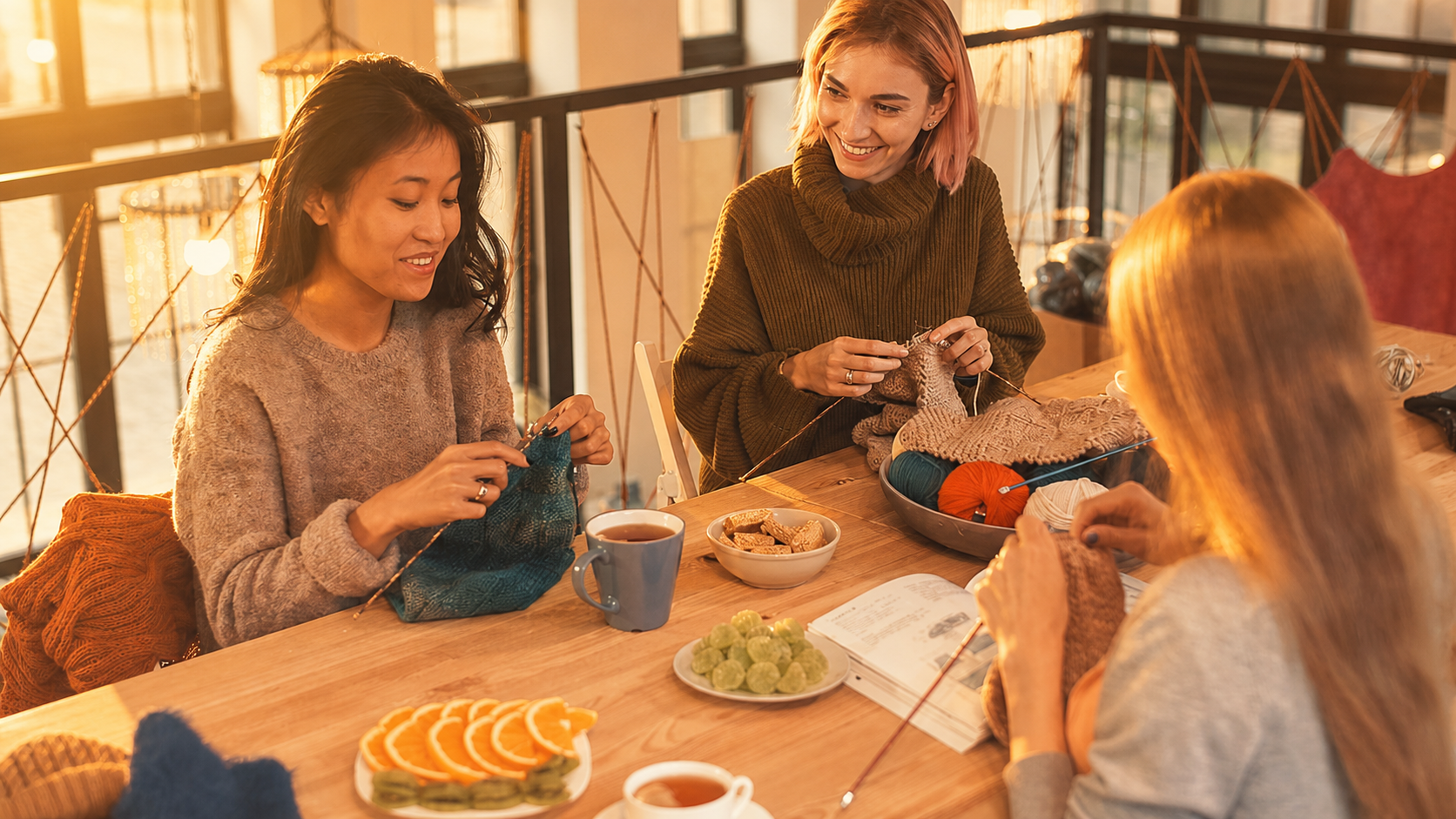
Knitting is repetitive, rhythmic handwork that can help settle an anxious mind. When your thoughts start spinning, that repetition gives your brain something simple and steady to focus on.
A lot of the calming effect comes from rhythm, focus, and alternating hand movement. The steady pace, plus the back-and-forth attention between your hands, can pull you away from worry and toward a calmer state. Research from the University of Gothenburg shows that knitting is beneficial for people living with mental health issues — described by participants as a way of bringing calm, giving life structure, and making thinking clearer and easier to manage.
Knitting can be a good fit if anxiety shows up as racing thoughts, rumination, restlessness, or trouble winding down. Counting stitches gives your mind a gentle job, which can interrupt mental loops. And the repeated motion gives restless energy somewhere useful to go.
Start small — a beginner kit or free YouTube tutorials can help you learn the basics without overload. A simple scarf or dishcloth is plenty for day one.
2. Gardening
If knitting helps by repeating the same motion, gardening helps by pulling your mind into something alive. Your attention has somewhere to go: a plant that needs water, a stem that needs trimming, soil that needs checking. That mix of routine, sensory input, and light physical work can help ease anxiety.
Research shows that green space may lower rumination, the loop of negative thoughts that often feeds anxiety. Gentle movement like digging, watering, and pruning may help support mood, and contact with soil may play a small part too.
Gardening fits especially well when anxiety feels like burnout, mental fatigue, or disconnection. It’s calming, but it doesn’t feel passive. You’re doing something with your hands, and your focus stays tied to something real that changes over time. A 2020 survey of U.S. adults found that people who gardened for more than 8 hours over a two-week period had lower anxiety scores than those who didn’t garden.
You also don’t need a yard or much money to begin. One pot with drainage holes, all-purpose potting soil, and a sunny windowsill can be enough. Lavender does well in bright sun and adds a calming scent. Pothos grows fast, so you can see progress without waiting forever. And if you don’t have outdoor space, many U.S. cities have community garden plots, which give you the same steady routine and sense of connection.
Start small: one pot, potting soil, and a sunny windowsill. If you want that same steady rhythm indoors, baking is the next best fit.
3. Baking
Baking can calm the mind because it gives you structure, repetition, and something physical to focus on. Your hands have a clear rhythm. Your senses have a clear job.
Measuring, stirring, kneading, and waiting for the timer pull your attention back to the task in front of you. That steady rhythm, along with the smell, texture, and sound of baking, can interrupt spiraling thoughts.
This works well when anxiety shows up as decision fatigue, racing thoughts, or screen fatigue. A recipe gives your brain a plan without asking for perfection. After a day packed with back-to-back choices and too much time on a screen, following a recipe can feel like a small reset.
Try 20 to 30 minutes once a week, and leave your phone in another room. Good low-pressure starting points include:
- Zucchini bread
- Basic cookies
- Muffins
- A simple no-knead bread loaf
If you want that same structured focus with less prep, jigsaw puzzling is next.
4. Jigsaw Puzzling
Jigsaw puzzling is simple: you sort loose pieces into a full picture, one fit at a time. That kind of steady visual focus can feel grounding when your mind is all over the place.
There’s also something calming about the structure. When life feels messy, a puzzle gives you a clear task and a clear next move — your brain gets one concrete job instead of juggling ten thoughts at once. The visual search for patterns and the small decisions required to test each piece provide a concrete focus point without demanding real mental effort.
That’s a big part of why it helps. Like the other hobbies here, puzzling gives your nervous system something steady and predictable to follow.
It can be a good match if your anxiety shows up as mental overload. Instead of juggling ten thoughts at once, your brain gets one concrete job. You’re not making big choices, either, so it can ease decision fatigue. And every piece that clicks into place gives you a small, visible win, which can push back against all-or-nothing thinking.
Getting started doesn’t cost much or ask much from you. Basic puzzles often cost $5–$15 at thrift stores or discount retailers. If you’re new to it, or if you feel stretched thin, start small with a 100-piece puzzle or even a kids’ puzzle. Choose an image that feels calm to look at, like a landscape, a cozy kitchen, or a nature scene. If table space is tight, a portable puzzle board or felt roll-up mat makes it easier to put the puzzle away between sessions.
Try 10 to 15 minutes after work. Don’t worry about finishing fast. The point is to be present, not to race.
Prefer calm outdoors? Birdwatching is next.
sbb-itb-23f89d4
5. Birdwatching
If the other hobbies calm you through hands-on repetition, birdwatching works in a quieter way: you slow down and watch. You start noticing the birds around you – their colors, movements, songs, and little habits. And the nice part is, you don’t need much to begin. A window, a backyard, or a local park is enough.
Birdwatching can calm the mind by shifting your attention into soft fascination – a gentle kind of focus that doesn’t take much effort. Like the other hobbies, it gives anxious attention one simple job. Dr. Susan Albers of Cleveland Clinic says 15 minutes in nature can lower cortisol, heart rate, and blood pressure.
This hobby fits best when anxiety shows up as rumination, screen fatigue, or plain mental exhaustion. Listening for birdsong or following a small movement in the branches gives your brain one quiet task, which can pull it away from looping thoughts. A 2024 study found that college students who looked for birds during weekly 30-minute nature walks reported lower distress than those who only walked.
One small shift may help even more. Instead of counting species, try “joy watching” – rating how much joy each bird brings you on a scale from 1 to 10. A 2023 study found that this led to bigger drops in anxiety than counting birds.
Getting started costs almost nothing:
- The free Merlin Bird ID app can identify birds by sound or photo, which makes it a good first tool.
- A basic backyard feeder and a bag of seed usually cost about $15–$40.
- Entry-level binoculars usually land in the $50–$150 range if you want to go further.
Try starting in the morning, when birds are most active and the light feels calm.
Next, match the hobby to the kind of stress you want to ease.
Which Hobby Matches Your Stress Style? A Quick Comparison
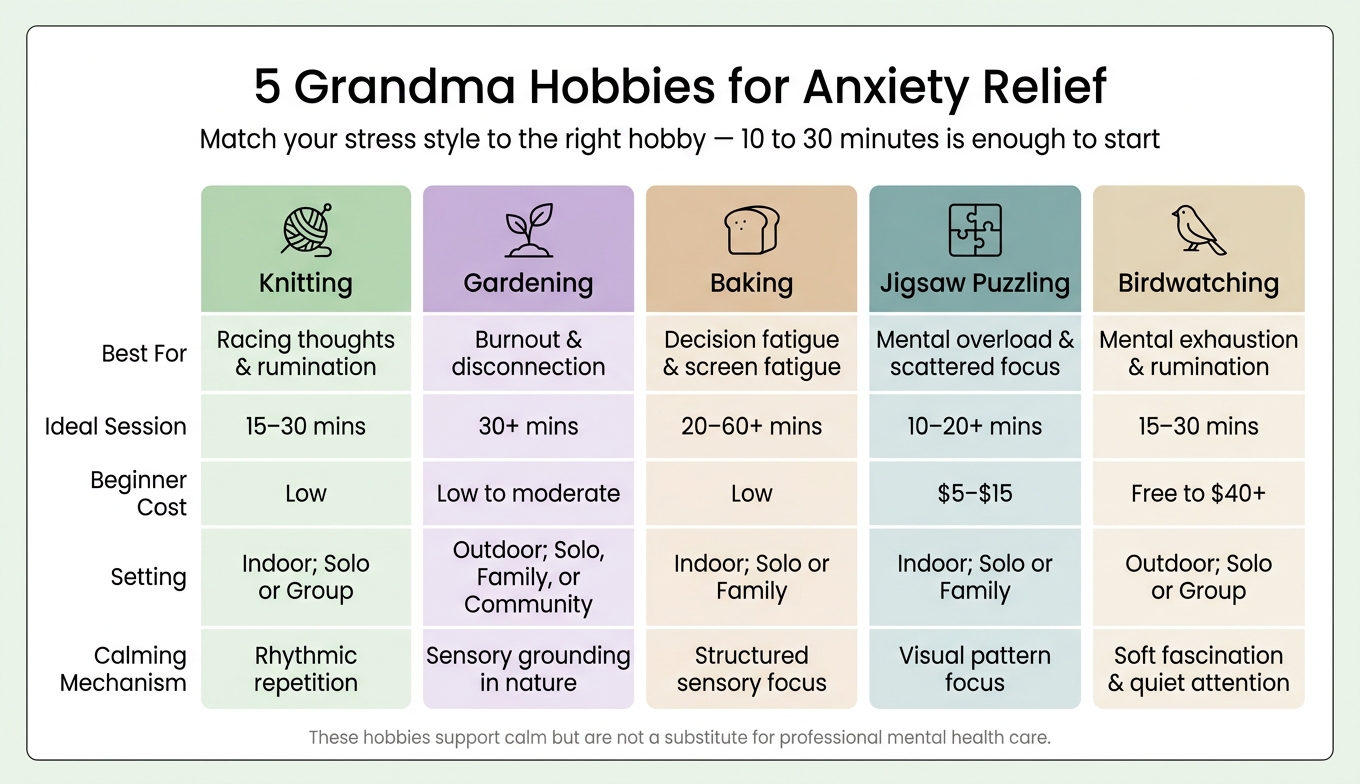
Pick the hobby that helps your nervous system calm down the fastest. The table below gives you a quick way to see what fits.
| Hobby | Best For | Ideal Session | Beginner Cost | Setting |
|---|---|---|---|---|
| Knitting | Less rumination | 15–30 mins | Low cost | Indoor; Solo or Group |
| Gardening | Time in nature | 30+ mins | Low to moderate | Outdoor; Solo, Family, or Community |
| Baking | Sensory grounding | 60+ mins | Low cost | Indoor; Solo or Family |
| Jigsaw Puzzling | Gentle focus | 20+ mins | Low cost | Indoor; Solo or Family |
| Birdwatching | Mental exhaustion | 15+ mins | Free to moderate | Outdoor; Solo or Group |
Once you know your stress style, the next move is picking the hobby you’ll stick with when life gets busy.
How to Pick the Right Hobby for You
Use the comparison table above to narrow your options, then try one hobby for a week. Pick something that matches how you feel right now. Slow, repetitive handwork can fit low-energy days. Puzzle-based hobbies can work better when your mind feels busy and ready to lock in.
As Susan Albers, PsyD, a psychologist at Cleveland Clinic, puts it:
“Match your activity levels to the hobby that you choose. If you are feeling tired, choose an activity that has slow, repetitive movements, such as crocheting or knitting. If your brain is feeling alert, a brain puzzle, or putting together a puzzle, can help to tap into your focus and concentration.”
Keep it simple at the start. Aim for 10 minutes a day during the first week. Try the hobby for one to two weeks using what you already own or a low-cost starter kit. Put your attention on the process, not on making something perfect.
If it still feels frustrating after two weeks, move on and test another hobby. And if stress still feels tough to handle, use the hobby alongside support from a mental health professional.
How Integrative Mental Health Support Fits Into the Picture
If anxiety sticks around, hobbies can still help. But they’re only one piece of the puzzle.
These activities tend to work best when they’re part of a broader care plan. When stress becomes chronic, or symptoms have a medical cause, a calming routine on its own usually isn’t enough.
Integrative mental health care looks at both biological and lifestyle factors at the same time. Modyfi Health brings psychiatry, therapy, nutrition, and exercise together in one care model, with the goal of getting at root causes that behavior-based routines alone may not touch.
In that setting, a calming hobby becomes a useful support tool, not a fix by itself.
Conclusion
These five hobbies can help settle your nervous system through rhythm, sensory focus, and gentle repetition. The goal isn’t to chase something new. It’s to give your mind a steadier place to land when life feels noisy.
Once you understand your stress pattern, the choice gets easier. Pick the hobby that matches your stress level, energy, space, and budget. Start small and pay attention to the process, not the result. Choose one hobby, keep it simple, and let it become something you can return to.
FAQs
Which hobby is best for my type of anxiety?
Match the hobby to how you feel right now. If you’re tired or overloaded, go with slow, repetitive activities like knitting, crocheting, or embroidery. The steady motion can help settle your nervous system.
If your mind feels alert, try puzzles, gardening, or a new craft pattern to give that focus somewhere to go. And if an activity starts to feel frustrating, switch gears. The point is to keep it calming and restorative, not turn it into another source of stress.
How long does it take to feel calmer?
You may start to feel calmer within a few minutes. These activities can pull your mind away from worry and bring it back to what’s happening right now.
If you practice every day, the stress relief and mood lift may build over time. Even 10 minutes a day can help, and many people report bigger changes after a month of daily practice.
What if these hobbies don’t help enough?
If these hobbies aren’t helping enough, that’s okay. They’re supposed to help you feel steadier, not turn into one more thing you have to “get right.” You can always switch to something that better matches your energy, mood, or what you need that day.
Can these hobbies replace therapy or medication for anxiety?
No — and it’s worth being clear about that distinction. Hobbies like knitting, gardening, or birdwatching can genuinely support your nervous system and help reduce everyday stress. But they work on the surface level of anxiety, not the root cause.
Therapy addresses the patterns of thinking, avoidance, and emotional response that drive anxiety. Medication, when appropriate, works on the neurochemical level. A calming hobby does neither of those things — it offers a way to regulate in the moment, not a way to resolve what’s underneath.
That said, the two aren’t in competition. Many people find that a regular calming practice makes therapy more effective — it gives the nervous system a baseline of steadiness that makes deeper work easier. The problem only arises when a hobby becomes a way to avoid getting the professional support that anxiety actually requires.
If your anxiety is affecting your sleep, your relationships, your work, or your ability to enjoy daily life, a hobby is a good addition to your routine — not a replacement for care.