

NAC may help most with compulsions, cravings, and some irritability symptoms — but it is not a stand-alone mental health treatment. That’s the clearest takeaway from the current research.
The bottom line before we get into the science:
- Best-studied use: OCD-related symptoms, repetitive behaviors, and cravings
- How it may work: it may affect glutamate, support glutathione, and lower oxidative stress and inflammation
- How it’s usually used: as an add-on to therapy or medication, not instead of them
- Typical study dose: 1,200 mg to 3,600 mg per day
- Typical study length: 8 to 24 weeks
- Main side effects: stomach upset, nausea, diarrhea, bloating, heartburn
- Main caution: talk with a clinician first if you take nitroglycerin, nitrates, blood thinners, blood pressure drugs, or if you’re pregnant, breastfeeding, or have liver, kidney, or asthma issues
What the data shows most consistently is this: the evidence is stronger for obsessions and compulsive patterns than for general anxiety or depression. A 2024 meta-analysis pooled 6 randomized trials with 195 patients and found lower OCD symptoms with NAC added to standard treatment. Autism research has also found lower irritability in a meta-analysis of 5 trials with 256 participants.
So if the question is “Could NAC help with mood?” — the more accurate question may be: “Are compulsions, urges, or repetitive symptoms the main issue?” If yes, NAC may be worth discussing with a clinician. If not, the case is less clear.
Before trying it, three things are worth keeping in view:
- Pick one symptom to track
- fewer urges
- less time spent on compulsions
- lower irritability
- fewer cravings
- Check medication safety
- NAC can interact with some drugs, especially nitrates
- Give it enough time
- most studies do not judge results after just a few days
The sections below break down how NAC may affect the brain, where the research is strongest, what doses studies use, and when it makes sense to talk with a clinician.
For a deeper look at the mechanisms behind these effects, Michael Berk — one of the leading researchers in this area — breaks it down in the video below.
How NAC May Affect the Brain
NAC may support mental health in a few key ways: by affecting glutamate signaling, helping the brain make more glutathione, and easing oxidative stress and inflammation. That helps explain why researchers have looked at NAC for compulsive behavior, cravings, and mood symptoms. For most readers, the plain-English question is simple: can this help with rumination, cravings, and stress?
Glutamate Balance and Reward Circuitry
Glutamate is the brain’s main excitatory neurotransmitter. NAC appears to help steady glutamate signaling through the cystine-glutamate exchange system, which may calm compulsive loops and cravings. In one study, a single 2,400 mg dose of NAC lowered glutamate levels in the anterior cingulate cortex of people with schizophrenia.
That matters because these brain circuits are closely tied to reward, habits, and compulsive behavior. NAC may also help support normal dopamine signaling. That’s one reason it keeps coming up in research on different mental health conditions.
Glutathione, Oxidative Stress, and Inflammation
NAC helps the brain produce glutathione, its main built-in antioxidant. Glutathione depends on cysteine, and NAC helps increase the supply of that building block. NAC also crosses the blood-brain barrier and can increase brain glutathione levels where they’re needed.
Oxidative stress and long-term inflammation are linked to psychiatric disorders. By restoring glutathione, NAC helps support redox balance and neuron function. It also appears to have anti-inflammatory effects, including inhibition of NF-κB signaling and lower levels of pro-inflammatory cytokines such as IL-6, IL-1β, and TNF-α. Chronic low-grade neuroinflammation may play a part in mood symptoms, irritability, and brain fog.
| Mechanism | Brain Effect | Relevant Symptoms |
|---|---|---|
| Cystine-glutamate exchange | Moves glutamate outside the synapse | May reduce compulsive loops and cravings |
| Inhibitory glutamate signaling | Lowers synaptic glutamate surges | May dampen compulsive loops and mental noise |
| Glutathione synthesis | Increases antioxidant capacity | May reduce oxidative stress and support mental clarity |
| Cytokine inhibition | Lowers TNF-α, IL-1β, and IL-6 | May help with neuroinflammation-linked mood symptoms |
| Reward signaling | Supports normal dopamine activity | May help normalize reward circuitry and reduce cravings |
Next, the research looks at where these pathways may matter most.
What the Research Says About NAC for Mental Health
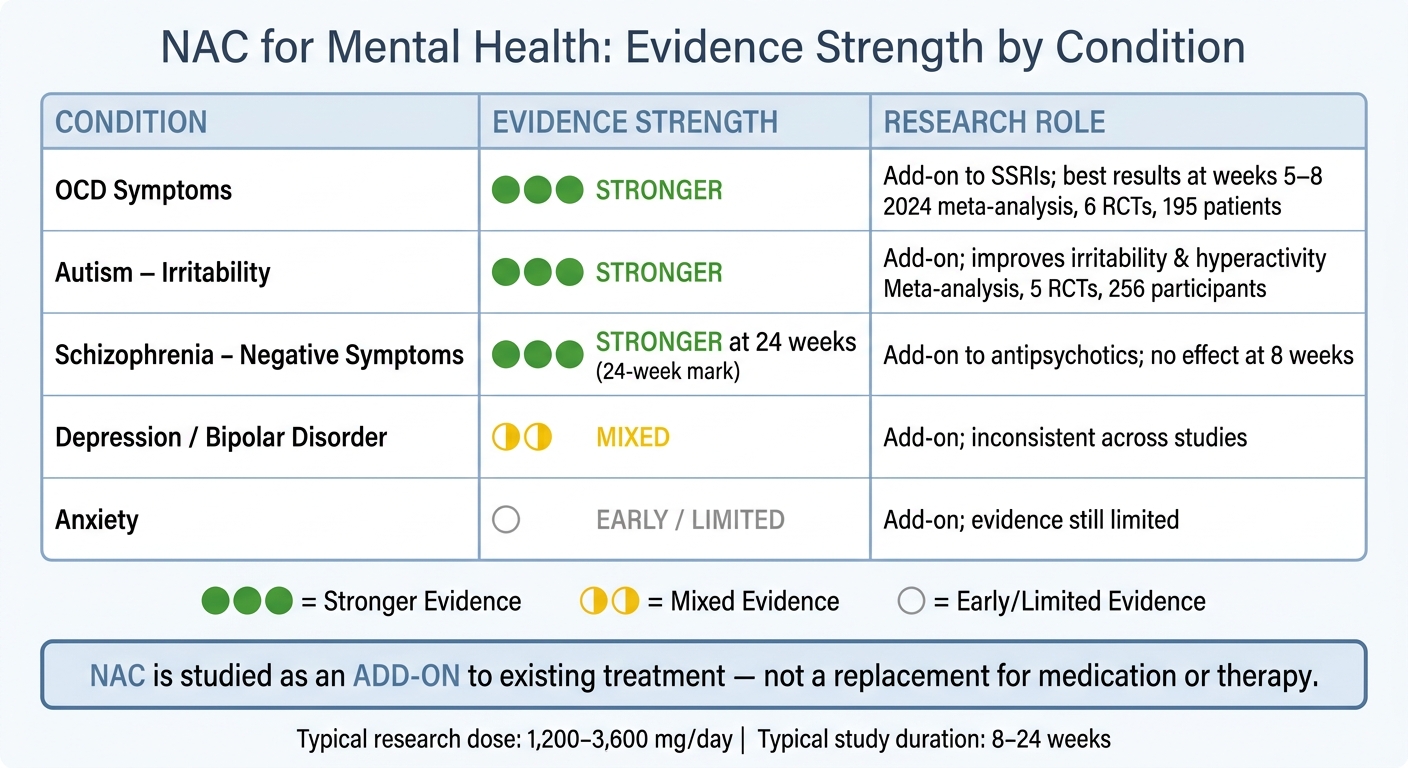
NAC for Mental Health: Evidence Strength by Condition
NAC is most often studied as an add-on to standard care, not as a substitute for medication or therapy. In plain English: researchers usually test it alongside treatment, not on its own. The clearest effects tend to show up in compulsive symptoms and cravings.
Stronger Evidence: OCD-Related Symptoms, Repetitive Behaviors, and Cravings
The clearest signal shows up in OCD-related symptoms. In a 12-week trial of adults with moderate-to-severe OCD, sertraline plus 2,400 mg/day NAC led to greater symptom improvement, with the biggest gains in obsessive thoughts.
That pattern also showed up in a September 2024 meta-analysis in Frontiers in Psychiatry. Researchers pooled six randomized controlled trials with 195 patients and found that NAC add-on treatment significantly reduced OCD symptoms, with the strongest effects during weeks five to eight.
Body-focused repetitive behaviors and substance cravings also show promise, though the data is still earlier there than it is for OCD.
Results are less consistent for mood and anxiety symptoms.
Mixed or Early Evidence: Depression, Anxiety, and Irritability
For depression, bipolar disorder, and anxiety, the picture is more uneven. Some trials report meaningful mood gains. Others found no difference from placebo.
Schizophrenia research lands somewhere in the middle. NAC showed no significant effect at 8 weeks, but by 24 weeks it outperformed placebo for total symptoms and negative symptoms.
Irritability is one area with more steady support, especially in autism research. A meta-analysis of five randomized controlled trials with 256 participants found that NAC significantly improved irritability and hyperactivity scores on the Aberrant Behavior Checklist. That lines up with NAC’s role in glutamate regulation and antioxidant support.
For general anxiety, the evidence is still early. Right now, the best-supported uses are OCD-related symptoms, autism-related irritability, schizophrenia negative symptoms, and related compulsive disorders.
| Condition | Evidence Strength | Typical Research Role |
|---|---|---|
| OCD Symptoms | Stronger | Add-on to SSRIs; best results at 5–8 weeks |
| Autism (Irritability) | Stronger | Add-on; may improve irritability and hyperactivity |
| Schizophrenia (Negative Symptoms) | Stronger (at 24 weeks) | Add-on to antipsychotics |
| Depression / Bipolar Disorder | Mixed | Add-on; inconsistent across studies |
| Anxiety | Early | Add-on; evidence is still limited |
Who Might Benefit Most From Discussing NAC With a Clinician
People dealing with compulsive symptoms, repetitive behaviors, or substance cravings may be the most sensible candidates to bring up NAC with a clinician. That’s where the research looks most promising.
One point matters a lot here: studies test NAC as an add-on. It’s used next to what’s already helping, not in place of it. If brain fog is the main issue, NAC does not yet have much support as a cognitive aid. Next, the dose, form, and safety profile matter most.
sbb-itb-23f89d4
Dosing, Forms, and Safety
For compulsions, cravings, mood symptoms, and irritability, the big day-to-day questions are pretty simple: how much to take, what form to use, and how safe it is.
There isn’t one standard NAC dose for mental health. The amount used depends on the condition and the symptom being targeted.
Common Forms and Research Dosing Ranges
For OCD-related symptoms, cravings, irritability, and mood concerns, psychiatric research usually uses oral NAC capsules or tablets. Most studies split the daily amount into two or three smaller doses across the day. That can help keep levels steadier and may ease stomach upset.
Mental health studies tend to use higher amounts than the dose used for thinning mucus. In research, the usual range is 1,200 mg to 3,600 mg per day. Most trials last 8 to 12 weeks, while schizophrenia studies may continue for 24 weeks.
*The doses below reflect what researchers used in clinical trials — they are not prescriptions. Always discuss dosing with a qualified clinician before starting.
| Condition | Research Dosing Range (Daily) | Typical Study Duration |
|---|---|---|
| OCD / Repetitive Behaviors | 2,400 mg – 3,000 mg/day | 12 – 13 weeks |
| Depression / Bipolar Disorder | 1,000 mg – 3,000 mg/day | 12 – 24 weeks |
| Schizophrenia (Negative Symptoms) | 1,000 mg – 3,600 mg/day | 24 weeks |
| General Anxiety / Irritability | 1,200 mg – 2,400 mg/day | 8 – 12 weeks |
Dose matters. But in practice, side effects and drug interactions are what decide whether NAC makes sense in an actual treatment plan.
Side Effects, Drug Interactions, and Higher-Risk Situations
Large systematic reviews generally find that NAC is well tolerated.
That said, the most common problems are stomach-related: nausea, diarrhea, bloating, cramps, and heartburn. If someone is taking nitroglycerin or other nitrates, NAC shouldn’t be added without clinician oversight because the combo can drop blood pressure too much. People using anticoagulants or certain chemotherapy agents should also check with a clinician before starting NAC.
| Category | Specific Concerns |
|---|---|
| Common Side Effects | Nausea, vomiting, diarrhea, bloating, cramps, heartburn, headache, dry mouth, fatigue, restlessness, dizziness, sulfur-like taste or odor, and sometimes rash, runny nose, or nasal congestion |
| Medication Cautions | Nitroglycerin/nitrates (hypotension risk), blood pressure medications, anticoagulants, and certain chemotherapy agents |
| Health Cautions | History of asthma, pregnancy, breastfeeding, kidney disease, and liver disease |
NAC is widely available in the U.S. as a dietary supplement, though its regulatory status has been subject to FDA review. Choosing a third-party tested product from a reputable brand is especially important in this context.
How to Decide Whether NAC Is Worth Discussing With a Clinician
If NAC still seems like a fit after looking at the research and safety points, the next step is simple: decide whether it makes sense to bring up with a clinician.
Key Questions to Review Before Starting NAC
Before that conversation, get clear on three things: what symptom you want to change, whether your meds create any risk, and how you’ll tell if NAC is helping.
NAC tends to make more sense when compulsions or cravings are the main issue. It’s also smart to check for nitrate medications, since NAC can make low blood pressure worse. And timing matters. Most studies run for 8 to 24 weeks, so judging it after a few days or even a couple of weeks doesn’t match how it’s usually studied.
You’ll also want one clear way to track progress. That could mean fewer compulsive behaviors, lower symptom scores, or less time spent on urges each day. Without a simple marker, it’s hard to know whether anything is changing or whether you’re just guessing.
If the symptom match looks right and the medication check is clear, the next piece is figuring out whether something else may be driving the symptoms.
When a Broader Integrative Assessment Makes More Sense
NAC usually makes more sense as one part of a larger plan, not the whole plan.
If symptoms are severe, getting worse fast, or linked with sleep issues, trauma, hormone changes, or nutrition problems, one supplement probably won’t move the needle much on its own. That’s where a broader assessment can help. NAC may sit alongside a deeper review of sleep, nutrition, therapy, inflammation, and current medications, but it doesn’t take the place of that review.
An integrative psychiatry visit can pull those pieces together and look at how they interact, instead of treating each one in isolation.
Key Takeaways on NAC and Brain Health
Once you’ve looked at symptom fit, safety, and your treatment goals, the decision gets easier. NAC is best seen as an add-on for compulsions and cravings, while the evidence is mixed for mood, irritability, and anxiety. Dose can vary by condition, so a safety review matters, especially if nitrate vasodilators are in the picture.
“Adjunctive NAC may enhance early clinical response in OCD, particularly for obsessions, when added to high-dose SSRI treatment.” – Mohammadreza Shalbafan, Associate Professor of Psychiatry, Iran University of Medical Sciences
The next move isn’t buying a bottle because of a headline. It’s talking with a qualified clinician who can review your symptoms, medications, health history, and goals, then help you decide whether NAC makes sense, what dose to consider, and how long to try it.
FAQs
Can NAC help with intrusive thoughts?
Research suggests NAC may help with intrusive thoughts, especially those tied to OCD. Studies also show it may work well as an add-on to standard medications like SSRIs.
Some newer findings suggest NAC may bring relief sooner and cut down obsessions more than a placebo. The main idea behind this effect is its role in helping regulate glutamate in the brain.
How long should I try NAC before judging results?
N-acetyl cysteine (NAC) is not fast-acting, so don’t expect instant results. Some studies have found benefits within 12 weeks, but in many cases, effects take weeks or even months to show up.
Because any change may be gradual, it helps to talk through realistic expectations with your clinician. Then use NAC consistently as one part of a broader treatment plan while you monitor how much it’s helping.
Can I take NAC with antidepressants or SSRIs?
Several clinical trials have tested NAC specifically as an add-on to SSRIs — particularly sertraline — for OCD symptoms, and the combination showed greater improvement than SSRIs alone. So the research precedent exists.
That said, “can I” and “should I” are different questions. NAC affects glutamate signaling and has mild effects on blood pressure, which means the interaction profile varies depending on what medication you’re taking, at what dose, and what your overall health picture looks like. There’s no blanket answer that applies to everyone.
The practical step is bringing it up with your prescriber before adding anything. A clinician who knows your full medication list can flag any concerns and help you decide whether NAC makes sense as part of your current plan.
How is NAC different from therapy for OCD?
They work through completely different mechanisms — and that’s exactly why research tests them together rather than against each other.
Therapy for OCD, particularly Exposure and Response Prevention (ERP), works by changing behavioral patterns and retraining how the brain responds to triggers over time. NAC works at a neurochemical level, primarily by modulating glutamate signaling, which may reduce the intensity of compulsive urges.
One doesn’t replace the other. The studies showing the strongest results for NAC use it alongside existing treatment — not instead of it. If OCD symptoms are significantly affecting your daily life, therapy remains the most evidence-backed first-line approach. NAC may support that process, but it’s not a substitute for it.
Does NAC help with brain fog?
This comes up often, and it’s worth being direct: the evidence for NAC as a cognitive aid is still limited.
NAC’s antioxidant and anti-inflammatory effects are theoretically relevant to brain fog — chronic neuroinflammation does appear to affect mental clarity and processing speed. But theoretical plausibility isn’t the same as clinical evidence, and most NAC trials haven’t used cognitive performance as a primary outcome.
If brain fog is the main concern, it’s worth looking at what’s driving it before reaching for a supplement. Poor sleep, nutritional gaps, unmanaged stress, or underlying mood disorders are far more common culprits — and more directly treatable. A thorough integrative assessment can help identify which of those factors are actually in play.
Who should not take NAC without medical advice?
Anyone thinking about using N-acetyl cysteine (NAC) for mental health should talk with a qualified clinician first.
That step matters for a few reasons. A clinician can help determine whether NAC makes sense for your situation, check for possible medication interactions, and look at personal health factors that could affect its use. That’s especially important because research on NAC for psychiatric conditions is still developing.
You Don’t Have to Navigate This Alone
If you’re considering NAC or any supplement as part of your mental health plan, the most important step is working with someone who can see the whole picture — your symptoms, your current medications, your nutrition, and your history. At Modyfi, our network of providers brings psychiatry, therapy, nutrition, and exercise together in one place, so no piece of your care is treated in isolation.
👉 Explore Providers to Book an Appointment and Start My Care Plan
(Note: Modyfi proudly accepts most major commercial insurance plans in MD, DC, VA, and WV; currently, we do not accept Medicare or Medicaid.)