


Vagus nerve stimulation gets talked about in two very different conversations. One is clinical — a surgical device used for drug-resistant epilepsy and treatment-resistant depression after other options have failed. The other is wellness — breathing exercises, cold exposure, and humming promoted as ways to “hack” the vagus nerve for better mood and less stress.
Both conversations are real. But they’re not talking about the same thing.
This post focuses on the clinical evidence: what VNS is, what the FDA has approved it for, what realistic outcomes look like, and where the research is still early. The short version — VNS can help some people significantly, but it works slowly, it’s not a first-line treatment, and the type of VNS matters enormously because the evidence varies widely across conditions.
The table below summarizes the key differences between implanted and non-surgical VNS — a useful reference before going deeper into each:
| Type | How it works | Main FDA-cleared or approved uses | What to know |
|---|---|---|---|
| Implanted VNS | Small device placed in the chest with a lead to the left vagus nerve in the neck | Epilepsy, treatment-resistant depression | Stronger evidence, steady dosing, surgery required |
| Non-surgical VNS | Handheld or wearable device used on the ear or neck | Migraine, cluster headache | No surgery, session-based use, less data for mental health |
Not all VNS is the same. The type of device, the delivery method, and the evidence behind each vary significantly.
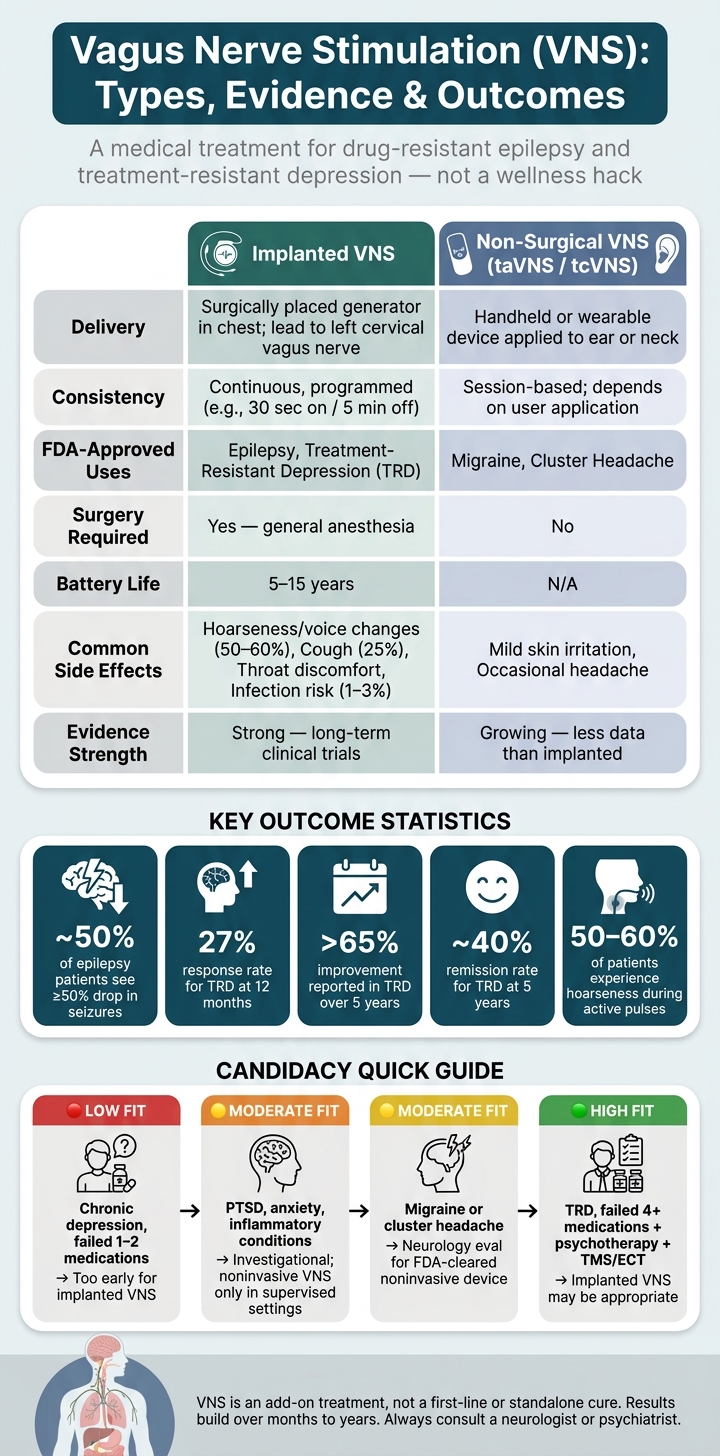
Implanted vs. Non-Surgical VNS: Evidence, Uses & Side Effects Compared
The vagus nerve, autonomic regulation, and how VNS works
What the vagus nerve does in stress, mood, and body regulation
The vagus nerve, also called cranial nerve X, is the main parasympathetic route linking the brainstem to the heart, lungs, and gut. It plays a central role in the body’s “rest and digest” response and helps balance the sympathetic system, better known as “fight or flight.”
When that balance is working well, the body can settle down after stress. Digestion runs more smoothly, and mood tends to stay on a more even track. But when stress sticks around and the sympathetic system stays switched on, anxiety and depression can get worse.
About 80% to 90% of vagal fibers send signals from the body up to the brain, which helps explain why VNS can affect mood and stress regulation. That body-to-brain signaling is the route clinicians aim for when they use VNS in treatment.
Stimulation also reaches relay centers in the brainstem that affect norepinephrine and serotonin systems. That’s a big part of why VNS can influence mood, arousal, and seizure control.
Implanted VNS vs. noninvasive VNS: delivery, dosing, and evidence compared
Both methods go after the same nerve. Where they differ is how they reach it, how steady the stimulation is, and which conditions they are cleared to treat. In plain English: the main gap isn’t the target. It’s the consistency and dose of stimulation.
Implanted VNS uses a small pulse generator, similar to a cardiac pacemaker, placed under the skin in the chest during surgery. A lead wire wraps around the left cervical vagus nerve in the neck. Clinicians usually avoid the right vagus nerve because it has stronger direct links to the heart, which can increase cardiac risk. The device sends continuous programmed pulses – often 30 seconds of stimulation every 5 minutes – day and night, with no work needed from the patient.
Noninvasive VNS avoids surgery. The two main forms are transcutaneous auricular VNS (taVNS), which places electrodes on the outer ear where a branch of the vagus nerve sits close to the skin, and transcutaneous cervical VNS (tcVNS), which sends stimulation through the skin of the neck. These devices are handheld or wearable and are used in set sessions instead of around the clock.
| Feature | Implanted VNS | Noninvasive VNS (taVNS/tcVNS) |
|---|---|---|
| Delivery | Surgically placed generator in chest; lead to left cervical vagus nerve | Handheld or wearable device applied to ear or neck |
| Consistency | Continuous, programmed (e.g., 30 sec every 5 min) | Session-based; depends on user application |
| FDA-Approved Uses | Epilepsy and treatment-resistant depression | Migraine and cluster headache (e.g., gammaCore) |
| Common Side Effects | Hoarseness, voice changes, cough during stimulation; surgical risks | Mild skin irritation, occasional headache |
An implanted pulse generator battery usually lasts 5 to 15 years. After that, it needs to be replaced. Noninvasive devices don’t come with surgical risk, which is a clear plus. The trade-off is that stimulation is less steady, and the research base – though growing – still isn’t as deep as it is for implanted VNS in the conditions where implanted devices have FDA approval.
Why breathing, cold exposure, and relaxation exercises are not medical VNS
Breathing drills, cold exposure, humming, and relaxation exercises can shift autonomic state. But they are not medical VNS.
The reason is pretty simple: those methods create short-lived and variable effects, while medical VNS uses calibrated electrical stimulation in repeatable doses. The clinical research for epilepsy and treatment-resistant depression was built on device-based stimulation, not lifestyle habits. So if a medical condition is on the table, swapping in those practices for VNS isn’t backed by the research.
For a clear visual explanation of how both implanted and non-invasive VNS work — including the mechanisms behind each delivery method — the video below offers a useful overview:
sbb-itb-23f89d4
Vagus Nerve Stimulation Explained! (VNS/tVNS) | Neuroscience Methods 101
Where VNS has the strongest evidence: epilepsy and treatment-resistant depression
Implanted VNS has the best support as an add-on treatment for drug-resistant epilepsy and treatment-resistant depression. The case is stronger for epilepsy. For depression, the data is less uniform, but it still points to a meaningful effect for some people. In both settings, VNS is used with medications and other care, not instead of them, and usually only after other options have not worked. Another key point: results take time. Benefits often build over months, and the full effect may take up to 24 months.
FDA-approved uses and realistic treatment outcomes
The FDA has approved implanted VNS for drug-resistant epilepsy and treatment-resistant depression (TRD). In day-to-day care, doctors usually turn to it only after other treatments have failed. For epilepsy, that usually means failure of two appropriate antiseizure medications. For depression, it often means several antidepressant trials, plus other treatments such as TMS or ECT.
That matters because VNS is not a first-step treatment. It’s more of a next move when the usual path hasn’t done enough.
What studies show about benefit, timeline, and durability
The research base for epilepsy is deeper and has followed patients for longer than the research on depression. For drug-resistant epilepsy, about 50% of patients get a 50% or greater drop in seizure frequency. Some seizure relief shows up within the first 3 months, and 2-year results are often better than 6-month results.
For TRD, the picture is more complex. A 2005 comparison study reported about a 27% response rate at 12 months versus 13% for treatment as usual. However, a more recent randomized controlled trial — the RECOVER trial (2024), with 493 patients — found that the primary outcome did not significantly distinguish active VNS from sham stimulation at 12 months. Longer-term open-label data from the same trial shows that approximately 40–50% of patients achieved meaningful improvement at 12–24 months, with about 80% of those maintaining benefits at 24 months. These are promising numbers — but the controlled evidence is less clear-cut than for epilepsy, and the timeline is significantly longer.
So the pattern is fairly clear: epilepsy tends to improve sooner, while depression may take longer but can last for years in some patients.
Benefits, limitations, and side effects of implanted VNS
Implanted VNS has upsides, but it also comes with trade-offs. The most common stimulation effects are hoarseness, cough, throat discomfort, and brief shortness of breath. Hoarseness or voice changes affect 50% to 60% of patients during the device’s active pulse cycles, and coughing happens in about 25%. These effects usually show up only during the 30-second “on” period and ease during the 5-minute “off” interval. Surgery also carries risk, though the rates are fairly low: infection at the implant site occurs in about 1% to 3% of cases.
Patients also get a handheld magnet. That magnet can trigger an extra burst of stimulation, which may help stop an oncoming seizure or help with acute depressive symptoms.
| Benefits | Limitations | Common Side Effects |
|---|---|---|
| Long-term durability; benefits often improve over years | Requires surgery under general anesthesia | Hoarseness and voice changes (50% to 60% of patients) |
| Automatic delivery; no daily pill adherence required | Very slow onset – months to years | Cough during active pulses (about 25% of patients) |
| Manual magnet override for seizures or acute mood symptoms | High upfront cost; private insurance coverage inconsistent | Throat discomfort and shortness of breath |
The next section covers the conditions still under study, where the evidence looks promising but is not settled.
What is still being studied: PTSD, anxiety, chronic stress, and related conditions
Because VNS affects autonomic signaling, researchers are also testing it in psychiatric conditions tied to stress. So far, the findings look encouraging. But they are not ready for routine clinical use.
PTSD, anxiety, and trauma-related symptoms: early research, not settled evidence
Trauma can leave the nervous system stuck in a state of hyperarousal. Because of that, researchers are studying whether VNS can help the body regulate more effectively. Early studies point to possible gains, including lower stress-linked inflammatory signaling and less negative emotional bias. Still, the data sets are small, and the results don’t line up cleanly across studies.
One small Phase 1 trial in treatment-resistant PTSD found that all 9 participants no longer met the criteria for a PTSD diagnosis after an implanted VNS device was paired with exposure therapy. That’s an encouraging signal. But with only nine people, it’s far too small to settle the issue.
More broadly, psychiatric VNS research has produced mixed outcomes. Response rates have ranged from 15% to 50%, and relapse within a year is still common. VNS also isn’t a standalone fix. It does not replace trauma-focused therapy or medication.
For now, VNS for PTSD or anxiety is still investigational.
Those early findings are hopeful, but they do not support routine use at this stage.
Other uses under study: migraines, inflammatory disorders, and more
Outside mental health, the strongest push is in headache, stroke recovery, and immune-related disease. Research is also testing VNS in headache, stroke recovery, rheumatoid arthritis, and other inflammatory conditions. FDA approvals now cover cluster headache, stroke rehabilitation, and moderate-to-severe rheumatoid arthritis. Optimal dosing still differs by condition.
Because the evidence varies so much from one condition to another, the next step is figuring out who should be evaluated for VNS in the first place.
Who VNS may be for, when to see a specialist, and how integrative care fits
Who may be a candidate for implanted or noninvasive VNS
The evidence points clearly to some candidates — and just as clearly away from others.
For implanted VNS, the clearest candidates are adults with drug-resistant epilepsy or TRD. In day-to-day care, implanted VNS is usually saved for adults with drug-resistant epilepsy or TRD after multiple medication trials, psychotherapy, and often TMS or ECT.
Noninvasive VNS is a different starting point. It comes up more often in migraine and headache care, and in research settings looking at PTSD, anxiety, and inflammatory conditions under physician oversight. People with pacemakers, implantable defibrillators, or serious arrhythmias are usually not candidates for electrical VNS.
What evaluation typically includes before VNS is considered
Getting evaluated for VNS, especially the implanted kind, usually takes time. A psychiatrist or neurologist will do a full assessment, review your treatment history, and use tools such as the PHQ-9 or GAD-7 to track symptom severity. The workup also includes safety screening for contraindications and other implanted devices.
For implanted VNS, you need a referral to a neurosurgeon or a specialized psychiatrist. Insurance is often the other big obstacle. Medicare has covered implanted VNS for treatment-resistant depression since 2019 — but only through Coverage with Evidence Development, meaning coverage is tied to participation in approved clinical trials. Private coverage is still uneven, and prior authorization usually requires proof of multiple treatment failures. Starting the paperwork early can save time and stress.
Before neuromodulation moves forward, the evaluation should also rule out treatable issues that can look like treatment resistance.
In practice, candidacy often falls into one of these paths:
| Scenario | Recommended Evaluation Step | VNS Referral Fit |
|---|---|---|
| Chronic depression, failed 1–2 medications | Functional lab testing for nutrients and hormones, plus therapy | Low – too early for implanted VNS |
| PTSD symptoms, anxiety, or inflammatory conditions | Integrative evaluation and specialist review; consider noninvasive VNS only in research or physician-supervised settings | Moderate – investigational, evidence still emerging |
| Migraine or cluster headache | Neurology evaluation for an FDA-cleared noninvasive device | Moderate – may fit noninvasive VNS |
| TRD, failed 4+ medications, psychotherapy, and TMS/ECT | Full surgical clearance and insurance prior authorization review | High – implanted VNS may be appropriate |
Conclusion: What VNS can do, what it cannot do, and your next step
VNS is an established medical treatment, with the strongest evidence in drug-resistant epilepsy and treatment-resistant depression (TRD). It works as an add-on to current care, not as a replacement.
For TRD, long-term studies show that implanted VNS can help some people, but the payoff tends to come slowly. For epilepsy, about half of treated patients see a 50% or greater drop in seizure frequency. That said, this is not a fast fix. That said, this is not a fast fix. The treatment comes with surgery, device management, and a slow timeline.
Outside epilepsy and TRD, the picture is less settled. For PTSD, anxiety, and chronic stress, the evidence is still early. There are hopeful signs, but VNS is not standard care for those conditions. Some noninvasive devices do have FDA clearance for migraine and cluster headache, but not for mental health conditions.
Stress-regulation practices may help on their own terms, but they are not stand-ins for device-based VNS. So the next move isn’t self-treatment. It’s getting a specialist’s opinion.
A full psychiatric or neurologic evaluation is the right starting point — not self-treatment.
How Modyfi Health can help assess root causes before moving to neuromodulation
Ready to Find Out If VNS Belongs in Your Care Plan?
Sometimes what looks like treatment resistance has a biological driver that hasn’t been fully evaluated — nutritional deficiencies, hormonal imbalances, inflammation markers, or low heart rate variability. At Modyfi, our Root-Cause Psychiatry approach brings psychiatry, therapy, nutrition, and exercise together to identify what’s actually driving symptoms before moving to more invasive options like VNS.
👉 Explore Providers to Book an Appointment and Start Your Care Plan
(Note: Modyfi proudly accepts most major commercial insurance plans. We do not accept Medicare or Medicaid.)
FAQs
How do I know if VNS is right for me?
It comes down to what you’re looking for: medical care for a diagnosed condition or general wellness support.
Clinical VNS is usually used for treatment-resistant depression or refractory epilepsy, and it requires a specialist’s evaluation. That’s a medical path, not a DIY one.
By contrast, noninvasive options like deep breathing, cold exposure, or meditation are generally safe for most people. They’re more in the wellness bucket.
If you’re thinking about trying an over-the-counter stimulation device, it’s smart to check with a healthcare provider first. The same goes if your symptoms interfere with daily life, or if you have heart or breathing concerns.
How long does VNS take to start working?
It depends on the type of VNS and the condition being treated.
Implanted VNS tends to work over time, not all at once. For treatment-resistant depression, effects tend to build slowly — often across 12 to 24 months. Some people notice gradual improvement within the first 6 months, but the strongest evidence for meaningful benefit comes from longer-term follow-up data.
By contrast, noninvasive methods like deep breathing can affect arousal, heart rate, or anxiety within minutes.
Can noninvasive VNS help anxiety or PTSD?
Research on noninvasive vagus nerve stimulation (VNS) for anxiety and PTSD is still in the early stages. The first results look promising, but it is not yet a standard treatment.
The idea is fairly simple: it may help calm the body’s stress response, reduce inflammatory responses linked to trauma, and possibly make psychotherapy more supportive. That said, the evidence is still limited, especially when compared with implanted VNS.
For now, it makes the most sense to look at noninvasive VNS with a medical professional and treat it as one part of a broader, evidence-based care plan.
Is vagus nerve stimulation safe?
For most candidates, implanted VNS has a well-established safety profile built on decades of clinical use. The most common effects are tied to the stimulation itself — hoarseness, cough, and throat discomfort during the device’s active pulse cycles. These typically ease during the off intervals and often become less noticeable over time as the device is fine-tuned.
Surgical risks exist but are relatively low. Infection at the implant site occurs in roughly 1% to 3% of cases. The device also requires battery replacement every 5 to 15 years, which involves another procedure.
Noninvasive VNS carries a significantly lower risk profile since there’s no surgery involved. The most commonly reported effects are mild skin irritation at the electrode site and occasional headache or dizziness during stimulation sessions.
Anyone with a pacemaker, implantable defibrillator, or serious arrhythmia should discuss those factors with a specialist before considering any form of electrical VNS, as cardiac effects are a known consideration — particularly with implanted devices targeting the left cervical vagus nerve.
What is the difference between VNS and TMS?
Both are neuromodulation treatments used for treatment-resistant depression, but they work through entirely different mechanisms and have very different practical profiles.
TMS — transcranial magnetic stimulation — uses magnetic pulses applied to the scalp to stimulate specific regions of the brain directly, typically the left prefrontal cortex. It requires no surgery, no implanted device, and no anesthesia. Treatment involves daily sessions over several weeks, usually 20 to 36 sessions total. Effects tend to appear within weeks.
VNS takes a different route — stimulating the vagus nerve rather than the brain directly, and relying on the nerve’s connections to mood-regulating brain regions. Implanted VNS is surgical and continuous, running around the clock rather than in discrete sessions. Its effects build slowly, often over months to years rather than weeks.
In practice, TMS is typically tried before VNS — it’s less invasive, faster-acting, and has a broader insurance coverage profile. VNS tends to come into consideration after TMS and multiple medication trials have not produced adequate response.
Can you feel vagus nerve stimulation?
With implanted VNS, most people do notice something during the active stimulation cycles — typically a sensation in the throat, mild hoarseness, or a slight pulling feeling in the neck. The standard setting is 30 seconds of stimulation every 5 minutes, so the sensation comes and goes in a predictable rhythm. Most people adapt to it over time and report it as manageable rather than uncomfortable.
The handheld magnet that patients receive can trigger an extra burst of stimulation on demand. That burst may feel more noticeable than the background cycling, but it’s brief.
With noninvasive VNS — whether auricular or cervical — the sensation depends on the device and placement. Auricular devices placed on the outer ear often produce a mild tingling. Cervical devices applied to the neck can cause a slight muscle twitch or pressure sensation during the session. Neither is typically described as painful, though individual sensitivity varies.