


Metabolic psychiatry is an emerging field that asks a different question about depression and anxiety: what if the root cause isn’t just brain chemistry, but how the body produces and uses energy?
For a significant subset of people, mood disorders may be rooted in metabolic dysfunction — insulin resistance, blood sugar instability, and neuroinflammation. This layer has been historically overlooked by standard psychiatric care. For people who’ve tried antidepressants or therapy without sustained relief, it may be part of what’s missing.
For a clinical overview of how metabolic dysfunction connects to psychiatric symptoms — from one of the leading researchers in this emerging field — the video below offers an accessible introduction before diving into the evidence:
What Is Metabolic Psychiatry?
Metabolic psychiatry is the study and treatment of psychiatric conditions through the lens of metabolic health. It asks a different set of questions than conventional psychiatry: not just what symptoms a person has, but what biological conditions might be driving them.
The field sits at the intersection of psychiatry, endocrinology, and nutritional medicine. The brain is metabolically active tissue — one of the most energy-demanding organs in the body. When energy metabolism breaks down, symptoms can look indistinguishable from major depression, anxiety, ADHD, and bipolar disorder.
A 2026 review in Nature Mental Health described metabolic psychiatry as targeting the dysregulation that underlies many mental health conditions. Psychiatric symptoms, in this framing, are downstream effects — not the root problem.
The Insulin Resistance and Depression Connection
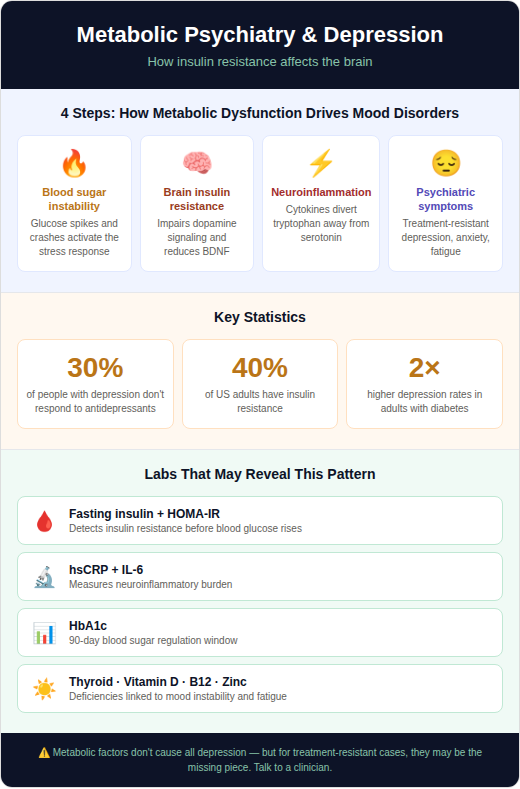
Insulin resistance — when cells stop responding normally to insulin, forcing the pancreas to produce more — affects an estimated 40% of American adults. Most people think of it as a diabetes risk factor. Few know it may also affect mood.
The connection isn’t coincidental. Insulin receptors are found throughout the brain, including in the hippocampus and prefrontal cortex — regions critical for mood regulation, memory, and executive function. When those receptors stop responding efficiently, the downstream effects can include impaired dopamine signaling, increased neuroinflammation, and disrupted cortisol regulation.
A large meta-analysis published in Neuroscience & Biobehavioral Reviews found that both insulin levels and the HOMA-IR index — a standard measure of insulin resistance — were significantly elevated during acute depression, but returned to normal during remission. This suggests insulin resistance isn’t just a comorbidity; it may be actively involved in depressive episodes themselves.
A 2025 UK Biobank analysis linked insulin-resistance-related conditions to antidepressant non-response and longer treatment duration, particularly when depression came first.
In plain terms: unresolved insulin resistance may be one reason some people don’t get better on antidepressants alone.
The diagram below summarizes how metabolic dysfunction may drive psychiatric symptoms — and which labs can help identify it:
Blood Sugar, Energy, and Mood Instability
Even without a formal diagnosis of insulin resistance, blood sugar patterns can affect mental health in ways that are easy to misattribute.
The brain runs almost entirely on glucose. When blood sugar swings — spiking after a high-carbohydrate meal and crashing an hour later — the brain experiences that as an energy shortage. The result can be irritability, difficulty concentrating, anxious restlessness, and low mood. For people already prone to anxiety or depression, these fluctuations can amplify symptoms significantly.
Chronic blood sugar instability also activates the HPA axis — the stress response system — raising cortisol and keeping the nervous system in a low-grade threat state. Over time, elevated cortisol suppresses hippocampal neurogenesis, impairs memory consolidation, and worsens the very mood dysregulation it was initially a response to.
This cycle — metabolic disruption → stress activation → mood symptoms → lifestyle changes that worsen metabolic health — is central to what metabolic psychiatry is trying to break.
Neuroinflammation: The Missing Link
One of the clearest mechanisms connecting metabolic dysfunction to psychiatric symptoms is inflammation. Insulin resistance promotes chronic low-grade inflammation — elevated circulating cytokines like IL-6, TNF-α, and CRP — that crosses the blood-brain barrier and disrupts neurotransmitter production.
Specifically, inflammatory cytokines divert tryptophan away from serotonin synthesis and toward the kynurenine pathway, producing compounds that can be neurotoxic at high concentrations. This is one reason researchers have found that people with treatment-resistant depression often have elevated inflammatory markers — and why anti-inflammatory interventions are an active area of psychiatric research.
A 2026 review in Frontiers in Psychiatry emphasized the significant physiological interplay between major depressive disorder and metabolic conditions, highlighting that up to 30% of individuals with MDD are resistant to current antidepressant treatments — and that metabolic dysfunction may be a key driver in that treatment-resistant group.
What Labs Can Reveal — and What They Can’t
One of the practical implications of metabolic psychiatry is that standard psychiatric assessments often don’t include the metabolic data that might explain a patient’s symptoms.
Labs that may be relevant include:
- Fasting insulin and HOMA-IR — to assess insulin resistance before it shows up as elevated blood glucose
- HbA1c — longer-term blood sugar regulation
- Inflammatory markers (hsCRP, IL-6) — to assess baseline neuroinflammatory burden
- Thyroid panel (TSH, Free T3, Free T4) — thyroid dysfunction can mimic depression closely
- Vitamin D, B12, folate, iron, zinc — nutrient deficiencies that affect neurotransmitter production
For clinicians, this argues for treating unexplained new-onset depression — particularly with atypical features like hypersomnia and increased appetite — as a reason to check fasting insulin or HOMA-IR, not just a glucose level.
This doesn’t mean every person with depression needs an extensive metabolic workup. But for people who haven’t responded to standard treatment, or whose depression comes with significant fatigue, weight changes, and cognitive symptoms, these labs may reveal a driver that would otherwise go untreated.
The diagram below illustrates how metabolic dysfunction can drive psychiatric symptoms — from blood sugar instability through to treatment resistance:
What Metabolic Psychiatry Is Not
It’s worth being precise about what this field claims — and what it doesn’t.
Current evidence does not show that blood sugar or insulin resistance secretly causes most depression. The relationship is bidirectional and complex. Depression changes eating patterns, sleep, and activity levels — all of which affect metabolic health. Metabolic dysfunction can worsen depression. These arrows run in both directions simultaneously.
Metabolic psychiatry doesn’t claim to replace therapy or medication. It argues that for some people — particularly those who are treatment-resistant or who have significant metabolic risk factors — addressing the metabolic layer alongside standard psychiatric care may produce better outcomes than either approach alone.
A 2024 Stanford pilot study put 23 adults with bipolar disorder or schizophrenia — all with existing metabolic problems — on a ketogenic diet for four months. Insulin resistance dropped about 27%, and psychiatric symptoms improved meaningfully. It’s a striking result in a hard-to-treat group — and also a single-arm pilot of 23 motivated people with no control group. It’s promising. It hasn’t been proven.
That kind of intellectual honesty is built into the best metabolic psychiatry practice.
How This Fits Into Integrative Care
Standard psychiatric care — therapy, medication, lifestyle recommendations — addresses many of the right factors. What metabolic psychiatry adds is a systematic look at the biological conditions that may be sustaining symptoms even when those interventions are in place.
An integrative approach combines both: psychiatric evaluation and medication management when appropriate, therapy to address the psychological and behavioral patterns that intersect with mood, nutrition to support stable blood sugar and reduce inflammatory burden, and physical activity to directly improve insulin sensitivity and brain-derived neurotrophic factor (BDNF) levels.
None of these operates well in isolation. Treating depression without addressing insulin resistance — when it’s present and relevant — is like treating a leak without fixing the pipe.
Symptoms Are Signals. Let’s Find the Source.
If you’ve tried standard treatment for depression or anxiety without the results you were hoping for, the missing piece might not be the wrong therapy or the wrong medication. It might be a metabolic factor that hasn’t been evaluated yet. At Modyfi, our Root-Cause Psychiatry approach brings psychiatry, therapy, nutrition, and exercise together — with functional lab testing when the picture calls for it — to find what’s actually driving your symptoms.
👉 Explore Providers to Book an Appointment and Start Your Care Plan
(Note: Modyfi proudly accepts most major commercial insurance plans. We do not accept Medicare or Medicaid.)
FAQ
Is metabolic psychiatry evidence-based?
Yes — with important caveats. The evidence base is real but still developing. The connections between insulin resistance, neuroinflammation, and depression are well documented in observational and mechanistic research. Intervention trials — particularly on ketogenic diets and insulin-sensitizing medications for psychiatric outcomes — are promising but preliminary. The most rigorous current evidence supports metabolic evaluation as part of precision psychiatry for treatment-resistant cases, not as a universal replacement for standard care.
Can treating insulin resistance improve depression?
Possibly — particularly in people with atypical depression features and documented metabolic dysfunction. A 2022 randomized controlled trial (TRIO-BD) found that treating insulin resistance with metformin improved both metabolic markers and psychiatric symptoms in people with treatment-resistant bipolar depression. The evidence is strongest for treatment-resistant populations with measurable metabolic abnormalities. For people without metabolic dysfunction, the direct antidepressant effect of metabolic interventions is less clear.
What is a metabolic subtype of depression?
Researchers have proposed that depression isn’t one condition but several — and that a metabolic subtype exists, characterized by atypical features like increased sleep, increased appetite, weight gain, and fatigue alongside low mood. This subtype appears to be more closely associated with insulin resistance than typical depression. Identifying it matters because people with this presentation may respond differently to antidepressants and may benefit more from metabolic interventions alongside standard psychiatric care.
Do I need to follow a ketogenic diet to benefit from metabolic psychiatry?
No. A ketogenic diet is one intervention that’s being studied — not a requirement. The broader metabolic psychiatry approach focuses on reducing blood sugar instability, addressing insulin resistance through diet and exercise, reducing inflammatory burden, and correcting nutrient deficiencies. These goals can be achieved through multiple dietary patterns, not only ketogenic. A clinician can help determine what level of intervention makes sense given your specific metabolic profile.
How does exercise fit into metabolic psychiatry?
Exercise directly improves insulin sensitivity and reduces inflammatory markers — making it one of the most directly relevant lifestyle interventions for metabolic psychiatry. Aerobic exercise in particular has been shown to increase hippocampal BDNF levels, improve glucose metabolism, and reduce cortisol reactivity. In the context of metabolic psychiatry, exercise isn’t just a wellness recommendation — it’s a mechanism for directly improving the biological conditions that affect mood.
What should I ask my doctor about metabolic psychiatry?
A few useful starting questions: Have my blood sugar and insulin levels been checked recently? Are my thyroid levels current? Do I have any inflammatory markers that might be affecting my mood? Is treatment-resistant depression in my case potentially related to metabolic factors? These questions help open a conversation about whether metabolic evaluation might be a useful part of your care.