


Loneliness is not the same as being alone. It’s the gap between the connection you want and the connection you actually feel — and that gap, when it persists, does something measurable to the body and mind.
In 2023, the U.S. Surgeon General declared loneliness a public health epidemic, citing research that linked chronic social disconnection to depression, anxiety, disrupted sleep, cognitive decline, and a stress response that stays activated long after it should have settled. The health effects are comparable in magnitude to smoking 15 cigarettes a day.
What makes loneliness particularly difficult to address is how easily it hides. It doesn’t always look like isolation. It can show up as low-grade irritability, emotional numbness, difficulty concentrating, or a quiet withdrawal from things that used to feel meaningful — while everything on the surface still appears fine.
This post covers what the science shows about how loneliness affects mental and physical health, who carries the most risk, and what actually helps.
The infographic below summarizes the key signs, health risks, and evidence-based solutions covered in this post — a useful reference before diving into the detail:
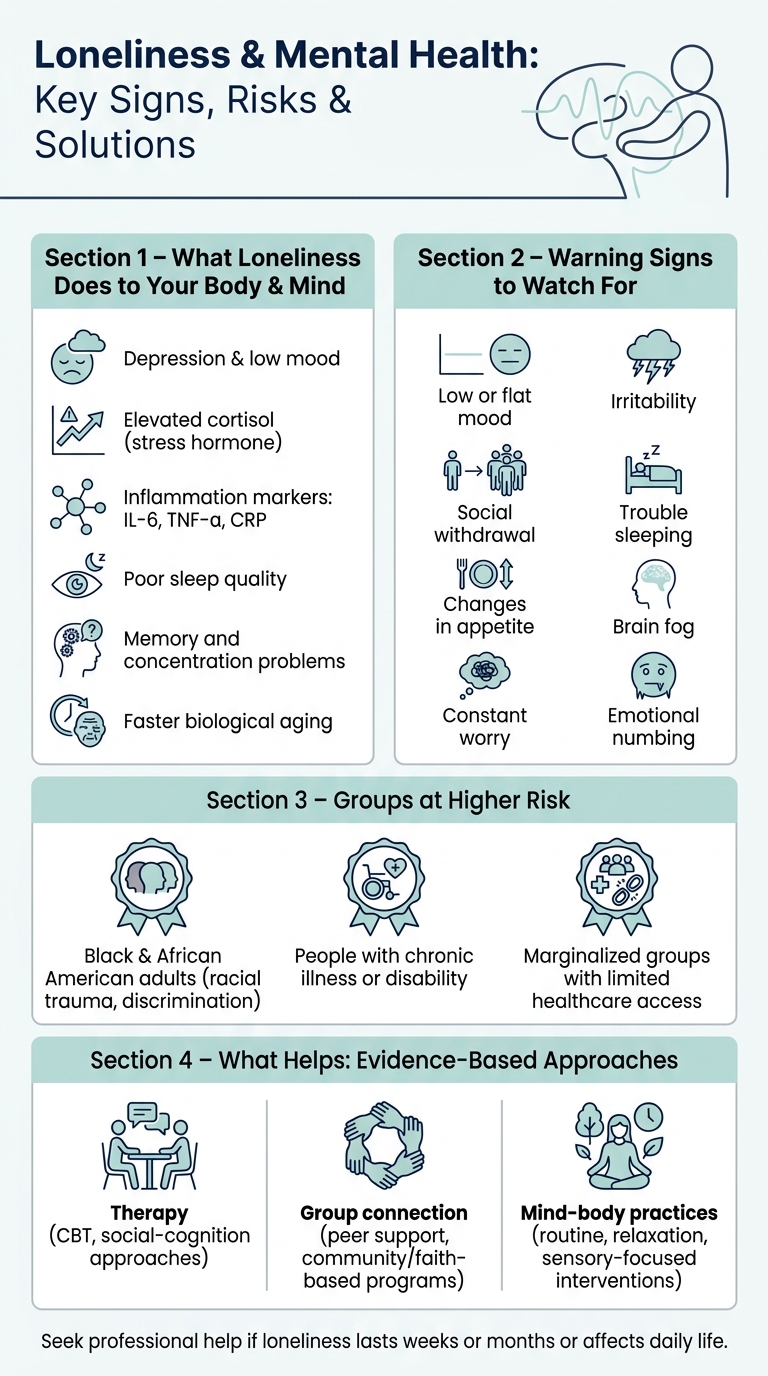
What the Science Shows About Loneliness and Health
Loneliness, Depression, and Mood Symptoms
Loneliness activates the same neural and hormonal pathways as physical pain — the brain processes social rejection in regions that overlap with physical threat detection. That distress doesn’t just affect how you feel in the moment. It can linger, keeping the brain and body stuck in a stress state that wears on mood over time.
When that stress sticks around, inflammation can shift brain chemistry in ways linked to depression. Loneliness is also tied to anxiety and broader psychological distress.
Stress Biology, Inflammation, and Physical Health Risk
Part of the reason comes down to the body’s stress response. Chronic loneliness can activate the HPA axis, increase cortisol, and drive low-grade inflammation, including IL-6, TNF-α, and CRP.
Over time, that added stress load may speed up biological aging.
Sleep, Cognition, and Memory
Those same stress shifts can also affect sleep, memory, and thinking. Higher cortisol can interfere with hippocampal function, which can make memories harder to form and keep.
That stress response can disrupt sleep too. And once sleep starts to slip, mood and thinking often get worse with it.
sbb-itb-23f89d4
How Loneliness Shows Up in Daily Life and Who Is Most at Risk
Common Signs Loneliness May Be Affecting Mental Health
These effects often show up first in mood, focus, sleep, and behavior. Loneliness isn’t always obvious. More often, it slips in through small changes that are easy to brush off or read as something else.
Mood shifts are one of the clearest signs. That can look like a low mood that sticks around, irritability, or emotional numbing. Loneliness and the stress tied to it can also make it harder to focus, remember things, or quiet repetitive worries.
Behavior can change too. Some people pull back from others or find it harder to trust people. Sleep and appetite may shift as well. On the surface, those changes can look like plain stress or burnout, which is part of why loneliness gets missed so often.
Groups at Higher Risk in U.S. Data
Some people run into more barriers to connection and support than others. Loneliness doesn’t hit everyone the same way. In U.S. data, a few groups carry more of that weight.
Black and African American adults face higher risk tied to racial trauma and discrimination. That can show up as hypervigilance, emotional numbing, and trouble trusting others.
Chronic illness, disability, and low energy can also make connection harder and increase the risk of loneliness. For marginalized groups, medical mistrust and limited access to culturally competent care can delay support.
Harvard psychiatrist Robert Waldinger — director of the longest-running study on human happiness — explains why the quality of our connections matters more than the quantity, and what the data shows about loneliness and long-term health:
What Helps: Evidence-Based Ways to Reduce Loneliness
Loneliness usually doesn’t lift from one small fix. In most cases, it takes a mix of approaches, and the best one depends on why someone feels cut off in the first place.
Therapy and Social-Cognition Approaches
CBT shows the strongest evidence among psychological interventions for loneliness — a 2025 meta-analysis of 25 studies found an effect size of g = 0.73, larger than mindfulness, social skills training, or community programs alone.
It works best when loneliness is maintained by rejection sensitivity, social fear, or avoidance patterns. The mechanism is direct: CBT targets the negative automatic thoughts and behavioral patterns — expecting rejection, misreading social cues, pulling back preemptively — that keep the cycle of isolation going even when connection is available.
A broader multicomponent program that combines CBT with exercise, relaxation, and problem-solving can improve both mental health and daily functioning. For people whose withdrawal is tied to trauma or mistrust, trauma-informed approaches that address the safety system first tend to be more effective than standard CBT alone.
Group Connection, Routines, and Mind-Body Practices
Because loneliness is fundamentally a connection problem, structured social contact is often part of getting better — but the type of contact matters. Unstructured social exposure doesn’t consistently reduce loneliness. What tends to work is contact that has purpose, consistency, and a shared focus.
Peer support groups, community programs, and structured group therapy all create conditions where connection can develop gradually, with lower stakes than unstructured social situations. For people whose withdrawal is tied to sensory overload or emotional dysregulation, sensory-focused or mindfulness-based approaches can help rebuild the capacity for social engagement before pushing into direct social contact.
Physical routines also matter. Consistent exercise supports mood, reduces inflammatory markers tied to loneliness, and provides a structured reason to be around other people — even without direct social interaction. Community-based or faith-based outreach can fill a similar function when geography or cultural factors make clinical support harder to access.
When to Seek Professional Support
Self-directed steps can help when loneliness is mild and situational. But when it becomes persistent — lasting weeks or months, or showing up alongside depression, anxiety, disrupted sleep, or social withdrawal that’s getting worse — professional support is the more appropriate next step.
A clinical evaluation can distinguish between loneliness that’s primarily situational and loneliness that’s connected to depression, anxiety, trauma, or attachment patterns that need direct treatment. It can also assess whether what feels like loneliness is partly driven by a mood disorder that’s making connection feel impossible regardless of circumstances.
Getting help earlier produces better outcomes. Loneliness that’s been building for months tends to be more entrenched — more intertwined with behavioral patterns, negative expectations, and biological stress responses — than loneliness that’s addressed early.
Conclusion: Loneliness Deserves Attention and Early Support
The evidence is clear: loneliness is a health issue with measurable biological consequences — not a personal failing or a phase that passes on its own.
When it persists, it activates stress pathways that affect mood, sleep, cognition, immune function, and long-term cardiovascular health. It can accelerate biological aging. And for people already navigating racial trauma, chronic illness, disability, or barriers to culturally competent care, the burden is disproportionately heavier.
The warning signs — persistent low mood, emotional numbing, withdrawal, disrupted sleep, brain fog, and constant worry — are worth taking seriously precisely because they’re easy to misread as ordinary stress or burnout. Loneliness that goes unaddressed tends to become more entrenched, not less.
What helps is real: CBT, structured social connection, consistent routines, and professional support when self-directed steps aren’t enough. The earlier those steps happen, the more options are available.
As Robert Waldinger, director of Harvard’s longest-running study on happiness, has put it — it’s not the number of connections that matters most. It’s the quality of those connections, and whether they make you feel seen.
Connection Is Possible. You Don’t Have to Figure It Out Alone.
If loneliness has been affecting your mood, sleep, or daily life — or if it’s starting to feel like something more than just a difficult season — that’s worth exploring with someone who can help you understand what’s driving it. At Modyfi, our Root-Cause Psychiatry approach brings psychiatry, therapy, nutrition, and exercise together to support the whole picture.
👉 Explore Providers to Book an Appointment and Start Your Care Plan
(Note: Modyfi proudly accepts most major commercial insurance plans. We do not accept Medicare or Medicaid.)
FAQs
How is loneliness different from being alone?
Loneliness is a personal, emotional state. It shows up as a painful feeling of disconnection from other people, even when someone isn’t physically by themselves.
Being alone, on the other hand, is neutral. It’s just solitude. And solitude doesn’t always hurt.
Someone can be alone and feel perfectly fine. But loneliness is different. It comes from feeling cut off from others. So it isn’t the same thing as simply having no one else in the room.
Can loneliness cause physical illness?
Yes — and the evidence for this is stronger than most people realize.
Chronic loneliness activates the HPA axis and sustains elevated cortisol, which over time promotes low-grade systemic inflammation. Inflammatory markers — including IL-6, TNF-α, and CRP — run higher in chronically lonely people, and those same markers are associated with cardiovascular disease, type 2 diabetes, and accelerated cognitive decline.
Research using AI-enabled cardiac testing found that social isolation was associated with accelerated biological aging independent of other cardiovascular risk factors. A 2023 Surgeon General advisory noted that the health effects of chronic loneliness are comparable in magnitude to smoking 15 cigarettes a day.
The immune system is also affected. Socially disconnected people show altered immune responses — including reduced natural killer cell activity and changes in gene expression related to inflammation — that increase vulnerability to infection and slow recovery.
These aren’t indirect effects. Social connection is a direct input into the body’s stress and immune regulation systems. Persistent disconnection keeps those systems in a state that wears on physical health over time.
When should I get help for loneliness?
Get help if loneliness starts to affect your mood, stress, sleep, or your ability to get through daily life. The same goes if feeling cut off from other people keeps hurting your mental or physical health over time.
Seek immediate professional help if you’re dealing with severe trouble functioning or thoughts of self-harm. If loneliness overlaps with depression or anxiety, or makes those problems worse, a healthcare provider can help you build an integrated, evidence-based care plan.
Is loneliness the same as depression?
They overlap significantly — but they’re not the same condition, and the distinction matters for how they’re addressed.
Loneliness is a subjective experience of disconnection: the gap between the social connection you want and what you actually feel. It can exist without clinical depression, and it can lift when circumstances change — when a meaningful relationship is formed, when a social environment improves, when isolation ends.
Depression is a clinical condition that affects mood, motivation, cognition, sleep, and physical health across all areas of life — not just in social contexts. It tends to persist regardless of circumstances, and often makes connection feel impossible even when it’s available.
The relationship between the two is bidirectional. Chronic loneliness increases the risk of developing depression — partly through the same inflammatory and stress pathways that affect brain chemistry over time. And depression can produce social withdrawal and emotional numbing that deepens loneliness, creating a cycle that’s hard to break without addressing both.
If low mood, loss of interest, fatigue, or hopelessness are present alongside loneliness — and they’ve persisted for two weeks or more — a clinical evaluation is the most useful next step. What looks like loneliness may have a depressive component that won’t resolve from social contact alone.
How do I stop feeling lonely when I’m surrounded by people?
This is one of the most common — and most misunderstood — forms of loneliness. The problem isn’t the number of people around you. It’s the quality and depth of those connections.
Loneliness in a crowd typically reflects a mismatch between the connections available and the ones that feel meaningful or safe. It can be driven by feeling unseen or misunderstood in existing relationships, by difficulty being vulnerable or authentic in social settings, by rejection sensitivity that makes closeness feel risky, or by a history of relational trauma that makes trust difficult to build.
A few things that tend to help: shifting from quantity to quality — investing more in one or two relationships rather than spreading attention across many. Identifying what makes connection feel unsafe and working directly with that, whether through therapy, gradual exposure, or both. And recognizing that the goal isn’t to feel comfortable in crowds — it’s to feel genuinely known by at least one or two people.
If this pattern has been consistent across relationships and settings, therapy is worth considering. A therapist can help identify the specific patterns — often rooted in attachment style or early relational experience — that make connection feel elusive even when other people are present.