


Magnesium is one of the most searched supplements for sleep and anxiety — and the science is more nuanced than most product pages suggest.
Research shows modest improvements in self-rated sleep quality, particularly in older adults and people with low magnesium intake or deficiency. The evidence for anxiety is weaker — most trials focus on mild stress, situational anxiety, or PMS-related symptoms rather than clinical anxiety disorders.
Magnesium is not a standalone treatment for chronic insomnia, generalized anxiety disorder, panic disorder, PTSD, or OCD. It works best as a modest add-on to a broader care plan — not a substitute for evidence-based treatment.
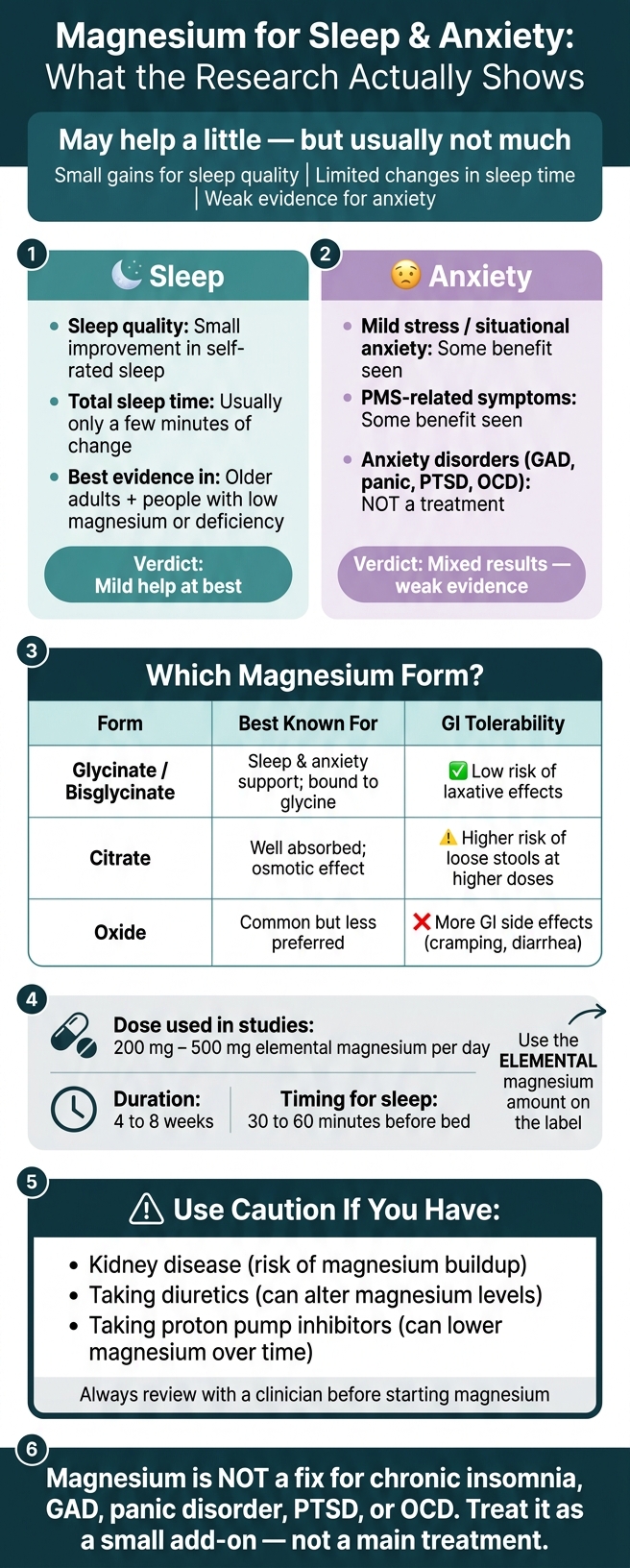
What the evidence actually shows at a glance:
- Sleep: small improvements in self-rated quality, mainly in older adults or people with low intake
- Anxiety: mixed results — most evidence limited to mild stress and situational symptoms
- Typical dose: 200–500 mg of elemental magnesium daily for 4–8 weeks
- Best-absorbed forms: glycinate (fewest GI side effects), citrate
- Who needs extra caution: people with kidney disease, those taking diuretics or proton pump inhibitors
The infographic below summarizes the key findings on magnesium for sleep and anxiety — including which forms work best, typical doses, and who should use extra caution:
sbb-itb-23f89d4
For a science-based breakdown of how different magnesium forms affect sleep and brain function — including the differences between glycinate and L-threonate — the discussion below between researchers Rhonda Patrick, PhD, and Andrew Huberman, PhD, offers useful context:
What the Research Shows at a Glance
| Topic | What research suggests | What to expect |
|---|---|---|
| Sleep quality | Small improvement in self-rated sleep | Mild help at best |
| Total sleep time | Usually only a few minutes of change | Often little to no clear change |
| Anxiety | Mixed results from small studies | May help mild stress, not anxiety disorders |
| Best fit | Low intake, deficiency, some older adults | More likely to notice a small effect |
| Safety | Main issue is GI side effects and drug interactions | Review meds and kidney health first |
Magnesium is not a fix for chronic insomnia, GAD, panic disorder, PTSD, or OCD. It works best as a modest add-on to a broader care plan — not a substitute for evidence-based treatment.
What research shows about magnesium and sleep
What randomized trials found in adults with poor sleep
The signal is there, but it’s modest. Randomized trials show small sleep gains in adults with poor sleep. A 2025 RCT with 155 adults found magnesium bisglycinate improved insomnia severity scores versus placebo — but with a small effect size (Cohen’s d = 0.2). People often report better sleep quality and lower insomnia severity scores after taking magnesium. That said, when researchers look at objective markers, the changes tend to be minor. Sleep duration and sleep efficiency usually move by only a few minutes. Studies that rely on wearables also don’t often show clear sleep gains.
What reviews and meta-analyses conclude
When results are pooled, the same pattern shows up. Meta-analyses find small improvements in self-rated sleep quality, while objective changes in total sleep time stay minimal. The overall evidence quality is typically rated low to moderate The overall evidence is usually rated low-to-moderate quality, mostly because many of the individual studies have small sample sizes.
Who is more likely to notice sleep benefits
The clearest pattern shows up in older adults and in people with low magnesium intake or deficiency. Those groups are more likely to notice a modest benefit. For people with normal magnesium levels, the effect is less clear. So the next practical issue is pretty simple: form, dose, and timing.
What research shows about magnesium and anxiety
What anxiety trials found
The evidence on anxiety is weaker than the evidence on sleep, and that should shape expectations from the start.
When it comes to anxiety, the gap between marketing claims and published research is even bigger than it is for sleep. A few small human trials found lower self-rated anxiety and stress after magnesium use. But other trials found no gain compared with placebo — and the overall quality of evidence is rated poor. The clearest pattern shows up in mild situational anxiety, day-to-day stress, and PMS-related symptoms.
What systematic reviews say about anxiety relief
Systematic reviews land in about the same place: the case for magnesium as an anxiety treatment is suggestive, but still weak. The main problems are small study sizes, short follow-up periods, and uneven dosing and outcome measures.
What realistic expectations look like
Magnesium may help a little with mild stress or nighttime tension. But it is not a treatment for anxiety disorders.
For GAD, panic disorder, PTSD, or OCD, magnesium should not take the place of evidence-based care.
If magnesium is still under consideration, the next step is to look at which forms, doses, and safety issues matter.
Forms, dosing, and safety: what matters in practice
If magnesium seems like a good option, the next step is simple: pick a form, dose, and safety approach that match the person.
Common forms studied for sleep or anxiety support
Not all magnesium supplements work the same way. The form can change how well it’s tolerated and what side effects show up.
Magnesium glycinate – also called bisglycinate – gets talked about most often for sleep and anxiety support. It’s bound to glycine and is less likely to lead to laxative side effects.
Magnesium citrate is absorbed well, but it also has an osmotic effect. In plain English, it pulls water into the intestines. That makes loose stools more likely, especially at higher doses.
Magnesium oxide is another common form, but it tends to cause more gastrointestinal side effects, including cramping or diarrhea.
Not all magnesium supplements work the same way. The form affects both tolerability and how well it’s absorbed — which is part of why study results vary so much across trials:
| Form | What stands out | GI tolerability |
|---|---|---|
| Glycinate / Bisglycinate | Often discussed for sleep and anxiety support; bound to glycine | Lower risk of laxative side effects |
| Citrate | Well absorbed; osmotic effect | Higher risk of loose stools at higher doses |
| Oxide | More likely to cause GI side effects | More GI side effects |
This is part of why study results vary so much — a trial using oxide and a trial using glycinate may produce different outcomes even at the same elemental dose. Form, dose, and timing all matter in practice.
Typical doses and timing used in studies
Most human trials use 200 mg to 500 mg of elemental magnesium per day, usually for 4 to 8 weeks. The most recent large RCT used 250 mg of elemental magnesium daily. For sleep support, magnesium is often taken in the evening or 30 to 60 minutes before bedtime.
⚠️ Label note: Check for the elemental magnesium amount, not the full compound weight. A 500 mg capsule of magnesium glycinate may contain only 50–70 mg of elemental magnesium.
Side effects, drug interactions, and who should be cautious
The main side effects are loose stools, cramping, and diarrhea. These show up more often with citrate or oxide, and they’re more common at higher doses.
Two groups need extra care: people with kidney disease and people taking certain medications. Kidney disease can increase the risk of magnesium buildup and toxicity.
Magnesium can also affect how some drugs are absorbed or how their levels change over time. For example:
- Diuretics can alter magnesium levels
- Proton pump inhibitors can lower magnesium over time
Before starting magnesium, reviewing it with a clinician is especially important for people with kidney disease, those on diuretics or proton pump inhibitors, and anyone managing a chronic health condition.
When to talk to a provider about magnesium
Now that forms, doses, and safety are on the table, the practical part is simple: when does magnesium make sense in a care plan? After looking at the evidence, the next step is to see whether it fits your symptoms, diet, and medications.
Cases where magnesium may be a reasonable addition
It may make sense to talk with a clinician about magnesium if you have mild trouble falling asleep, nighttime racing thoughts, or want to see whether it fits into a broader treatment plan. A provider can look at your diet, current medications, and sleep patterns before you start.
That said, magnesium is best thought of as an option for mild symptoms. If symptoms stick around or feel more severe, it’s time for a proper clinical evaluation.
When symptoms need more than a supplement
Persistent insomnia, panic attacks, or an anxiety disorder call for clinical evaluation, not just a supplement trial. The same goes for substance use, including alcohol, where self-supplementation may not be the right move and professional oversight may be needed.
If this is a crisis, call 911, go to the nearest ER, or contact 988.
Ready to Find Out If Magnesium Belongs in Your Care Plan?

Magnesium is one piece of a larger picture. Understanding whether it makes sense for your specific symptoms, diet, medications, and sleep patterns takes more than a label check. At Modyfi, our Root-Cause Psychiatry approach brings psychiatry, therapy, nutrition, and exercise together — including functional lab testing when the picture calls for it — to find what’s actually driving your symptoms.
👉 Explore Providers to Book an Appointment and Start Your Care Plan
(Note: Modyfi proudly accepts most major commercial insurance plans. We do not accept Medicare or Medicaid.)
FAQs
Should I take magnesium if my levels are normal?
If your magnesium blood levels are normal, supplements are less likely to help with anxiety or sleep. Put simply, when there’s no deficiency, there’s no clear extra upside.
A better question to ask is whether your diet is low in magnesium or whether a clinician has confirmed a deficiency. If your symptoms keep going, magnesium makes more sense as something to discuss with your doctor, not as a substitute for evidence-based mental health care.
How long should I try magnesium before deciding it’s not helping?
Give it at least 8 to 12 weeks of steady use before you decide if it’s helping.
Nutritional support often works little by little, not all at once. So if you judge it after a few days – or even after a couple of weeks – you may be calling it too early. It’s smart to work with your healthcare provider and track your symptoms during that period.
Can magnesium be taken with sleep or anxiety medications?
There’s no one-size-fits-all answer. Whether magnesium is safe to take with sleep or anxiety medication depends on the exact drug you use, your dose, and your overall health.
Because supplements can interact with prescription treatments, talk with your healthcare provider before adding magnesium. They can review your medication list and see whether it makes sense as part of your current mental health plan.
What is the best form of magnesium for sleep?
Magnesium glycinate — also called bisglycinate — is the most commonly recommended form for sleep support, and for good reason. It’s well absorbed, gentle on the digestive system, and the glycine it’s bound to has mild calming properties of its own. For people who are sensitive to digestive side effects from other forms, glycinate is usually the most tolerable starting point.
Magnesium L-threonate is worth mentioning separately. It’s the only form shown to cross the blood-brain barrier efficiently, which makes it theoretically useful for sleep and cognitive support. A 2024 randomized controlled trial found that magnesium L-threonate improved both subjective and objective sleep scores in adults with self-reported sleep problems. It tends to be more expensive than glycinate and has less research behind it overall — but it’s a reasonable option for people specifically interested in brain bioavailability.
Magnesium citrate is well absorbed but has a stronger laxative effect at higher doses, which can disrupt sleep rather than support it. Magnesium oxide has lower bioavailability and more GI side effects — it’s the most common form in cheap supplements but not the best choice for sleep support.
The practical starting point for most people: magnesium glycinate, 200–400 mg of elemental magnesium, taken 30–60 minutes before bed. Check the label for elemental magnesium content — a 500 mg capsule of magnesium glycinate may contain only 50–70 mg of actual elemental magnesium.
Does magnesium help with anxiety attacks?
For acute anxiety attacks or panic attacks, no — magnesium is not an effective intervention. Panic attacks involve a rapid, intense activation of the autonomic nervous system that magnesium supplementation doesn’t address in real time. Using magnesium in place of evidence-based treatment for panic disorder — which includes CBT and, when appropriate, medication — would delay care that actually works.
Where magnesium may play a modest supporting role is in the background conditions that make anxiety more likely: chronic stress, poor sleep, and nervous system hyperreactivity tied to low magnesium status. Some research suggests that people with lower magnesium intake tend to report higher anxiety and stress — and correcting a deficiency may take the edge off baseline tension over time. But this is a slow, background effect measured over weeks, not a tool for managing acute episodes.
If anxiety attacks are a regular occurrence, a clinical evaluation is the right next step — not a supplement trial. A clinician can assess whether panic disorder, generalized anxiety, or another condition is driving the pattern and recommend treatment accordingly.
Can you get enough magnesium from food alone?
For many people, yes — but dietary surveys consistently show that a significant portion of the population falls short of the recommended daily amount. The NIH sets the RDA for magnesium at 400–420 mg per day for adult men and 310–320 mg per day for adult women. Getting there from food alone is possible but requires consistent attention to magnesium-rich sources.
The best dietary sources include dark leafy greens (spinach, Swiss chard), pumpkin seeds, almonds, black beans, avocado, whole grains, and dark chocolate. The challenge is that modern food processing strips magnesium from many staple foods — white bread, white rice, and refined cereals contain a fraction of the magnesium found in their whole-grain equivalents.
Factors that increase magnesium loss and may push intake below adequate levels include chronic stress, high alcohol consumption, type 2 diabetes, prolonged use of proton pump inhibitors, and some diuretics. Older adults are also at higher risk of deficiency due to reduced absorption efficiency.
If you eat a varied diet rich in whole foods and aren’t in a high-risk group, food alone is likely sufficient. If you fall into one of those categories — or if symptoms like poor sleep, muscle cramps, or persistent anxiety suggest possible deficiency — a conversation with a clinician about testing and supplementation is worth having.