


You can be burned out and still look completely fine from the outside.
That’s what makes high-functioning burnout different from the version most people picture. There’s no visible breakdown. No missed deadlines. No obvious sign that anything is wrong. Instead, you keep delivering — while your energy, focus, and sense of meaning quietly drain away.
The signals are subtler: waking at 3:00 or 4:00 a.m. with your mind already running through tomorrow’s list. Finishing a project and feeling nothing. Snapping at someone over something small and knowing, even as it happens, that the reaction doesn’t match the situation. A growing sense that you’re going through the motions.
A 2024 SHRM survey found that 51% of U.S. employees felt used up at the end of the workday — and 45% felt emotionally drained. Most of them kept showing up anyway.
Burnout isn’t only about whether the work still gets done. It’s about how much it now costs you to keep going.
For a clinical overview of what burnout looks like — and why it’s so easy to miss until it’s well established — the video below from Cleveland Clinic psychologist Dr. Adam Borland offers useful context before diving into the evidence:
Exhausted? What High-Functioning Burnout Actually Looks Like
What high-functioning burnout is
High-functioning burnout is ongoing emotional, mental, and physical exhaustion that exists alongside continued productivity. The work still gets done. But your energy, sense of meaning, and feeling of reward keep slipping.
What keeps this cycle going isn’t grit by itself. It’s often pressure, habit, and fear of stepping back.
That’s part of why it can be hard to spot. People may still look dependable, organized, and on top of things. Responsibility, perfectionism, and fear of letting others down can keep someone performing long after they’ve started to feel depleted. A 2024 SHRM survey found that 51% of U.S. employees said they felt used up at the end of the workday, and 45% said they felt emotionally drained. A lot of people keep delivering anyway, even while running low. You do not need a breakdown or job loss to be burned out.
Why you can still look fine while feeling drained
Several patterns can keep someone performing long after they’re depleted. A strong sense of responsibility makes stepping back feel wrong. Perfectionism turns lowering the bar into failure. People-pleasing makes saying no feel unsafe. And when self-worth is tied to being reliable or high-achieving, rest can feel like a direct threat to identity.
There’s also a physical side to it. Chronic stress switches on the body’s stress-response system, which can briefly boost alertness through stress hormones. That short-term push can help you get through the day, even while fatigue keeps building underneath. So from the outside, coworkers see results. On the inside, you feel drained.
How it differs from ordinary stress
Ordinary stress often has a clear trigger, like a big presentation, a rough week, or family conflict. When that stressor passes, energy and mood usually start to come back.
Burnout works differently. The exhaustion, irritability, and detachment stick around even after a deadline passes or a weekend ends. Time off may help for a moment, but the exhaustion comes back. Tasks that once felt manageable can start taking much more effort, and finishing them may bring little relief.
Those differences often show up first in day-to-day life.
Early warning signs in daily life
High-functioning burnout often begins with small shifts in mood, focus, sleep, and daily routines.
Emotional exhaustion, irritability, and feeling flat after accomplishments
One of the first signs is a shorter fuse. You snap at a coworker over a small scheduling mix-up. Or you feel annoyed when someone asks for “just one more thing.” You still show up and get things done, but it starts to feel automatic. You’re there, but a little checked out.
That shift can be easy to miss. On the surface, you’re still doing fine. But when you finish a big project or get good feedback, the feeling isn’t pride or relief. It’s more like: okay, next. That muted reaction matters.
This kind of emotional flattening after achievement is one of the first signs worth noticing.
Mental fog, slower thinking, and more effort for basic tasks
The mental side usually creeps in. You read the same email three times before it sinks in. You lose track of what someone said in a meeting. You walk into a room and forget why. Little things start slipping, and routine choices take more mental energy than they used to.
Burnout can make basic tasks feel oddly heavy. Your thinking slows down. Work that used to feel simple now takes extra effort. A lot of people try to cover for that by staying later or checking everything twice. From the outside, output may still look the same. Inside, though, the drain keeps growing.
The clearest sign isn’t whether the work still gets done — it’s whether doing that same work now costs far more than it did before.
Sleep disruption, body tension, and changes in daily habits
Burnout doesn’t stay in your head. It often shows up in the body too, and sleep is one of the first places it appears. A common pattern is falling asleep without much trouble, then waking up at 3:00 or 4:00 a.m. with your mind already racing through tomorrow’s list.
These sleep problems often stick around for weeks or months, along with daytime fatigue, irritability, and foggy thinking. That’s a big clue. This isn’t just one rough night.
Chronic stress keeps the body in alert mode. Common physical signs include:
- Tight shoulders
- Tension headaches
- Jaw clenching
- Feeling on edge, like you’re waiting for the next demand
Daily habits often shift too. You drink more caffeine. You skip meals. You stop working out because there’s just nothing left in the tank. On their own, those changes may not seem like a big deal. But when they become your normal, they point to burnout, not just a busy week.
The pattern worth taking seriously: irritability, mental fog, poor sleep, skipped meals, and muted satisfaction — week after week
These patterns help show why burnout can keep building even when you already know something feels off.
sbb-itb-23f89d4
Why burnout keeps going even when you know something is wrong
Burnout tends to stick around because the same habits and stress responses that sparked it keep getting repeated. Simply spotting burnout doesn’t make it stop. You can know you need rest, see the warning signs plain as day, and still catch yourself answering emails at 10:00 p.m. or saying yes to one more task when you’re already running on fumes. That’s not about weak willpower. The cycle feeds itself.
Chronic stress and poor sleep keep the body on alert
When stress shows up all the time instead of once in a while, the body’s stress-response system doesn’t get much of a break. Stress messes with sleep, and poor sleep makes stress harder to handle the next day. The nervous system remains in a state of low-grade activation — even when the body is exhausted.
That creates a rough loop. Sleep is when the brain and body do the repair work — and cutting into that window means starting the next day already behind. After a while, the nervous system starts treating fatigue like the default setting instead of recovery.
Overresponsibility, perfectionism, and constant availability keep the load high
The behavior side of burnout can be just as self-perpetuating as the body side. Perfectionism makes stopping feel expensive. If you’re used to giving full effort all the time, anything less can feel risky. Overresponsibility makes it tough to delegate or say no, because underneath it all is a belief like: if I don’t do it, no one will.
Put those habits together, and slowing down can feel harder than just keeping yourself in motion.
Constant availability adds another layer. Even the expectation that you should be reachable after hours can keep the brain from fully powering down, which is exactly the kind of mental break recovery needs. The brain stays on call. And that’s why the pattern keeps going: in the short term, staying on top of things feels safer than stepping back, even if stepping back is what you need most. Over time, each quick fix can make the next pause a little harder to take.
How to reduce overload and start recovering
The table below compares common overload patterns with recovery behaviors — a useful reference for identifying where to start:
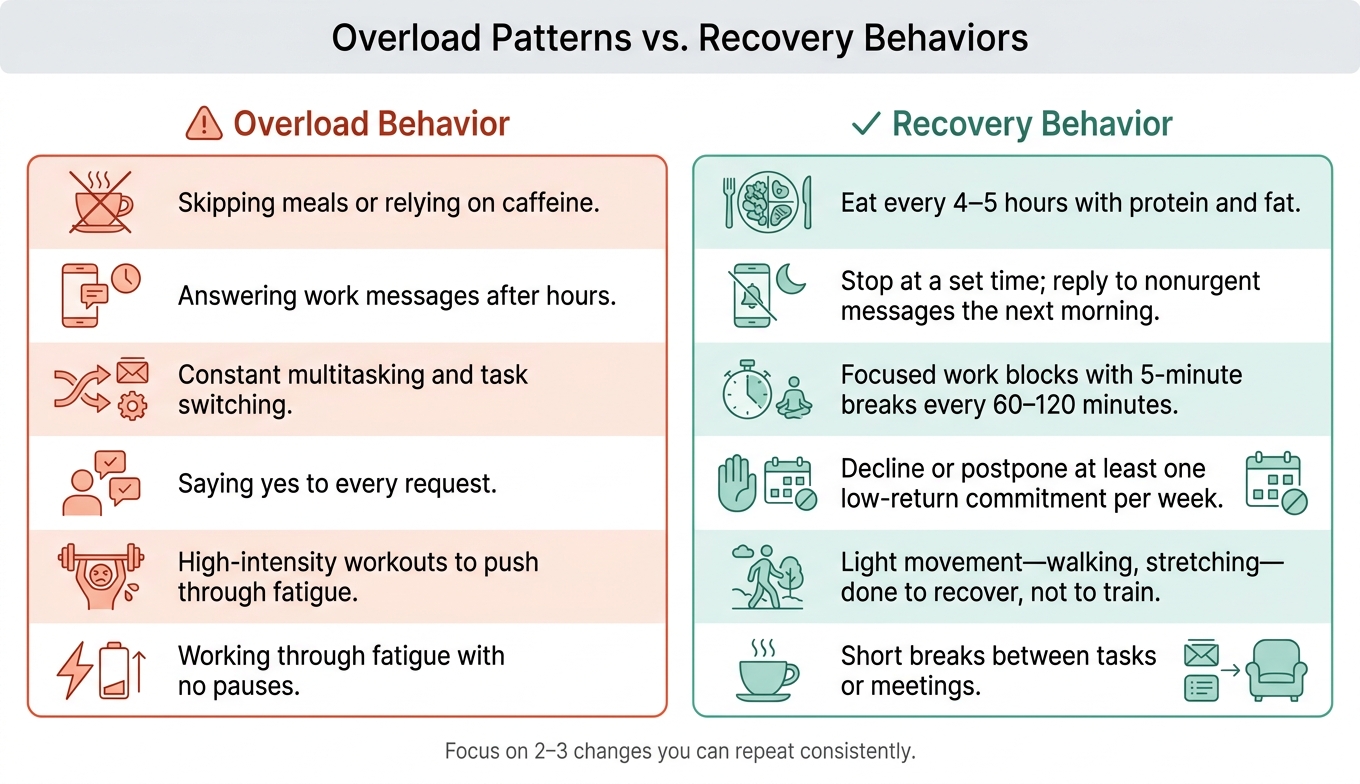
Once you can spot what keeps burnout going, the next move is simple: lower the load. Recovery usually starts with small, repeatable changes to workload, sleep, and boundaries.
Cut nonessential demands and set limits on availability
Start by sorting your current commitments into three buckets:
- Essential: real deadlines, real consequences
- Flexible: can be moved, shortened, or simplified
- Optional: can be declined or paused
Cut the low-return stuff first. That might mean extra meetings, perfectionist over-editing, or social plans that drain more energy than they give back.
Then choose one clear action for this week. For example:
- Say no to one request you’d usually accept out of guilt
- Ask a family member to take over a recurring chore
- Set a firm end time for your workday and stick to it
Example: “For example: ‘I stop working at a set time each day and respond to nonurgent messages the next morning.’ The specific time matters less than the consistency.
The key is doing it the same way each time. If your limits keep changing, your brain stays on alert.
Rebuild energy through sleep, meals, movement, and short recovery breaks
Aim for 7–9 hours of sleep on a steady sleep-wake schedule. Add a 30–60 minute wind-down period, and get bright light within 30–60 minutes of waking to help steady your body clock.
For meals, eat every 4–5 hours and include protein and fat each time. Skipping meals can make stress and brain fog worse.
When your energy is low, go with low- to moderate-intensity movement like a 20–45 minute walk, light stretching, or restorative yoga. The point is to recover, not to train.
Short breaks between tasks matter more than most people think. Even 5 minutes away from your screen, a few slow breaths, or a quick look out the window can help your nervous system settle enough that the next task feels less draining.
When to seek professional support
Self-care can help significantly. But sometimes it isn’t enough on its own. If better sleep, firmer boundaries, and workload changes aren’t easing your symptoms, it’s time to get evaluated.
Signs that self-care may not be enough
If symptoms stick around even after you’ve made real changes, that points to something bigger than short-term stress. When symptoms show up on most days for 2–4 weeks despite honest efforts to rest and cut back, talk to a professional. A key feature of high-functioning burnout is that external performance can remain intact while the nervous system is still in a sustained stress state.
Some signs warrant clinical evaluation sooner rather than later:
- Panic symptoms
- Using alcohol or other substances to cope
- Mood that stays low or irritable for more than two weeks
Feeling flat, numb, or disconnected isn’t the same as feeling calm. It can be a sign of long-term overload. At that stage, self-management may not be enough, and a clinical assessment makes sense.
What professional care can look like
A professional can help sort out whether burnout is overlapping with something else. Burnout can look a lot like anxiety, depression, or sleep disorders, and treatment depends on what’s actually driving the symptoms.
Care may include therapy, medication when it’s appropriate, and screening for sleep or medical issues that can keep exhaustion going, such as thyroid function or nutrient levels. The goal is to look at the whole pattern, not just one symptom. Support can happen virtually or in person and may involve psychiatry, therapy, nutrition support, and exercise-based care.
You’ve Been Running on Empty Long Enough
If better sleep, firmer boundaries, and workload changes aren’t moving things in the right direction — or if the pattern has been going on long enough that self-management clearly isn’t sufficient — that’s worth taking seriously. At Modyfi, our Root-Cause Psychiatry approach brings psychiatry, therapy, nutrition, and exercise together to understand what’s actually driving your exhaustion.
👉 Explore Providers to Book an Appointment and Start Your Care Plan
(Note: Modyfi proudly accepts most major commercial insurance plans. We do not accept Medicare or Medicaid.)
Conclusion: High-Functioning Burnout Is Real — and It’s Recoverable
The fact that you’re still delivering doesn’t mean you’re fine. High-functioning burnout is defined precisely by that gap — between what the outside world sees and what it actually costs to keep going.
The warning signs are real: the 3:00 a.m. wake-ups, the emotional flatness after finishing something that should feel good, the mental effort that simple tasks now require. These aren’t character flaws or signs of weakness. They’re signals from a nervous system that has been running without adequate recovery for too long.
Recovery is possible — but it rarely happens on its own. It starts with reducing the load, rebuilding the basics of sleep, nutrition, and movement, and setting limits that the nervous system can actually use to power down. For many people, those steps produce meaningful improvement within weeks.
When they don’t — when symptoms persist despite real effort, or when burnout is overlapping with depression, anxiety, or another condition — professional support tends to produce more complete and lasting change than self-management alone.
The work you’re doing matters. So does the cost of doing it. Both deserve attention.
FAQs
How is burnout different from stress?
Stress and burnout are linked, but they’re not the same thing.
Stress usually looks like too much engagement. Your mind races. You feel irritable. You push forward because pressure is driving you.
Burnout goes further. It’s a deeper kind of depletion: exhaustion that sticks around, emotional distance, and less sense of reward even when you’re still getting through your day-to-day tasks. On the biological side, burnout points to longer-term dysregulation, not just a short-term stress response.
Can I have burnout if I still perform well?
Yes — and this is one of the most common reasons high-functioning burnout goes unrecognized for so long.
Burnout is not defined by whether the work gets done. It’s defined by what it now costs to keep doing it. Performance can remain intact — deadlines met, meetings attended, deliverables completed — while emotional exhaustion, mental fog, irritability, and disrupted sleep build steadily in the background.
This pattern is particularly common in people with a strong sense of responsibility, perfectionism, or identities closely tied to being reliable and high-achieving. Those traits can sustain output long after the internal reserves that used to make the work feel manageable have been depleted.
A 2024 SHRM survey found that 51% of U.S. employees felt used up at the end of the workday and 45% felt emotionally drained — yet most kept showing up. Performance is often the last thing to decline. By the time it does, burnout is typically well established.
The clearest indicator isn’t productivity. It’s whether doing the same work you’ve always done now requires significantly more effort, leaves less sense of reward, and takes longer to recover from.
How long should I try self-care before getting help?
There’s no fixed timeline — but there are useful signals worth paying attention to.
Self-directed changes like better sleep, reduced workload, firmer boundaries, and consistent movement can produce meaningful improvement within two to four weeks when burnout is relatively early stage. If you’re making genuine changes and seeing some movement — even slow — that’s a reasonable sign to continue.
A clinical evaluation makes sense when symptoms persist for two to four weeks despite genuine changes to sleep, workload, and daily habits. It also makes sense when burnout appears to be overlapping with depression, anxiety, or sleep disorders — conditions that self-management can’t fully address on its own.
Some people also find that having professional support alongside self-care produces faster and more durable results than self-care alone — particularly when biological factors like cortisol dysregulation, nutrient deficiencies, or sleep disorders are part of what’s sustaining the burnout.
If you’re asking the question, that itself is worth taking seriously. Waiting until things get significantly worse before seeking help is one of the most common patterns that extends recovery time.
What does high-functioning burnout feel like physically?
High-functioning burnout has a recognizable physical signature — one that often shows up before people connect it to burnout at all.
The most common early physical sign is disrupted sleep — specifically, falling asleep without much difficulty but waking at 3:00 or 4:00 a.m. with the mind already running through the next day’s demands. This pattern reflects a nervous system that can’t fully disengage from threat mode, even during sleep.
Chronic muscle tension is another consistent feature. Tight shoulders, jaw clenching, tension headaches, and a persistent sense of physical bracing — like waiting for the next demand — are all common. These are signs of sustained sympathetic nervous system activation rather than acute stress responses.
Other physical signs include persistent fatigue that doesn’t resolve with sleep, changes in appetite (often reduced during high-stress periods, then increased when the pressure eases), digestive disruption, and lowered immunity — getting sick more often than usual, or taking longer to recover.
The physical symptoms of high-functioning burnout are often attributed to other causes — poor posture, not enough exercise, getting older. But when they cluster together and persist over weeks, they often reflect the body’s sustained response to chronic stress rather than isolated physical issues.
Can burnout cause depression?
Burnout and depression are distinct conditions — but they can overlap, and burnout can contribute to the development of clinical depression when left unaddressed.
The overlap in symptoms is significant: fatigue, loss of motivation, difficulty concentrating, emotional flatness, and withdrawal from activities that previously felt meaningful are common to both. The key clinical distinction is that burnout is primarily tied to chronic overload and recovers more readily when the load is reduced. Depression tends to persist regardless of circumstances and involves a broader range of symptoms — including pervasive low mood, hopelessness, loss of pleasure, and sometimes thoughts of worthlessness or self-harm.
Research suggests that chronic burnout, particularly when it involves sustained sleep disruption and HPA axis dysregulation, creates biological conditions — elevated inflammation, disrupted cortisol rhythms, and altered neurotransmitter function — that increase vulnerability to depressive episodes. In other words, burnout doesn’t automatically become depression, but it can set the stage for it.
If low mood, loss of interest, or hopelessness are present alongside burnout symptoms — and they’ve persisted for more than two weeks — a clinical evaluation is the appropriate next step. The distinction matters because the treatment approach differs, and treating burnout alone may not be sufficient if a depressive episode is already underway.
How long does it take to recover from burnout?
Recovery from burnout doesn’t follow a fixed timeline — and setting unrealistic expectations about how quickly it should happen is one of the things that can make recovery harder.
For mild to moderate burnout caught relatively early, meaningful improvement in energy, mood, and cognitive function can begin within two to four weeks of consistent changes — reduced workload, improved sleep, better nutrition, and genuine recovery time built into the week. The nervous system can begin to down-regulate when the conditions for recovery are consistently present.
For more entrenched burnout — particularly when it’s been building for months or years, or when it’s overlapping with depression, anxiety, or significant sleep disruption — recovery typically takes longer. Three to six months of consistent, often multi-pronged support is a more realistic expectation for lasting change rather than symptom management.
A few factors tend to extend recovery time: continuing to perform at high levels while trying to recover, addressing only one layer of the problem (lifestyle changes without addressing biological factors, or vice versa), and expecting linear progress in what is typically a non-linear process.
The clearest signal that recovery is real: not just lower symptom scores, but a return of the sense that the same work costs less than it did at the peak — that there’s something left in the tank after a full day, and that rest actually feels restorative again.