


Anxiety is not always just a thought problem. In some people, low-grade inflammation may be part of what keeps symptoms switched on — especially when anxiety shows up alongside fatigue, brain fog, poor sleep, body aches, digestive issues, and a wired-but-tired feeling that doesn’t fully respond to standard care.
Research links anxiety disorders to higher levels of inflammatory markers like CRP, IL-6, and TNF-α. Anxiety disorders are among the most common mental health conditions — 31.1% of U.S. adults will experience one at some point — and yet standard treatment reaches only part of the picture for many people.
This matters clinically because the standard treatment toolkit for anxiety — therapy, SSRIs, lifestyle changes — may only get part of the way when inflammation is a driver. Understanding the brain-immune connection can change what questions get asked, what labs get ordered, and what kind of care actually helps.
For an accessible explanation of how inflammation may drive anxiety symptoms — including the biological pathways behind the brain-immune connection — the video below offers useful context before diving into the evidence:
Inflammation Causes Anxiety: Root Cause and Cure
sbb-itb-23f89d4
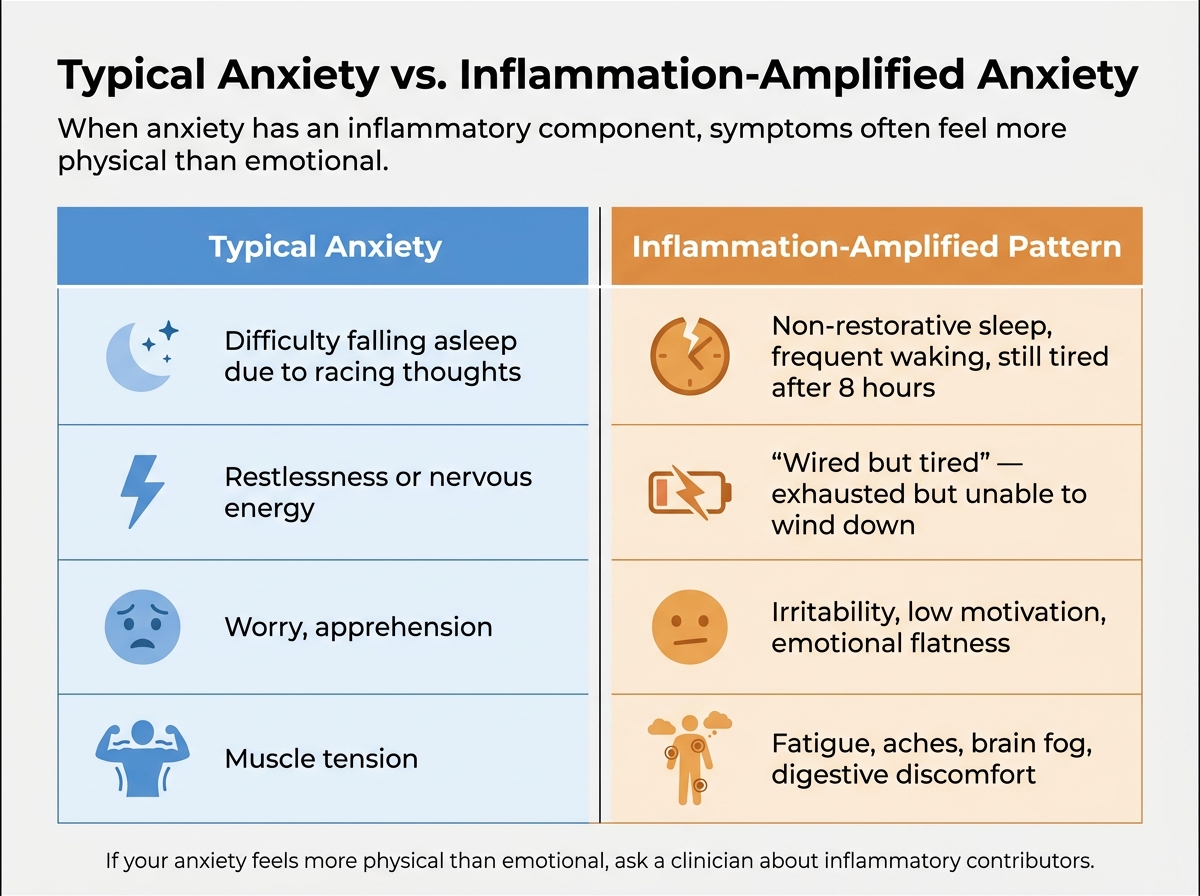
The infographic below shows how typical anxiety symptoms differ from the inflammation-amplified pattern — a useful reference for identifying which picture fits best:
How Inflammation Can Make Anxiety Symptoms Worse
Inflammation can turn anxiety up a notch. Short-term inflammation is a normal part of how the body protects itself. The trouble starts when it becomes chronic and low-grade. At that point, it can quietly interfere with energy, sleep, hormones, and brain function.
In some people with anxiety-related symptoms, markers like C-reactive protein (CRP), interleukin-6 (IL-6), and tumor necrosis factor-alpha (TNF-α) tend to run higher. A systematic review of generalized anxiety disorder found higher CRP levels in people with GAD than in controls, with a standardized mean difference of 0.38 (95% CI 0.06–0.69; p=0.02). Large-cohort data from over 54,000 participants also found that anxiety disorders — with the exception of social anxiety — were significantly associated with increased CRP. Inflammation can amplify stress reactivity, worry, and physical discomfort.
How the Brain-Immune Connection Affects Stress, Sleep, and Mood
Inflammation doesn’t stay in one lane. It affects stress signals, sleep, and mood through a direct path to the brain. Inflammatory cytokines can move through the bloodstream, send signals through the vagus nerve, and reach the brain through areas where the blood-brain barrier is more open. Once there, they can change neurotransmitter metabolism, including serotonin and dopamine, and shift activity in threat-detection regions like the amygdala and ventromedial prefrontal cortex.
That can set off a self-reinforcing cycle. Chronic stress and persistent inflammation can throw off the normal cortisol rhythm. Cortisol is supposed to be higher in the morning and lower at night. When that pattern flattens, people may feel drained during the day and wide awake at night. Then poor sleep pushes inflammatory markers higher, which can make the next night even worse. On top of that, sympathetic nervous system overactivation – the fight-or-flight response – can keep the body tense and alert even when there’s no clear threat.
Why Some Anxiety Symptoms Feel More Physical Than Emotional
Inflammation often hits body systems first: energy metabolism, sleep, pain sensitivity, and appetite. That helps explain why anxiety can feel less like nonstop worry and more like being tired, achy, foggy, and restless all at once.
Research links low-grade systemic inflammation to persistent fatigue that doesn’t improve with rest, non-restorative sleep, brain fog, low motivation, and irritability. For these body-heavy symptoms, inflammation may fit the pattern better than sharp mental worry on its own.
| Symptom | Typical Anxiety | Inflammation-Amplified Pattern |
|---|---|---|
| Sleep | Difficulty falling asleep because of racing thoughts | Non-restorative sleep, frequent waking, still tired after 8 hours |
| Energy | Restlessness or nervous energy | “Wired but tired” – exhausted but unable to wind down |
| Mood | Worry, apprehension | Irritability, low motivation, emotional flatness |
| Physical | Muscle tension | Fatigue, aches, brain fog, digestive discomfort |
When anxiety feels mostly physical and doesn’t fully respond to treatment, it’s worth asking a qualified provider whether inflammation or another medical issue could be part of the picture. That kind of pattern often calls for a broader medical check, starting with common drivers of inflammation.
Common Causes of Anxiety-Linked Inflammation
Anxiety-linked inflammation often comes back to the same day-to-day drivers: poor sleep, chronic stress, gut disruption, blood sugar swings, illness, pain, and nutrient gaps. When these issues keep showing up, the body can stay stuck in an activated state. That makes symptoms harder to settle. The main question is simple: which of these drivers might be keeping your symptoms switched on?
Poor Sleep, Chronic Stress, and Nervous System Overload
Poor sleep can hit hard, and fast. A 2025 meta-analysis of 35 studies found that partial sleep restriction over multiple nights was associated with significant increases in IL-6 and CRP — while a single night of deprivation did not consistently raise inflammatory markers. Even short-term sleep loss, however, can increase anxiety, fatigue, and depressive symptoms the following day.
Chronic stress adds fuel to the fire. When stress stays high, the body’s stress-response system and fight-or-flight response can stay switched on too, which increases inflammatory signaling. Stress also disrupts gut function, and that can feed back into the brain through the gut-brain axis, making anxiety worse.
The cycle compounds over time: stress hurts sleep, poor sleep pushes inflammation up, and more inflammation can make the next stressor feel bigger than it should. Over time, even small triggers may start to feel like too much. That wired, tired, foggy, irritable baseline can start to feel normal when it isn’t.
Gut Disruption, Blood Sugar Swings, and Diet-Related Inflammation
Gut imbalance can also push anxiety-linked inflammation. When gut bacteria get out of balance, the intestinal lining may become leakier, which can let pro-inflammatory molecules enter the bloodstream. Research often finds fewer helpful bacteria and more inflammatory bacteria in anxious and depressed groups. If digestive symptoms rise with anxiety – like bloating, loose stools or constipation, or abdominal discomfort that gets worse under stress – that’s worth bringing up with a provider.
Diet plays a big part here too. A 2023 prospective cohort study of 96,679 UK Biobank participants found that a more pro-inflammatory diet was associated with a higher risk of anxiety disorders — with effects most pronounced in women. Blood sugar swings are tied into this as well. Large cohort data show that frequent spikes and drops in blood sugar are significantly associated with higher rates of anxiety and depression, independent of diabetes status.
Blood sugar instability can show up in ways that are easy to dismiss as unrelated to anxiety:
- shakiness after skipping a meal
- a mid-afternoon crash after a high-carb lunch
- that wired-and-tired feeling that doesn’t line up with how much sleep you got
Illness, Pain, and Nutrient Gaps That Can Keep Symptoms Going
Chronic pain and autoimmune conditions can increase the body’s baseline inflammatory load in ways that overlap with anxiety symptoms. A 2025 UK population-based study reported that living with an autoimmune disease was linked to almost twice the risk of persistent depression, generalized anxiety, and bipolar disorder. Recent infections may also fit the pattern, especially when anxiety symptoms begin or get worse after being sick.
Nutrient gaps are another piece that often gets missed. Omega-3 fatty acids, vitamin D, B12, and iron all help regulate inflammation and support brain function. In a 2011 double-blind RCT with medical students receiving 2.5g/day of omega-3s for 12 weeks, the treatment group showed a 20% reduction in anxiety symptoms and a 14% decrease in stimulated IL-6 production compared to placebo — notably in adults without a prior anxiety disorder diagnosis. Low levels can make fatigue, low mood, and poor stress tolerance worse.
If anxiety keeps hanging around and comes with fatigue, brain fog, or unexplained aches, it may make sense to ask a provider about checking ferritin, vitamin D, B12, and omega-3 status. If several of these patterns sound familiar, bring them to a qualified provider as part of a broader evaluation.
How to Recognize the Pattern and Ask for a More Complete Evaluation
If a few of the patterns above sound familiar, the next move is simple: track what’s happening and bring that pattern to a clinician. That gives you a more focused medical conversation instead of a vague “I just don’t feel right.”
Signs Your Anxiety May Have an Inflammation Component
The clearest clue usually isn’t one symptom on its own. It’s a cluster of symptoms showing up together. In the Netherlands Study of Depression and Anxiety (NESDA), somatic anxiety symptoms — including fatigue, low energy, and bodily discomfort — were associated with higher CRP, IL-6, and TNF-α. Cognitive anxiety symptoms showed weaker and less consistent associations with inflammatory markers. So if your anxiety feels more physical than emotional, that pattern is worth medical attention, especially when it seems tied to inflammation-driven stress signaling.
Pay close attention to combinations like anxiety plus heavy fatigue, brain fog, non-refreshing sleep, frequent headaches or muscle aches, and digestive issues that get worse under stress. It also helps to notice triggers. Do symptoms flare after poor sleep, travel, a high-sugar meal, heavy alcohol use, or while recovering from an illness?
A simple journal for two to four weeks can help a lot. Track:
- Your anxiety level from 0–10
- Physical symptoms
- Sleep quality
- Food and drink
- Stressors
That kind of notes page can turn scattered complaints into a short clinical summary that’s much more useful in a brief appointment than a long spoken explanation. It also helps point the clinician toward the labs and history questions that matter most.
Lab Work and Health History to Discuss With Your Provider
If you’ve already tried standard anxiety care but still feel tired, foggy, or physically keyed up, a good starting line with your primary care provider might be: “Can we rule out common medical and inflammatory contributors to my anxiety and fatigue?”
Based on your symptoms and history, a clinician may look at labs such as a CBC, comprehensive metabolic panel, TSH, fasting glucose or HbA1c, nutrient levels like vitamin D, B12, and ferritin, and a lipid panel. If an inflammatory or autoimmune process seems possible, hs-CRP or ESR may also make sense. Out-of-range results need clinical interpretation.
Before the visit, write down a short summary that covers your top three concerns, when symptoms started or got worse, your medical history, current medications and supplements, and a basic snapshot of sleep, diet, and activity. That gives your provider something concrete to work with.
If testing points to a biological driver, medical treatment should be paired with anxiety care.
Whole-Person Treatment Options That Address Both Anxiety and Inflammation
CBT, SSRIs, and SNRIs still matter. But the goal here is broader: lower inflammation, steady the body, and ease anxiety at the same time. In practice, that usually means coordinated care works better than treating each part on its own. A meta-analysis of 79 randomized controlled trials with over 11,000 participants found that psychotherapy produced medium to large effect sizes for GAD outcomes — and that combining approaches tends to outperform single-track treatment.
Lifestyle support matters too. The strongest evidence points to steady sleep routines, regular physical movement, and anti-inflammatory eating patterns such as a Mediterranean-style diet. A 2026 scoping review of 42 randomized controlled trials found that anti-inflammatory diets — particularly Mediterranean-style patterns — were associated with reductions in depressive symptoms. Evidence for anxiety and other mental health outcomes was more mixed, with some trials reporting improvements and others showing no effect. Targeted nutrition support, especially omega-3s, vitamin D, and B12 when levels are low, may also be worth discussing with a provider.
The point is to make sure biological drivers are part of the care plan.
Conclusion: A More Complete Way to Think About Anxiety
Anxiety isn’t always driven by thought patterns alone. In some cases, whole-body inflammation can add fuel to the fire — shifting the next step from managing symptoms to understanding what’s driving them.
If anxiety keeps coming back alongside fatigue, brain fog, irritability, and restless sleep, it’s worth asking whether inflammation or another body-wide issue is part of the picture. A more complete evaluation can connect symptoms, triggers, labs, and treatment into one plan.
If anxiety keeps returning, the body may be part of the problem — and addressing it may be part of what finally helps.
Symptoms Are Signals. Let’s Find the Source.
If your anxiety feels more physical than emotional — or if fatigue, brain fog, and poor sleep keep showing up alongside worry — the missing piece may be biological. At Modyfi, our Root-Cause Psychiatry approach brings psychiatry, therapy, nutrition, and exercise together, including functional lab testing when the picture calls for it, to find what’s actually driving your symptoms.
👉 Explore Providers to Book an Appointment and Start Your Care Plan
(Note: Modyfi proudly accepts most major commercial insurance plans. We do not accept Medicare or Medicaid.)
FAQs
How do I know if my anxiety is linked to inflammation?
Look for signs that often come with inflammation: chronic fatigue, brain fog, poor concentration, restless sleep, digestive issues, chronic pain, autoimmune conditions, or blood sugar swings.
This matters even more if standard anxiety treatment hasn’t helped. At that point, it may be worth looking past anxiety alone and asking what else could be going on under the surface.
For more clarity, talk with your provider about labs like hsCRP, IL-6, TNF-α, and ferritin, along with fasting insulin, thyroid function, and nutrient levels.
What lab tests should I ask about for anxiety and fatigue?
When you’re dealing with anxiety and fatigue, it can help to look past basic lab work and check for possible biological drivers. Depending on your symptoms and provider, it may be worth asking about a four-point salivary cortisol test.
It may also be worth asking about nutrient testing, including vitamin D, B12, folate, iron, zinc, and potassium.
Can improving sleep, diet, and gut health help reduce anxiety?
Yes. Better sleep, diet, and gut health may help ease anxiety by working on some of the body systems tied to it, including inflammation, blood sugar ups and downs, and gut-brain signaling.
Good eating habits and stronger sleep can help with emotional regulation, immune function, neurotransmitter production, and your ability to handle stress.
Can anxiety cause inflammation, or does inflammation cause anxiety?
Both — and that’s part of what makes this relationship so clinically relevant.
Anxiety activates the stress response, which triggers the release of cortisol and pro-inflammatory cytokines. When anxiety is chronic, that activation becomes sustained, driving low-grade systemic inflammation over time. At the same time, inflammation independently affects the brain through cytokine signaling, neurotransmitter disruption, and HPA axis dysregulation — producing or amplifying anxiety symptoms even in people without a prior anxiety history.
The NESDA cohort and UK Biobank data suggest that the relationship runs in both directions, with inflammation more strongly associated with somatic anxiety symptoms — fatigue, physical restlessness, body tension — than with cognitive symptoms like worry and rumination.
What this means practically: treating only the anxiety without addressing inflammation, or treating only inflammation without addressing anxiety, often produces incomplete results. The strongest outcomes tend to come from care that addresses both sides of the loop simultaneously.
What foods reduce inflammation and help with anxiety?
No single food reduces inflammation significantly — the effect comes from consistent dietary patterns over time. The Mediterranean diet has the strongest evidence, with multiple trials showing reductions in inflammatory markers and depressive symptoms. Key components include fatty fish rich in omega-3s (salmon, sardines, mackerel), leafy greens and colorful vegetables, olive oil, legumes, nuts and seeds, and fermented foods that support gut microbiome diversity.
Foods consistently associated with higher inflammation include ultra-processed foods, refined carbohydrates, added sugars, and trans fats. Alcohol in excess raises inflammatory markers and disrupts sleep architecture — compounding both inflammation and anxiety over time.
For people with anxiety that has a physical, body-heavy quality, dietary changes are worth discussing with a clinician as part of a broader plan — not as a standalone intervention, but as a meaningful supporting element.
Is there a test to check if inflammation is causing my anxiety?
There’s no single test that confirms inflammation as the cause of anxiety — but functional lab work can identify whether elevated inflammatory markers are present alongside your symptoms, which can inform a more targeted care plan.
Commonly relevant markers include high-sensitivity CRP (hs-CRP), IL-6, and TNF-α for direct inflammation assessment. A comprehensive metabolic panel, thyroid panel, CBC, and nutrient levels — vitamin D, B12, ferritin, and omega-3 status — can identify biological factors that worsen both inflammation and anxiety symptoms.
Elevated results don’t diagnose anxiety as “inflammatory” — that determination requires clinical interpretation alongside your full history, symptom pattern, and response to previous treatment. But when anxiety persists despite standard care and comes with fatigue, brain fog, restless sleep, and body-heavy symptoms, targeted lab work is a reasonable next step to discuss with a clinician.