


If you can handle a high-stakes work project but can’t make yourself reply to a two-minute email, that pattern has a name — and it’s not laziness.
Executive dysfunction is the gap between wanting to do something and being able to start it. It shows up when the brain’s planning, prioritizing, and initiating systems don’t fire the way they need to — especially for tasks that are vague, low-reward, or lack outside pressure. The result can look like procrastination from the outside. From the inside, it feels more like being stuck at the starting line while knowing exactly where the finish line is.
This pattern is common in ADHD, depression, anxiety, and burnout — but it can also show up in people without a formal diagnosis, particularly during periods of chronic stress or exhaustion. Understanding what’s driving it changes what actually helps.
For a clear clinical explanation of what executive function is and how it breaks down in ADHD — from board-certified psychiatrist Dr. Tracey Marks — the video below offers useful context before diving into the evidence:
sbb-itb-23f89d4
Executive dysfunction is a brain-based problem, not a character flaw
Executive functions are the mental skills your brain uses to get things done. They help with starting tasks, making plans, staying organized, managing time, holding details in mind, directing attention, and checking your own progress. Together, they function as the brain’s management system: what needs to happen, when, and how to stay on course.
When executive dysfunction is in the mix, those skills can feel uneven and hard to reach, especially without outside structure. On the surface, that can look like procrastination. But that label misses what’s going on underneath.
Executive dysfunction is a brain-based pattern that affects planning and follow-through. It is not a character flaw. It also does not always come with a formal diagnosis. Chronic stress and exhaustion can wear down follow-through too.
What executive dysfunction looks like day to day
Executive dysfunction often shows up in the space between intention and action. You plan to answer the emails. You know the laundry is still in the dryer. You’ve already moved your primary care appointment twice. And yet, the step from “I need to do this” to actually doing it keeps getting stuck.
Day to day, this can look oddly uneven. Someone might spend two solid hours locked in on a work presentation while a five-minute insurance form sits untouched. Or clean laundry stays in a basket for days because folding it feels way harder than it “should.”
That pattern isn’t random. Low-reward tasks, vague tasks, and tasks with no outside pressure are often the hardest to start. That’s also why a big project can sometimes feel easier than a five-minute errand.
In adults, executive dysfunction often shows up as internal restlessness, disorganization, and trouble deciding where to begin — even when the to-do list is short.
How motivation, attention, and reward affect starting a task
The brain’s motivation and reward systems play a big part in whether a task feels possible to start. When those systems are disrupted by ADHD, burnout, anxiety, or chronic stress, the brain may struggle to produce the internal push needed to begin, even if the task looks simple on paper.
That’s why someone can honestly want to do something and still feel frozen at the starting line. It’s not laziness. It’s a mismatch between intention and the brain systems that help turn intention into action.
Tasks that feel boring, vague, repetitive, or emotionally loaded tend to come with a high startup cost. They ask for effort up front but offer very little immediate payoff.
The brain usually responds more to what feels rewarding now than to pressure that’s far off. So a deadline-driven project can feel easier to start than a tiny task with no urgency, even when the tiny task would take only five minutes.
Why big projects can feel easier than small tasks
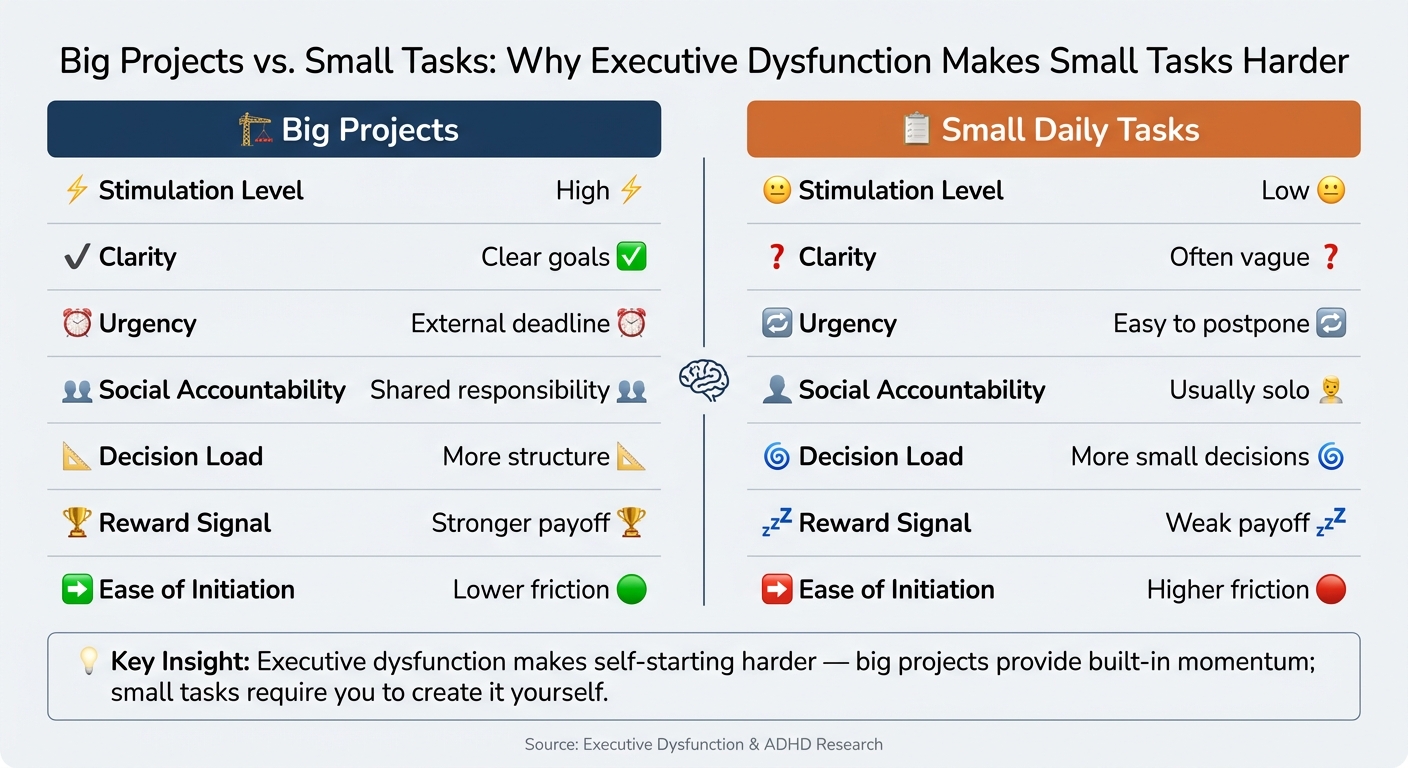
Big projects can feel easier because they come with urgency, structure, and a payoff you can see coming. That’s why a five-minute task can feel oddly harder to start than a high-stakes project. Executive dysfunction makes self-starting tougher, so outside pressure often ends up doing that job for you.
Interest, urgency, and deadlines can drive follow-through
Big projects usually come with deadlines , visible stakes, and other people waiting on the result. That creates the kind of urgency executive dysfunction often responds to. Bigger, more complex work can also feel more interesting, while routine tasks may not offer enough stimulation to get you moving.
The task itself isn’t easier. It just comes with more momentum.
Vague, low-reward tasks carry a higher startup cost
Small tasks often seem simple from the outside, but they’re packed with tiny choices. “Deal with email” sounds straightforward, yet your brain still has to figure out where to begin, how long to spend, and what “done” even means.
That mental setup can be a drag. It’s even harder to switch into a low-reward task when you’re coming out of rest or stepping away from deep-focus work. Dull, repetitive, or emotionally loaded tasks tend to have the most starting friction – not because they’re hard in any big way, but because they offer almost no immediate payoff for getting started.
When this pattern may point to ADHD, depression, anxiety, or burnout
When the same task-friction pattern keeps coming back, it helps to ask what else might be behind it. If it shows up at work, at home, and in daily routines, there may be more going on. ADHD, depression, anxiety, and burnout can look similar at first glance, but they affect executive function in different ways.
How ADHD, depression, anxiety, and burnout each affect executive function
ADHD often shows up as steady trouble with tasks, deadlines, and follow-through. It can also come with a constant sense of restlessness or mental clutter. Many adults don’t get diagnosed until later in life because they spent years masking what was going on.
Depression often drains energy and slows thinking. Anxiety can lead to avoidance, which makes tasks feel even harder to begin. Burnout can make even simple choices feel too heavy.
A useful clinical distinction: ADHD often presents as low stimulation — the task doesn’t generate enough internal drive to begin. Burnout and depression tend to present as low energy — the capacity to act is depleted regardless of how interesting the task feels.
If emails, laundry, and appointments feel harder than big work projects, the issue may be executive function, not effort.
Ways to make small tasks easier
Task chunking, timers, external cues, and body doubling
These tools help by making the first step feel lighter. The point isn’t to force yourself to feel motivated. It’s to cut the cost of getting started.
If starting is the problem, make the start smaller.
Task chunking means shrinking a task until the next move is clear and doable in about 5 to 10 minutes. A checklist takes pressure off working memory and makes the next action obvious. So instead of “do laundry”, you might write “fold only towels.” Instead of “handle email”, try “reply to two emails.” After that first step, you can choose whether to keep going.
Timers make time feel more concrete. A 15-minute countdown labeled “fold only towels” turns a fuzzy chore into a short work sprint. A sticky note on your laptop or a calendar alert that says “call clinic to schedule follow-up – 5 minutes” puts the task right in front of you — so you don’t have to rely on memory alone. Body doubling can also make a big difference: work next to someone, in person or on video, for 25 minutes, then check in.
Here’s a quick side-by-side look at the main tools.
| Strategy | Best Task Type | Executive Challenge Addressed | Simple Implementation Example |
|---|---|---|---|
| Task chunking | Overwhelming, multi-step tasks | Planning, initiation, working memory | “1) Open inbox, 2) Star 5 emails, 3) Reply to 2 starred emails – stop after step 3” |
| External cues | Repetitive or easy-to-forget tasks | Forgetfulness, inconsistent routines | Sticky note on laptop: “Open patient portal” |
| Timers (work sprints) | Low-interest tasks that feel endless | Attention, time blindness, all-or-nothing thinking | Set a 15-minute timer labeled “fold only towels”, stop when it rings |
| Body doubling | Chronically avoided or emotionally heavy tasks | Low motivation, avoidance, self-starting | 25-minute video call with a friend; both name one task, start the timer, check in at the end |
Signs it may be time to get professional support
The main question isn’t whether one label fits in a perfect way. It’s whether the pattern sticks around long enough to affect daily life. If these struggles keep getting in the way of work, school, relationships, or basic routines, it’s time to take that seriously. Shame and harsh self-talk can also maintain the pattern — making avoidance feel even more entrenched and professional support feel less accessible. When the pattern keeps showing up even after practical changes, professional support is a smart next step, not a last resort.
How Modyfi Health approaches executive dysfunction with whole-person care
When practical tools only get part of the way, there may be more going on underneath. Persistent executive dysfunction — especially when it’s linked to ADHD, depression, anxiety, or burnout — often has layers that self-help strategies alone can’t reach.
At Modyfi, a clinical evaluation starts by looking at the full picture: symptoms, sleep patterns, daily habits, stress load, and lab work that may reveal biological factors — like cortisol imbalances, hormonal shifts, or nutrient deficiencies — that can make focus and follow-through harder than they should be. This isn’t just about identifying a label. It’s about understanding what’s actually driving the pattern.
From there, care is built around what that person specifically needs. Our network of providers — psychiatric nurse practitioners, licensed therapists, nutritionists, and exercise specialists — works from one shared plan rather than separate tracks. Medication management, skills-based therapy, nutritional support, and lifestyle guidance all form part of that plan, depending on what the evaluation reveals.
Modyfi delivers all care virtually, which removes common barriers like travel time, rigid scheduling, and geographic distance — so support stays accessible even when energy and follow-through are already stretched thin.
Ready to Find Out What’s Actually Behind the Pattern?
If executive dysfunction keeps showing up despite your best effort, a whole-person evaluation can help identify what’s driving it — and build a plan that fits your specific situation.
👉 Explore Providers to Book an Appointment and Start Your Care Plan
(Note: Modyfi proudly accepts most major commercial insurance plans. We do not accept Medicare or Medicaid.)
Conclusion: struggling with small tasks does not mean you are lazy
Executive dysfunction is not a motivation problem. It’s a brain-based pattern — one that can show up in anyone under enough stress, and one that’s especially common in ADHD, depression, anxiety, and burnout.
The solution is structural: shrink the first step, add outside pressure, reduce friction, and build in cues that compensate for what the brain isn’t generating on its own.
That pattern showing up across work, home, and daily routines despite real effort is a signal worth taking seriously — a clinical evaluation can help identify what’s actually driving it.
FAQs
How can I tell if this is executive dysfunction or just procrastination?
What separates the two is usually what’s behind the struggle.
Procrastination is often conscious, or at least partly conscious, avoidance of a specific task. Executive dysfunction is a brain-based struggle with motivation, getting started, and managing tasks.
If this keeps happening, disrupts day-to-day life, and sticks around even when you want to do the task, it may point to patterns often linked with ADHD. Similar symptoms can also show up with anxiety, depression, burnout, and stress, so a professional evaluation can help sort out what’s going on.
Why do tiny tasks feel harder than urgent work?
Tiny tasks can feel oddly hard. Not because they take more skill, but because they often give you almost no instant payoff. There’s not much stimulation, not much urgency, and not much momentum. So getting started, staying with it, and finishing it can take more effort than people expect.
Urgent work often feels easier to begin for the opposite reason. Pressure helps. Consequences help. A deadline can flip the task into something your brain is ready to act on.
Small tasks can also ask for more self-management than they seem to on the surface. If the plan or reminder doesn’t line up with your actual schedule, your energy level, or simple practical barriers, even a basic task can stall out. This pattern can show up alongside ADHD-related attention challenges.
When should I get professional help for this?
Consider getting professional help if executive dysfunction keeps getting in the way of work, school, relationships, or day-to-day life.
Self-screening tools can be useful, but they can’t tell you what’s causing the problem. If trouble with focus, getting started, or motivation sticks around or starts disrupting your life, a licensed clinician can look at what may be going on, including ADHD, depression, anxiety, or burnout, and help build a care plan that fits you.
Is executive dysfunction the same as ADHD?
No — but the two are closely connected.
Executive dysfunction is a symptom pattern, not a diagnosis. It refers to difficulties with planning, initiating, organizing, and following through on tasks. ADHD is one of the most common conditions that produces it — but depression, anxiety, burnout, and chronic stress can all impair executive function in measurable ways too.
What makes ADHD distinct is that executive dysfunction is a core, persistent feature — not a side effect of something else. In depression, it often improves when mood lifts. In burnout, it eases when stress reduces. In ADHD, the pattern typically persists across contexts and life stages regardless of mood or energy.
A clinical evaluation matters before drawing conclusions — because the right support depends on understanding which condition is actually driving the pattern.
Can executive dysfunction get worse over time?
It can — depending on what’s driving it and whether you’re addressing it.
For executive dysfunction rooted in ADHD, the pattern tends to worsen gradually as life demands increase. Adulting adds complexity — more decisions, more responsibilities, fewer external structures — which amplifies the gap between intention and action.
Depression, burnout, and chronic stress follow a different trajectory. When those conditions go untreated, persistent sleep deprivation and ongoing stress erode the prefrontal cortex’s capacity to regulate attention over time — and the effects compound.
The clearest signal that something is worsening: the pattern starts affecting areas of life it didn’t before, or tools that used to help stop working. That’s a reason to seek evaluation rather than wait.
What does body doubling actually do for executive dysfunction?
Body doubling means working in the presence of another person — in the same room, on a video call, or in a shared online work session — without necessarily interacting with them.
The most supported explanation is that social presence activates the brain’s attention and accountability systems in ways that solo work doesn’t. For people with executive dysfunction, external structure often substitutes for the internal drive that isn’t firing on its own. Another person’s presence — even a silent one — provides that structure.
It works best for tasks that require sustained attention but don’t need collaboration: administrative work, writing, studying, cleaning. It doesn’t fix the underlying issue — but it reliably lowers the startup cost enough that getting started becomes possible.