

Feeling emotional during and after pregnancy is expected. Hormones shift dramatically, sleep is disrupted, life changes in ways that are hard to prepare for, and the gap between what you imagined and what the experience actually feels like can be significant.
But there is a meaningful difference between the emotional adjustment that is a normal part of this period — and depression that needs clinical attention. Understanding that difference matters, because perinatal depression is common, frequently missed, and consistently undertreated — and because it responds well to treatment when identified.
This post covers what prenatal and postpartum depression actually look like, how they differ from the baby blues, what the research shows about risk factors and treatment, and when it’s time to reach out for support.
⚠️ If you are experiencing thoughts of harming yourself or your baby, please contact the 988 Suicide & Crisis Lifeline (call or text 988) or the Postpartum Support International Helpline at 1-800-944-4773 immediately.
What Is Perinatal Depression?
Perinatal depression is a clinical term for depression that occurs any time during pregnancy or in the first year after birth. It includes prenatal depression (during pregnancy) and postpartum depression (after delivery) — part of the same spectrum.
According to NIMH, perinatal depression affects approximately 1 in 7 new mothers in the United States — making it one of the most common complications of pregnancy and the postpartum period. Prenatal depression specifically affects an estimated 10–20% of gestational parents — a rate that often surprises people, because depression during pregnancy receives far less attention than postpartum depression.
What makes perinatal depression particularly difficult to recognize is how much its symptoms overlap with normal pregnancy and postpartum experiences. Fatigue, sleep disruption, appetite changes, and emotional sensitivity are all expected in this period. The distinction lies in persistence, severity, and functional impact — not the presence of symptoms alone.
The Baby Blues: Normal, Expected, and Temporary
Between 50% and 80% of new mothers experience what are commonly called the baby blues — a period of emotional volatility in the days immediately following delivery. Weepiness, irritability, mood swings, mild anxiety, and difficulty sleeping are all typical.
According to NIH/StatPearls, the baby blues typically begin within two to three days of delivery, peak around day four or five, and resolve entirely within two weeks. They are connected to the rapid hormonal shifts that follow delivery.
Baby blues are time-limited and do not significantly impair your ability to function or care for your baby. They need rest, support, and reassurance — not clinical treatment.
Postpartum Depression: When It’s More Than the Blues
If emotional symptoms persist beyond two weeks, intensify, or begin to interfere significantly with daily life, that pattern warrants clinical attention.
Postpartum depression is not a character flaw or a sign of weakness. It is a clinical condition — one that the brain and body can develop in response to the combination of hormonal changes, sleep deprivation, physical recovery, emotional adjustment, and psychological stress that the postpartum period brings.
Signs that may indicate postpartum depression:
- Persistent sadness, emptiness, or low mood that doesn’t lift
- Difficulty bonding with your baby or feeling detached from them
- Loss of interest in activities that previously felt meaningful
- Overwhelming guilt, shame, or feelings of inadequacy as a parent
- Significant anxiety that doesn’t ease with reassurance
- Significant changes in appetite or sleep beyond what newborn care explains
- Feeling unable to care for yourself or manage daily tasks
If you are experiencing any thoughts of harming yourself or your baby, please contact the 988 Suicide & Crisis Lifeline (call or text 988) or reach the Postpartum Support International Helpline at 1-800-944-4773. These resources connect you with clinicians who specialize in exactly this.
For a brief clinical overview of what separates postpartum depression from the baby blues — and what the first steps toward support look like — the video below from Mayo Clinic offers a useful starting point:
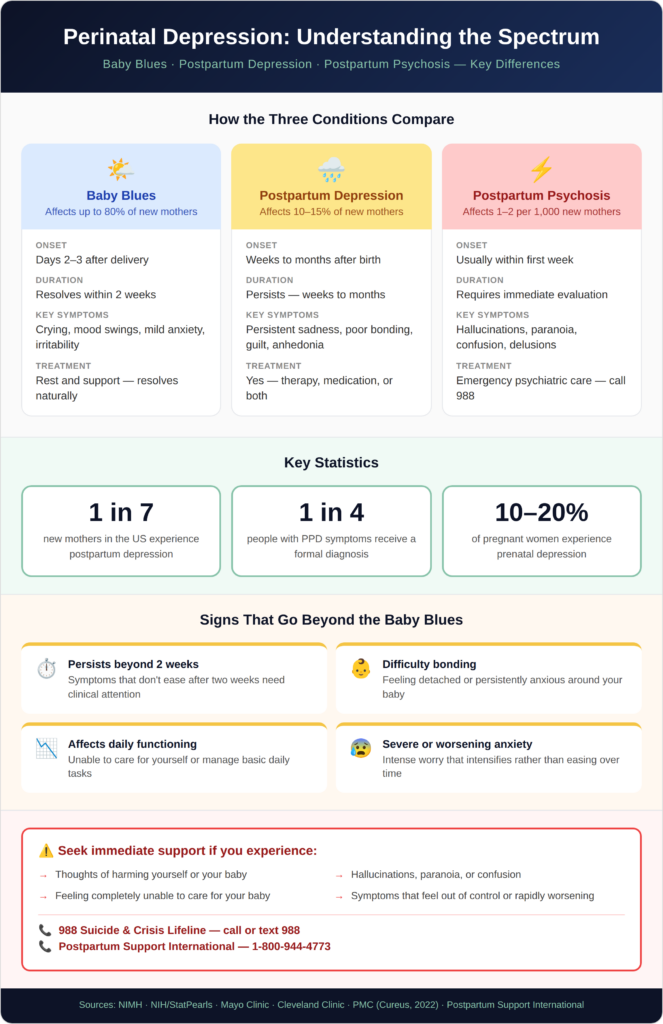
The infographic below summarizes the key differences between the baby blues, postpartum depression, and postpartum psychosis — including prevalence, onset, duration, and when to seek immediate help:
The Infographic: Understanding the Full Spectrum
Prenatal Depression: What Happens Before Birth
Depression during pregnancy is less discussed than postpartum depression but equally common and equally serious. A 2024 study found depression symptoms in 26.3% of women before childbirth.
Prenatal depression can be harder to recognize because many of its symptoms overlap with normal pregnancy experiences. There is also a cultural expectation that pregnancy should be a happy time, which can make it harder to acknowledge when something feels persistently wrong.
Signs that may indicate prenatal depression:
- Persistent low mood that doesn’t lift between difficult moments
- Difficulty forming an emotional connection with the pregnancy or the baby
- Excessive worry or fear about the baby’s health, your ability to parent, or the future
- Withdrawal from relationships and support
- Symptoms significant enough to affect your ability to function day to day
Research consistently links untreated depression during pregnancy to increased risk of complications — and prenatal depression is also a significant predictor of postpartum depression. Addressing it during pregnancy is part of maternal and infant health.
Who May Be at Higher Risk
Perinatal depression can affect anyone — but research identifies several factors that may increase the likelihood:
- Personal or family history of depression, anxiety, or mood disorders
- History of premenstrual dysphoric disorder (PMDD)
- Previous episode of postpartum depression
- Limited social support or relationship difficulties
- Stressful life events during pregnancy
- History of trauma
- Financial stress or housing instability
- Stopping antidepressant medication during pregnancy without clinical guidance
Having risk factors doesn’t mean postpartum or prenatal depression is inevitable — but it does mean that proactive monitoring and support are worth building into your care plan.
The Treatment Gap — and Why It Matters
Only about 1 in 4 people with postpartum depression symptoms receive a diagnosis. Roughly half get no postpartum mental health care at all.
This gap exists for several reasons: stigma, the mistaken belief that struggling is a normal part of new parenthood, limited screening at postpartum appointments, and the practical difficulty of seeking care while managing a newborn.
The evidence on treatment is clear: perinatal depression responds well to care. CBT combined with medication consistently outperforms either approach alone. Interpersonal Psychotherapy (IPT) has particularly strong evidence for perinatal depression. And in 2023, the FDA approved zuranolone — the first oral medication specifically approved for postpartum depression.
Telehealth has meaningfully improved access to perinatal mental health care, making it possible to receive psychiatric evaluation, therapy, and follow-up without the logistical challenges of in-person appointments during the postpartum period.
What Integrated Care Looks Like
The most effective care for perinatal depression addresses multiple layers simultaneously.
Psychiatric Evaluation and Therapy
Psychiatric evaluation can identify whether medication is appropriate, which medications are safe during pregnancy and breastfeeding, and whether hormonal or nutritional factors are contributing to symptoms.
Therapy — particularly CBT and IPT — addresses the cognitive patterns, relational stress, and adjustment difficulties that often accompany perinatal depression. Therapy during pregnancy may also reduce the risk of postpartum depression in people with elevated risk.
Nutrition, Exercise, and Lifestyle Support
Nutritional support matters in this period. Omega-3 fatty acids, iron, folate, and vitamin D all play roles in mood regulation — and postpartum nutrition often becomes secondary to infant care in ways that can deepen depletion.
Exercise, even gentle and consistent movement, has evidence for supporting mood regulation during the perinatal period.
You Don’t Have to Navigate This Alone.
If something feels persistently wrong — during pregnancy or after — that feeling deserves attention, not reassurance that it will pass. At Modyfi, our Root-Cause Psychiatry approach brings psychiatry, therapy, nutrition, and exercise together in one coordinated virtual plan, with telehealth access so care fits around new parenthood rather than the other way around.
👉 Explore Providers to Book an Appointment and Start Your Care Plan
(Note: Modyfi proudly accepts most major commercial insurance plans. We do not accept Medicare or Medicaid.)
Conclusion: Seeking Support Is Part of Taking Care of Your Baby
Perinatal depression is not a reflection of how much you love your baby or how capable you are as a parent. It is a clinical condition with identifiable factors, evidence-based treatments, and real consequences when left unaddressed.
The baby blues are real and temporary. Prenatal and postpartum depression are real and treatable. The clearest signal that something needs attention: symptoms that persist beyond two weeks, intensify over time, or begin to affect your ability to function and connect with your baby.
Reaching out for support during this period is not weakness. It is one of the most important steps you can take — for yourself, and for the child you are caring for.
Frequently Asked Questions
How do I know if I have postpartum depression or just the baby blues?
The clearest distinction is time and severity. Baby blues typically begin within the first few days after delivery and resolve completely within two weeks. They are emotionally intense but don’t significantly impair your ability to function or care for your baby. Postpartum depression persists beyond two weeks, often intensifies, and begins to affect daily functioning. If you’re asking this question and your symptoms have continued for more than two weeks, that’s worth discussing with a clinician.
Can postpartum depression start months after birth?
Yes. While postpartum depression often begins within the first few weeks after delivery, it can develop or be recognized up to a year postpartum. Some people notice delayed onset — particularly after stopping breastfeeding, when hormones shift again, or after returning to work. If symptoms emerge at any point in the first year, they deserve clinical attention regardless of when they started.
Is it safe to take antidepressants during pregnancy or while breastfeeding?
This is a decision that requires individual clinical evaluation. A psychiatrist familiar with perinatal care can help you weigh the options specific to your situation, history, and the medications being considered. Stopping medication abruptly without clinical guidance also carries risks. A clinical evaluation is the safest starting point for this conversation.
Can postpartum depression affect fathers or non-birthing partners?
Yes — research suggests that approximately 10% of new fathers experience postpartum depression, typically peaking between three and six months after birth. It is significantly under-recognized and undertreated. If a partner is struggling, that’s worth addressing too.
What’s the difference between postpartum depression and postpartum anxiety?
They often co-occur — a 2025 meta-analysis of 122 studies found approximately 9% of perinatal women experience both. Postpartum anxiety can present without significant depression, characterized by persistent worry, racing thoughts, inability to rest even when the baby sleeps, and physical symptoms like heart pounding. It responds to many of the same treatments, though the specific approach may differ.
What should I do if I’m struggling and don’t know where to turn?
The safest first step is to contact your OB, midwife, or primary care provider. You can also reach the Postpartum Support International Helpline at 1-800-944-4773 — they connect callers with local perinatal mental health specialists. If you are in crisis, call or text 988.