


Low mood, anxiety, brain fog, poor sleep, and exhaustion can all be linked to hormones — but symptoms alone don’t tell you which hormone is involved, or whether hormones are the cause at all.
That distinction matters. The same pattern of fatigue and low mood can come from depression, sleep disorders, chronic stress, or a thyroid condition. Getting that wrong means treating the wrong thing. The goal isn’t to self-diagnose from a symptom list — it’s to recognize patterns worth bringing to a clinician, and to know which tests can actually clarify what’s going on.
Four hormones — estrogen, testosterone, cortisol, and thyroid hormones — are most commonly linked to mental health symptoms. Each has a distinct pattern of when symptoms tend to appear, what physical signs tend to accompany them, and what kind of evaluation makes sense. This post covers what the research shows about each one, and what a practical next step looks like.
The key numbers:
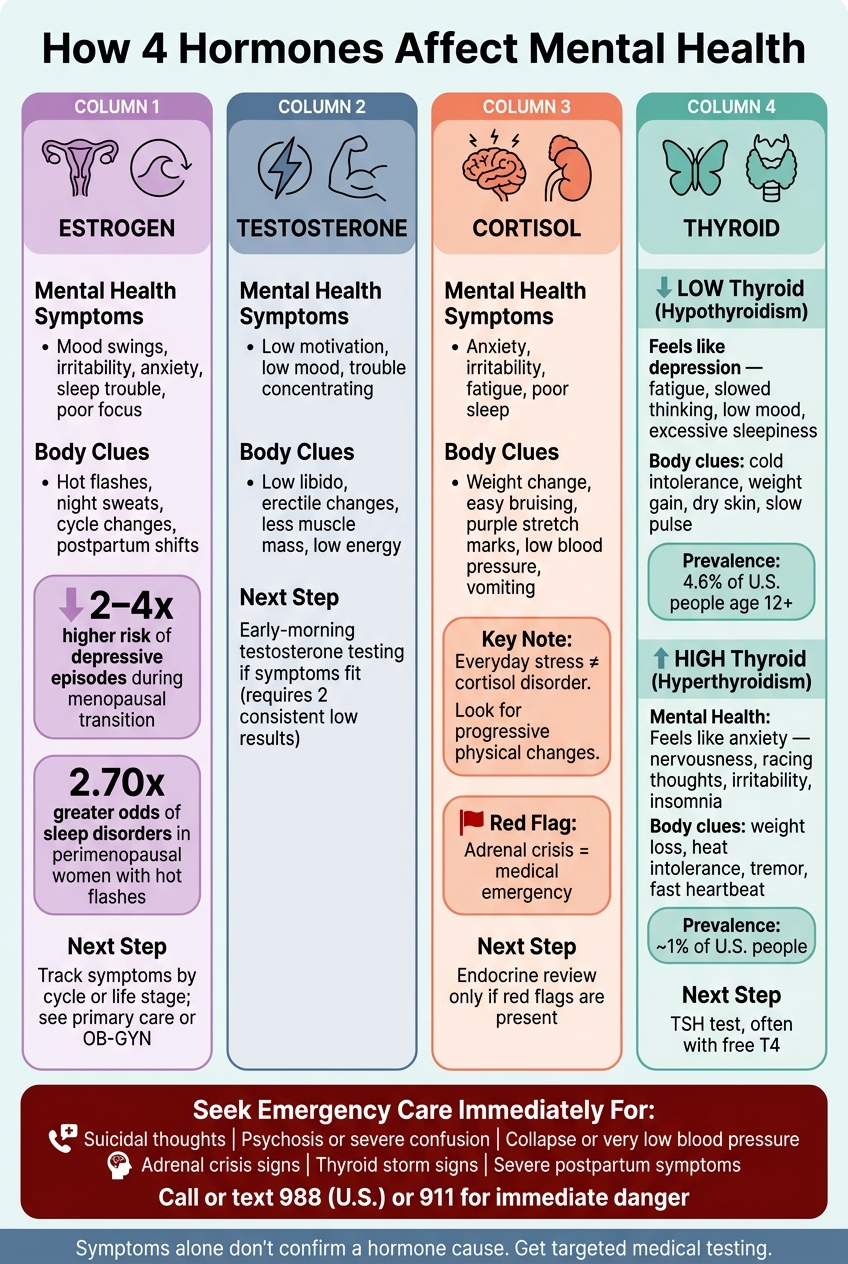
- Hypothyroidism affects about 4.6% of U.S. people age 12 and older, while hyperthyroidism affects about 1%
- During the menopausal transition, research reports depressive episodes at 2 to 4 times the usual risk
- In one meta-analysis, perimenopausal women with hot flashes had 2.70 times higher odds of sleep problems
The infographic below summarizes how each of the four hormones affects mental health — including body clues that help distinguish them, next steps for evaluation, and when to seek emergency care:
For a clinical perspective on how hormones affect mood — and which common assumptions about hormone-related mental health symptoms don’t hold up to scrutiny — the video below from board-certified psychiatrist Dr. Sue Varma, Clinical Assistant Professor at NYU Langone Health, offers useful context:
Hormones, mood and mental health myths Dr Sue Varma
sbb-itb-23f89d4
The main takeaway: if your symptoms follow a clear cycle, started after childbirth, changed with menopause, or come with things like palpitations, cold intolerance, hot flashes, libido changes, or major weight shifts, I’d bring that pattern to a clinician instead of trying to self-diagnose.
How Estrogen and Testosterone Can Affect Mood, Sleep, Focus, and Motivation
Estrogen and testosterone often first show up through changes in sleep, focus, motivation, and mood during reproductive transitions. If symptoms line up with menstrual cycles, pregnancy, postpartum changes, menopause, or shifts in sexual function, these hormones are worth a closer look.
Estrogen: How Reproductive Transitions Can Change How You Feel
Estrogen affects brain systems tied to serotonin, thinking, emotional control, and the stress response. And the key issue isn’t always one “low” lab value. Often, it’s the speed of change or uneven fluctuation that seems to drive symptoms. Mood symptoms increase during the menopausal transition, and research consistently shows peri- and postmenopausal women face a 2–4 times higher risk of depressive episodes.
Sleep is often significantly affected during these transitions. In one meta-analysis, perimenopausal women with hot flashes had 2.70 times greater odds of sleep disorders. Depression was associated with 2.73 times greater odds of sleep problems in the same analysis. Repeated night sweats disrupt sleep continuity, contributing to fatigue, irritability, and cognitive fog the following day.
| Reproductive stage or timing | Common mental health symptoms | Physical clues |
|---|---|---|
| Recurrent symptoms 1–2 weeks before menstruation, improving after bleeding | Irritability, anxiety, depressed mood, poor focus, sleep disruption | Breast tenderness, bloating, headaches, cramps |
| Pregnancy and first year after birth | Persistent sadness, excessive worry, panic, emotional numbness, insomnia beyond infant-care disruption | Appetite changes, severe sleep loss, breastfeeding difficulties |
| Perimenopause (changing or skipped cycles) | Mood swings, anxiety, reduced concentration, fatigue, sleep-related irritability | Hot flashes, night sweats, irregular bleeding, menstrual changes |
| Postmenopause | Low mood, reduced resilience, insomnia, concentration difficulties | Persistent hot flashes, night sweats, vaginal or urinary symptoms |
For premenstrual symptoms, a primary care or gynecologic visit, along with daily symptom tracking for at least two cycles, is a good starting point. Postpartum concerns call for obstetric or primary care evaluation with standard screening for depression and anxiety. Perimenopause workup should look at menstrual history, sleep, thyroid risk, anemia, and other possible causes. Clinicians should individualize postmenopausal assessment based on symptom burden, age, time since menopause, and medical history.
Menopausal hormone therapy may help sleep when hot flashes are the primary driver of disruption — but it does not treat clinical depression or anxiety.
Testosterone: Low Energy, Low Drive, and Trouble Concentrating
When the pattern is less about cycle shifts and more about low libido, low drive, or less strength, testosterone becomes more relevant to consider.
Testosterone affects energy, sexual function, muscle maintenance, motivation, and parts of mood in people of any sex. Low testosterone, or hypogonadism, can lead to a pattern that clinicians often recognize: reduced libido, changes in erectile function or morning erections, decreased muscle mass, low energy, depressed mood, irritability, and trouble concentrating. In severe deficiency, hot flashes can happen too.
That said, fatigue, low motivation, and poor concentration are not specific to testosterone. Depression, sleep apnea, anemia, diabetes, thyroid disease, medication effects, and chronic stress can look almost the same. That’s why clinicians should diagnose testosterone deficiency only when symptoms match consistently low levels on at least two early-morning measurements.
| Symptom pattern | Features that support evaluating testosterone | Common non-hormonal explanations | Next step |
|---|---|---|---|
| Low energy and reduced drive | Persistent fatigue plus low libido, sexual-function changes, reduced muscle mass or strength | Depression, poor sleep, sleep apnea, anemia, diabetes, medication effects | Primary care evaluation, sleep and medication review, physical exam, targeted lab testing |
| Trouble concentrating and depressed mood | Cognitive symptoms with sexual-function changes and other physical signs | Major depression, anxiety, ADHD, thyroid disease, burnout, sleep deprivation | Mental health assessment alongside medical evaluation; don’t delay psychiatric care while pursuing hormone testing |
| Reduced sexual desire | Persistent low libido with erectile changes or absent morning erections | Relationship distress, depression, antidepressants, hormonal contraception, alcohol use | Discuss sexual, mental, reproductive, and medication history with a clinician |
| One unexpectedly low testosterone result | Lab finding without a consistent symptom pattern | Normal daily variation, acute illness, inadequate sleep, assay differences | Repeat an early-morning measurement before diagnosing deficiency |
Testosterone treatment is not a catch-all fix for fatigue or low mood. It comes with real tradeoffs, including effects on fertility, hematocrit, cardiovascular risk, sleep apnea, and prostate health, and it should not be started unless the diagnosis is clear.
When symptoms like these show up alongside anxiety, fatigue, or brain fog, cortisol and thyroid issues often become the next places to look.
When to Seek Medical or Psychiatric Assessment
Get evaluated when symptoms last for several weeks, come back in a clear pattern and interfere with daily life, or start during pregnancy or after childbirth. Big changes in sexual function, sleep, energy, or your ability to work, parent, or stay connected in relationships also deserve medical attention.
Most hormone-linked symptoms are not emergencies. But some patterns need prompt care. Seek prompt psychiatric or emergency care for suicidal thoughts, psychosis, severe confusion, or sudden reduced sleep with elevated or irritable mood, racing thoughts, impulsivity, or grandiosity. New severe postpartum depression, mania, or psychotic symptoms need urgent attention. Postpartum psychosis is a psychiatric emergency.
In many cases, coordinated care works best. Depending on the symptom pattern, evaluation may involve primary care, psychiatry, obstetrics and gynecology, or endocrinology – without making you prove the cause first.
How Cortisol and Thyroid Hormones Can Drive Anxiety, Fatigue, Irritability, and Brain Fog
Cortisol and thyroid disorders can show up as anxiety, fatigue, irritability, and brain fog.
Cortisol: Normal Stress Response vs. Signs of a Cortisol Disorder
The hypothalamic-pituitary-adrenal (HPA) axis controls cortisol. It usually rises in the morning, falls at night, and can jump for a short time during stress. That short spike is normal. By itself, it does not point to a cortisol disorder.
The key issue is pattern. When symptoms persist, worsen, or occur alongside specific physical changes, the pattern may point to an endocrine condition rather than ordinary stress.
| Normal stress responses | Stress-related symptoms | Red-flag patterns |
|---|---|---|
| Brief increase in alertness, heart rate, or muscle tension during a stressful event | Trouble sleeping, irritability, fatigue, or reduced focus that tracks with stress | Progressive abdominal weight gain, easy bruising, reddish-purple stretch marks, thin skin, proximal muscle weakness, new or difficult-to-control high blood pressure – may suggest Cushing syndrome |
| Symptoms ease after rest, safety, support, or resolution of the stressor | Anxiety and insomnia without signs of endocrine disease are more often evaluated through a broad medical and mental-health history | Persistent fatigue, muscle weakness, weight loss, poor appetite, abdominal pain, nausea, vomiting, diarrhea, salt craving, or low blood pressure with dizziness or fainting – may suggest adrenal insufficiency |
| No distinctive physical changes | Severe weakness, repeated vomiting, confusion, collapse, or very low blood pressure may indicate adrenal crisis and require emergency treatment |
The Endocrine Society recommends testing for Cushing syndrome only when several progressive features are present, such as easy bruising, facial fullness, proximal muscle weakness, reddish-purple striae, early osteoporosis, or unusual hypertension. A random blood cortisol test usually doesn’t tell clinicians much. When suspicion is real, they more often use a 24-hour urinary free cortisol test, late-night salivary cortisol, or a 1-mg overnight dexamethasone suppression test.
Thyroid Hormones: How Low and High Thyroid Levels Affect Mental Health Differently
Thyroid hormones – T4 (thyroxine) and the more active T3 (triiodothyronine) – help control metabolism, heart rate, body temperature, and brain function. When thyroid levels are low, body systems slow down. When levels are high, they speed up. That’s why hypothyroidism and hyperthyroidism can feel almost like opposites.
Hypothyroidism can look a lot like depression. People may feel tired, mentally slowed down, unfocused, low in mood, less motivated, and overly sleepy. Physical signs help sort it out: cold intolerance, weight gain, constipation, dry skin, hair thinning, and a slower pulse.
Hyperthyroidism tends to look more like anxiety. Common symptoms include nervousness, racing thoughts, irritability, restlessness, insomnia, and trouble concentrating. Those symptoms often come with weight loss, heat intolerance, sweating, tremor, and a fast or irregular heartbeat. About 4.6% of U.S. people age 12 and older have hypothyroidism, while about 1% have hyperthyroidism.
| Condition | Mental health and cognitive symptoms | Physical clues | Common initial testing | Urgency signals |
|---|---|---|---|---|
| Hypothyroidism | Low mood, fatigue, slowed thinking, poor concentration, reduced motivation, excessive sleepiness | Cold intolerance, weight gain, constipation, dry skin, hair changes, muscle aches, slow pulse | TSH, often with free T4 | Confusion, profound sleepiness, low body temperature, slowed breathing, fainting, or cardiovascular instability |
| Hyperthyroidism | Anxiety, nervousness, irritability, restlessness, racing thoughts, insomnia, mood swings, impaired concentration | Weight loss, heat intolerance, sweating, tremor, frequent stools, weakness, fast or irregular heartbeat | TSH, free T4, and sometimes T3 | High fever, severe agitation or confusion, collapse, vomiting, or very rapid heartbeat |
A 2018 meta-analysis of 19 studies published in JAMA Psychiatry found that autoimmune thyroiditis was linked to higher odds of depression and anxiety symptoms. Even so, mood symptoms alone can’t confirm or rule out a thyroid disorder.
If your symptoms match one of these patterns, the next move is prompt medical review and targeted lab testing.
Warning Signs That Need Prompt Medical Attention
Seek emergency care right away for any of the following:
- Suicidal thoughts or an immediate risk of self-harm
- Inability to care for yourself or an infant
- Severe confusion, collapse, fainting, or very low blood pressure
Repeated vomiting, profound weakness, or severe abdominal symptoms in someone with known adrenal insufficiency can signal adrenal crisis — a medical emergency requiring immediate intravenous corticosteroids and fluids. High fever, marked agitation or confusion, and a very rapid or irregular heartbeat in someone with possible hyperthyroidism may point to thyroid storm — a medical emergency, not an anxiety episode.
A Practical Plan for Evaluation, Tracking, and Whole-Person Treatment
After ruling out emergencies, the next step is to build a clear picture of what’s going on and bring that picture to a clinician who can help sort it out.
What to Track Before Your Appointment
Track your symptoms every day for 2–3 weeks before your visit. Focus on mood, anxiety, irritability, energy, motivation, focus, and sleep. Also track physical symptoms like palpitations, temperature sensitivity, bowel changes, appetite shifts, weight changes, headaches, and exercise tolerance. Include major hormone-related changes too, such as menstrual timing, pregnancy or postpartum status, hot flashes, night sweats, or sexual symptoms.
It also helps to write down what these symptoms are getting in the way of: work, parenting, sleep, exercise, or relationships. Instead of writing “brain fog,” be specific. For example: “needed three attempts to finish a routine report” or “missed two appointments this week.” Specific details help a clinician assess severity and distinguish short-term stress from a lasting pattern.
Also log every prescription, over-the-counter medication, hormonal contraceptive, vitamin, and supplement you take. Include dose changes and start or stop dates, since those can affect results.
How to Talk With a Clinician About Labs and Next Steps
Use your symptom log to ask which diagnoses best match the pattern and which tests would change the next step. Bring a one-page timeline that covers symptom onset, major triggers, cycle timing, pregnancy or postpartum status, illness, and prior tests. Bring a full medication and supplement list too.
Your family history should include thyroid disease, adrenal disorders, mood disorders, bipolar disorder, psychosis, substance-use disorders, and sleep disorders.
Instead of asking for “a full hormone panel,” ask targeted questions such as: “Which diagnoses are you considering, and which tests would meaningfully change the next step?” Then ask when each test should be drawn and what it can actually show.
A few examples matter here:
- Testosterone is usually checked in the morning.
- Cortisol often needs follow-up testing, not just one result.
- Thyroid workup usually starts with TSH, with free T4 added when needed.
One abnormal result does not equal a diagnosis. It needs to be read alongside symptoms, exam findings, history, and reproductive stage. In some cases, a clinician will need to repeat testing.
Before you leave the visit, pin down the practical details: who will review the results, how you’ll get them, when repeat testing makes sense, and which symptoms should lead to earlier follow-up.
Why Treating the Whole Person Often Works Best
Treat the confirmed hormone issue and the mental health symptoms at the same time. A thyroid disorder and a primary anxiety disorder can exist side by side, and fixing one does not always fix the other.
The best approach is coordinated care: confirm the hormone issue, address psychiatric symptoms, review medications, support sleep, and work on daily function and habits together.
Conclusion: Find the Pattern, Confirm the Cause, Treat the Whole Person
Estrogen, testosterone, cortisol, and thyroid hormones can all shape how you feel — affecting mood, sleep, focus, energy, and irritability. But none of these symptoms, by themselves, point to one clear cause. The same issues can come from depression, sleep disorders, medications, illness, stress, or hormone shifts. A symptom is a reason to look closer, not a diagnosis.
Timing is often the most useful signal. Look at when symptoms show up and what changes around them: menstrual cycles, postpartum shifts, medication changes, or poor sleep. Also note physical clues like cold intolerance, palpitations, weight change, or libido changes. That kind of context can help a clinician understand what’s going on — but it still does not prove cause and effect.
Self-diagnosis can send you down the wrong path. Online symptom checklists and unregulated “hormone balance” products can’t tell you which body system is involved or whether a hormone is actually driving the problem.
The practical next step is a clinical review. Track the pattern, get a proper evaluation, and treat the whole person. Bring your symptom log, medication list, and a clear timeline. Then ask whether targeted testing makes sense.
Depending on the assessment, care may include psychotherapy, psychiatric medication, hormone treatment when indicated, sleep care, medication review, and support for nutrition and physical activity. A coordinated plan can address both the symptoms and the possible causes, while keeping an eye on benefits, side effects, and changing needs.
If you have suicidal thoughts or cannot stay safe, call or text 988 in the U.S., or call 911 for immediate danger.
Symptoms Are Signals. Let’s Find the Source.
If mood changes, brain fog, or sleep disruption are showing up alongside physical symptoms — and standard mental health treatment hasn’t fully resolved them — there may be a biological layer worth investigating. At Modyfi, our Root-Cause Psychiatry approach brings psychiatry, therapy, nutrition, and exercise together, including functional lab testing when the picture calls for it.
👉 Explore Providers to Book an Appointment and Start Your Care Plan
(Note: Modyfi proudly accepts most major commercial insurance plans. We do not accept Medicare or Medicaid.)
FAQs
How can I tell if hormones are affecting my mental health?
Hormones rarely announce themselves with a clear label. The strongest signal is pattern — when symptoms follow a recognizable rhythm tied to biological events rather than external circumstances alone.
Some patterns worth paying attention to: mood changes that track consistently with the menstrual cycle, symptoms that began or significantly worsened during pregnancy, postpartum, perimenopause, or menopause, or a combination of mood and physical symptoms that don’t fully respond to standard psychiatric treatment. Physical clues — cold intolerance, heat intolerance, unexplained weight changes, palpitations, significant libido changes, or hair and skin changes — alongside mood symptoms can suggest a hormonal or endocrine component worth investigating.
Standard lab testing is the most reliable starting point. A TSH with free T4 can screen for thyroid dysfunction. Clinicians should check testosterone with two early-morning measurements before considering a deficiency. Cortisol evaluation typically requires follow-up testing beyond a single result — your clinician can advise which approach fits your symptom pattern.
Symptoms alone can’t confirm a hormonal cause. Lab results need context — your symptom history, physical exam findings, reproductive stage, and timing all shape what a result actually means. Any clinician who takes that full picture into account is better positioned to determine whether hormones are part of the picture than any symptom checklist or self-test.
Which hormone tests are worth asking about?
The most useful tests depend on your specific symptom pattern — ask your clinician which tests would meaningfully change the next step rather than requesting a broad panel.
For thyroid concerns, TSH is the standard starting point, with free T4 added when needed. Testosterone requires two early-morning measurements before deficiency can be confirmed — a single low result is insufficient. Cortisol evaluation typically goes beyond a single blood draw; options include 24-hour urinary free cortisol, late-night salivary cortisol, or a dexamethasone suppression test, ordered only when specific clinical features are present. Reproductive hormones such as FSH, LH, and estradiol may be relevant during perimenopause, interpreted alongside menstrual history and clinical context.
One abnormal result does not equal a diagnosis. Every result needs interpretation alongside symptoms, exam findings, timing, and reproductive stage.
When should symptoms be treated as an emergency?
Most hormone-related mental health symptoms are not emergencies — but some patterns require immediate care rather than a scheduled appointment.
Seek emergency care right away for suicidal thoughts or an immediate risk of self-harm. Call or text 988 in the United States, or call 911 if there is immediate danger.
Also seek emergency care for an inability to care for yourself or an infant, severe confusion, collapse, fainting, or very low blood pressure. New severe postpartum depression, mania, or psychosis requires urgent psychiatric evaluation. Postpartum psychosis — which can involve hallucinations, delusions, severe confusion, or rapidly shifting mood — is a psychiatric emergency.
Two medical emergencies specifically related to hormone disorders also require immediate attention. Adrenal crisis — which can occur in someone with known adrenal insufficiency — may present with repeated vomiting, profound weakness, severe abdominal pain, and very low blood pressure or collapse. It requires immediate intravenous corticosteroids and fluids. Thyroid storm — which can occur in someone with severe hyperthyroidism — may present with high fever, marked agitation or confusion, and a very rapid or irregular heartbeat. It is a medical emergency, not an anxiety episode.
When in doubt, err toward seeking care sooner. A clinician can rule out emergencies more reliably than a symptom list.
Can hormone changes cause anxiety and depression?
They can contribute — but rarely as the sole cause.
Certain hormonal transitions consistently raise the risk of depression and anxiety. During the menopausal transition, depressive episodes occur at two to four times the usual rate. The rapid hormonal drop after childbirth underlies the elevated risk of postpartum depression and anxiety. Thyroid dysfunction — both hypothyroidism and hyperthyroidism — can produce symptom patterns clinically indistinguishable from depression or anxiety respectively.
Association doesn’t mean causation. The same hormonal transition affects people differently depending on sleep, stress, social support, and prior psychiatric history. For many people, mood symptoms during hormonal changes have both hormonal and non-hormonal drivers. A clinical evaluation that addresses both layers tends to produce better outcomes than treating one in isolation.
When Both Layers Need Treatment
A clinical evaluation that looks at both layers — hormonal status and psychiatric symptoms — tends to produce better outcomes than treating one in isolation. In some cases, addressing the hormone issue improves mood significantly. In others, psychiatric treatment is needed alongside or instead of hormone management.
What is the connection between thyroid and mental health?
The connection is well established and clinically significant — thyroid disorders are among the most common medical causes of mood and cognitive symptoms.
Thyroid hormones regulate metabolism, heart rate, body temperature, and brain function. When levels fall too low — hypothyroidism — body systems slow down. The mental health presentation can look nearly identical to major depression: fatigue, slowed thinking, low motivation, poor concentration, and low mood. Physical signs help distinguish it: cold intolerance, unexplained weight gain, constipation, dry skin, hair thinning, and a slower pulse.
When thyroid levels run too high — hyperthyroidism — the picture tends to resemble anxiety: nervousness, racing thoughts, irritability, restlessness, insomnia, and difficulty concentrating. Physical signs include weight loss, heat intolerance, sweating, tremor, and a fast or irregular heartbeat.
A 2018 meta-analysis of 19 studies published in JAMA Psychiatry found that autoimmune thyroiditis was associated with significantly higher odds of depression and anxiety symptoms. Even so, mood symptoms alone cannot confirm or rule out a thyroid disorder — a TSH test, interpreted alongside clinical findings, is the appropriate starting point.
One important clinical point: treating thyroid dysfunction does not always resolve mood symptoms completely. Depression and anxiety can co-exist with a thyroid condition, and fixing one doesn’t automatically fix the other. Both may need direct treatment.
How do I know if my depression is hormone-related or clinical?
The distinction often isn’t clean — and that’s clinically important to understand.
Hormone-related mood changes tend to follow a recognizable biological rhythm: appearing consistently before menstruation, during postpartum recovery, or during perimenopause, and sometimes partially improving as hormonal fluctuations stabilize. Physical symptoms like hot flashes, night sweats, or libido changes often accompany them.
Clinical depression is defined by persistent low mood or loss of interest most of the day, nearly every day, for at least two weeks — impairing daily functioning. It can occur during hormonal transitions but doesn’t reliably improve when hormonal factors are addressed alone.
In practice, the two often coexist. A clinician who evaluates both hormonal status and psychiatric symptom criteria is better positioned to recommend the right combination of treatment. If mood symptoms are significantly affecting your daily life, a clinical evaluation is the right next step — regardless of whether you think the cause is hormonal.
When to Seek a Clinical Evaluation
If mood symptoms are significantly affecting your daily life, a clinical evaluation is the right next step — regardless of whether you think the cause is hormonal or not.