


When the same fight keeps coming back — with the same reactions, the same silence, the same unresolved ending — that’s usually not a communication problem. It’s a pattern problem.
Couples therapy is built to address that. It puts the relationship itself at the center: not one partner’s version of events, not who’s right, but what keeps happening between two people and why. A therapist stays neutral, helps both partners see the cycle clearly, and works with them to change how they respond to each other — not just what they say.
It works best when both people join willingly and can speak openly. It’s not the right starting point when safety is a concern — controlling behavior, intimidation, or fear of consequences after sharing concerns need to be addressed differently, with individual support and safety planning first.
For everything else — recurring conflict, emotional distance, broken trust, or the kind of stress that a major life change can put on a relationship — couples therapy offers something casual advice rarely can: a neutral space, a clear structure, and a clinician trained to see what two people inside the dynamic often can’t.
For a research-based look at why couples fight — and what decades of clinical data show about what actually determines whether conflict brings partners closer or further apart — the TED Talk below from Drs. Julie and John Gottman offers essential context:
Even Healthy Couples Fight — the Difference Is How | Julie and John Gottman | TED
sbb-itb-23f89d4
What couples therapy is and how it differs from advice or individual therapy
Couples therapy puts the relationship itself at the center. The point isn’t to look at only one person’s feelings or actions. It’s to look at what happens between two people. A therapist stays neutral and helps both partners work through trust problems, communication issues, and the same fights that keep showing up. That’s why couples therapy can help with repeated patterns in a way casual advice usually can’t.
Informal advice tends to lean to one side. Friends and family often hear one version of the story, then respond from that angle. A couples therapist does something different: they pay attention to the dynamic between both partners, not just one person’s view.
Individual therapy serves another purpose. It focuses on one person’s goals, like handling anxiety, getting through a life change, or understanding themselves better. Couples therapy shifts the lens to the interaction – how you talk to each other, where things break down, and what keeps pulling you back into the same cycle.
What couples therapy addresses
Couples therapy is meant to help with issues like communication breakdowns, emotional distance, trust injuries, and big life changes such as postpartum adjustment or a major career shift. It can also help when anxiety or depression is affecting the partnership.
A relational lens also considers what surrounds the relationship: stress, health, daily routines, and outside pressure.. Those factors often shape how partners respond to each other. Couples therapy is built to slow those moments down and make the pattern easier to see.
What couples therapy is not
It is not the right tool for urgent safety concerns. If either partner is in immediate danger, contact emergency services or a crisis hotline first. Couples therapy works best for repeated patterns that need structure, not emergencies.
When to consider couples therapy before problems get worse
Recurring conflict becomes harder to change when the same reactions play out week after week without repair. At that point, what feels like a difficult season has become an established pattern — and patterns tend to entrench over time.
Signs the relationship may need structured support
Some signs deserve a closer look. The same argument keeps resurfacing with no new result – just the same loop, the same frustration, and the same silence afterward. Talks either heat up fast or one partner shuts down to avoid another fight. You feel alone even though you’re in the relationship. After conflict, there’s no repair – just moving on until it all happens again.
Big life changes can put more pressure on a relationship than it can handle on its own. A move, a new baby, job loss, caregiving, grief – stress like that doesn’t always fade on its own. Left unspoken, it can turn into distance.
If that sense of safety is missing, couples therapy is not the next step.
Table: When ordinary stress becomes a recurring pattern
One useful distinction: does the conflict shift after you talk about it, or does it keep replaying with the same result? The table below is not a diagnostic tool — it’s a reference for identifying when structured support may help.
| Situation | What it may look like | Why support may help | What to do next |
|---|---|---|---|
| Recurring conflict | The same conflict keeps returning despite attempts to resolve it. | Helps identify the underlying triggers driving the cycle. | Schedule an assessment to map the conflict pattern. |
| Stress becomes a pattern | Tension from a major change stops being temporary and reshapes how partners interact daily. | Creates space to process shifting roles and adjustment stress. | Discuss how external stressors are affecting the relationship dynamic. |
| Emotional shutdown | One or both partners go silent or withdraw to avoid conflict. | Reopens communication safely and builds skills for expressing needs. | Practice expressing needs in a structured, low-stakes setting. |
| Loss of trust | Constant suspicion or persistent tension around honest communication. | Provides a structured path to rebuild transparency and security. | Establish clear goals for rebuilding trust with a neutral third party. |
Safety and readiness check
Before scheduling anything, check whether both partners can speak freely and safely. Couples therapy works best when both people join willingly and can talk openly without fear of what happens later. If there is controlling behavior, intimidation, ongoing violence, or fear of consequences after sharing concerns, couples should not begin joint sessions here. In those cases, individual support and safety planning should come first. If you or someone you know is in immediate danger, contact emergency services (911) or a crisis lifeline like 988.
What actually happens in couples therapy sessions
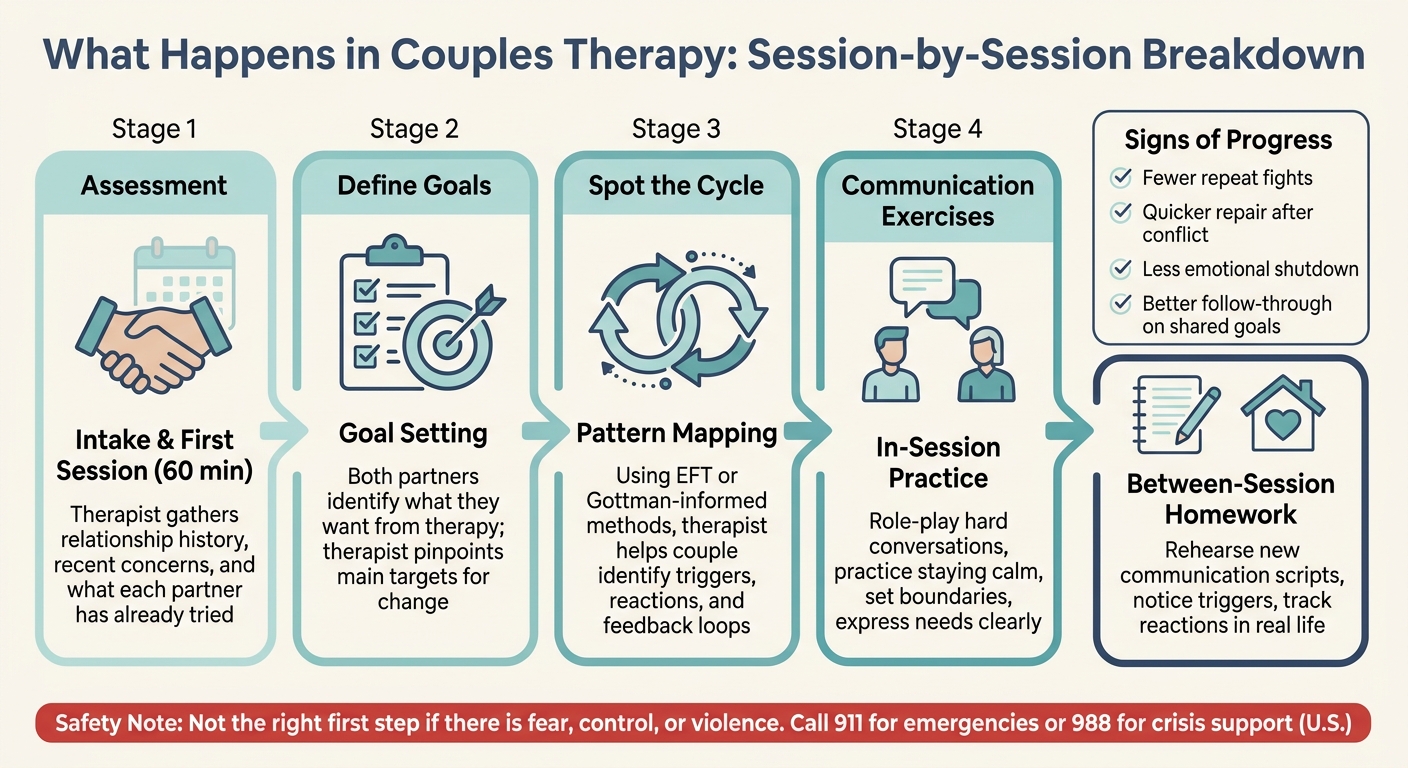
When couples therapy seems like a good fit, the first few sessions focus on three things: understanding the pattern, setting goals, and building a shared approach.
Assessment, relationship history, and setting goals
The first appointment is usually 60 minutes long. That first session isn’t only about the latest fight. It’s meant to help the therapist understand the relationship pattern underneath it.
Early sessions often cover your relationship history, what’s been hard lately, what each of you has already tried, and what you want from therapy. The therapist is trying to see the whole picture — not just the moment that brought you in.
That picture often includes more than the relationship itself. A therapist may ask about physical health, sleep, daily routines, past experiences, and outside stressors, since those things can shape how a couple shows up with each other. From there, the therapist pinpoints the main targets for change and lays out the next steps.
Once that groundwork is in place, sessions usually move from understanding the problem to practicing different responses.
Pattern-mapping, communication exercises, and conflict repair
As the assessment gets going, sessions often turn toward the cycle that keeps repeating. Therapists using Emotionally Focused Therapy (EFT) or Gottman-informed methods help couples spot what triggers the cycle and how each partner’s reactions sustain it.
Much of this work happens through active practice. Partners may role-play hard conversations, work on communication skills, and practice staying calm, speaking clearly, and handling tense moments without letting them spiral. The goal is simple: help each person say what they need, set boundaries, and stay steady during conflict.
Between-session practice and what progress looks like
What happens in session doesn’t stay there. Therapists often assign homework, rehearse new communication scripts, or pay attention to triggers and reactions as they come up in daily life.
Progress is often gradual. You might notice fewer repeat fights, quicker repair after conflict, and better follow-through on shared goals. The therapist and the couple usually track that progress together over time.
How to prepare for the first appointment and next steps
What to bring up in the first session
Come in ready to talk about the pattern you want to change. Start there, then get into what has shifted and what still feels stuck.
Try to describe the repeating cycle, not just the latest fight. That gives the therapist a clearer picture of what keeps happening between you. It also helps to say what you’ve already tried, so you don’t spend time going in circles.
You should also mention any mental or physical health factors that may be part of the picture, like anxiety, depression, chronic stress, or poor sleep. Those issues can shape how each person reacts and how the relationship dynamic plays out. And if there are any safety concerns, bring them up in the first session.
Before booking, confirm the therapist holds a license in your state. Also check insurance coverage and telehealth details ahead of time, so the first session can stay focused on the relationship pattern.
Conclusion: Why couples therapy is worth considering
Couples therapy isn’t a last resort. It works best before patterns become entrenched — when the same fight is still happening, but repair is still possible.
The goal isn’t to decide who’s right. It’s to understand what keeps happening between two people and whether a different response is possible. That work requires a neutral space, a structured process, and a clinician trained to see the cycle that both partners are too close to see clearly on their own.
If recurring conflict, emotional distance, or broken trust is affecting the relationship — and the pattern hasn’t shifted despite genuine effort — that’s worth taking seriously. Couples therapy gives both partners a shared framework for understanding what’s driving the dynamic, and a structured way to test whether it can change.
One important note: couples therapy is not the right starting point when safety is a concern. If there is controlling behavior, intimidation, or fear of consequences after sharing concerns, individual support and safety planning should come first. If you or someone you know is in immediate danger, call 911. For crisis support in the U.S., call or text 988.
The Relationship Deserves the Same Care You’d Give Anything Else That Matters.
If the same patterns keep showing up — and self-directed effort hasn’t been enough to shift them — a structured, neutral space can make a real difference. At Modyfi, our network of providers includes licensed therapists trained in evidence-based approaches to relationship work, as part of a coordinated care model that looks at the full picture.
👉 Explore Providers to Book an Appointment and Start Your Care Plan
(Note: Modyfi proudly accepts most major commercial insurance plans. We do not accept Medicare or Medicaid.)
FAQs
How many couples therapy sessions do most couples need?
There’s no fixed number. Most couples work with a therapist for 12 to 24 sessions, though some see meaningful progress earlier and others benefit from longer-term work.
EFT typically runs 8 to 20 sessions. Gottman-informed approaches vary by goal. Both tend to be time-limited rather than open-ended — most therapists set goals early and track progress against them.
The pattern and depth of the problem shape the timeline more than anything else. Recurring conflict with strong communication is easier to shift than long-standing emotional distance or broken trust. A therapist can give a clearer estimate after the first few sessions.
Can couples therapy help if only one partner is fully motivated?
Yes — though it works better when both partners engage. A motivated partner can still learn to respond differently, which sometimes shifts the dynamic even when the other person is hesitant.
That said, one partner doing all the work has limits. If the reluctant partner won’t engage at all, individual therapy is often the more productive starting point. It builds insight and coping skills that benefit the relationship indirectly.
Therapists regularly work with mismatched motivation. It’s worth starting — the dynamic often shifts once sessions begin.
Should we try couples therapy or individual therapy first?
It depends on what you want to address. Individual therapy focuses on one person’s patterns, coping skills, and internal experience. Couples therapy focuses on what happens between two people.
When the main concern is the relationship dynamic — recurring conflict, emotional distance, broken trust — couples therapy is usually the right starting point. When one partner is managing significant individual distress, individual therapy often helps first.
Many couples do both. Individual and couples work can run alongside each other when each addresses a different layer of the problem.
What is the success rate of couples therapy?
The evidence is stronger than most people expect. EFT moves 70–75% of couples from distressed to non-distressed in clinical trials. Gottman research shows 75% of couples report meaningful intimacy gains within three months.
Results vary by approach, therapist training, and how entrenched the pattern is. Couples who engage earlier — before conflict becomes the default mode — tend to see faster progress.
Success also depends on how you define it. Not all couples stay together after therapy. For some, the outcome is a clearer, healthier separation rather than reconciliation. Both count as progress when the alternative is staying stuck in a damaging pattern.
What should I not say in couples therapy?
Avoid leading with blame. Statements like “you always” or “you never” put the other partner on the defensive before any real conversation can start. Therapists call these generalizations — they close down dialogue rather than open it.
Don’t use the session to score points. Couples therapy isn’t a courtroom. Trying to get the therapist to validate your position usually slows progress and frustrates both partners.
It also helps to avoid catastrophizing mid-session — saying “this will never change” or “we’re done” during a difficult moment. Therapists expect hard conversations, but all-or-nothing language makes the work harder for everyone in the room.
Can couples therapy help with trust issues after infidelity?
Yes — and it’s one of the areas where structured couples therapy tends to be more effective than trying to work through it without support.
Rebuilding trust after infidelity requires both partners to engage with what happened, why it happened, and what would need to change. That process rarely goes well without a neutral third party to slow it down and keep it from turning into repeated cycles of accusation and defense.
EFT has specific protocols for affair recovery. Progress is possible, but it takes time — typically longer than standard couples therapy. Both partners need to commit to the process, including the partner who caused the breach.