


Many men need help long before they ask for it.
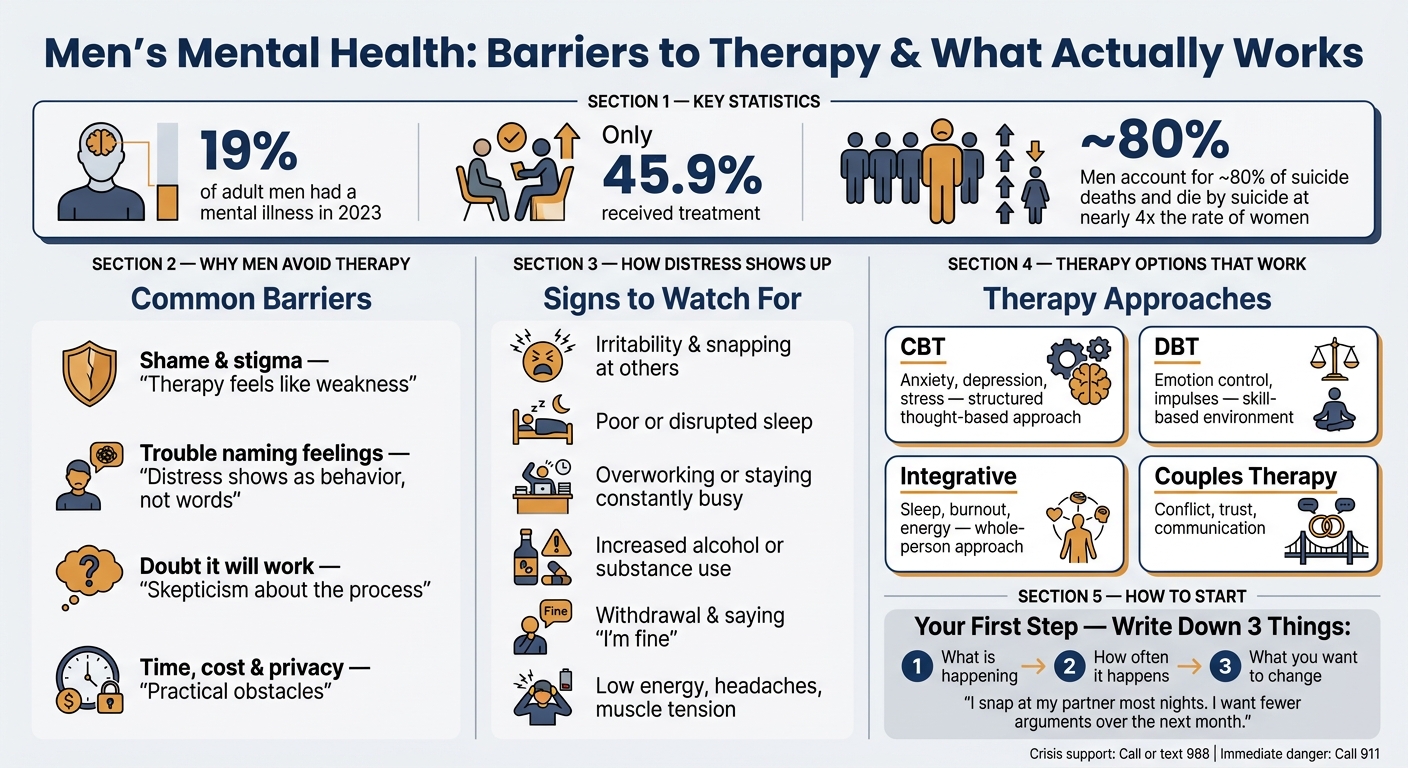
In the U.S., about 19% of adult men had a mental illness in 2023. Only 45.9% received treatment. Men account for about 80% of suicide deaths — at nearly four times the rate of women. These numbers aren’t a statement about weakness. They reflect what happens when stigma, self-reliance, and doubt about whether therapy will help get in the way of care.
Distress in men often shows up as behavior before it shows up as words: irritability, poor sleep, overworking, withdrawal, drinking more, low energy. It can look like “just stress” for a long time before anyone calls it a mental health issue.
Therapy doesn’t have to start with deep emotional language. It can start with one clear problem — “I’m not sleeping,” “I keep snapping at people,” “I feel off” — and build from there. Practical, structured, goal-focused care works. The barrier isn’t the therapy itself. It’s usually the first step.
Example: “I snap at my partner most nights. I want fewer arguments over the next month.”
The table below maps the most common barriers to seeking care, how they tend to show up, and a practical starting point for each:
| Main issue | How it may show up | What can help |
|---|---|---|
| Shame or fear of looking weak | Delaying care, hiding stress, saying “I’m fine” | Reframe therapy as problem-solving |
| Trouble naming feelings | Anger, numbness, sleep trouble, tension | Start with plain facts, not perfect words |
| Doubt therapy will work | Avoiding the first appointment | Ask how progress will be tracked |
| Time, cost, privacy | Missed follow-through | Check insurance, fees, telehealth, and privacy before booking |
If someone may hurt himself or someone else, has suicidal thoughts, or cannot stay safe, call or text 988. If there is immediate danger, call 911.
For a clinical overview of how depression and anxiety show up differently in men — and what getting help can look like — the video below from UC Davis Health offers useful context before diving into the evidence:
Men’s Mental Health: Depression, Anxiety and How to Ask for Help | UC Davis Health
sbb-itb-23f89d4
Why men often avoid therapy
Men often avoid therapy for learned reasons: stigma, self-reliance, fear of judgment, and doubt that it will help.
Stigma, self-reliance, and the fear of looking weak
Many men grow up hearing the same messages: man up, deal with it yourself, don’t talk about feelings, handle it alone. Over time, those ideas don’t just shape behavior. They shape self-judgment too. Therapy can start to feel like proof that something is wrong with you, not just a place to get help. Other people may treat therapy as weakness, and men can absorb that message and use it against themselves. Help then feels like failure.
That often shows up in everyday behavior. Men often put off making the call puts off making the call. He tells himself it’s not that bad. He waits until work, relationships, or his health have already taken a hard hit. Self-reliance can be useful right up to the point where it gets in the way of support.
Fear of vulnerability and being judged
Some men worry a therapist will see them as weak. Others worry a partner will lose respect for them, or that being open about distress could make them seem less capable at work. Those fears make sense, and they can make starting care feel heavy.
Therapy is generally private in the U.S. It helps to ask up front what the limits of confidentiality are and what an insurer or employer can actually see. If that feels fuzzy, clear it up before you book.
Not knowing what to say – and doubting therapy will work
For some men, the issue is simpler than people think: they don’t know how to explain what’s wrong. Distress doesn’t always show up as a clean, named feeling. More often, it starts with irritability, poor sleep, muscle tension, trouble focusing, or drinking more than usual. That can happen long before the pattern gets a name — anxiety, burnout, or grief.
That’s a normal place to start, not a reason to stay away. A therapist can work with something as plain as I’m sleeping four hours a night and snapping at everyone just as well as with a polished explanation.
Practical doubts matter too. Cost, insurance confusion, a packed schedule, no private room at home for a virtual session, or not believing that talking will change anything can all get in the way. Those are real concerns worth raising before or during the first appointment — not reasons to avoid taking it.
These barriers often show up as behavior first — before anyone involved recognizes them as a mental health concern.
How distress shows up before men call it a mental health problem
Most men notice distress in what they do before they call it a mental health issue. It often shows up as irritability, shutting down, overworking, drinking more, or sleep trouble. None of these signs prove a diagnosis. But if they persist, worsen, or begin affecting daily life, they deserve attention. That’s part of why this gets missed so often: it can look like “just stress” at first.
Irritability, shutdown, and avoiding hard conversations
Anger is often the first thing other people notice. A man might snap at his partner over something minor, lose patience with his kids faster than usual, or feel keyed up at work. Men may show depression through irritability and frustration instead of obvious sadness.
Withdrawal can be easy to brush off too. It may look like shorter answers, fewer plans, or saying “I’m fine” while feeling flat or numb. If that pattern keeps going, it’s worth paying attention to.
Overworking, substance use, and other ways of escaping discomfort
Distress doesn’t always look like falling apart. Sometimes it looks like staying busy all the time. Work, workouts, errands, side projects – on the surface, that can look productive. But it can also be a way to avoid being still. The issue isn’t busyness by itself. The issue is not being able to slow down, feeling guilty while resting, or feeling worse the second the motion stops.
Substance use can play the same role. Drinking more often, using drugs to sleep or calm down, needing something to get through social situations, or trying to cut back and not being able to – those changes matter. NIMH lists increased alcohol or drug use as a possible sign of depression. These behaviors often point to something deeper.
Sleep problems, low energy, and physical symptoms
Sleep changes are another common clue. Trouble falling asleep, waking up too early, sleeping too much, or dragging through the day can all signal that stress is piling up. NIMH also lists headaches, muscle tension, digestive problems, chest tightness, and a racing heart as possible physical signs of distress. Since these symptoms feel physical, many men go to a doctor for them before linking them to stress, burnout, or mood.
Other signs can show up too:
- Less interest in sex or hobbies
- Feeling disconnected
- Feeling trapped or hopeless
If several of these signs have lasted for weeks, are getting worse, or are hurting work, relationships, or basic day-to-day function, that’s reason enough to reach out. A useful starting point: What changed? When did it start? Is it affecting daily life?
If someone may harm himself or another person, has suicidal thoughts, or cannot stay safe, call or text 988. For immediate danger, call 911.
What therapy for men can actually look like
For a lot of men, distress shows up in behavior before it shows up in words. That’s why therapy often starts with what’s right in front of you: poor sleep, work stress, irritability, low motivation, or trouble starting, organizing, or finishing tasks. From there, treatment can focus on behavior change and practical skills before moving into deeper emotional territory.
What happens in a first session
A first appointment is usually a 60-minute intake session. The therapist will ask what’s been going on, along with your health history, lifestyle, sleep, nutrition, and what you want from treatment. The goal is to build a treatment plan based on your situation.
A good therapist helps turn everyday problems into clear goals. So if you come in saying, “I can’t sleep,” “I keep snapping at people,” or “I feel stuck at work,” they should help define what progress looks like. You don’t have to figure that out on your own. After that first session, follow-up visits usually last 30 to 60 minutes.
Therapy approaches that often fit men’s needs
Once the therapist has a sense of the problem, the next step is picking the approach that fits it. Some men want a structured, skills-based setup. Others want to look at stress, health habits, and relationships all at once. The main approaches vary in structure and focus:
| Therapy Approach | Primary Focus | Common Concerns Addressed | What Sessions May Involve | Best Fit |
|---|---|---|---|---|
| CBT | Identifying thoughts, beliefs, and assumptions that make life harder | Anxiety, depression, perfectionism | Identify unhelpful thoughts and practice new responses. | Men who prefer a structured, cognitive-based approach |
| DBT | Balancing behavior change with acceptance; building specific life skills | Emotional dysregulation, impulsivity, trauma, substance use | Build mindfulness, distress tolerance, and communication skills. | Men who prefer a highly structured, skill-based environment |
| Integrative Therapy | The connection between mind, body, lifestyle, and environment | Chronic stress, burnout, sleep issues, low energy | Review sleep, movement, nutrition, and stress together. | Men looking for a whole-person or biological approach to mental health |
| Couples Therapy (EFT/Gottman) | Improving communication and rebuilding trust | Relationship conflict, disconnection | Use structured methods to improve communication and trust. | Men looking to improve their primary partnership |
Why fit, structure, and format matter
The method matters. But the working relationship matters too. Men often stay more engaged when therapy feels structured, practical, and tied to clear goals. If a therapist gives homework, tracks progress, and changes the plan based on what’s helping, that’s usually a sign the format is a good match.
Virtual care can also make a big difference when the main barrier is privacy or scheduling. It gives you access to individual therapy, skills groups, and medication management from home. For many people, that makes getting started feel more doable.
During or after your first session, it helps to ask directly: How will we measure progress? What does the treatment plan look like? If a provider can answer clearly, a clear answer is a good sign the provider works in a structured, transparent way.
How men can take the first step toward care
Reframe therapy as problem-solving and skill-building
Start with a plain description of what’s going on. You don’t need a big speech. Something like “I’m not functioning like myself” or “I need help with stress and anger” is enough.
Before the first session, write down three things: what’s happening, how often it happens, and what you want to change. For example: “I snap at my partner most evenings. I want to pause before reacting and have fewer arguments within the next month.” That’s a clear goal, not a confession. It gives the session a direction right away.
How to choose a therapist and judge fit early
Once you know what you want help with, look for a therapist whose style fits the way you want to work. Check the basics first: licensure, fees, insurance, telehealth availability, and experience with your main concern. Fit matters too. The right provider listens, avoids stereotypes, and adjusts to your goals instead of forcing you into a one-size-fits-all approach.
Before you book, ask a few direct questions:
- “How do you work with clients who are unsure about therapy?”
- “How will we know this is helping?”
- “Do you use structured exercises or between-session practice?”
- “What are your fees, and are you in network with my insurance?”
Use the first one to three sessions to judge fit, not therapy as a whole. If you feel dismissed, judged, or confused about the treatment plan, that’s worth raising directly or reconsidering the fit. A poor early match doesn’t mean the process failed.
Before booking, confirm whether the provider is in network, whether your deductible applies, and whether prior authorization is needed. If you’re using telehealth, confirm the clinician holds a license in your state. Coverage and licensing rules vary by plan and location.
Getting Started With Integrated Care
When the main barrier is access or coordination, integrated virtual care can address multiple layers of a problem in one place — psychiatry, therapy, nutrition, and exercise support working from a shared plan.
Therapy Works Best When It Fits the Way You Think.
If you want structured, goal-focused care that treats the full picture — not just one symptom at a time — Modyfi brings psychiatry, therapy, nutrition, and exercise together in one coordinated virtual plan. No referral chain. No separate offices. One shared approach built around your specific situation.
👉 Explore Providers to Book an Appointment and Start Your Care Plan
(Note: Modyfi proudly accepts most major commercial insurance plans. We do not accept Medicare or Medicaid.)
Conclusion: One Step Is Enough to Begin
Many men delay seeking therapy for overlapping reasons — stigma, pressure to handle problems alone, fear of judgment, and doubt that talking will help. Distress doesn’t always look like sadness. It can look like irritability, overworking, poor sleep, or withdrawal. That’s exactly why practical, structured care matters.
Therapy doesn’t require a complete understanding of what’s wrong before starting. It can begin with one clear problem, one goal, and a few concrete skills. It tends to work better when treated as problem-solving — not as a verdict on character.
Name one thing that isn’t working. Write it down. That’s a sufficient starting point.
Asking for help is a health decision.
FAQs
How do I know if therapy is right for me?
Therapy may be a good fit if you’re dealing with mild to moderate emotional distress, moving through a life change, or trying to build better coping skills.
It helps most when low mood, anxiety, or loss of interest has lasted more than two weeks and doesn’t ease with usual coping — or when it begins affecting work and relationships.
What if I do not know how to talk about what I feel?
You’re not alone. Therapy is meant to help you build this skill, so you don’t need to walk in with the “right” words.
A therapist can help you sort through your experiences, spot patterns, and name what you’re feeling. Approaches like DBT can also teach emotion-awareness skills in a structured, nonjudgmental way, at your own pace.
How can I tell if a therapist is a good fit?
A therapist fits when their approach matches what you want help with and feels comfortable to work with. That’s clearer than it sounds — you don’t need to decide after one session.
Pay attention to how they structure the work. A good therapist listens closely, picks up on shifts in tone or behavior, and creates a space where you feel heard and included in your care. They set clear goals, track progress, and adjust the plan based on what’s actually helping.
If sessions feel vague, you’re unsure what you’re working toward, or you leave most appointments without a clear next step — that’s worth raising directly. You can say: “I’m not sure what we’re working on. Can we define a clearer goal?” If the response doesn’t help, switching providers is reasonable. A poor early match doesn’t mean therapy doesn’t work.
Does therapy actually work for men?
Yes — and the evidence is stronger than most people expect.
CBT produces meaningful symptom reduction for depression and anxiety across large clinical trials, with effect sizes comparable to medication for mild to moderate cases. EFT moves 70–75% of couples from distressed to non-distressed in clinical research. Structured, goal-based approaches tend to work especially well for men who prefer practical problem-solving over open-ended conversation.
Fit matters as much as method. Men who engage with a therapist they trust, in a format that feels structured and relevant to their daily life, tend to stay in therapy longer — and longer engagement produces better outcomes. The research on dropout rates shows that men leave therapy early more often than women, but that gap narrows significantly when the format matches the way they prefer to work.
Therapy doesn’t work for everyone in every format. But the evidence strongly supports trying it — particularly when symptoms have been present for weeks, are worsening, or are affecting work and relationships.
How long does therapy take to work?
It depends on the problem, the approach, and how consistently sessions happen.
Short-term shifts — better sleep, fewer arguments, clearer thinking — can appear within four to six weeks of consistent work with the right approach. CBT for depression and anxiety typically produces measurable change within 8 to 16 sessions. Deeper patterns — long-standing anxiety, trauma, or relationship dynamics — often take longer, sometimes six months or more.
Men who set clear goals early and treat sessions like structured work tend to see progress faster. If nothing has shifted after 8 to 10 sessions, that’s worth raising directly with the therapist. It may mean adjusting the approach, the focus, or the fit — not that therapy isn’t the right direction.
The most useful frame: track one or two specific things you want to change, not just how you feel in general. Concrete progress is easier to see — and easier to build on.
What type of therapy is best for men with depression or anxiety?
There’s no single answer — but structured, goal-based approaches tend to fit best for men who prefer practical problem-solving.
CBT is the most evidence-backed starting point for both depression and anxiety. It focuses on identifying thought patterns and behavioral responses that sustain distress, and building concrete skills to change them. Sessions are structured, homework-based, and tied to measurable goals — a format many men find easier to engage with than open-ended talk therapy.
DBT is worth considering when emotional reactivity, impulse control, or intense mood swings are part of the picture. It teaches specific skills — distress tolerance, emotional regulation, interpersonal effectiveness — in a structured, practical format.
For men dealing with relationship conflict alongside depression or anxiety, couples therapy using Gottman or EFT methods addresses both the relational dynamic and individual distress at the same time. And when sleep, nutrition, or physical health are part of the pattern, integrated care that brings psychiatry, therapy, and lifestyle support into one plan tends to produce more complete results than addressing each separately.