


“Brain rot” is not a medical diagnosis. It’s slang — a way people describe feeling foggy, scattered, or mentally drained after too much scrolling, app-switching, or late-night screen time.
The term went viral for a reason. It captures something real. After hours of short-form video, doomscrolling, and nonstop notifications, focus gets harder. Sleep gets shorter. Mood takes a hit. These effects are real — even if the label isn’t clinical.
But brain rot doesn’t always mean digital overload is the culprit. The same symptoms show up with anxiety, depression, ADHD, and chronic stress. A 2024 systematic review found that problematic social media use was associated with depression, anxiety, and poor sleep — but association doesn’t prove causation. Sometimes scrolling is how people cope with distress that was already there.
The most useful question isn’t whether brain rot is real. It’s what’s actually driving the pattern — and whether it eases when habits change, or sticks around regardless.
⚠️ If you are in emotional crisis or having thoughts of suicide, call or text 988 — the Suicide & Crisis Lifeline — available 24/7 across the United States. If there is immediate danger, call 911.
For a science-based look at what researchers have actually found about doomscrolling and attention spans — including what the studies show and what they don’t — the video below from BBC Global offers useful context before diving into the evidence:
Is Brain Rot Taking a Toll on Your Health?
sbb-itb-23f89d4
What “brain rot” is and what it is not
Brain rot is slang for that foggy, scattered, low-motivation state some people feel after spending hours with repetitive, highly stimulating online content. Think short videos, meme feeds, or auto-play clips that just keep coming.
A slang term, not a diagnosis
Brain rot is not a psychiatric or neurological diagnosis. It also doesn’t mean your brain has been permanently damaged.
The underlying symptoms are real and worth naming: attention fatigue, trouble concentrating, irritability, poor sleep, or lower motivation. Those symptoms are real, and they matter. But on their own, they don’t add up to a medical label.
That difference matters. Calling the feeling “brain rot” can make it sound permanent, even though, in many cases, the symptoms ease when the pattern behind them changes.
Why the cause is not always clear
The term can be useful, but it doesn’t tell you why this is happening. The same symptoms can also show up with anxiety, depression, ADHD, chronic stress, poor sleep, medication side effects, or other medical issues. A 2024 systematic review found that problematic social media use was associated with depression, anxiety, and sleep problems, but association does not prove scrolling caused them.
Sometimes the relationship goes both ways. Someone who already feels stressed, lonely, or anxious may scroll more to cope. In that case, the media habit may be a response to distress just as much as a factor adding to it. Assuming screen time is always the root cause can cause something else to go unaddressed.
The most useful question is simple: does the fog lift when screen time drops, or do symptoms stick around regardless?
How digital overload affects focus, mood, and sleep
Habits often linked to mental overload
Brain rot often shows up after too much switching between apps, feeds, and devices. That can look like doomscrolling – endlessly consuming upsetting news – short-form video loops, and nonstop notifications. Algorithm-driven feeds serve content continuously, making it easy for one video to become ten without a conscious decision. And when alerts keep firing, there’s barely any natural break.
That means your brain stays stimulated for long stretches without much downtime. Over time, that steady input can wear down attention and self-control.
Attention fatigue and stress on the nervous system
The main issue isn’t only screen time. It’s the constant switching.
Every time you jump from one app to another, your brain has to reset. It has to reorient, let go of the last task, and lock onto the next one. Do that over and over throughout the day, and staying focused on one thing can start to feel weirdly difficult. That’s attention fatigue – a temporary drop in sustained focus after repeated mental effort.
In a University of British Columbia study, smartphone users reported higher levels of inattention and hyperactivity when notifications were turned on than when they were turned off.
Over time, this pattern can show up as irritability, restlessness, lower motivation, and trouble settling into slower activities like reading, exercising, or having a real conversation. It can also keep your nervous system on edge, as if it never gets the signal to stand down.
To be clear, attention fatigue is temporary. It is not brain damage. When the pattern behind it changes, the symptoms often ease too.
Why poor sleep makes it worse
Late-night screen use can delay sleep in a few plain ways:
- It keeps your mind engaged
- It pushes bedtime later
- Notifications interrupt wind-down time
A 2025 systematic review of 21 studies with 548,338 participants found that each additional hour of daily screen time was associated with about 3–5 fewer minutes of sleep and an odds ratio of 1.25 for short sleep. The evidence is associative, so it doesn’t prove that every late-night scroll causes sleep problems. Still, the pattern shows up often enough to take seriously.
And once sleep slips, the rest tends to follow. The CDC reports that adults sleeping fewer than 7 hours have greater difficulty concentrating, remembering, and performing daily activities than those sleeping 7–9 hours.
A tired brain also has a harder time resisting passive, high-stimulation content the next day. That’s how the loop keeps feeding itself. Stop recreational screen use 30–60 minutes before bed and keep your phone out of reach.
The key question is whether these symptoms fade when the pattern changes or keep showing up even when you’re off your phone.
The infographic below compares temporary digital overload with signs that may point to something more serious — across duration, triggers, sleep, mood, and functional impact:
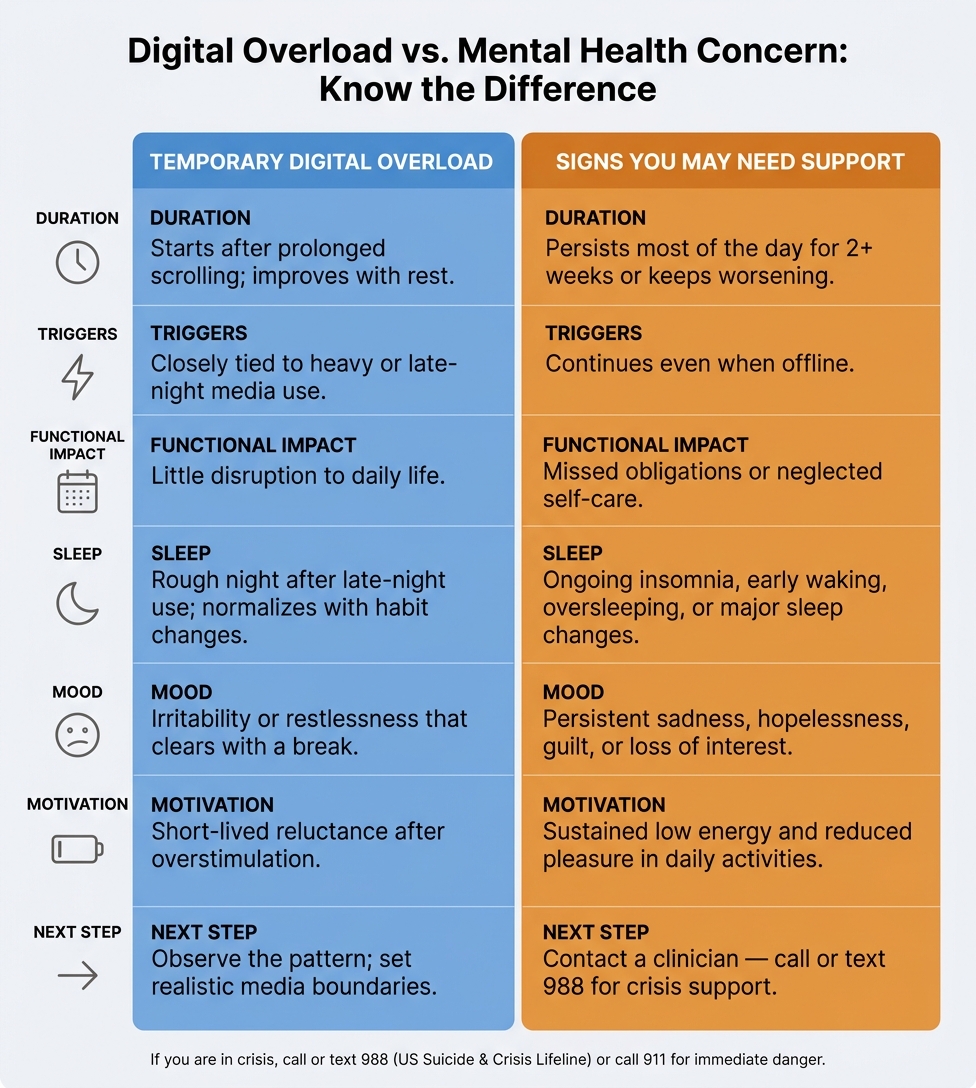
How to tell short-term overload from lasting symptoms
The main question is simple: does the fog lift after rest, or does it stick around even when you’re offline?
Temporary digital overload often shows up after long scrolling sessions or late-night screen time. You might feel scattered, irritable, or mentally drained. But once you sleep, step away from the feed, and lower the noise, those feelings usually ease. In most cases, work, relationships, and basic self-care are still mostly on track.
A different pattern emerges when symptoms persist even when you’re offline. Low mood, anxiety, hopelessness, or loss of interest that continues throughout the day – even when you’re off your phone points to something more serious. Major depression involves low mood or loss of interest most days for at least 2 weeks, along with symptoms that interfere with daily life. If you’re skipping obligations, pulling away from people, or having a hard time doing basic tasks for 2 weeks or more, it’s time to see a clinician – not just try a digital detox.
Screen habits can also become a way to avoid loneliness, anxiety, or grief. The problem is that scrolling often pushes out sleep, exercise, and face-to-face connection. That can make distress worse, which then feeds even more scrolling. Each tends to reinforce the other.
A simple plan to reduce digital overload and protect well-being
If your symptoms ease up when your screen habits change, try a short reset. When the pattern points to overload, make small adjustments and track your sleep, mood, and focus for 1–2 weeks.
Identify the pattern and reduce automatic scrolling
Before you change anything, spend 7–14 days paying attention to what’s actually going on. Each time you scroll without intending to, note the time, trigger, app, duration, and how you felt afterward. Common triggers are boredom, stress, loneliness, and fatigue. It doesn’t take long for that record to show what’s driving the habit.
Once the trigger is clear, cut down on the prompts around it. Turn off nonessential notifications. Move distracting apps off your home screen. Use app limits or downtime if that helps. Keep your phone out of reach during meals, meetings, and conversations.
A good starting target is simple:
- Cut one predictable scrolling session by 10–15 minutes
- Check messages at set times instead of reacting to every alert
Protect single-task focus and improve your evening routine
Attention usually comes back bit by bit, not all at once. Start with one clearly defined task, silence nonessential alerts, and put your phone somewhere you can’t grab it on impulse. Try 20–30-minute focus blocks with 5-minute breaks. Batching communication can help — for example, checking messages at set times rather than reacting to every alert throughout the day.
Sleep has a huge effect on focus, so your evening habits matter. Protect the last hour before bed. Set a screen cutoff 30–60 minutes before bedtime, charge your phone outside the bedroom, and swap scrolling for reading, stretching, music, or journaling. Then give the routine a few nights before judging it. You’re looking for changes in how fast you fall asleep, whether you wake up during the night, and how your energy feels the next day.
When integrative mental health care may help
If the brain fog doesn’t lift after a couple of weeks, it may be time to move from self-management to a proper evaluation. Lasting trouble with concentration, poor sleep that keeps dragging on, or a steady drop in motivation can point to depression, anxiety, ADHD, insomnia, or other medical factors that a screen-time reset won’t fix on its own. At that point, the issue may be more than digital overload, and professional support makes sense.
When self-management isn’t enough, an integrated clinical evaluation can identify what’s actually driving persistent symptoms — and build a plan around it.
Symptoms Are Signals. Let’s Find the Source.
If brain fog, low motivation, or poor sleep are sticking around despite habit changes — the issue may go beyond screen time. At Modyfi, our Root-Cause Psychiatry approach brings psychiatry, therapy, nutrition, and exercise together to understand what’s actually driving your symptoms.
👉 Explore Providers to Book an Appointment and Start Your Care Plan
(Note: Modyfi proudly accepts most major commercial insurance plans. We do not accept Medicare or Medicaid.)
Conclusion: Use the term with care and look at the pattern behind it
“Brain rot” is slang, not a medical diagnosis. It captures something real — that foggy, scattered state that can follow hours of doomscrolling, nonstop notifications, and late-night screen use. But the same symptoms can also point to anxiety, depression, ADHD, or chronic stress that reducing screen time alone won’t fix.
The most useful question is whether symptoms ease when habits change, or persist regardless of what you do on your phone. If the fog lifts with better sleep and fewer notifications, digital overload was likely part of the problem. If low mood, poor focus, or loss of motivation stick around after genuine habit changes, that’s worth taking seriously.
A licensed mental health professional can look at the full picture — ruling out other causes, identifying what’s actually driving the pattern, and recommending appropriate next steps.
If you are ever in crisis or having thoughts of suicide or self-harm, call or text 988 in the United States, or call 911 if there is immediate danger.
FAQs
Can brain rot become permanent?
Brain rot is not a medical condition, so the question of permanence doesn’t apply in a clinical sense. What people usually mean when they ask this is whether the mental fog, reduced focus, and low motivation associated with heavy screen use can become lasting — and the honest answer is: it depends on what’s actually causing them.
When symptoms are primarily driven by digital overload — too much screen time, poor sleep from late-night scrolling, constant notification interruptions — they tend to improve meaningfully when those habits change. The brain is not permanently altered by passive content consumption in the way the term “brain rot” implies. Attention fatigue is real, but it’s also reversible.
Where things get more complicated is when symptoms persist despite genuine habit changes. Low mood, poor concentration, loss of motivation, and disrupted sleep that continue even after reducing screen time may point to depression, anxiety, ADHD, or another condition that self-management can’t fully address. In those cases, the symptoms aren’t caused by screen time — they’re being revealed by it, or masked by it.
The short answer: if symptoms ease when habits change, digital overload was likely part of the picture. If they don’t, something else may need attention.
How much screen time is too much?
There’s no one-size-fits-all limit for screen time. The issue starts when it disrupts sleep, affects daily functioning, or becomes difficult to control.
A simple rule of thumb: set a digital curfew and stay off screens for 60 to 90 minutes before bed. If media use is tied to ongoing low mood, sleep trouble, or problems with work or basic self-care, it may be time to seek professional support.
When should I talk to a clinician?
A clinical evaluation makes sense when symptoms persist, worsen, or begin interfering with daily life — regardless of whether you’ve already tried adjusting your screen habits.
Specifically, consider reaching out if low mood, anxiety, or loss of interest has lasted more than two weeks and isn’t connected to a specific event or circumstance. If you’re struggling to meet work or school obligations, withdrawing from relationships, or having difficulty with basic self-care, those are signals worth taking seriously.
It’s also worth seeking support if your usual coping tools — including digital detoxes or reduced screen time — aren’t helping. Some symptoms that look like digital overload are actually early signs of depression, generalized anxiety disorder, ADHD, or sleep disorders. A clinician can help distinguish between the two and recommend appropriate next steps.
Other signs that warrant prompt evaluation include severe mood swings, major changes in sleep or appetite, substance use as a coping strategy, or any thoughts of self-harm. If you’re in crisis, call or text 988 — the Suicide and Crisis Lifeline — which is available 24 hours a day, seven days a week across the United States.
Is brain rot real or just a trend?
The term is a trend. The underlying experience is real — though less dramatic than the name suggests.
Oxford University Press named “brain rot” its Word of the Year for 2024, reflecting a 230% increase in usage between 2023 and 2024. The official definition describes it as “the supposed deterioration of a person’s mental or intellectual state, especially viewed as the result of overconsumption of material considered to be trivial or unchallenging.”
The word “supposed” in that definition is doing real work. There is no evidence that the brain literally rots — or that passive digital consumption causes permanent neurological damage. What the research does show is more nuanced: sustained attention on a single digital task has declined from around 150 seconds in 2004 to about 47 seconds in 2024, according to research by Gloria Mark at UC Irvine. Heavy social media use is associated with depression, anxiety, and poor sleep — though the relationship is bidirectional, not simply causal.
So brain rot is real in the sense that the symptoms people describe are genuine. It’s a trend in the sense that the label has outrun the science. The most useful response isn’t to dismiss the experience or to catastrophize it — it’s to look at what’s actually driving the pattern and whether it eases when habits change.
How do I know if I have brain rot or ADHD?
The symptoms overlap significantly — which is part of why this question comes up so often. Both brain rot and ADHD can involve difficulty sustaining attention, mental fog, restlessness, low motivation, and a tendency to seek stimulation over slower tasks.
The key distinction is developmental history and persistence. ADHD is a neurodevelopmental condition — its core symptoms have typically been present since childhood, even if they weren’t recognized or diagnosed until later. They show up across multiple settings, regardless of screen habits, and they don’t resolve when someone takes a break from their phone.
Brain rot symptoms, by contrast, are more situational. They tend to follow periods of heavy screen use and ease — at least partially — when those habits change. If focus and motivation return meaningfully after a few days of better sleep and fewer notifications, digital overload is the more likely explanation.
That said, heavy screen use can mask or amplify ADHD symptoms — making them harder to recognize. And ADHD can make it harder to regulate screen use in the first place, creating a cycle where both are present. If reducing screen time doesn’t improve focus and motivation, or if attention difficulties have been a lifelong pattern, an evaluation for ADHD is worth considering.
Can you recover from brain rot?
Yes — and for most people, the recovery is more straightforward than the term implies.
When symptoms are primarily driven by digital overload, meaningful improvement tends to follow within one to two weeks of consistent habit changes: reducing overall screen time, turning off nonessential notifications, stopping screen use 30–60 minutes before bed, and protecting longer blocks of uninterrupted focus during the day. Attention fatigue responds relatively quickly to reduced stimulation — the brain doesn’t need months to recalibrate when the input load drops.
Sleep is often the fastest lever. Many people notice improved clarity, mood, and focus within a few days of better sleep alone — before making any other changes.
Recovery becomes more complex when symptoms don’t respond to habit changes, or when they were never primarily about screen use in the first place. Persistent low mood, poor concentration, or low motivation that continues despite genuine lifestyle changes may point to depression, anxiety, ADHD, or another condition that requires professional evaluation and support.
The most useful frame: treat the habit changes as a diagnostic tool as much as a treatment. If things improve, you have your answer. If they don’t, that’s information worth acting on.