


Genetic testing for antidepressants can help guide medication choice and dose, but it cannot tell you which medication will work. It may be worth asking a prescriber about, especially after side effects or unsuccessful medication trials.
What the evidence actually shows:
- Genes help estimate how the body processes some medications. CYP2D6, CYP2C19, and sometimes CYP2B6 can guide prescribing for certain antidepressants. For example, the FDA limits citalopram to 20 mg per day for CYP2C19 poor metabolizers.
- Treatment history still matters. Symptoms, past response, other medications, and health conditions can change how a genetic result applies. Testing does not measure blood drug levels or reliably predict specific side effects.
- Not every marker has the same support. Established gene–drug guidance carries more weight than claims about MTHFR or a report’s color coding.
- Check the practical details first. Ask about insurance, written costs, DNA privacy, and who will explain the results. For telehealth, confirm that testing is available and that the clinician holds a license in your state.
Genetics works best as one part of the decision, not the whole answer. Do not change or stop an antidepressant based on a genetic report alone.
How Metabolism Affects Medication Choice and Dose
Understanding Metabolizer Status
Many antidepressants pass through liver enzymes from the cytochrome P450 family. Gene variants can make these enzymes work faster or slower than usual. A test report sorts each result into a metabolizer status, from poor to ultrarapid.
Metabolizer status works as a dosing tool. It can help prescribers choose a starting dose and decide how fast to adjust it, a process called titration. These dose effects apply only to specific gene–drug pairs.
| Metabolizer status | Expected medication exposure | Main risk | Typical action | |
|---|---|---|---|---|
| Poor metabolizer | Very high | More side effects or toxicity | Lower dose, slower titration, or another medication | |
| Intermediate metabolizer | High | Increased side-effect risk | Lower starting dose or careful monitoring | |
| Normal metabolizer | Standard | Usual medication risks still apply | Standard dosing and titration when otherwise appropriate | |
| Rapid metabolizer (CYP2C19) | Low | Reduced benefit for some medications | Standard starting dose; if response is poor, a higher dose or another medication, depending on the drug | |
| Ultrarapid metabolizer | Very low | Inadequate response for some medications |
|
These patterns get more complicated when a drug produces an active metabolite: a breakdown product that also has therapeutic effects. Venlafaxine is one example. Its active metabolite, O-desmethylvenlafaxine, means parent-drug levels do not fully predict response.
Antidepressants With Gene-Based Guidance
Recommendations depend on the specific gene–drug combination. The strength of the guidance and the suggested changes both vary. The same metabolizer status may call for different actions depending on the antidepressant. The table below summarizes common pairs from the 2023 CPIC guideline.
| Medication | Gene | Gene-based dose guidance | Limitations |
|---|---|---|---|
| Citalopram | CYP2C19 | FDA maximum for poor metabolizers: 20 mg per day | Higher exposure increases the risk of QT prolongation, a heart rhythm risk |
| Escitalopram | CYP2C19 | Lower starting dose and slower titration for poor metabolizers; an alternative for ultrarapid metabolizers | Recommendations differ by status |
| Sertraline | CYP2C19 | Lower starting dose and slower titration for poor metabolizers | CYP2B6 also influences metabolism |
| Sertraline | CYP2B6 | Use status to guide dosing | Both gene results may need review |
| Paroxetine | CYP2D6 | Use a lower dose or another medication for poor metabolizers | The appropriate action depends on the specific result |
| Fluvoxamine | CYP2D6 | Lower starting dose and slower titration for poor metabolizers | Side-effect monitoring remains important |
| Venlafaxine | CYP2D6 | Consider an alternative not mainly processed by CYP2D6 for poor metabolizers | Optional recommendation; parent-drug levels do not fully explain response |
| Vortioxetine | CYP2D6 | Lower starting dose for poor metabolizers | Recommendation strength varies by status |
Why Dose Changes Need Prescriber Supervision
Both tables are educational summaries, not dosing instructions. Before changing a dose, a prescriber needs to review symptoms, side effects, age, interacting medications, and liver or kidney function. Bring a complete list of medications and supplements so genetics can sit alongside these other factors.
Do not change or stop an antidepressant based on genetics alone. If a switch makes sense, a prescriber can plan a gradual taper to reduce withdrawal symptoms.
For a general overview of how pharmacogenomics works, the short video below from Mayo Clinic explains how genetic information can inform medication choice and dosing. Current gene–drug recommendations, like those in the tables above, follow the 2023 CPIC guideline.
sbb-itb-23f89d4
Pharmacogenomics: The Right Drug, for the Right Patient, at the Right Dose
What Genetics Can Tell Us About Side Effects and Response
Medication Levels and Side-Effect Risk
Higher medication exposure can increase side-effect risk, while lower exposure can reduce treatment benefit. Testing does not reliably predict sedation or activation (restlessness, anxiety, or insomnia). These reactions need clinical assessment.
What Testing Can and Cannot Predict
Genetic testing cannot explain depression by itself. Metabolizer status helps estimate medication exposure, but treatment response still depends on symptoms, treatment history, and follow-up.
Some markers, including MTHFR, have weaker and less consistent links to antidepressant response. The 2023 CPIC guideline also found that current data do not support using serotonin-related genes like SLC6A4 and HTR2A to guide prescribing.
The infographic below shows what genetic testing can inform, what it cannot establish on its own, and what other clinical information still matters.
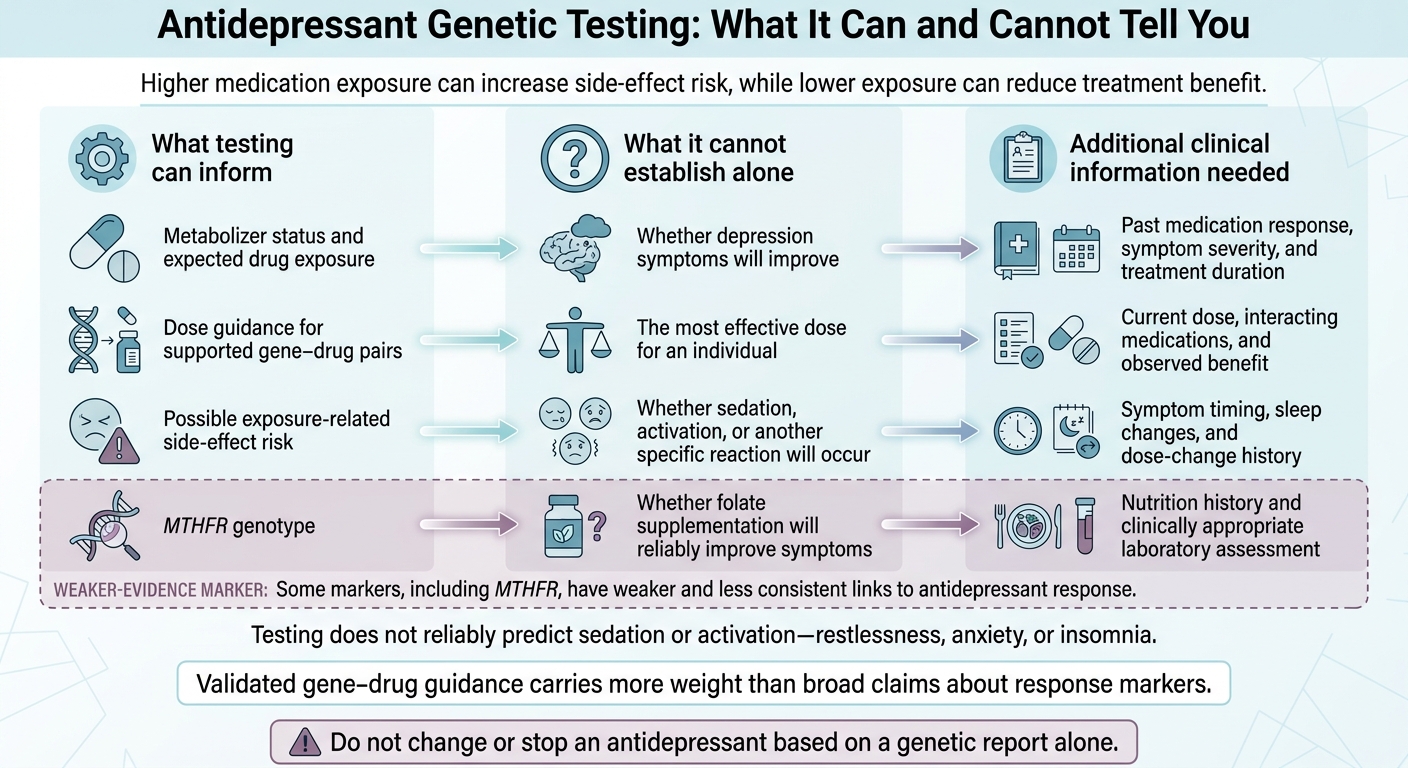
Validated gene–drug guidance therefore carries more weight than broad claims about response markers.
Research on Genetic Testing and Treatment Outcomes
The largest trial so far is PRIME Care, published in JAMA in 2022. It enrolled 1,944 veterans with major depression at 22 VA medical centers. In half the group, clinicians received pharmacogenomic results to guide treatment. The other half received usual care.
Testing changed prescribing. About 59% of tested patients started an antidepressant with no predicted drug–gene interaction, compared with about 26% in usual care. Remission rates were higher with testing, but the difference was small and did not persist over time.
The FDA takes a similarly measured view. Its Table of Pharmacogenetic Associations lists gene–drug pairs with sufficient scientific evidence. Inclusion in the table does not mean the FDA recommends testing before every prescription.
Evidence for folate-based treatment guided by MTHFR results remains limited. Clinicians should weigh test results alongside other clinical information, not use them as a standalone answer.
How Clinicians Use Genetics Alongside Medication History
Review Symptoms and Past Treatment
Once a test reports metabolizer status, clinicians compare it with past treatment response. The evaluation also covers symptoms, medication history, sleep, nutrition, trauma, and current health factors.
For each antidepressant you’ve tried, note the dose, how long you took it, benefits, side effects, and why you stopped. Past records can fill in gaps. A medication that works should generally stay in place unless genetics points to a specific dosing or safety issue.
Check Drug Interactions and Health Factors
Share every prescription, over-the-counter medicine, and supplement you use. Clinicians check for interactions and health factors that may change enzyme activity or drug exposure.
Actual enzyme activity can differ from what the gene result predicts, a change called phenoconversion. Strong CYP2D6 inhibitors such as fluoxetine, paroxetine, or bupropion can make a normal metabolizer act like a poor one. In that case, the medication list can matter more than the genetic report.
Choose a Plan and Track Results
The clinician and patient then decide whether to continue, adjust, or switch medication, using clinical information and past treatment response. Licensed clinicians make prescribing decisions.
Modyfi Health uses 30- to 60-minute follow-ups to review progress and adjust care. If treatment response is poor, the clinician rechecks the diagnosis, dose, interactions, and health factors.
Deciding Whether to Get Tested
When to Discuss Genetic Testing
Genetic testing may help guide the next step when medication response, side effects, or interactions leave questions unanswered. Ask about testing after repeated side effects or unsuccessful antidepressant trials. It matters most when the results could change your next medication or dose. Most people don’t need testing before every prescription.
Your genotype stays the same over time. Medications, interactions, health status, age, and pregnancy can still change how results apply to your care. Bring the full report and ask your clinician to use current, medication-specific guidance, not just the report’s color coding.
If testing could change your care, confirm costs and privacy details before providing a sample.
Insurance, Costs, Privacy, and Telehealth
Check insurance coverage, prior authorization requirements, and whether the lab bills separately. Request a written maximum out-of-pocket cost that includes testing, interpretation, and follow-up.
Ask where the lab stores your DNA and results, how long it keeps them, and who can access them. Federal law under GINA protects against genetic discrimination in health insurance and employment. Those protections do not cover life, disability, or long-term care insurance.
For virtual care, check whether the clinician can both order the test and interpret the results. Confirm that the service is available where you’ll be during the visit and that the clinician holds a license there.
Agree on who will explain your results and when follow-up will take place. Any additional tests should have a clear clinical purpose. No test alone proves what causes depression or guarantees recovery.
Genetics Guides Treatment but Does Not Decide It
Genetic testing for antidepressants can refine medication choice or dose for specific gene–drug pairs. Past benefit, tolerability, interactions, and health factors still shape the plan. Used that way, testing becomes one useful input among several. Don’t change antidepressants based on a genetic report alone.
Ready to Turn This Research Into a Real Plan?
Genetic results only help when someone puts them in context. Modyfi brings psychiatry, therapy, nutrition, and exercise together in one coordinated virtual plan. Your provider can review your full medication history and discuss whether genetic testing could change your next step. They can also explain what any results mean for you, alongside everything else that shapes your care.
👉 Explore Providers to Book an Appointment and Start Your Care Plan
(Note: Modyfi proudly accepts most major commercial insurance plans. We do not accept Medicare or Medicaid.)
FAQs
What if my genetic results conflict with my medication response?
Both deserve attention. A clear, observed response to a medication usually counts more than a predicted one. Phenoconversion may explain the gap, since other medications can change how enzymes work.
Bring the report and a full medication list to your prescriber. Together, you can decide whether the result points to a real dosing or safety concern. Do not adjust anything on your own.
Can genetic testing help after just one failed antidepressant?
It may. Pharmacogenomic testing tends to help most when the result could change the next medication or dose. That can apply after a single unsuccessful trial, especially if side effects were strong.
Results work best alongside clinical judgment. Your prescriber should also weigh how you responded, how long you took the medication, and other health factors.
How soon will I know if a gene-guided dose change helps?
Timing varies from person to person. Antidepressants often take several weeks to show their full effect, and a dose change can follow a similar timeline.
Prescribers usually schedule a follow-up a few weeks after a change to review progress and side effects. Stay in touch sooner if symptoms worsen or new side effects appear.
Does insurance cover genetic testing for antidepressants?
Coverage varies by plan. Some insurers cover testing when it could change medication decisions, while others require prior authorization or deny it.
Before providing a sample, ask the lab and your insurer for a written estimate. Include the cost of interpretation and follow-up, not just the test itself.
Do I need to repeat a pharmacogenomic test?
Usually not. Your genes do not change, so one clinical-grade result can inform future prescriptions for years.
Keep a copy of the full report. Guidelines update as research grows, so ask your prescriber to read old results against current recommendations.
Can a consumer DNA test guide antidepressant choice?
Not reliably. Consumer DNA tests may not cover the gene variants that matter for antidepressants. The FDA has also warned about pharmacogenetic tests marketed with claims that lack scientific support.
If a consumer report suggests a drug–gene issue, ask your prescriber about confirming it