


AI chatbots can help with mood tracking, journaling, and practicing coping skills. That’s genuinely useful. But they are not therapy, they cannot diagnose mental health conditions, and they should never be used as the primary source of care when symptoms are serious.
The distinction matters more now than ever. As AI tools become more accessible and more convincing, the line between support and treatment is getting easier to blur — and blurring it can delay care that actually works.
One small clinical trial found symptom improvement after two weeks of chatbot use. That’s a starting point, not a conclusion. It doesn’t make AI a substitute for a licensed therapist or psychiatrist, and it doesn’t mean every chatbot produces those results.
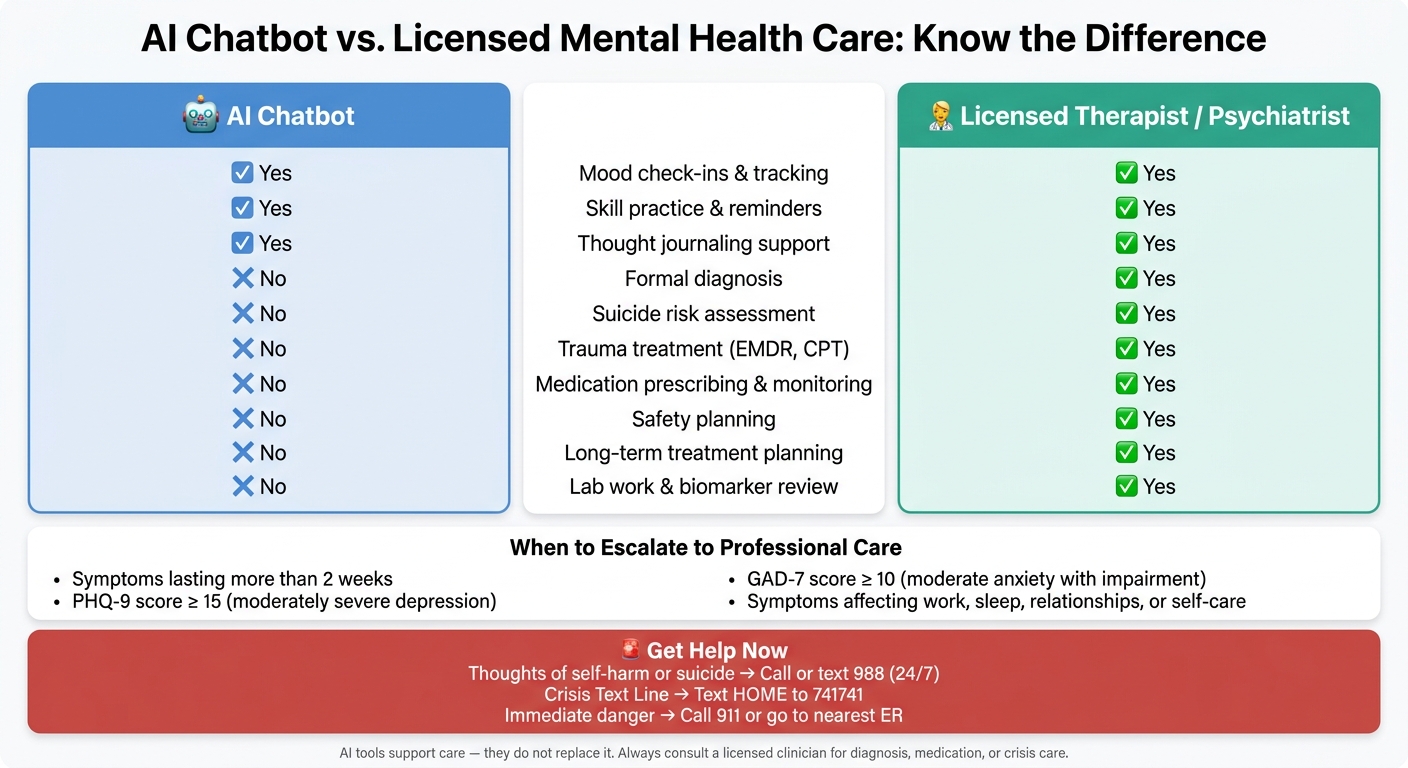
AI Chatbot vs. Licensed Therapist: What Each Can and Can’t Do for Your Mental Health
AI Emotional Support vs. Real Therapy: What’s the Difference?
The differences become clear when you put them side by side:
| Need | AI Chatbot | Licensed Clinician |
|---|---|---|
| Mood check-ins | Yes | Yes |
| Skill practice | Yes | Yes |
| Diagnosis | No | Yes |
| Suicide risk assessment | No | Yes |
| Trauma treatment | No | Yes |
| Medication care | No | Yes |
| Long-term treatment plan | No | Yes |
What Chatbots Can Help With – and Where They Stop
Helpful Uses: Reflection, Routines, and Between-Session Tracking
There is a narrow lane where chatbots can help without drifting into treatment.
AI chatbots are useful for a small set of tasks: structured, low-stakes, and outside clinical judgment. Think of them as a support tool for your routine, not the thing holding it all together.
They can help you jot down scattered thoughts before they vanish, set reminders for daily routines, and turn an overwhelming day into smaller, more doable steps. A well-timed nudge can make routines easier to stick with.
AI works best as a reminder, tracker, or practice tool between sessions. For example, it can walk you through a thought record and help you use skills you already learned in therapy right when you need them.
Hard Limits: No Diagnosis, No Crisis Judgment, No Trauma Treatment
Once a situation calls for diagnosis, risk assessment, trauma care, or medication decisions, chatbots are not enough.
These limits are built in. Chatbots follow patterns and scripts. They do not have the clinical judgment needed for complex mental health care. They also can’t pick up tone, urgency, or shifts in behavior the way a clinician can, so they may miss subtle signs that something is changing.
With OCD, a chatbot can even become part of the compulsion if you keep turning to it to feel certain.
Chatbot Support vs. Licensed Therapy and Psychiatry: A Side-by-Side Comparison
The difference stands out fast when you put them next to each other.
| Feature | AI Chatbot | Licensed Therapist / Psychiatrist |
|---|---|---|
| Primary Goal | Practicing skills and organizing next steps | Assessing symptoms and treating conditions |
| Diagnosis | None; cannot perform formal clinical assessment | Formal clinical diagnosis and evaluation |
| Crisis response | Limited; can only redirect to hotlines | Real-time safety planning and intervention |
| Trauma treatment | Not equipped for trauma processing | Evidence-based trauma care |
| Medication | Cannot prescribe or monitor | Psychiatric evaluation and management |
| Data handling | Policies vary; sensitive data may be stored or shared | Licensed and held to ethical/privacy standards |
| Personalization | Pattern-based, scripted responses | Human nuance and therapeutic alliance |
| Long-term treatment planning | Not possible | Ongoing, adaptive care across conditions |
When symptoms move past tracking or skill practice, licensed care brings assessment and a treatment plan. It also adds diagnosis, safety planning, and treatment decisions.
sbb-itb-23f89d4
What Licensed Mental Health Care Provides That AI Cannot
Evidence-Based Treatments for Common Mental Health Conditions
Licensed care does more than respond to symptoms. It turns those symptoms into a treatment plan.
Clinicians use approaches like CBT, DBT, ACT, and EMDR, then fine-tune pacing, exposure, and homework in real time. That matters because treatment isn’t just about picking a method. It’s about knowing when to slow down, when to push a bit further, and when a person needs a different approach.
For depression and anxiety, psychotherapy plus medication can work better than either one on its own.
Why Assessment, Safety Planning, and Medication Decisions Require Clinicians
A psychiatric evaluation pulls together history while also looking at affect, speech patterns, thought processes, and other cues that shape diagnosis. Those details help support a DSM-5 diagnosis, and they’re often missing in text-only exchanges.
Research confirms that AI systems cannot legally or clinically diagnose mental illness — diagnosis requires clinical judgment, context, and the therapeutic relationship. Text-only tools miss what clinicians routinely observe: vocal patterns, psychomotor changes, facial expressions, and behavioral shifts that shape diagnosis in critical ways.
Psychiatric prescribers also look at how physical health, lab values, sleep, hormones, and current medications may be shaping symptoms. That bigger picture matters when medication is part of care. A clinician can weigh side effects, medical factors, and treatment choices together instead of looking at symptoms in isolation.
Safety planning works the same way. Checking for suicide risk, psychosis, or medication toxicity calls for real-time clinical judgment, not keyword matching or scripted replies.
For people who need more than symptom support, integrated care that connects psychiatry, therapy, nutrition, and exercise tends to produce better outcomes than treating each piece separately.
| What it provides | AI Chatbot Support | Modyfi Health Integrative Care |
|---|---|---|
| Medication | Cannot prescribe medication or monitor side effects | Licensed prescribers manage medication and order lab tests |
| Lab testing | None | Targeted lab work for cortisol, hormone levels, vitamin levels, and inflammation markers |
Those differences matter most when symptoms start affecting safety, functioning, or daily life.
Symptoms That Should Not Be Handled by AI Alone
The line is pretty clear: if symptoms stick around, get worse, or start disrupting daily life, it’s time for a clinician to step in.
If low mood, anxiety, or loss of interest lasts more than two weeks without easing, that calls for a professional evaluation. The same goes for symptoms that don’t improve with the coping methods you’d normally use.
Functional impairment is the other big sign. If symptoms are getting in the way of work, school, relationships, or basic self-care, self-guided tools can only do so much. That includes trouble with things like showering, eating, or leaving the house. The same applies to severe mood swings, major changes in sleep or appetite, substance misuse, or symptoms of psychosis. That’s the point where support needs to shift into clinical care.
The general clinical guideline is straightforward: self-help for mild, improving symptoms — professional care when symptoms are moderate-severe, persistent, or significantly impairing daily life.
PHQ-9 and GAD-7 can help you get a rough sense of severity, but they do not replace a diagnosis. A score of 15 or higher on the PHQ-9 points to moderately severe depression, and a score of 10 or higher on the GAD-7 suggests moderate anxiety with functional impairment.
When to Seek Urgent or Emergency Support
Some situations need human help right away. Not later. Not after more self-checking. And not through a chatbot.
If you’re having thoughts of self-harm or suicide, have a plan to hurt yourself or others, or are experiencing hallucinations or delusions, get help immediately:
- Call or text 988 – Suicide and Crisis Lifeline, available 24/7
- Contact SAMHSA‘s National Helpline at 1-800-662-HELP – free, confidential support for mental health and substance use
- Call 911 or go to your nearest emergency room if you’re in immediate danger
Veterans in crisis can call 988 and press 1, or text 838255. If text support feels easier, text HOME to 741741 to reach the Crisis Text Line.
If you’re unsure where your situation fits, the table below can help you match what you’re experiencing to the next step.
Symptom-to-Care Table: Matching Common Experiences to the Right Next Step
Use this quick guide when the next move isn’t obvious:
| Experience / Symptom | Recommended Next Step |
|---|---|
| Thoughts of self-harm, suicide, or harming others | 988 Lifeline, 911, or nearest Emergency Room |
| Hallucinations, delusions, or a break from reality | Psychiatrist or Emergency Room |
| Severe mood swings, suspected Bipolar Disorder, PTSD, or OCD | Psychiatrist or Psychiatric Nurse Practitioner |
| Persistent symptoms affecting daily life | Licensed Therapist (LCSW, LPC, or Psychologist) |
| Substance misuse alongside mental health symptoms | Addiction Counselor or SAMHSA Helpline (1-800-662-HELP) |
| Unexplained physical symptoms like fatigue, racing heart, or dizziness | Primary Care Physician |
| Moderate symptoms needing both medication and therapy | Coordinated Telehealth or Integrated Care |
A psychiatric evaluation does one of two things: it confirms that self-help is appropriate for now, or it identifies a treatable condition that’s been getting in the way.
Key Takeaways:
Know the limits of chatbots. Use them for reflection, habit tracking, and skill practice — not for diagnosis or emotional reassurance in a crisis. If you catch yourself turning to AI repeatedly just to calm distress, that’s a signal to step back and redirect.
Watch for signs that call for professional care. If emotions start affecting sleep, work, or relationships, bring in a clinician. Big life changes and trauma need a human setting that can respond in real time — not preset prompts.
Use 988 in a crisis. Call or text 988 if you’re thinking about self-harm or suicide. You can also text HOME to 741741.
Seek integrated care when symptoms affect daily life. When AI tools reach their limits, the next step is care that looks at the full picture — psychiatry, therapy, nutrition, and the biological factors that chatbots cannot assess or treat.
Use AI for support, and turn to licensed care for treatment.
Conclusion: Use AI as a Tool, Not as Treatment
AI chatbots can help with mood tracking, breaking tasks into smaller steps, and practicing coping skills. But they can’t diagnose, prescribe, or handle a crisis — and that distinction matters more as these tools become more convincing. Chatbots can support care, but they can’t stand in for it.
Mental health care works best when it has the full picture — not just what fits in a text box. Digital tools are a bridge, not treatment. They tend to help most when they fit into a care plan that a clinician is already guiding. And there’s a catch: the more you lean on AI for certainty, the shakier your own judgment can start to feel.
The next move is simple: match the tool to the need, and match the need to the right level of care.
Whole-Person Care Through Modyfi Health‘s Integrative Model
Symptoms Are Signals. Let’s Find the Source.
If what you’re experiencing goes beyond what a chatbot can help with — persistent low mood, anxiety that won’t lift, sleep problems, or anything affecting your daily functioning — that’s worth exploring with someone who can see the full picture. At Modyfi, our Root-Cause Psychiatry approach brings psychiatry, therapy, nutrition, and exercise together to find what’s actually driving what you’re feeling.
👉 Explore Providers to Book an Appointment and Start Your Care Plan
(Note: Modyfi proudly accepts most major commercial insurance plans. We do not accept Medicare or Medicaid.)
FAQs
Can AI make my anxiety worse?
Yes. AI can sometimes make anxiety worse. Chatbots don’t have real-life context, and they can sound sure of themselves even when they’re off base. That means they may give advice that doesn’t fit your situation at all.
There’s another catch too: using AI for reassurance can feed anxious habits. You ask, it answers, you still feel uneasy, so you ask again. Over time, that loop can chip away at your trust in your own judgment.
If a chatbot leaves you feeling more confused, pressured, or alone instead of calmer, pull back and get support from a mental health professional.
Should I see a therapist or a psychiatrist first?
It depends on your symptoms and what you want help with.
A therapist is often a good place to start if you’re dealing with mild to moderate emotional distress, going through a life change, or trying to build better coping skills. Think stress, grief, relationship strain, or feeling stuck and wanting someone to help you sort it out.
A psychiatrist or other psychiatric provider may make more sense as a first step if your symptoms feel persistent or severe, you want a formal diagnosis, you need a medication review, or therapy hasn’t helped enough on its own.
Many people do best with both. Therapy can help you work through patterns and daily challenges, while a psychiatric provider can look at diagnosis and medication if needed.
How do I use a chatbot safely between therapy sessions?
Use a chatbot between sessions as support, not as a stand-in for professional care. It works best for clear, bounded tasks like tracking your mood, doing a short mindfulness exercise, or going over coping steps your therapist already gave you.
Before you open it, pause for a second. Ask yourself if you’re using it to check in with your plan – or just looking for reassurance or fast relief. That small check matters.
It also helps to set gentle guardrails:
- Decide how long you’ll use it
- Limit how often you check in
- Bring any helpful patterns or takeaways to your therapist
If you notice it’s making you more dependent or more anxious, pull back. At that point, offline support should come first.
Is it safe to use AI chatbots for mental health?
It depends on what you’re using them for and what your symptoms look like.
For low-stakes, structured tasks — mood tracking, journaling prompts, practicing coping skills you already learned in therapy, or breaking an overwhelming day into smaller steps — AI chatbots are generally safe for most people. The risk is low when the task is bounded and the stakes are mild.
The risk increases when chatbots are used for things they’re not designed to handle: crisis support, trauma processing, diagnosing symptoms, or as a primary source of emotional reassurance. In those situations, chatbots can give confidently wrong answers, miss critical signs, or inadvertently reinforce avoidance and reassurance-seeking patterns that make anxiety worse over time.
A useful rule of thumb: if you’re using a chatbot to feel less alone or to calm acute distress, that’s a signal to redirect toward human support instead.
Can AI replace a therapist?
No — and understanding why helps clarify what AI is actually useful for.
A therapist brings clinical judgment, real-time attunement, and the capacity to adjust based on what they observe in session — not just what you type. They can detect shifts in affect, tone, and behavior that don’t translate into text. They can hold a therapeutic relationship over time, track progress across sessions, and make judgment calls when something unexpected comes up.
AI tools can replicate some of the structure of therapy — prompts, reflections, psychoeducation — but not the clinical substance. They don’t assess risk, they can’t diagnose, and they can’t adapt in the nuanced way a trained clinician does when a session goes somewhere unexpected.
Research confirms that while AI shows promise for psychoeducation and mood tracking, its diagnostic accuracy and ability to engage users clinically remain significantly limited compared to licensed care. For mild, stable symptoms, AI may be a useful complement. For anything moderate, persistent, or affecting daily functioning, it’s not a substitute.
What is the best AI mental health app?
This is one of the most searched questions about mental health technology — and the honest answer is that “best” depends heavily on what you need it for, and that no app substitutes for professional care when symptoms are significant.
A few things worth knowing before downloading anything: most mental health apps are not FDA-regulated as medical devices, which means their clinical claims are often not independently verified. A 2023 review found that the majority of mental health apps available in app stores have little to no published clinical evidence supporting their effectiveness.
That said, some apps have more research behind them than others. Apps built around established frameworks — CBT, DBT skills, mindfulness — and used as between-session tools alongside professional care tend to produce better outcomes than apps used as standalone treatment.
Rather than recommending specific apps — which change frequently and vary by individual need — the more useful question is: what do you need it for? If it’s mood tracking, journaling, or skill practice between therapy sessions, a simple, evidence-informed app can add value. If you’re looking for something to manage significant anxiety, depression, or trauma, that conversation belongs with a clinician who can recommend tools that fit your specific situation.