


Depression is one of the leading causes of disability worldwide — and one of the most treatable. But treatment rarely works as a single lever. The evidence consistently points toward a combination of approaches: addressing thought patterns, changing behavior, building lifestyle habits, and staying connected to other people.
This post covers five evidence-based coping strategies for depression in adults — each with a distinct mechanism and a distinct role in recovery. None of them is a cure on its own. Together, they form a foundation that supports both short-term symptom relief and long-term stability.
The infographic below summarizes all five strategies at a glance — including the key statistics behind each one:
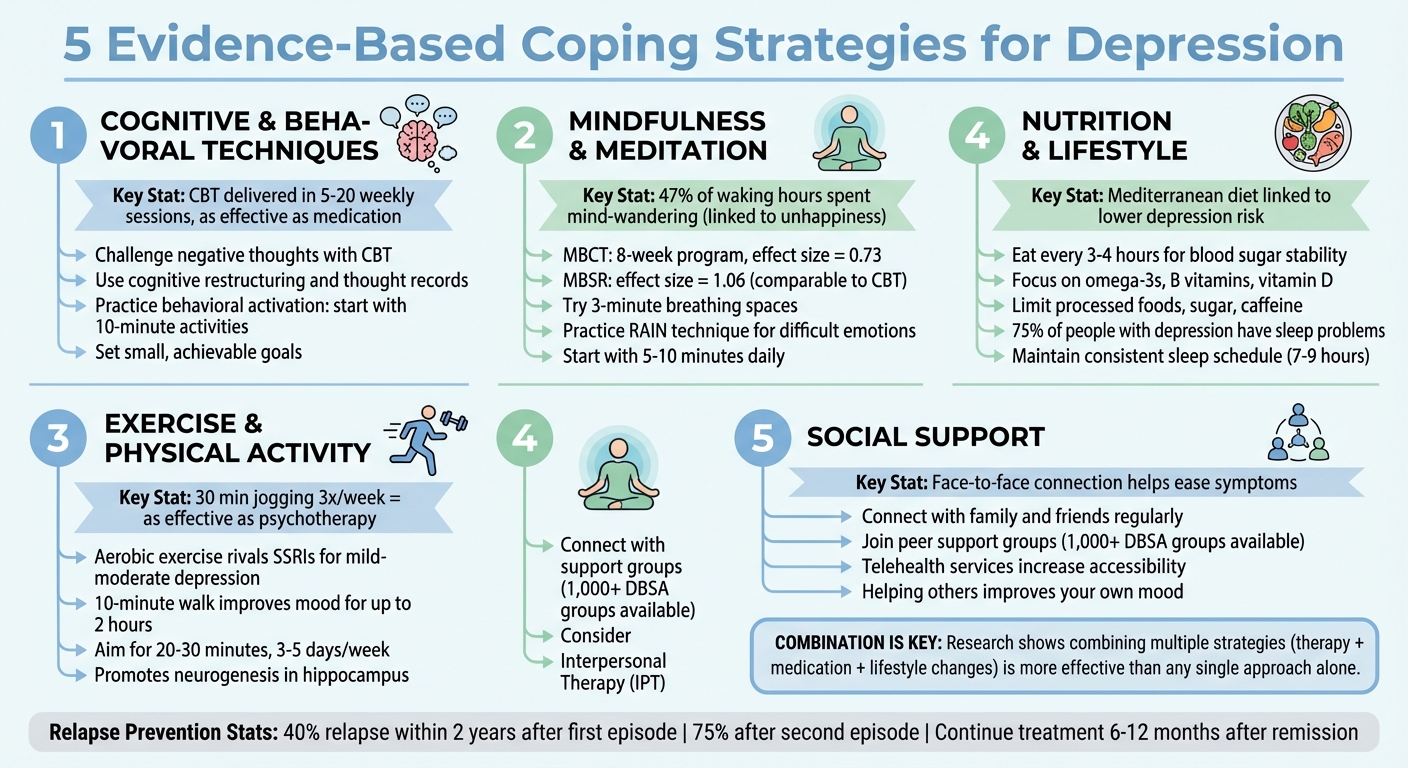
Cognitive and Behavioral Techniques: Reshaping the Mind
Depression often brings a flood of negative thoughts like “I’m a failure” or “Nothing will ever get better.” These thoughts, while powerful, are usually distortions of reality. Learning to recognize and challenge them can help break the cycle of depression. Cognitive strategies focus on addressing these thought patterns head-on.
Cognitive Behavioral Therapy (CBT) is a widely used approach based on the idea that thoughts, feelings, and behaviors are deeply connected. As Psychology Today puts it, “CBT rests on the idea that thoughts and perceptions influence behavior.” Delivered in 5–20 weekly sessions, CBT has been shown to be as effective as medication, while also equipping individuals with long-term tools to prevent relapse.
Identifying and Challenging Negative Thoughts
Depression often acts like a heavy filter, distorting how you see yourself, your loved ones, and the world around you. In the clinical world, these biased patterns are known as cognitive distortions. They create a frustrating feedback loop: a distorted thought triggers a painful emotion, which then reinforces the negative thinking, making the cycle feel incredibly hard to escape.
Fortunately, the first step to breaking this loop is simply learning to notice these patterns. You are not your thoughts, and you don’t have to believe everything your brain tells you when you’re feeling down. Here are the most common traps to watch out for:
-
All-or-Nothing Thinking: Seeing things in black-and-white. For example: “If I’m not perfect at this task, I’m a total failure.”
-
Catastrophizing: Jumping straight to the worst-case scenario. For instance: “I made a small mistake on this report; now I’ll definitely get fired and lose everything.”
-
Emotional Reasoning: Mistaking a feeling for a fact. Such as: “I feel completely hopeless right now, so my situation must actually be hopeless.”
One effective tool is cognitive restructuring. This involves asking yourself questions like, “What evidence supports this thought? What evidence contradicts it? Is there a more balanced way to see this?”
Keeping a thought record can also help. When something upsets you, write down the situation, the automatic thought you had, and the emotion it triggered. For instance, if you think, “My friend didn’t text me back – they must hate me”, consider other possibilities, like they might be busy or their phone could be dead. The goal isn’t about forcing yourself to think positively but rather aiming for a more accurate perspective.
Another helpful approach is reframing “should” statements. Replace phrases like “I should be doing better” or “I must handle this perfectly” with gentler alternatives like “I would like to” or “I want to.” This small shift can reduce feelings of guilt and shame, which often fuel depressive thoughts.
Once negative thought patterns are addressed, taking action through behavioral changes can further improve mood and break the cycle of depression.
Implementing Behavioral Activation
While restructuring thoughts is essential, changing physical behavior is equally critical. Depression naturally drives people to isolate and withdraw, creating a cycle that deepens the depressive state. To disrupt this pattern, Behavioral Activation encourages taking action before you feel motivated, allowing positive emotions to follow.
Consequently, building momentum through small, structured goals acts as a powerful catalyst for clinical improvement. One structured way to implement this approach involves three core steps:
-
Schedule Micro-Steps: Do not wait for motivation. Schedule small, highly manageable tasks—like a 10-minute walk (which is clinically shown to boost mood for up to two hours) or making a brief phone call.
-
Build a Wellness Toolbox: Create a readily accessible list of quick mood boosters, such as spending five minutes in nature, listening to a favorite song, or reading a book.
-
Track Your Progress: Keep a simple daily log of your activities and your mood. Visually tracking these patterns helps identify avoidance behaviors and highlights how micro-actions directly lift your baseline.
Mindfulness and Meditation Practices
Depression often triggers a cycle of automatic, negative thoughts that can feel impossible to escape. Research suggests that about 47% of our waking hours are spent in mind wandering, a state closely linked to unhappiness. Mindfulness offers a way to interrupt this cycle by teaching you to observe your thoughts without becoming entangled in them.
Rather than treating your thoughts as unchangeable truths, mindfulness helps you see them as fleeting mental events. Stefan G. Hofmann, Ph.D., Professor of Psychology at Boston University, explains:
The overarching theoretical premise of MBIs is that, through mindfulness practice, individuals will become less reactive to unpleasant internal phenomena but more reflective, which in turn will lead to positive psychological outcomes.
This shift – from reacting to reflecting – can disrupt the patterns of depressive thinking. Mindfulness practices also serve as a foundation for structured programs like MBCT.
Mindfulness-Based Cognitive Therapy (MBCT)
MBCT is an 8-week program that combines mindfulness techniques with cognitive therapy. Designed specifically to prevent depression relapse, it has been shown to be as effective as antidepressant medication for individuals with a history of recurrent depression. Studies reveal a significant reduction in acute depression symptoms, with an effect size of Hedge’s g = 0.73.
The program focuses on three main techniques: body scanning to ground awareness, mindful breathing to refocus attention, and sitting meditation to observe thoughts without judgment. These tools help break the cycle of depressive thinking.
For managing difficult emotions, the RAIN technique (Recognize, Accept, Investigate, Non-identify) can be a helpful framework. Another quick and effective tool is the 3-minute breathing space, which allows you to step out of automatic thought patterns during the day.
Even outside formal programs, shorter mindfulness exercises provide immediate relief from stress.
Meditation for Stress Reduction
Mindfulness-Based Stress Reduction (MBSR) targets physiological stress responses and helps improve emotional regulation. For people with Major Depressive Disorder, research has found MBSR effect sizes up to SMD = 1.06 — comparable to other active treatments. Even brief mindfulness training of just 3–4 days can meaningfully reduce stress levels.
Start small by practicing mindfulness for 5–10 minutes daily, gradually increasing your time as you develop consistency. According to Stuart Eisendrath, Former Director of the UCSF Depression Center:
The goal is not to get rid of depression completely – as this may be unlikely for many people – but to accept it and detach from it enough to live a happier, healthier life.
Another approach to counter self-critical thoughts is loving-kindness meditation, where you repeat affirming phrases like “May I be safe, may I be healthy, may I be happy”.
If sitting meditation feels challenging, try incorporating mindful movement into your routine. Activities like walking, swimming, or yoga can also cultivate mindfulness. Pay attention to sensations, like the rhythm of your breathing or the feel of your feet on the ground. Whether static or active, these practices support mental well-being and become more natural over time. As Deborah Yip, Medical Student and Researcher, emphasizes:
Mindfulness is a skill to be honed over time, at your own pace.
Lifestyle Changes to Support Mental Health
Depression continues to be the leading cause of disability worldwide, according to the World Health Organization. While earlier discussions highlighted thought patterns and mindfulness, lifestyle habits add a physical layer to managing depression. The choices we make daily – what we eat, how we move, and how we rest – can shape brain chemistry and emotional strength.
The American College of Lifestyle Medicine underscores this point:
Physical activity is the lifestyle intervention that has the most compelling and robust evidence regarding efficacy for MDD.
Incorporating these lifestyle changes can help build a stronger foundation for mental well-being.
Exercise and Mental Health
Exercise isn’t just about physical fitness – it’s a game-changer for brain chemistry. Activities like running or swimming release endorphins, natural chemicals that lift your mood. They also boost levels of serotonin, dopamine, and norepinephrine, the same neurotransmitters targeted by many antidepressants. In fact, research analyzing 49 studies found that consistent exercise has a moderate to substantial effect on reducing symptoms of depression.
For example, jogging for 30 minutes three times a week has been shown to be as effective as psychotherapy for treating depression. For mild-to-moderate depression, aerobic exercise has been shown to produce meaningful symptom reduction — in some studies comparable to antidepressant medication, and without the side effect burden.
Exercise also supports neurogenesis, or the growth of new brain cells, especially in the hippocampus – a region critical for mood regulation. It reduces inflammation linked to depression and helps balance cortisol, the stress hormone. Sleep, another area often affected by depression, also improves with regular physical activity, as it helps regulate your body’s internal clock.
How to start? Aim for 20 to 30 minutes of exercise three to five days a week. Choose activities you enjoy, like walking, dancing, or swimming. Group activities can be particularly helpful by reducing feelings of isolation and keeping you motivated. Adding mindfulness – such as focusing on your breath or the rhythm of your steps – can further break negative thought cycles.
| Exercise Type | Mental Health Benefits | Examples |
|---|---|---|
| Aerobic | Boosts mood, increases serotonin | Running, swimming, cycling |
| Resistance | Builds confidence, strengthens muscles | Weightlifting, resistance bands |
| Mind-Body | Reduces stress, improves mindfulness | Yoga, Tai Chi, Qigong |
| Social/Group | Reduces isolation, builds connections | Team sports, group classes |
Nutrition and Mental Health
What you eat has a direct impact on how you feel. The Mediterranean diet, which emphasizes vegetables, fruits, nuts, whole grains, olive oil, and fish, is linked to a lower risk of depression. On the other hand, diets high in processed foods and sugar are associated with poorer mental health outcomes.
A balanced diet supports the gut-brain connection. Nutrients like fiber, plant polyphenols, and healthy fats help maintain a healthy gut microbiome, which plays a role in emotional health. The American Psychiatric Association notes:
Research increasingly supports the role of diet in mental health — with nutrient-rich dietary patterns consistently associated with lower rates of depression.
Key nutrients to focus on include:
- Omega-3 fatty acids: Found in salmon, mackerel, sardines, and tuna, these fats stabilize mood and improve brain cell communication.
- B vitamins: Deficiencies in B-12, thiamine, or folic acid can lead to depressive symptoms. Leafy greens and citrus fruits are excellent sources.
- Vitamin D and magnesium: Both support brain health and relaxation.
Blood sugar stability is also crucial. Skipping meals or eating sugary “comfort foods” can lead to energy crashes and mood swings. To avoid this, eat every three to four hours and focus on whole, unprocessed foods. Limit refined carbs like white bread and pastries, which can cause a “sugar crash” that worsens mood. Reducing caffeine and alcohol intake can also improve both mood and sleep quality.
Some natural supplements, like saffron or SAMe (S-adenosylmethionine), show promise in easing depressive symptoms. Probiotics can also support the gut-brain connection. However, always consult a healthcare provider before starting supplements to ensure they don’t interfere with any medications.
Sleep Hygiene and Journaling
Sleep problems affect about 75% of people with depression, according to Johns Hopkins Medicine. One-third of adults rate their sleep as “poor” or “only fair”. Improving sleep habits, or sleep hygiene, can help restore balance and reduce inflammation linked to depression.
Start by establishing a consistent sleep schedule: go to bed and wake up at the same time daily, even on weekends. Keep your bedroom cool, dark, and quiet. Reserve your bed for sleep and intimacy to strengthen the mental association with rest. Avoid caffeine after 4:00 PM and limit screen time two hours before bed. A 30-minute wind-down routine – like reading, taking a warm bath, or practicing deep breathing – can signal your body that it’s time to sleep.
Journaling can also be an incredibly powerful tool in your toolkit. Writing down negative thoughts effectively externalizes them, taking them out of your head and making them much easier to analyze and manage. To practice this, try keeping a simple thought log to identify recurring patterns and gently replace distorted thinking with more balanced perspectives.
You can also use stress tracking to pinpoint exact moments of tension throughout your week and explore how your body responds. Furthermore, if traditional journaling feels a bit challenging or restrictive, feel free to experiment with poetry, art, or free-writing to process your emotions in whatever way feels safest for you.
Naturally, making these kinds of lifestyle changes can feel overwhelming, especially when your energy is low. When depression takes over, even the smallest tasks require immense effort. As a well-known therapeutic reminder points out:
“The things that help the most are often the things that are the most difficult to do.”
Therefore, we encourage you to focus exclusively on what you can realistically do today, no matter how small it may seem, and build from there. Progress is never linear, and every micro-step counts toward your healing.
sbb-itb-23f89d4
Building Social Support Networks
Depression often makes you want to retreat from others. The fatigue, shame, or guilt that comes with it can make isolation feel like the easier option. But staying connected is one of the most effective tools for recovery. As Melinda Smith, M.A., Lawrence Robinson, and Jeanne Segal, Ph.D., explain:
Getting support plays an essential role in overcoming depression. On your own, it can be difficult to maintain a healthy perspective and sustain the effort required to beat depression.
A strong support network not only provides comfort but also helps challenge negative thoughts, keeps you accountable for healthy changes, and reminds you that you’re not alone. Let’s look at some practical ways to build these connections.
Connecting with Family and Friends
Face-to-face interactions offer emotional and even biological benefits that texting or video calls just can’t match. Talking in person with someone who cares can help ease depressive symptoms. If your energy is low, start small – try a 10-minute walk together or a quick phone call. Setting up regular check-ins, like a weekly coffee date, can help maintain consistency. Activities like watching a movie, working on a craft, or taking a walk together can shift the focus from talking to simply being present with one another.
Be honest with at least one trusted person about how you’re feeling. Explain that depression is a medical condition, not a personal flaw, to help them understand your experience. Choose someone who listens with compassion instead of rushing to “fix” things. As Mayo Clinic Staff highlights:
Just listening and being understanding can be powerful healing tools.
Interestingly, research shows that helping others can improve your own mood — volunteering is associated with reduced depression and increased life satisfaction. Volunteering or simply being there for someone else can give you a sense of purpose and naturally expand your social circle.
In addition to personal relationships, professional and peer support can play a vital role in recovery.
Professional and Peer Support
Therapy offers a structured environment to develop coping skills, manage emotions, and uncover patterns linked to depression. For example, Interpersonal Psychotherapy (IPT) focuses on improving communication and resolving relationship conflicts that may worsen symptoms. Telehealth services have also made accessing professional help easier, especially for those with busy schedules or mobility challenges.
Peer support groups can help break down feelings of isolation and the misconception that you’re alone in your struggles. The Depression and Bipolar Support Alliance (DBSA) runs over 1,000 peer-led support groups across the U.S., where members share advice on coping strategies and treatment experiences. The University of Michigan Depression Center notes:
A support group can be a good place to address both of these barriers to recovery.
To find a group, reach out to local hospitals, community mental health services, or use the NAMI Helpline at 1-800-950-6264. When choosing a group, consider whether you’d prefer one led by peers with lived experience or a professionally facilitated option – both can be equally helpful. Most importantly, choose a group or therapist where you feel safe and understood. And if you’re in crisis, call or text the 988 Suicide & Crisis Lifeline immediately.
The table below summarizes the main types of support available — and how to access each one:
| Support Type | Primary Focus | Delivery Method |
|---|---|---|
| Family & Friends | Emotional support, shared experiences, reducing isolation | In-person visits, phone calls, shared activities |
| Peer Support Groups | Shared experiences, mutual advice, community building | In-person meetings or virtual group sessions |
| Interpersonal Therapy (IPT) | Improving communication skills, resolving relationship issues | Structured sessions with a licensed professional |
| Telehealth Services | Convenient access to professional guidance | Video calls, secure messaging, or phone therapy |
Many people find that combining professional support with personal connections offers the best results over time. Start small, take manageable steps, and gradually build a network that works for you.
Integrative Care with Modyfi Health
Depression is complex, and there’s no universal solution that works for everyone. That’s why Modyfi Health has created a fully virtual clinic that combines psychiatric care with lifestyle adjustments. Instead of just addressing symptoms, their approach tackles the deeper factors behind depression – like nutrition, sleep habits, exercise, stress levels, and social connections.
Personalized Treatment Plans
Effective depression treatment rarely looks the same from person to person. A plan built around your specific symptoms, history, and lifestyle factors tends to produce better outcomes than a one-size-fits-all approach.
A comprehensive plan typically starts with a full psychiatric evaluation — including functional lab testing when relevant — to identify root causes that standard symptom checklists might miss. These can include nutrient deficiencies, hormone imbalances, gut health concerns, or inflammatory markers that affect mood and energy.
From there, treatment is organized around what the individual actually needs: dietary changes to stabilize blood sugar and reduce inflammation, movement and sleep protocols tailored to their schedule and capacity, stress management tools, and psychiatric care when medication is part of the picture. The goal is to treat the whole person — not just the episode.
At Modyfi, this is how care works. Our network of providers brings psychiatry, therapy, nutrition, and exercise together in one coordinated virtual plan — so nothing operates in isolation. If lab results point to a metabolic driver, that gets addressed alongside the psychiatric care. If sleep is disrupting recovery, that becomes part of the plan too.
Ready to Build a Plan That Works for You?
If you’ve been managing depression with one approach and it isn’t enough, an integrated evaluation may reveal what’s been missing. At Modyfi, your care starts with a thorough assessment — and builds from there.
👉 Explore Providers to Book an Appointment and Start Your Care Plan
(Note: Modyfi proudly accepts most major commercial insurance plans. We do not accept Medicare or Medicaid.)
Telehealth Services for Convenient Care
Research confirms that telehealth is as effective as in-person treatment for depression — with comparable outcomes for psychiatric evaluation, medication management, therapy, and nutrition counseling. For people with busy schedules, mobility challenges, or limited access to local providers, virtual care removes the barriers that often delay treatment.
At Modyfi, all services are delivered virtually — including individual and couples therapy, psychiatric evaluation, medication management, and nutrition counseling. Flexible scheduling, including evenings and weekends, means care fits into your life rather than the other way around.
Consistency matters for long-term outcomes. Continuing antidepressants for at least six months after remission significantly lowers the risk of relapse — research shows relapse rates of around 20% for those who continue medication, compared to nearly 38% for those who stop. The virtual format supports that consistency — regular follow-ups happen without disrupting your routine.
Conclusion: Combining Strategies for Long-Term Management
Bringing together multiple strategies into a unified, long-term plan is crucial for sustained recovery. Research shows that combining antidepressants with psychotherapy — such as CBT or IPT — is more effective for moderate to severe depression than either approach alone. Adding regular exercise, quality sleep, and mindfulness creates a stronger foundation for recovery.
Recovery typically happens in stages. The acute phase (6–12 weeks) focuses on controlling symptoms, the continuation phase (4–9 months) works to prevent relapse, and the maintenance phase (lasting a year or more) ensures long-term stability. At least 50% of people who recover from a first depressive episode will have a second one — and after two episodes, the risk rises to around 70%. This underscores the importance of sticking with your treatment plan, even when you feel better.
As Dr. A. John Rush explains:
“Remission is the ideal goal, because it is associated with a better prognosis and more significant improvements in daily function than response without remission.”
Creating a Personalized Plan
An effective long-term strategy tailors these approaches to your individual needs. For mild depression, lifestyle changes — such as exercise or guided self-help — can be a good starting point before considering medication. In cases of severe symptoms, a more comprehensive approach may be required right from the beginning.
Start with small steps. A short walk, spending time outdoors, listening to music, or calling a friend can provide quick mood boosts. Build a wellness toolbox filled with strategies that work for you. Keep track of your progress and adjust your plan with your provider’s guidance. If one method only offers partial relief, refine it with professional support.
FAQs
What are some simple ways to add mindfulness to my daily life?
Incorporating mindfulness into your daily life doesn’t have to be complicated. Start small by dedicating just a few minutes each day to focus on your breathing or to simply observe your thoughts and emotions without judgment. As you get more comfortable, you can gradually extend this time.
Mindfulness can also be woven into everyday tasks. For instance, when eating, take a moment to truly notice the flavors and textures of your food. While walking, pay attention to the sensation of your feet touching the ground. Even during household chores, you can focus on the sounds, movements, and sensations involved.
The trick is consistency – making mindfulness a daily habit can help you better manage depression and enhance your overall sense of well-being.
How can I build a strong support system while managing depression?
Creating a solid support system can play a key role in managing depression. Start by identifying people in your life – friends, family, or colleagues – who bring positivity and encouragement. Reach out to them regularly in ways that feel comfortable for you, whether that’s a quick text, a phone call, or meeting in person.
You might also explore joining groups or classes that match your interests, like painting, yoga, or gardening. These activities not only give you a sense of purpose but also open doors to meeting others who enjoy similar things. Volunteering is another great option – it allows you to connect with people while making a meaningful impact in your community.
If face-to-face interactions feel like too much, virtual options can be a great alternative. Video calls or online groups can help you stay connected and even build new relationships. By strengthening your current connections and seeking out new ones, you can create a network that supports your emotional health.
How does regular exercise improve mental health and help with depression?
Exercise can have a profound impact on mental health by reducing symptoms of depression and anxiety, lifting your mood, and improving overall well-being. When you engage in physical activity, your body releases endorphins – those “feel-good” chemicals that naturally enhance your emotional state. At the same time, exercise helps lower stress hormones like cortisol, which can contribute to a calmer, more balanced mindset.
Beyond the immediate boost to your mood, staying active regularly can lead to better sleep, higher energy levels, and a sense of achievement. Even simple activities like walking, cycling, or practicing yoga can help manage depression in the long run. Consistency is what creates lasting change – choosing activities you genuinely enjoy and weaving them into your daily routine can create lasting positive effects on your mental health.
How long does it take for coping strategies to work for depression?
It depends on the strategy and the severity of symptoms — and setting realistic expectations matters as much as the strategies themselves.
Some effects are relatively fast. A single session of aerobic exercise can improve mood for up to two hours. Behavioral activation — scheduling small, manageable activities — often produces noticeable shifts within the first one to two weeks of consistent practice. Mindfulness practices tend to show measurable stress reduction within three to four weeks of daily use.
Therapy takes longer. CBT typically requires 8 to 16 sessions before significant symptom reduction is established. Medication, when appropriate, usually takes two to four weeks to produce noticeable effects, and four to eight weeks to reach full efficacy.
The honest answer is that recovery from depression is rarely linear. Progress often shows up in small ways first — slightly better sleep, a bit more energy, moments of genuine enjoyment — before the overall picture improves. If you’ve been consistently applying one or more strategies for four to six weeks without any change, that’s worth discussing with a clinician rather than waiting longer.
Can depression be managed without medication?
For some people, yes — and for others, medication is an essential part of treatment. The right answer depends on the severity and nature of the depression.
For mild to moderate depression, evidence-based approaches like CBT, behavioral activation, regular aerobic exercise, sleep improvement, and dietary changes have demonstrated meaningful symptom reduction — sometimes comparable to antidepressant medication. Guidelines from several professional organizations support lifestyle and psychological interventions as first-line treatment for mild depression before medication is considered.
For moderate to severe depression — particularly when symptoms are significantly impairing daily functioning, when suicidal ideation is present, or when previous episodes have not responded to non-medication approaches — medication alongside therapy tends to produce substantially better outcomes than either alone.
The goal isn’t to avoid medication or to rely on it exclusively. It’s to match the level of intervention to the actual clinical picture — which is why a thorough evaluation is the most useful starting point, regardless of what you expect the outcome to be.
What is the difference between sadness and clinical depression?
Sadness is a normal emotional response to loss, disappointment, or difficulty. It tends to be proportionate to what triggered it, comes and goes, and doesn’t fundamentally change how you function or how you see yourself.
Clinical depression is different in several key ways. It persists — typically for two weeks or more, most of the day, nearly every day. It often feels disconnected from external events — present even when circumstances haven’t changed, or disproportionate to what triggered it. And it affects functioning: sleep, appetite, concentration, motivation, and the ability to experience pleasure in things that used to feel meaningful.
Depression also tends to reshape how people think about themselves — bringing pervasive feelings of worthlessness, guilt, or hopelessness that aren’t characteristic of ordinary sadness. The difference isn’t about how intense the feeling is. It’s about persistence, pervasiveness, and functional impact.
If what you’re experiencing has lasted more than two weeks, affects multiple areas of your life, and doesn’t seem to lift with time or circumstances, that’s worth taking seriously — regardless of whether it feels “bad enough” to merit help.