

Dance therapy, or dance/movement therapy (DMT), uses movement to improve emotional, social, cognitive, and physical well-being. It’s an alternative to traditional talk therapy, offering a non-verbal way to process emotions and trauma. Research shows DMT can reduce anxiety and depression, improve emotional awareness, and boost self-esteem. Here are five ways it helps:
- Improves Emotional Expression: Movement helps express emotions that words can’t, aiding emotional awareness and regulation.
- Lowers Stress and Anxiety: Activates the vagus nerve, through rhythmic movement and coordinated breathing, which helps reduces tension, and releases mood-boosting chemicals like endorphins.
- Supports healthy serotonin and dopamine regulation: Supports healthy serotonin and dopamine levels, while improving mood and energy through movement.
- Supports Trauma Recovery: Provides a safe space to process trauma through movement, bypassing verbal barriers.
- Boosts Self-Esteem and Social Connection: Shifts focus from appearance to ability, building confidence and fostering connections in group settings.
DMT is backed by studies showing lasting mental health improvements, making it a valuable tool for emotional and psychological care.
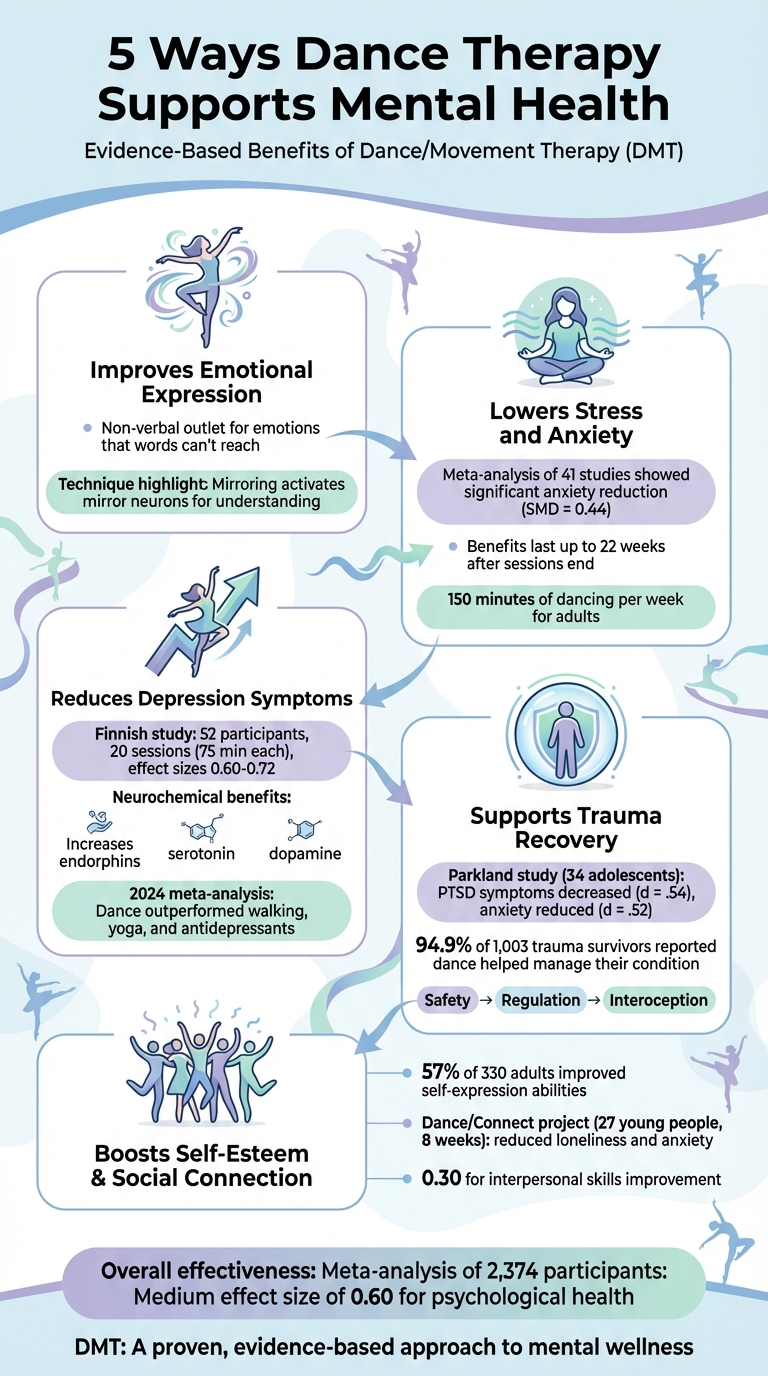
5 Ways Dance Therapy Supports Mental Health: Key Benefits and Research Findings
Move your body, Move your Mind: The role of Dance Therapy in Mental Health
1. Improves Emotional Expression and Awareness
Dance therapy taps into the deep connection between the mind and body, opening pathways for emotional expression that words often can’t reach. For those grappling with trauma, grief, or emotional suppression, putting feelings into words can feel impossible. Dance therapy sidesteps this challenge by using movement as a non-verbal outlet, making it an approachable option for anyone who struggles to articulate complex emotions through speech.
When you move, your body sends signals – called proprioceptive feedback – that help you recognize and process emotions. As Tal Shafir, Ph.D., explains, this feedback, combined with interoception (awareness of internal sensations), can bring unconscious emotions to light, revealing the roots of conscious feelings.
One powerful technique used in dance therapy is mirroring, where the therapist reflects your movements. This activates mirror neurons, fostering a sense of understanding and acceptance without the need for words. Another method, known as authentic movement, encourages spontaneous, eyes-closed movement to explore deep-seated thoughts and emotions that might be too painful or complex to address in traditional talk therapy.
Movements in dance therapy often take on symbolic meaning. For example, a gesture like “pushing away” can represent the act of confronting and resolving internal conflicts. Vicky Karkou, a professor at Edge Hill University, emphasizes this, stating:
“DMT may offer a way to work through issues that are difficult to articulate or are buried in the unconscious because they are painful, frightening, or simply difficult to access and address through cognitive means”.
Beyond emotional expression, dance therapy also helps with emotional regulation. Simple adjustments like standing tall with an open chest during stressful moments can evoke feelings of confidence. Trying out new movement patterns can even help nurture and reinforce positive emotions.
2. Lowers Stress and Anxiety
Stress doesn’t just stay in your head – it spreads through your body, affecting muscles, breathing, and your entire nervous system. Dance therapy taps into rhythmic movement to create biological shifts that help ease anxiety.
One key player here is the vagus nerve, which plays a major role in calming the body. By combining movement with deep diaphragmatic breathing, dance therapy activates this nerve, helping shift the body from a heightened state to one of relaxation. As Lana Ruvolo Grasser, a neuroscientist at the Stress, Trauma and Anxiety Research Clinic, puts it:
“Whenever they need to calm down, they can take a deep breath, and by engaging their vagus nerve, they can bring their bodies to a more restful and less reactive state”.
Beyond breathing, dancing triggers the release of endorphins and boosts mood-regulating neurotransmitters. The science backs this up: a meta-analysis of 41 controlled studies found that dance therapy significantly reduced anxiety, with a measurable improvement (SMD = 0.44). Another review of 28 randomized trials found dance interventions reduced both anxiety (SMD = -0.99) and stress (SMD = -1.0).
Dance therapists also use tension-release exercises to help the body shed accumulated stress. A striking example comes from a 2017 program by the Stress, Trauma and Anxiety Research Clinic in Detroit. Refugee children were encouraged to write their negative memories on colorful streamers, use expressive movements to “release” those emotions, and then symbolically throw the streamers into a trash can. This activity helped process stress stored in non-verbal parts of the brain, offering relief where talk therapy might not.
The benefits of dance therapy aren’t fleeting – they can last up to 22 weeks after the sessions end. For adults, aiming for at least 150 minutes of dancing each week can lead to noticeable improvements. And with adherence rates in clinical trials ranging from 86% to 100%, it’s clear that people find this approach both effective and enjoyable.
Next, we’ll look at how dance therapy can help tackle depression and improve mood.
3. Reduces Depression Symptoms and Improves Mood
Depression impacts over 350 million people globally, ranking as one of the top causes of disability. Dance therapy offers a powerful way to address this condition by triggering neurochemical changes that enhance mood. When you move to music, your body releases endorphins – natural compounds that relieve pain and lift your spirits. Additionally, dancing supports healthy serotonin levels and balances dopamine, both critical for mood regulation.
Research backs these effects with compelling evidence. A multicenter randomized controlled trial in Finland studied 109 individuals diagnosed with depression. The treatment group of 52 participants engaged in 20 dance therapy sessions, each lasting 75 minutes, held twice a week over 10 weeks. These sessions emphasized themes like body awareness, emotional expression, and personal agency. Three months after the intervention, the dance therapy group showed significantly greater reductions in depression (measured by the Beck Depression Inventory) and physical distress than the control group of 57 participants. The effect sizes ranged from 0.60 to 0.72.
Dance therapy also tackles what experts call “vitalization” – a process that helps release chronic tension, often referred to as “body armor”, which can leave individuals with depression feeling drained. As dance therapy researcher Schmais describes:
“Vitalization is investing people with the power to live”.
Specific movement techniques play a key role in this process. Kristy Gonyan, a licensed therapist at Relief Mental Health, highlights one approach:
“For patients with depression, one common directive is to jump or hop, because research shows people with depression engage in less vertical movement than people without depression”.
A recent 2024 meta-analysis of 218 trials revealed that dance outperformed walking, yoga, and even standard antidepressants in reducing depression symptoms. Follow-up studies also show that these benefits remain stable or even improve up to six months after therapy. To maximize results, aim for at least 2.5 hours of dance therapy each week.
sbb-itb-23f89d4
4. Supports Trauma Recovery and Builds Resilience
Trauma often shows up as “speechless terror” – experiences so overwhelming they can feel impossible to put into words. Dance therapy offers a way to process these deeply buried memories without relying on verbal expression. As trauma expert Bessel Van der Kolk explains, “Trauma is in the body”.
The healing journey in dance therapy typically follows three key stages. First, it establishes a sense of safety through regular sessions and clear boundaries. Next, it helps regulate the hyperarousal that keeps trauma survivors in a constant state of alertness. Finally, it works to rebuild interoception – the ability to sense and understand what’s happening internally – which trauma often disrupts. This method not only alleviates symptoms but also lays the groundwork for long-term resilience.
One powerful example comes from the aftermath of the February 2018 shooting at Marjory Stoneman Douglas High School in Parkland, Florida. A creative arts therapy camp for 34 adolescents led to measurable improvements: PTSD symptoms decreased (d = .54), along with reductions in depression (d = .34) and anxiety (d = .52). At the same time, participants experienced an increase in positive emotions (d = .81) and a drop in negative ones (d = .42). This case highlights how structured dance therapy can significantly reduce the effects of traumatic stress.
In another study of 1,003 individuals with trauma histories, an impressive 94.9% reported that dance helped them manage their condition. Regular participation – dancing at least once a week for over five weeks – was linked to higher mindfulness levels and a greater likelihood of entering a flow state during recovery.
Dance therapy fosters resilience on multiple levels: physically (through better boundaries and body awareness), psychologically (by encouraging self-soothing and emotional release), socially (through building healthy relationships), and existentially (by helping individuals find meaning). Movements like “sinking down and rising up” symbolize transforming trauma into a story of renewal and strength. This full-circle healing process reinforces dance therapy’s vital role in mental health care.
5. Increases Self-Esteem, Confidence, and Social Connection
Dance therapy continues to shine as a way to support mental health by boosting self-esteem and building social connections. One of its key strengths is shifting the focus from how the body looks to what it can do. Unlike competitive sports, which often emphasize external achievements, dance encourages participants to immerse themselves in the movement process itself. This shift in perspective can help reduce social physique anxiety – the fear of being judged based on appearance – a concern that affects many people, especially women.
Learning new movements fosters self-efficacy, or the belief in your ability to reach goals. For example, a study involving 330 adults across 34 dance classes found that 57% of participants felt they had improved their ability to express themselves through dance. This growing sense of competence often leads to greater self-esteem, not because of any external physical changes, but because participants begin to value what their bodies can achieve. This newfound confidence often carries over into group settings, amplifying the benefits.
Participating in group dance sessions takes these advantages even further. From September to December 2021, the Dance/Connect project – run by University College London, The University of Edinburgh, and Dance Base – offered 16 online contemporary dance classes to 27 young people (ages 16–24) dealing with anxiety. Over the 8-week program, participants reported feeling closer to their group and experienced notable reductions in loneliness and anxiety levels. One participant, Priya, shared her experience:
“I don’t think the first thing I felt was belonging, but it was more, like, you didn’t need to belong to it because it [the dance class] felt really open so anyone could belong, so it wasn’t necessarily that you had to fit in.”
In group settings, techniques like mirroring enhance non-verbal empathy by helping participants connect on a deeper level. Moving in sync with others also releases endorphins, which naturally strengthen social bonds. Meta-analyses have shown that dance movement therapy consistently improves interpersonal skills and overall quality of life, with an effect size of 0.30. These connections often extend beyond the dance studio, creating lasting friendships and support networks that further enhance mental health.
Conclusion
Dance Movement Therapy (DMT) has emerged as a proven method for improving mental health. A 2019 meta-analysis of 41 controlled studies, which included 2,374 participants, demonstrated that DMT achieved a medium effect size of 0.60 in enhancing psychological health outcomes. The research highlights DMT’s ability to reduce depression and anxiety, enhance quality of life, and improve interpersonal skills, with benefits that can last up to 22 weeks.
What sets DMT apart is its ability to foster emotional, social, cognitive, and physical integration. Unlike traditional talk therapy, DMT works around cognitive barriers, making it especially helpful for trauma survivors, individuals with severe depression, or those who struggle to express themselves verbally.
Studies also show that DMT works best when combined with other treatments. Sensitivity analyses reveal that pairing DMT with standard care yields better results for depression than standard care alone. This integrative approach reflects the evolving landscape of mental health care, which increasingly prioritizes the interconnectedness of physical, mental, and social well-being.
For example, Modyfi Health incorporates movement-based therapies like DMT into personalized care plans. Their model combines psychiatric care, therapy, and nutrition services to address the root causes of mental health challenges. By integrating exercise therapy with other treatments, they provide a comprehensive approach to healing.
FAQs
What makes dance therapy different from traditional talk therapy?
Dance therapy takes a different route from traditional talk therapy by focusing on movement and dance to support healing, rather than relying primarily on spoken communication. While talk therapy revolves around verbal discussions to explore thoughts and emotions, dance therapy allows individuals to express themselves non-verbally through physical movement.
This method can be particularly helpful for processing emotions or trauma that feel too complex or overwhelming to articulate. By involving the body, dance therapy encourages emotional release, builds self-awareness, and promotes mental well-being in a way that feels both dynamic and deeply personal. On the other hand, talk therapy leans more on cognitive and emotional insights gained through conversation.
What techniques are used in dance therapy to support trauma recovery?
Dance therapy taps into the power of movement to help individuals work through trauma, often focusing on emotional expression and physical awareness. One widely used technique is mirroring, where therapists replicate a client’s movements. This approach helps build trust, enhances self-awareness, and creates a sense of safety within the therapeutic environment.
Another key element involves empowerment-focused exercises. These movements are designed to help participants reconnect with their bodies, regain control, and express emotions in a way that doesn’t rely on words. It’s a way to process feelings through the body rather than through verbal communication.
Trauma-informed practices in dance therapy also emphasize mindfulness and body awareness. By encouraging individuals to pay attention to their physical sensations, these techniques can help reduce feelings of disconnection or dissociation. Together, these methods create a supportive and non-judgmental space where healing, emotional balance, and resilience can flourish.
Can dance therapy be used alongside other treatments to improve mental health?
Yes, dance therapy can be paired with other treatments to support mental health. It blends naturally with methods like psychotherapy, medication, and wellness-focused care, addressing conditions such as anxiety, depression, and PTSD. At Modyfi Health, we believe that healing is more effective when we look at the whole person. Our approach integrates these creative outlets with precision psychiatry and functional nutrition to help you find your rhythm again. If you’re curious about how a personalized plan could support your journey, we invite you to book a Discovery Session and explore what’s possible with the Modyfi team.