


If you prescribe controlled substances by telehealth, December 31, 2026 is a date to watch. That is when the DEA’s temporary telemedicine flexibilities expire. Without another extension or a permanent framework, prescribing without an in-person visit could get much harder on January 1.
For PMHNPs and PAs who treat ADHD, anxiety, insomnia, or substance use online, the stakes are practical. The next DEA telemedicine rules could shape who you treat, how you document care, and whether your setup still works.
This article is for general information only and is not legal advice. Rules in this area can change quickly. Check the Federal Register or a health care attorney before making decisions about your practice.
What the DEA’s Telemedicine Flexibilities Allow Today
The Ryan Haight Act of 2008 sets the default rule. A clinician generally must complete an in-person medical evaluation before prescribing a controlled substance through telemedicine. The law allows limited exceptions.
In March 2020, the DEA temporarily waived that requirement. It has extended the waiver several times since then. The current extension, the fourth, runs from January 1 through December 31, 2026.
Under this extension, DEA-registered practitioners can prescribe Schedule II through V medications through audio-video telemedicine. They do not need a prior in-person evaluation. For psychiatric practice, that covers ADHD stimulants, which are Schedule II, and benzodiazepines, which are Schedule IV.
What Happens If the Flexibilities Expire on December 31, 2026
If the DEA does not extend the flexibilities or finalize a new rule, the Ryan Haight default returns. Telehealth prescribing of controlled substances would again generally require a prior in-person evaluation.
That could affect patients who started treatment online and never had an in-person visit. Some may need one before their next controlled substance prescription. For a practice built entirely on telehealth, that is a scheduling, logistics, and access problem.
Some prescribing already runs under separate permanent rules. Final rules on buprenorphine for opioid use disorder and on VA continuity of care took effect December 31, 2025. These rules are narrower than the current flexibilities.
The Special Registration Rule: What Could Change
The Ryan Haight Act already allows an exception for clinicians who hold a “special registration” for telemedicine. For more than 16 years, the DEA never created the process to issue one.
In January 2025, the DEA proposed a framework called Special Registrations for Telemedicine and Limited State Telemedicine Registrations. On August 25, 2026, the agency sent a final version to the White House for regulatory review. The final text is not public yet. The Justice Department’s regulatory agenda lists the final rule for November 2026.
What the 2025 Proposal Included
The January 2025 proposal offers the clearest preview so far. As proposed, it would have required:
- A special registration for clinicians who prescribe controlled substances through telemedicine
- Separate state telemedicine registrations for each state where patients live
- Prescription drug monitoring program checks before prescribing
- Audio-video visits in most cases, with limited audio-only exceptions
- Added restrictions on Schedule II medications
- Identity verification, recordkeeping, and reporting to the DEA
- Registration for certain telemedicine platforms
The final rule could look different. Until the DEA publishes it in the Federal Register, every detail on that list remains a proposal.
Who Is Most Exposed
Not every clinician faces the same level of risk. Exposure tends to be highest for:
- PMHNPs and PAs who prescribe ADHD stimulants by telehealth, since Schedule II medications drew the tightest limits in the proposal
- Clinicians with patients in several states, who could need a separate registration for each state
- Clinicians who prescribe through a telehealth company’s systems, contracts, or platform
That last group deserves a closer look. When a company controls the platform, its compliance decisions shape your prescribing. If a platform pauses controlled substance prescribing, your patients and your schedule feel it first. You may have little say in the timing.
New graduates face an extra challenge. Many learned DEA registration as a one-time step. The next set of rules may treat it as an ongoing responsibility.
Why Waiting Is a Risk for Independent Clinicians
Timing is the core problem. If the final rule appears in November, clinicians may have only a few weeks before December 31. That is a short window to learn new requirements and adjust a practice.
In its latest extension, the DEA explained the extra time. It wants providers ready for any new registration, recordkeeping, or security requirements. That language signals that new obligations are likely. The open question is how heavy they will be.
Clinicians who own their practice can act on the final rule as soon as it appears. They control their own registrations, documentation, and policies. Clinicians who work inside someone else’s system often have to wait for decisions made above them.
That leaves one practical question: what should you be doing now, before the final text is public?
Don’t Wait for the Final Rule to Find Out Where You Stand
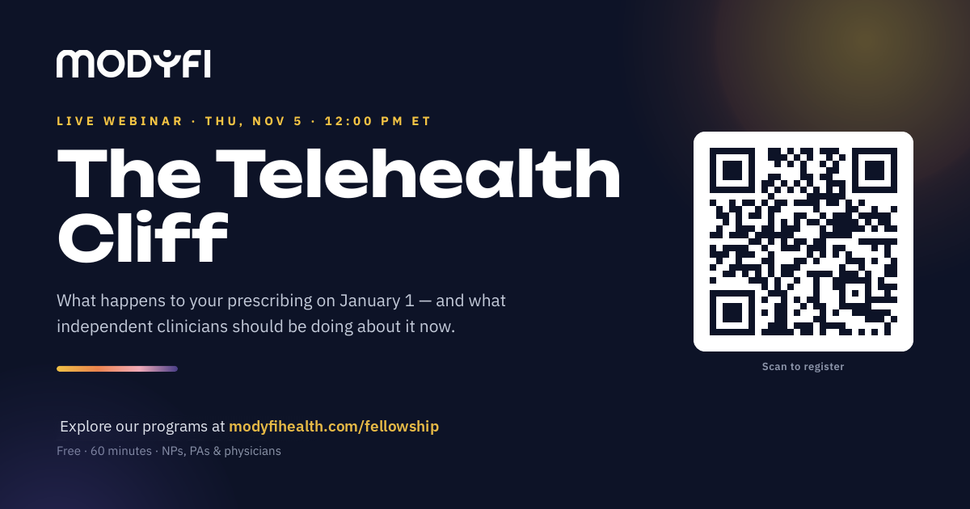
On November 5, Patrick Brown, PMHNP-BC, founder of Modyfi, will walk through what happens to telehealth prescribing on January 1. He will also cover what independent clinicians should be doing about it now. Patrick left a clinic model built on 15-minute med checks. He learned contracts and patient acquisition the hard way and had a full panel within a year.
👉 Register for The Telehealth Cliff Webinar
Live webinar · Thursday, November 5 · 12:00 PM ET
The webinar is free, runs 60 minutes, and is open to NPs, PAs, and physicians.
(Questions? Contact hello@modyfihealth.com. Looking for ongoing support? Explore the Modyfi Fellowship.)
FAQ
Will the DEA telemedicine flexibilities definitely end on December 31, 2026?
Not necessarily. December 31, 2026 is the current end date. The DEA could finalize a permanent rule before then, extend the flexibilities again, or do both.
The agency has extended the flexibilities four times since 2020. Each extension came close to the deadline. Planning around another last-minute extension is a risk, not a strategy.
What is the DEA special registration for telemedicine?
It is a permanent pathway that the Ryan Haight Act created in 2008. It would let qualified clinicians prescribe controlled substances by telemedicine without a prior in-person evaluation.
The DEA proposed a framework in January 2025 and sent a final version for White House review in August 2026. The final requirements will not be known until the rule appears in the Federal Register.
Will I need an in-person visit to prescribe controlled substances by telehealth in 2027?
It depends on what happens before December 31. If the flexibilities expire with no replacement, the Ryan Haight default generally requires an in-person evaluation first.
If the special registration rule takes effect, clinicians who obtain it may be able to keep prescribing remotely. They would likely face added requirements, such as monitoring program checks and stricter recordkeeping.
Does the change affect buprenorphine prescribing?
Buprenorphine for opioid use disorder falls under a separate final rule. That rule took effect on December 31, 2025, and allows telemedicine prescribing under specific conditions.
Clinicians who treat opioid use disorder should review that rule on its own terms. It does not depend on whether the broader flexibilities expire.
Will I need a DEA registration in every state where my patients live?
The January 2025 proposal required a state telemedicine registration for each state where patients live. That would add cost and paperwork for multi-state practices.
The final rule could change this requirement. Clinicians with patients in several states should watch this detail closely once the text is public.
What should PMHNPs do to prepare right now?
Start with what you control. Confirm that your DEA registration and state licenses are current. Review how many of your patients receive controlled substances without a prior in-person visit.
If you prescribe through a telehealth company, ask how it plans to handle the transition. Then watch the Federal Register for the final rule, which the DEA expects to publish in November 2026.