


Exercise can help with depression — and the evidence is stronger than most people expect.
A 2024 network meta-analysis in the BMJ reviewed 218 randomized clinical trials with more than 14,000 participants. It found that walking, jogging, yoga, strength training, and dancing all reduced depressive symptoms — with effect sizes comparable to antidepressant medication and psychotherapy for mild to moderate depression.
That doesn’t mean exercise replaces professional care. For moderate to severe depression, it works best alongside therapy, medication, or both. But it does mean that movement is a clinically meaningful part of treatment — not just a lifestyle recommendation.
The harder part is usually getting started. Depression reduces energy, motivation, and follow-through — which is exactly what makes beginning difficult. The goal isn’t a perfect workout. It’s the smallest version of movement you can repeat consistently on a hard day.
Exercise as a Treatment for Depression [Scientific Review]
sbb-itb-23f89d4
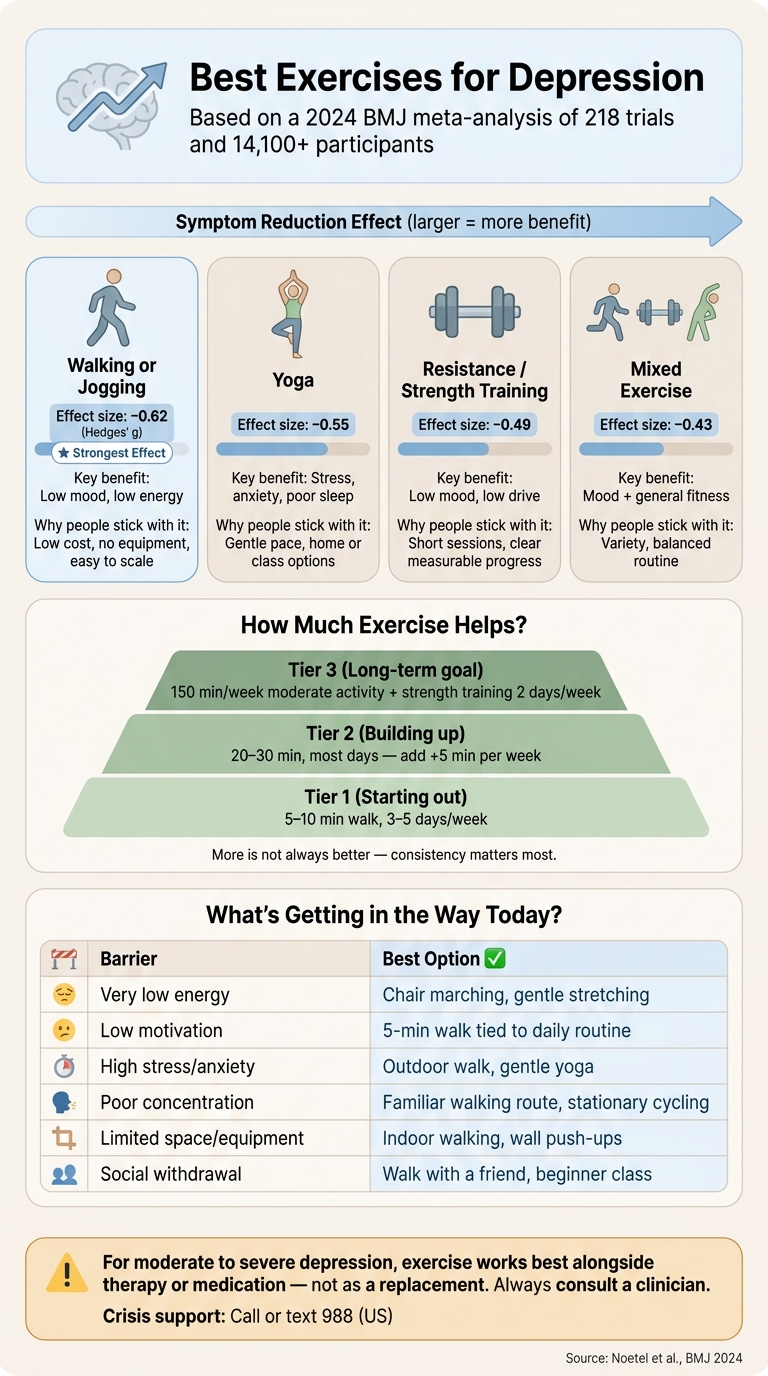
The infographic below summarizes which exercise types show the strongest evidence for depression, how to build up to a weekly goal, and what to do when today’s barrier gets in the way:
Which Types of Exercise Help Depression Most
No single activity works best for everyone. The best choice is the one you can start safely and keep doing.
A 2024 network meta-analysis in the BMJ looked at 218 randomized clinical trials with more than 14,100 participants. It compared several exercise types against active controls. The table below shows average effect sizes by exercise type — along with practical reasons people tend to stick with each:
| Exercise Type | Average Trial Effect (Hedges’ g) | Practical Strengths |
|---|---|---|
| Walking or jogging | −0.62 | Low cost, no equipment needed, easy to scale |
| Yoga | −0.55 | Combines movement, breathing, and body awareness |
| Resistance training | −0.49 | Short sessions, clear measurable progress |
| Mixed aerobic exercise | −0.43 | Supports mood and general physical health |
These are trial averages, not promises. Small gaps in the numbers matter less than whether you like the activity, can access it, and can stick with it. On a rough day, the best option is often the one that feels easiest to do anyway.
For a lot of people, the choice has less to do with fitness level and more to do with energy, stress, and what feels doable.
Walking, Jogging, and Moderate Aerobic Exercise
Walking is the easiest starting point for most people. You don’t need much gear, and you can adjust it by pace, route, and time.
Jogging can add more training stimulus, but you do not need to jog to get mood benefits. Other moderate aerobic options, like cycling, swimming, dancing, and elliptical training, can work just as well, especially if they feel better on your body or fit your routine more easily. A useful way to check intensity without tracking heart rate is the talk test: at moderate intensity, you can speak in short sentences but can’t comfortably sing.
Resistance Training, Yoga, and Mixed Programs
Resistance training can include body-weight moves like sit-to-stand exercises and wall push-ups, along with resistance bands, weight machines, and free weights. It often works well for people who want shorter sessions, indoor workouts, or clear signs of progress, like one extra rep or a bit more resistance. Even one or two sets of a few exercises, done on a steady basis, can help.
Yoga can be a good fit when depression shows up alongside stress, anxiety, muscle tension, or sleep problems. It blends movement, breathing, and body awareness. Gentle, restorative, or beginner-level classes usually make more sense than advanced or hard classes at the start. The point is to find a style and instructor that match your comfort and mobility right now.
Mixed programs combine aerobic activity with resistance work, which can help mood and general physical health at the same time. One simple version is 20 minutes of brisk walking plus 10 minutes of body-weight or band work, two to three times a week.
Type is one piece of the picture. The other is dose — how much exercise is actually needed to make a difference.
How Much Exercise Makes a Real Difference
Start with the smallest amount you can repeat. Even short sessions can help. Mood gains can begin below the standard adult target, especially when you stay active on a regular basis. That gives you a starting point. The next piece is figuring out what a weekly goal can look like in everyday life.
A solid long-term aim is 150 minutes a week of moderate activity, plus strength training on two days a week. If you’re below that, it still counts. In fact, building up to that range bit by bit tends to work better than hitting it once and then burning out.
In depression studies, gains went up with moderate weekly activity and then leveled off at very high amounts. The goal is symptom relief, not accumulating more workout time.
Starting, Building, and Maintenance Targets
If you’re starting from little or no activity, a 5- to 10-minute walk three to five days a week is a valid place to begin. If one session feels like too much, break it into two or three short walks. That’s still movement, and it still counts.
From there, add about 5 minutes at a time or one extra session each week until you reach 20 to 30 minutes most days. A useful longer-term target is about 30 to 45 minutes of moderate activity on three to four days a week.
You can also add resistance training on 2 nonconsecutive days. That can include:
- Chair squats
- Wall push-ups
- Resistance bands
- Other body-weight movements
On low-energy days, scale back rather than skip. Any movement counts. Some days, that may mean a full walk. Other days, it may mean a few minutes around the block. Either way, you’re still in the game.
When More Exercise Is Not Better
Going too hard, too soon can backfire. It can lead to fatigue, soreness, injury, and the kind of discouragement that makes you want to quit. More exercise doesn’t help in a straight-line way.
A few warning signs to watch for:
- Ongoing exhaustion
- Pain that changes how you move
- Repeatedly skipping sessions because the plan feels too hard
When that happens, scale back. The better plan is the one you can keep doing, not the one that looks good on paper. The next step is matching the plan to the barrier right in front of you.
How to Match Movement to Your Energy, Stress, and Motivation Level
Knowing your weekly target is one thing. Matching today’s activity to today’s barrier is what makes it actually happen: match today’s activity to today’s barrier. The most useful starting question is: what’s getting in the way today? The answer usually points you to the best place to begin.
What to Do on Hard Days
On the hardest days, make the start almost effortless. Use a 5-minute minimum: choose one manageable activity, set a timer for 5 minutes, and begin.
If 5 minutes feels okay, keep going for another 5 to 10 minutes. If you feel exhausted, dizzy, in pain, panicked, or overwhelmed, stopping still counts as following the plan.
Good options for hard days include:
- A slow walk around the block
- Seated marching
- Gentle stretching
- Wall push-ups
- A short guided yoga video
Sometimes the first step is as small as putting on your shoes.
Match the Activity to the Barrier
| Main barrier | Best starting option | How to start |
|---|---|---|
| Very low energy | Chair marching, gentle stretching, 5-minute slow walk | Keep it indoors; place shoes and clothing within reach |
| Low motivation | Scheduled 5-minute walk tied to an existing routine | Attach it to morning coffee or a post-work habit; use a calendar reminder |
| High stress or anxiety | Outdoor walk, gentle yoga, slow stretching | Use a familiar route, comfortable pace, and slow breathing |
| Poor concentration | Familiar walking route, stationary cycling | Use a timer and a simple, repetitive playlist; avoid complex routines |
| Limited equipment or space | Indoor walking, wall push-ups, sit-to-stands, resistance bands | No gym needed; a hallway or living room works fine |
| Social withdrawal | Walk with a trusted person, beginner class | Treat the social contact as part of the plan, not an add-on |
A calendar reminder, walking buddy, or simple check-in can help you rely less on willpower. That matters because on rough days, motivation can vanish fast.
Set a minimum first, then treat anything extra as a bonus. That small shift helps protect consistency without turning every session into a pass-or-fail test.
It also helps to track mood, sleep, energy, stress, and consistency. Over time, those patterns show what’s helping, what tends to get in the way, and when movement may need to work alongside professional care.
Why Exercise Works and Where It Fits in Treatment
How Movement Affects Mood
Exercise helps for more than physical fitness. It can shift mood through both the body and day-to-day behavior. That’s one reason small, repeatable sessions often matter more than the occasional all-out workout.
Exercise may improve mood through sleep, stress, inflammation, and brain plasticity. These are likely part of the picture, not one single answer for every person.
But the body side is only half of it. Even one small completed action can bring back a sense of control. Confidence often comes back before motivation does, and movement can open that door. This is behavioral activation: you act first to interrupt the pull toward withdrawal.
When exercise includes support, it can also bring accountability, connection, and less isolation in the same activity. And those effects can build on each other. Better sleep can improve energy. More energy can make movement feel easier. Lower stress can help sleep. That loop helps explain why consistent, structured exercise tends to stick better than sporadic intense effort.
When to Add Professional Support
Understanding these mechanisms also helps clarify where exercise reaches its limits. They don’t tell you where its limits are.
Exercise can make sense as a first step when symptoms are mild and daily functioning is mostly intact. Structured programs often use supervised sessions several times per week for about 10 to 14 weeks.
That said, the same routine that helps with mild symptoms may not be enough when depression is more severe. Professional assessment is needed when symptoms are moderate to severe, lasting, or getting worse. The same applies when work, relationships, or self-care are clearly affected, or when thoughts of self-harm appear.
In those cases, exercise works best as an add-on to therapy, medication, or both, not a replacement. Do not change prescribed treatment without your clinician’s guidance.
Integrated care can help line up exercise goals with symptoms, medications, sleep, and daily functioning. In that setup, movement becomes one part of a broader treatment plan.
When exercise is not enough: If symptoms are moderate to severe, lasting, or getting worse, or if daily life is significantly affected, contact a mental health professional. If you are thinking about suicide or self-harm, call or text 988 in the United States; call 911 or go to the nearest emergency department if you may act soon. Do not change prescribed treatment without your clinician’s guidance.
Conclusion: Start Small, Stay Consistent, and Know When to Ask for More
The evidence is clear: exercise reduces depression symptoms — and for mild to moderate depression, the effect sizes are comparable to medication and psychotherapy. Walking, yoga, strength training, and mixed programs all show meaningful benefit. The differences between them matter less than whether you can start and keep going.
Dose matters, but perfection doesn’t. A 5-minute walk three times a week is a valid starting point. Building from there — gradually, at a pace that fits your energy and stress level — tends to produce more durable results than starting too hard and stopping.
Depression makes starting harder. That’s not a character flaw or a lack of willpower. It’s the illness blocking the circuits for energy, motivation, and follow-through. The goal on hard days isn’t a great workout. It’s the smallest version of movement you can repeat.
Exercise is not a replacement for professional care when depression is moderate to severe, lasting, or getting worse. In those cases, it works best as part of a broader plan — alongside therapy, medication, or both. Knowing that boundary is as important as knowing the benefits.
If you’re not sure where you fall on that spectrum, a clinical evaluation is the right next step — not to replace the movement you’re already doing, but to make sure everything is working together.
Ready to Build Exercise Into a Real Care Plan?
Exercise works best when it’s coordinated with the rest of your treatment — not added on separately. At Modyfi, our Root-Cause Psychiatry approach brings psychiatry, therapy, nutrition, and exercise together in one plan, so movement becomes part of your care rather than another thing to figure out on your own.
👉 Explore Providers to Book an Appointment and Start Your Care Plan
(Note: Modyfi proudly accepts most major commercial insurance plans. We do not accept Medicare or Medicaid.)
FAQs
How long before exercise helps depression?
It depends on which kind of benefit you’re looking for — and both timelines are worth knowing.
Short-term mood shifts can happen within minutes to a few hours after a single session. After exercise, the brain releases endorphins and increases norepinephrine — neurotransmitters that can temporarily lift mood, reduce anxiety, and sharpen focus. Many people notice these effects even after a 10-minute walk. They don’t last all day, but they’re real and they accumulate.
Measurable changes in depressive symptoms — the kind you’d see on a validated scale like the PHQ-9 — typically emerge after four to six weeks of consistent exercise. This is the timeline most clinical trials use as their primary endpoint, and it’s when most participants start reporting meaningful improvement in mood, energy, and motivation.
Longer-term changes, including neurological ones like increased hippocampal volume and improved stress regulation, tend to require eight to twelve weeks or more of sustained activity. These are the changes that may make exercise’s antidepressant effects last beyond the active treatment period.
The practical implication: don’t judge exercise by how you feel after two weeks. The short-term shifts are real encouragement, but the meaningful clinical benefit takes longer to establish. Consistency over weeks matters more than intensity in any single session.
What if I miss workouts due to low motivation?
Missing sessions because of low motivation is one of the most common experiences in depression — and one of the most frustrating, because the very illness that exercise can help is also what makes starting so difficult.
A few things tend to help more than trying harder. First, reduce the goal rather than abandoning it. A 5-minute walk is not a failed workout. It’s a completed one. On days when motivation is close to zero, the question isn’t “can I do my full plan?” — it’s “what’s the smallest thing I can still do?” Completing even a short session protects the habit and maintains the neural pathway associated with movement.
Second, choose an activity you don’t dread. Choosing something that feels less aversive — whether that’s a slow walk, yoga, or strength work — reduces the friction of getting started on hard days. If every session feels like a battle, the activity itself may not be the right fit.
Third, use external structure when internal motivation isn’t available. A scheduled class, a walking commitment with someone else, or a calendar reminder tied to an existing habit removes the moment-to-moment decision of whether to go. On rough days, motivation usually comes after starting — not before.
If low motivation is consistently preventing you from moving at all, that’s worth discussing with a clinician. It may signal that depression is more severe than self-management alone can address.
Can exercise help if I’m already in therapy or taking medication?
Yes — and the evidence supports using exercise alongside both, not instead of either.
For people with mild to moderate depression, adding structured exercise to therapy or medication tends to improve outcomes beyond what either approach achieves alone. Research suggests that exercise supports brain rewiring through increased BDNF production, reduces inflammatory markers associated with depression, and helps regulate the HPA axis — mechanisms that complement rather than duplicate what medication and therapy do.
For people on antidepressants specifically, exercise may help in two practical ways: it can support the medication’s effectiveness by improving sleep and reducing inflammation, and it can partially offset some side effects like fatigue and weight changes that sometimes accompany antidepressant use.
Coordinating with your care team ensures the plan fits your medical history and current treatment. Some medications affect heart rate and exercise tolerance, which is worth flagging before starting a new program. And one point that matters a lot: don’t stop or change medication on your own based on exercise progress. Any medication adjustments should happen in conversation with your prescriber.
Can exercise replace antidepressants?
For most people with clinical depression — particularly moderate to severe depression — exercise alone is not a sufficient replacement for antidepressant medication. The evidence supports exercise as a powerful complement to standard treatment, not a substitute for it.
That said, the picture is more nuanced for mild depression. For people with mild depressive symptoms and intact daily functioning, exercise-based interventions have shown effect sizes comparable to medication in some trials — and clinical guidelines for mild depression often recommend lifestyle interventions, including exercise, as a first-line approach before medication is considered.
The key distinction is severity. Mild depression may respond well to structured exercise, particularly when combined with therapy. Moderate to severe depression, lasting depression, or depression that is worsening tends to require medication alongside other interventions — and exercise works best in that context as an add-on rather than a standalone treatment.
Stopping or reducing prescribed medication to try exercise instead is not recommended without clinical guidance. The two can work together, and making changes to medication should always happen in conversation with your prescriber.
What type of exercise is best for anxiety and depression together?
When anxiety and depression co-occur — which is common — the choice of exercise type becomes slightly more nuanced, because what helps most with depression doesn’t always feel accessible when anxiety is high.
Aerobic exercise like walking and jogging shows the strongest evidence for depression specifically. But for people whose anxiety includes physical tension, hyperarousal, or difficulty tolerating elevated heart rate, starting with yoga or gentle movement may feel safer — and is more likely to be repeated. Yoga has evidence for both conditions, particularly when anxiety involves stress, sleep disruption, and somatic tension.
Resistance training is worth considering when anxiety presents as restlessness or the need for something to focus on — the structured, goal-oriented nature of strength work can provide containment that open-ended aerobic activity doesn’t.
Outdoor exercise has some additional evidence for anxiety specifically — natural environments have been associated with faster physiological recovery from stress compared to indoor settings. Even a slow walk in a park or green space may produce slightly different benefits than the same walk on a treadmill.
The practical answer: start with whatever feels least threatening to begin, then build from there. On high-anxiety days, yoga or a slow outdoor walk may be the right entry point. On lower-anxiety days, a brisker walk or strength session may be more accessible. Flexibility in the plan tends to produce better long-term adherence than a fixed routine that doesn’t account for how anxiety fluctuates.
How do I exercise when I have no energy from depression?
This is one of the most common barriers — and the one most people feel least able to talk about, because the advice to “just move more” can feel dismissive when depression has genuinely depleted the energy needed to start.
A few things that actually help:
Start with the smallest possible version. A 5-minute walk around the block counts. Seated marching counts. Gentle stretching counts. The point isn’t to perform — it’s to create a tiny completed action that maintains the habit and builds the evidence that movement is possible even on hard days.
Remove as many friction points as possible the night before. Put your shoes by the door. Set out clothes. Decide exactly where you’ll go and for how long. When energy is low, each decision costs more than usual. Making those decisions in advance means one less barrier when morning comes.
Attach movement to something already happening. A 5-minute walk after morning coffee, or gentle stretching before getting into bed, doesn’t require a separate burst of motivation — it rides on an existing routine.
Accept that output will vary. A 5-minute session on a low-energy day is not a failure. It’s the appropriate dose for that day. Keeping a consistent minimum — even a very small one — across days tends to produce better outcomes than alternating between nothing and trying to catch up.
If energy is so low that even minimal movement feels impossible most days, that’s a signal worth discussing with a clinician. Severe energy depletion can indicate a level of depression that self-directed exercise alone won’t adequately address.