


Stress problems often show up in labs before they make sense in daily life — and a root-cause view goes beyond mood or sleep. Cortisol rhythm, inflammation, thyroid function, nutrient status, gut health, and eating patterns all tell part of the story.
What the evidence actually shows:
- Chronic stress can disrupt the HPA axis, sleep, immune signals, and brain function
- One cortisol test is often not enough — a daily cortisol pattern shows whether stress response is high, flat, or off-time
- Inflammatory markers like IL-6, IL-1β, and TNF-α may run higher in people with greater stress vulnerability
- Thyroid changes, including subclinical hypothyroidism, can make stress symptoms harder to manage
- Low magnesium, zinc, and B vitamins may affect mood, energy, and stress response
- Microbiome diversity and short-chain fatty acids may affect cortisol control
- A meta-analysis of 633,317 people linked healthier diets with lower stress and anxiety
- In a 2026 trial, matched care based on a person’s own data improved outcomes in a subgroup analysis (p = 0.049)
The core finding across this research: stress resilience improves when care matches the person, not just the symptom. That usually means pairing lab data with sleep support, therapy, movement, and a food plan built around steady meals, whole foods, gut support, and adequate protein and micronutrients.
This article breaks down which markers and nutrition tools may help guide that plan.
Biology of Stress: How Nutrition & Functional Medicine Can Help | Dr. David Wiss
sbb-itb-23f89d4
What Research Says About Functional Lab Testing for Stress Resilience
Functional lab testing doesn’t diagnose stress. What it can do is show which body systems are out of balance. When someone’s symptoms point to stress overload, lab data can help show what’s fueling the problem.
Cortisol Patterns and HPA Axis Function
Chronic stress can push cortisol in two very different directions: it may stay high, or it may flatten out. That’s why a single cortisol reading often doesn’t tell you much. The daily pattern matters more.
Diurnal salivary cortisol testing looks at cortisol at several points during the day. This can show whether the HPA axis is overactive, blunted, or not regulating well.
Another marker that can help is the cortisol/DHEA-S ratio. DHEA-S helps counter some of cortisol’s catabolic effects, so this ratio gives a clearer sense of stress balance. Research published in the Archives of General Psychiatry found that a higher DHEA-S to cortisol ratio was associated with fewer symptoms of dissociation and superior military performance under acute stress. In plain terms, it’s one way to track how well the body is handling pressure over time.
Other lab markers can add context too. They can show whether the stress response is spilling over into inflammation, oxidative stress, or gut imbalance.
Nutrient, Thyroid, Inflammation, and Gut Markers
Stress doesn’t stay in one lane. It can show up in immune signaling, thyroid function, nutrient status, and the gut.
TNF-α, IL-6, and IL-1β tend to rise in people with greater stress vulnerability and anxiety. Thyroid issues can matter too. In particular, subclinical hypothyroidism may make a person more sensitive to stress, which is why screening can make sense when symptoms stick around.
Nutrient markers add another piece of the puzzle. Higher salivary zinc levels and lower potassium levels have been linked with adaptive coping and higher antioxidant capacity. Elevated TBARS/MDA, by contrast, are linked to maladaptive stress responses.
The gut-brain axis is getting more attention here as well. Microbiome diversity and short-chain fatty acid, or SCFA, production look meaningful because SCFAs seem to help regulate cortisol release and reduce allostatic load.
| Marker Category | Specific Marker | What Research Links It To |
|---|---|---|
| HPA Axis | Cortisol/DHEA-S Ratio | Higher ratio = better stress adaptation |
| Inflammation | TNF-α, IL-6, IL-1β | Elevated = greater stress vulnerability |
| Thyroid | Subclinical hypothyroidism | Amplifies stress sensitivity |
| Nutrients | Salivary Zinc | Higher levels = adaptive coping |
| Nutrients | Potassium | Lower levels = adaptive coping |
| Oxidative Stress | TBARS/MDA | Elevated = maladaptive stress response |
| Gut-Brain Axis | SCFAs (microbiome) | Supports cortisol regulation |
How Lab Data Can Shape a More Personalized Care Plan
This is where testing starts to matter in practice. The point isn’t any one marker by itself. It’s the pattern across markers, and how that pattern helps match care to the person in front of you.
A 2026 clinical trial tested what happens when people follow a stress-management plan built around their own data — versus just picking whatever approach felt right. The overall results were mixed. But the people who actually followed the personalized recommendation showed meaningfully greater stress reduction than those who didn’t. The takeaway: the right match matters more than any single intervention.
Personalized Nutrition Research for Stress Regulation
Diet quality, nutrient status, and meal timing can shape stress resilience just as much as lab markers. Labs can flag strain in the stress system. Nutrition is what helps support recovery in daily life.
How Chronic Stress Can Increase Nutrient Needs
Chronic stress can increase the body’s need for key nutrients, including magnesium, zinc, calcium, and B vitamins like folate, B12, and B6. These nutrients help with neurotransmitter synthesis and HPA-axis regulation. Inflammation can also increase oxidative stress and drain folate, B12, and B6, which matter for neurotransmitter synthesis and epigenetic regulation.
Stress doesn’t just affect nutrient demand. It often changes how people eat.
People dealing with chronic stress tend to lean more on ultraprocessed, low-fiber foods, and that can further disrupt gut microbiota diversity. Meal patterns can get messy too. Skipped meals or uneven eating can worsen blood sugar swings and make stress symptoms hit harder. That’s part of why diet patterns linked to lower stress tend to have a few things in common: whole foods, regular meals, and better nutrient density.
Whole-Food Dietary Patterns and Meal Timing
A meta-analysis of 633,317 individuals across 23 countries found that healthy diets rich in whole grains, vegetables, fruits, nuts, seeds, and fish were linked to lower symptoms of stress (SMD −0.24) and anxiety (SMD −0.25). Most studies were conducted in low- and middle-income countries, so generalization requires caution — but the direction of the evidence is consistent.
Mediterranean-style and MIND diets show up again and again in this research. Both are linked to lower psychological distress and seem to work through overlapping pathways, including lower systemic inflammation, better antioxidant status, and support for the gut-brain axis. On a practical level, regular meals and steady protein intake can help keep blood sugar and cortisol on a more even track.
Why Personalization Matters in Nutrition Care
One of the biggest findings here is that people don’t all respond to food in the same way. Gut microbiota diversity is one reason why the same meal can affect two people very differently.
That’s where generic advice like “eat healthier” starts to fall apart. Nutrition care for stress resilience should account for symptoms, lab findings, gut health, medications, age, and health history. Looking at labs, symptoms, and personal history together can help narrow down which nutrients and gut-focused strategies deserve the most attention.
Key Interventions Studied for Improving Stress Resilience
Omega-3s, Magnesium, and B Vitamins
Once lab work points to likely weak spots, the next step is figuring out what may help recovery most. Omega-3s, magnesium, and B vitamins have the strongest nutrition evidence for stress support, and they tend to help most when a person has a deficiency or low intake to begin with.
EPA-heavy omega-3s show the clearest link with anxiety support. Magnesium helps regulate GABA and monoamine pathways. Vitamins B6, B12, and folate help with neurotransmitter production and methylation. There’s also a genetics angle here: the MTHFR C677T variant can reduce folate activation and lower stress tolerance in some people.
Mediterranean and MIND Diets
Diet patterns matter because they shape both nutrient intake and inflammatory burden. The MIND and Mediterranean diets have the strongest evidence in this area. Systematic reviews link MIND diet adherence with lower depression, anxiety, and perceived stress.
Gut-Directed Nutrition and Microbiome Support
When stress symptoms show up alongside digestive issues, gut-focused nutrition becomes a more relevant option. That makes sense. If the gut feels off, stress can feel louder too.
In a 2026 crossover trial, heat-treated L. gasseri CP2305 improved parasympathetic activity and reduced tension-anxiety. In a separate 12-week trial, a live blend of Bifidobacterium longum CECT 7347 and Lactobacillus rhamnosus CECT 8361 significantly improved SF-36 vitality scores (p = 0.017), though the primary anxiety endpoint was not met.
The table below sums up the current evidence across these options:
| Intervention | Primary Outcome | Key Limitation |
|---|---|---|
| Postbiotics (L. gasseri CP2305) | Improved parasympathetic activity; reduced tension-anxiety | Small samples; mechanisms need further validation |
| Probiotic Blends (B. longum + L. rhamnosus) | Improved vitality; preserved butyrate-producing bacteria | High placebo response; primary anxiety endpoints not always met |
| MIND/Mediterranean Diet | Lower depression, anxiety, and perceived stress | High study heterogeneity; mostly observational |
Putting the Evidence Into Practice
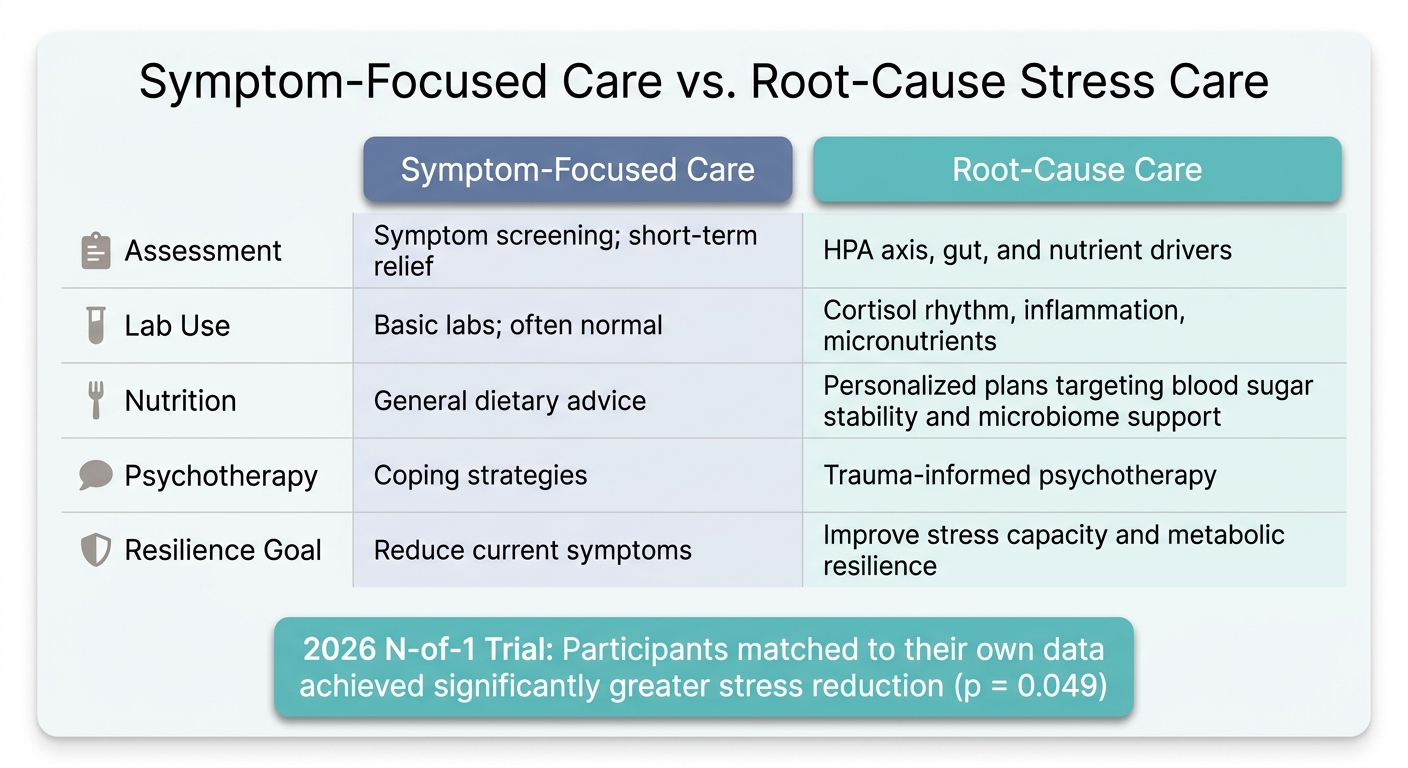
Symptom-Focused Care vs. Root-Cause Stress Care: Key Differences
What an Integrative Stress-Resilience Care Model Looks Like
Stress resilience tends to improve when care looks at the whole stress picture at once: the HPA axis, gut health, inflammation, sleep, and nutrient status. That points to a model of care that matches support to the systems under strain instead of chasing one symptom at a time.
In practice, that means building one shared plan around the same patient goals. Psychiatric evaluation, psychotherapy, nutrition support, sleep hygiene, and movement all work together rather than sitting in separate lanes. The idea is simple: if stress affects many systems, care should too.
Symptom-Focused Care vs. Root-Cause Stress Care: A Comparison
The day-to-day difference isn’t just how symptoms are described. It’s what actually gets checked, interpreted, and treated.
| Feature | Symptom-Focused Care | Root-Cause Care |
|---|---|---|
| Assessment | Symptom screening; short-term relief | HPA axis, gut, and nutrient drivers |
| Lab Use | Basic labs; often normal | Cortisol rhythm, inflammation, micronutrients |
| Nutrition | General dietary advice | Personalized plans targeting blood sugar stability and microbiome support |
| Psychotherapy | Coping strategies | Trauma-informed psychotherapy |
| Resilience Goal | Reduce current symptoms | Improve stress capacity and metabolic resilience |
Conclusion: Key Findings to Remember
Functional lab testing can help flag cortisol patterns, inflammation, micronutrient status, and gut-related signals that standard workups may miss. That matters because treatment tends to work better when it fits the person in front of you, not just the diagnosis on paper.
In a 2026 N-of-1 trial, participants who followed the stress-management intervention recommended by their own data had significantly greater stress reduction than those who did not (p = 0.049). That’s the main takeaway from the evidence reviewed above: the strongest plan is one that matches the patient’s biology and is realistic enough to stick with over time.
These strategies are most effective – and safest – when guided by qualified clinicians, especially when symptoms are complex or when more than one driver may be involved.
Ready to Build a Stress Plan Based on Your Biology?
Understanding which systems are under strain — cortisol patterns, inflammation, nutrient gaps, gut health — is the first step. The next is working with providers who can apply that data to your specific situation and build a plan that fits your biology, not just your symptoms. At Modyfi, our Root-Cause Psychiatry approach brings psychiatry, therapy, nutrition, and exercise together in one integrated plan.
👉 Explore Providers to Book an Appointment and Start Your Care Plan
(Note: Modyfi proudly accepts most major commercial insurance plans in MD, DC, VA, and WV; currently, we do not accept Medicare or Medicaid.)
FAQs
Which stress labs matter most?
The most useful stress labs show how your body reacts under pressure. At Modyfi Health, key assessments include a four-point salivary cortisol test to map your cortisol pattern across the day and HRV to check how flexible your autonomic nervous system is.
We also look at inflammatory and metabolic markers like hsCRP, homocysteine, ferritin, thyroid panels, and glucose metabolism markers. These tests help flag stress-related imbalance that can reach beyond cortisol alone.
Can diet really improve stress resilience?
Yes. Diet can help improve stress resilience because it affects how the body handles stress, from gut-brain signaling to inflammation to neurotransmitter production.
A whole-food, plant-forward diet with plenty of omega-3s, fiber, magnesium, and zinc can support the nervous system and help keep mood more steady. At Modyfi Health, personalized nutrition and functional testing can help pinpoint individual needs.
Who should consider functional testing for stress?
Functional testing may help people dealing with signs of chronic stress or a dysregulated nervous system, including anxiety, depression, burnout, brain fog, fatigue, and gut-related issues.
It can also help people who want to look past symptom relief and dig into possible root causes, such as hormone imbalances, inflammation, or nutrient deficiencies. At Modyfi Health, this testing helps shape personalized care.
What labs should I get for chronic stress?
There’s no single “stress panel” — but a few tests tend to be most useful. A four-point salivary cortisol test maps your cortisol pattern across the day, which tells you far more than a single blood draw. Beyond that, inflammation markers like hsCRP, thyroid panels, and nutrient levels — particularly magnesium, zinc, vitamin D, and B12 — help identify which systems are under the most strain. The goal isn’t to run every possible test. It’s to build a care plan around what the data actually shows.
Can functional medicine help with burnout?
Yes — and burnout is one of the clearest cases where a functional lens adds something standard care often misses. Burnout tends to show up in the body in measurable ways: flattened cortisol curves, elevated inflammation, and depleted nutrient levels. Standard approaches address the psychological side, which matters. But if the underlying biological dysregulation isn’t addressed, recovery tends to be slower. A functional approach looks at both sides and matches support to where the system is actually breaking down.
Does magnesium help with stress and anxiety?
It can. Magnesium plays a direct role in regulating the HPA axis and supports GABA — the brain’s main calming neurotransmitter. Chronic stress depletes magnesium faster than a normal diet replenishes it, which can create a cycle: stress lowers magnesium, lower magnesium makes stress harder to manage. Not all forms work the same way — magnesium glycinate and threonate tend to absorb better than the magnesium oxide found in most cheap supplements. Worth discussing with a clinician before adding to an existing routine.