

Guided meditation is a simple yet effective way to help ease anxiety. It works by focusing your mind, calming anxious thoughts, and relaxing your body. Here’s what you need to know:
- What It Is: A structured practice where a guide helps you focus on breathing, relaxation, or visualization.
- How It Helps: Reduces mental worry, calms physical symptoms, and improves sleep. Studies show just 13 minutes a day for 8 weeks can lower anxiety.
- Techniques: Breath-focused meditation, body scanning, and guided imagery are popular methods.
- Brain & Body Benefits: Calms the stress response, lowers heart rate, and reduces overactivity in the brain’s fear center.
- Best Use: Works well as part of a broader care plan, including therapy and healthy habits.
Start small with 2–5 minutes daily, and remember: meditation is a tool to manage anxiety, not a standalone solution. If anxiety interferes with daily life, seek professional care.
How Guided Meditation Affects the Brain and Body
How Anxiety Triggers the Stress Response
When your brain perceives a threat – whether it’s real or imagined – the amygdala kicks into high gear, releasing stress hormones like cortisol and adrenaline. This response activates your body’s fight-or-flight mode: your heart races, muscles tense, and breathing speeds up. For people with anxiety, this alarm system becomes overly sensitive, firing off too often and too easily. Meanwhile, the prefrontal cortex (PFC) – the brain’s rational “control center” – struggles to step in and manage the fear response. The result? A relentless cycle of worry, physical tension, and heightened alertness. Guided meditation steps in here, helping to recalibrate these automatic stress reactions.
How Guided Meditation Calms the Nervous System
Guided meditation works on a biological level to interrupt this stress cycle. Techniques that focus on controlled breathing can stimulate the vagus nerve, which activates the parasympathetic nervous system – your body’s “rest-and-digest” mode. This shift helps slow your heart rate, lower blood pressure, and release muscle tension.
Scientific studies back these effects. In 2011, a team led by Sara Lazar at Harvard University used MRI scans to examine participants before and after an 8-week Mindfulness-Based Stress Reduction (MBSR) program. They discovered a reduction in gray matter density in the right amygdala, the brain’s fear center. More recently, a 2023 study published in JAMA Psychiatry compared an 8-week MBSR program to the antidepressant escitalopram (Lexapro) in adults with anxiety disorders. Both groups showed similar reductions in anxiety symptoms, demonstrating that MBSR was just as effective as medication.
These changes in the brain create the foundation for mindfulness to help separate your thoughts from emotional reactions.
The Role of Mindfulness in Guided Meditation
Mindfulness – a key element of guided meditation – teaches you to observe your thoughts and emotions without judgment. This is particularly helpful for anxiety because it allows you to step back and see anxious thoughts for what they are: just thoughts, not facts. Researchers call this process decentering or cognitive defusion. For example, instead of believing a thought like “something bad is going to happen”, mindfulness encourages you to recognize it as a passing mental event, not an inevitable reality.
Guided meditation also helps reduce activity in the Default Mode Network (DMN), a brain circuit linked to mind-wandering and rumination. With less DMN activity, the repetitive “what-if” scenarios that fuel anxiety become less frequent.
“Meditation… allows us to experience voluntary, sustained, and systematic exposure to negative stimuli within the safe setting of our own self-attunement, self-regulation and self-compassion.” – Miles Neale, Psy.D., Buddhist Psychotherapist
sbb-itb-23f89d4
10-Minute Meditation For Anxiety | Goodful
Guided Meditation Techniques for Anxiety
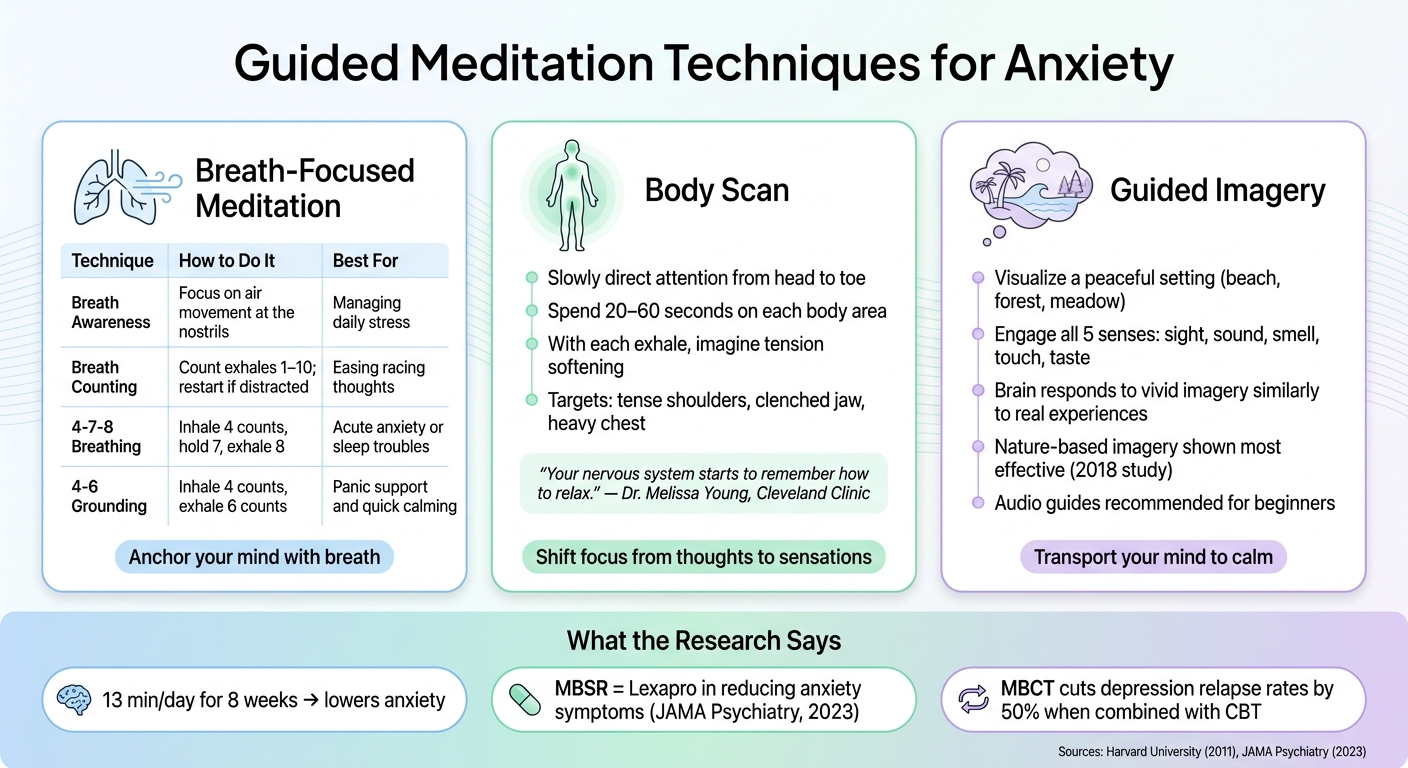
Guided Meditation Techniques for Anxiety: A Quick Comparison
Meditation offers a powerful way to calm your mind and body, especially when dealing with anxiety. Here are three effective guided meditation techniques that can help you integrate mindfulness into your daily life: breath-focused meditation, body scanning, and guided imagery. Each method takes a slightly different approach to ease anxiety, giving you options to find what works best for you.
Breath-Focused Meditation
Your breath can act as a natural anchor for your mind. As Miles Neale, Psy.D., puts it:
“The mind needs an anchor, or a single point of focus, to direct it away from ruminations and elicit the body’s natural relaxation response.”
When anxiety hits, it often speeds up your breathing, which can intensify stress. Slowing your breath can help activate your body’s relaxation response. A popular method is the 4-7-8 technique: inhale through your nose for 4 counts, hold for 7 counts, and exhale through your mouth for 8 counts. The extended exhale helps your body shift into a calmer state.
If your thoughts are racing, try breath counting. With each exhale, count “one,” then “two” on the next, continuing up to ten. If your mind drifts, gently return to “one” without judgment.
| Technique | How to Do It | Best For |
|---|---|---|
| Breath Awareness | Focus on air movement at the nostrils | Managing daily stress |
| Breath Counting | Count exhales 1–10; restart if distracted | Easing racing thoughts |
| 4-7-8 Breathing | Inhale 4 counts, hold 7, exhale 8 | Acute anxiety or sleep troubles |
| 4-6 Grounding | Inhale 4 counts, exhale 6 counts | Panic support and quick calming |
Once your breath has steadied your mind, you can deepen the relaxation with a body scan.
Body Scan for Relaxation
The body scan technique involves slowly directing your attention through each part of your body, from head to toe. Dr. Melissa Young from Cleveland Clinic explains:
“It’s about taking time to scan through all parts of the body from head to toe and checking in with the sensations in the body. How does the body feel?”
Anxiety often shows up in your body as tense shoulders, a clenched jaw, or a heavy chest. A body scan helps you shift focus from anxious thoughts to the physical sensations in the moment. Spend 20–60 seconds on each area, and with each exhale, imagine the tension softening – even if just a little. The goal isn’t perfection but awareness. As Dr. Young notes:
“When you practice this technique and incorporate it into your self-care routine, your nervous system starts to remember how to relax.”
Guided Imagery for Calm
Guided imagery uses your imagination to transport you to a peaceful setting. Research shows that the brain reacts to vividly imagined scenes in much the same way as it does to real experiences. That’s why picturing a serene beach or a quiet forest can help lower your heart rate and slow your breathing.
Engaging all your senses can make this practice even more effective. For instance, instead of just visualizing a beach, imagine the warmth of the sun, the sound of waves, and the salty scent of the air. A 2018 study found that nature-based guided imagery was especially effective in reducing anxiety compared to other types of imagery. If you’re just starting out, an audio guide can walk you through the process and help you ease into relaxation.
How to Start a Guided Meditation Practice
Now that you’re familiar with techniques to ease anxiety, the next step is making guided meditation a habit. The good news? Starting is easier than you might think, and a little preparation can go a long way.
Setting Up Your Space and Mindset
You don’t need a fancy meditation room to get started. What matters most is consistency. Choose a quiet spot where you can close the door, silence your phone, and sit comfortably. A corner of your bedroom with a cushion or chair can work perfectly. Over time, this space will become a signal to your brain that it’s time to relax.
Posture is important, but comfort comes first. Sit with your back upright yet relaxed. A sturdy chair with your feet flat on the ground works well. If closing your eyes feels uncomfortable or makes you more anxious, keep them softly open and focus on a neutral point in front of you.
One common misconception about meditation is that you need to “clear your mind.” That’s not the goal. As Gary Soffer, MD, from Yale Medicine explains:
“People should be aware that meditating is not as hard as they think it is, and that no one is a ‘bad meditator.’ The most important thing is that meditation is about paying attention – beyond that, it’s a matter of keeping it simple.”
Starting Small and Building a Routine
Start with just 2–5 minutes a day. Short, consistent sessions are far more effective than a long session once a week. Even as little as two weeks of daily practice has been shown to significantly improve symptoms of anxiety and depression.
To help make meditation a daily habit, try linking it to something you already do, like brewing your morning coffee or brushing your teeth at night. This “habit stacking” approach can make it easier to remember. Morning meditation can set a calm tone for the day, while an evening session helps release the stress you’ve collected. Using a timer can help you stay focused, and you can gradually increase your practice time by a minute or two each week.
Dealing With Common Challenges
It’s completely normal for your mind to wander during meditation. When it happens, try a technique called thought labeling. Silently name the distraction – like “worrying”, “planning”, or “judging” – and gently bring your attention back to your anchor.
If your thoughts feel overwhelming, the 5-4-3-2-1 grounding method can help: identify 5 things you see, 4 you can touch, 3 you hear, 2 you smell, and 1 you taste. This exercise brings your mind back to the present moment.
Here’s a quick guide to common challenges and how to handle them:
| Challenge | Strategy | Why It Helps |
|---|---|---|
| Racing thoughts | Thought labeling | Helps you observe thoughts instead of being consumed by them |
| Restlessness | Walking or gentle movement | Releases nervous energy while keeping you engaged |
| Frustration | Practicing non-judgment | Reduces pressure to “get it right” |
| Falling asleep | Sitting upright in a chair | Keeps you alert and prevents drowsiness |
| Panic or spiking anxiety | 5-4-3-2-1 grounding | Anchors you in the present using sensory input |
If focusing on your breath feels uncomfortable, try shifting your attention to something else – like the weight of your body, surrounding sounds, or the sensation of your feet on the floor.
Using Guided Meditation as Part of Anxiety Treatment
When Guided Meditation Works Best
Guided meditation can be a useful tool for managing mild to moderate anxiety. It helps by calming repetitive, ruminative thoughts and fostering emotional strength. If stress tends to peak during the day or interferes with your sleep, regular meditation can break those cycles before they spiral. It also works well alongside other treatments. For example, studies reveal that an 8-week Mindfulness-Based Stress Reduction (MBSR) program was as effective as the antidepressant Lexapro in treating anxiety disorders. Additionally, when combined with Cognitive Behavioral Therapy (CBT), mindfulness forms the foundation of Mindfulness-Based Cognitive Therapy (MBCT), which has been shown to cut depression relapse rates by half.
This evidence highlights meditation’s role as a supportive tool. However, it’s important to recognize when meditation might need to be paired with professional care for the best results.
“Meditation isn’t a magic bullet for anxiety. It’s more like a tool in your toolbox, a resource you can tap into to help manage the ebb and flow of anxious thoughts.” – Calm Editorial Team
When to Seek Professional Help
While guided meditation offers many benefits, it’s not a solution for every situation. If anxiety begins to interfere with work, relationships, or daily life, relying solely on self-help methods may not suffice. This is especially true if you’re experiencing frequent panic attacks, a constant feeling of being on edge, or worsening symptoms over time.
Currently, over 60% of people with anxiety disorders in the U.S. don’t receive treatment. Meditation can serve as an excellent starting point, but for those with diagnosed anxiety disorders, professional care – such as therapy, medication, or a combination of both – is often necessary to achieve lasting progress.
For individuals requiring more structured support, integrated care models, like those offered by Modyfi Health, provide tailored solutions that go beyond self-help.
How Modyfi Health Uses Guided Meditation in Care Plans
At Modyfi Health, we believe that understanding how guided meditation eases anxiety is a beautiful first step, but lasting recovery often requires a comprehensive, personalized care plan. Your journey with us can begin with a complimentary 15-minute discovery call to explore your goals.
Instead of rushed appointments, our expert care team takes the time to look at the root causes of your distress. Through virtual care, we integrate evidence-based therapy, mindful lifestyle coaching, and functional lab testing to uncover hidden biological triggers—such as nutrient deficiencies or hormonal imbalances—that might be fueling your nervous system’s alarm response.
Modyfi Health operates entirely online via telehealth across Maryland, DC, Virginia, and Delaware, and accepts most major insurance plans.
👉 Schedule your FREE discovery call with Modyfi Health today to co-create a plan that heals the whole person.
Conclusion: Guided Meditation as a Tool for Managing Anxiety
Guided meditation can be an effective way to manage anxiety – when viewed as exactly what it is: a tool, not a standalone solution. It helps calm the nervous system, interrupts cycles of overthinking, and strengthens mental resilience over time. Studies suggest that even 10 minutes of daily meditation can reduce mind-wandering and anxious thoughts. And with just 8 weeks of consistent practice, meditation can lead to lasting changes in the brain.
That said, meditation has its boundaries. While it can ease symptoms and help you handle stress more effectively, it’s not a replacement for therapy, medication, or professional care – especially for those dealing with moderate to severe anxiety. As the Calm Editorial Team explains:
“Meditation is a powerful tool, but it’s not a replacement for professional help if you need it.”
The best results often come from pairing meditation with other healthy habits, like getting enough sleep, staying active, and eating well. For those experiencing anxiety that disrupts daily life, work, or relationships, reaching out to a licensed professional is essential. Clinics such as Modyfi Health offer a more integrated approach, combining mindfulness with therapy, psychiatric care, and nutritional guidance to tackle anxiety from multiple angles.
If you’re new to meditation, starting small can make all the difference. Just 3 to 5 minutes a day can help you build a consistent habit, and over time, consistency matters more than how long each session lasts.
FAQs
How do I know which guided meditation technique is best for my anxiety?
The most effective technique is the one you can practice regularly. Since everyone’s preferences and needs vary, it’s worth experimenting with different approaches to see what resonates with you. Guided sessions can be particularly helpful, offering structure through cues like a calming voice or breathing instructions. Begin with shorter sessions to make it manageable, and adjust the duration over time. If a particular method feels off or uncomfortable, consider trying alternatives like a body scan or grounding exercise to find what suits you best.
What should I do if focusing on my breath makes me feel more anxious?
If paying attention to your breath feels overwhelming or increases anxiety, it’s okay to try something else. Consider focusing on a neutral anchor instead – like the sounds around you, the feeling of your feet on the floor, or other physical sensations. Grounding exercises can also help, such as the 5-4-3-2-1 technique, which guides you to engage your senses to stay in the moment. At Modyfi Health, we emphasize tailored methods to ensure your mental health journey feels supportive and comfortable.
When is anxiety serious enough to get professional help instead of self-guided meditation?
Guided meditation is a useful tool for managing stress, but it’s not a one-size-fits-all solution. If anxiety becomes persistent, interferes with your daily life, or feels like an ongoing state of heightened alertness, it’s essential to seek professional help. Modyfi Health provides tailored care for anxiety through its integrative psychiatric services. Before trying new practices – especially if you experience panic attacks – consult with a therapist to ensure they’re right for you.