
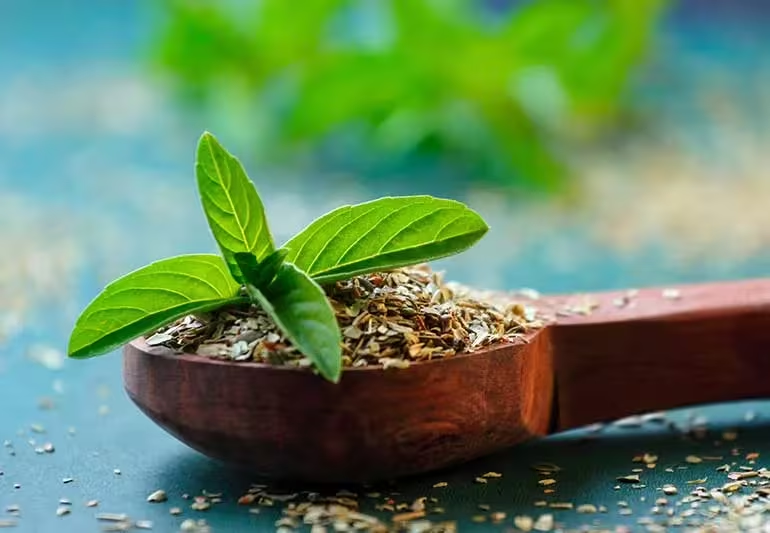
Holy basil (Ocimum tenuiflorum), also known as tulsi, has been used for centuries in Ayurvedic medicine to support well-being and reduce stress. Early clinical evidence suggests it may help to lower cortisol levels and improve perceived stress and mental clarity. Studies highlight its bioactive compounds – like eugenol and rosmarinic acid – that help regulate stress responses and reduce inflammation.
Key insights:
- Ayurvedic use focuses on balancing the body through teas, rituals, and meditation aids like tulsi beads.
- Modern research suggests stress relief through standardized extracts, with noticeable effects in 6-8 weeks.
- Some clinical trials have shown meaningful reductions in perceived stress and improved sleep quality with doses of 250-1,200 mg daily.
While both approaches highlight its calming effects, modern science offers measurable data, while Ayurvedic practices emphasize daily rituals and self-care. Always consult a healthcare provider before use, especially if pregnant or on medications.
Holy Basil for Stress: Ayurvedic vs Modern Science Comparison
1. Ayurvedic Uses of Holy Basil
Stress Relief Mechanisms
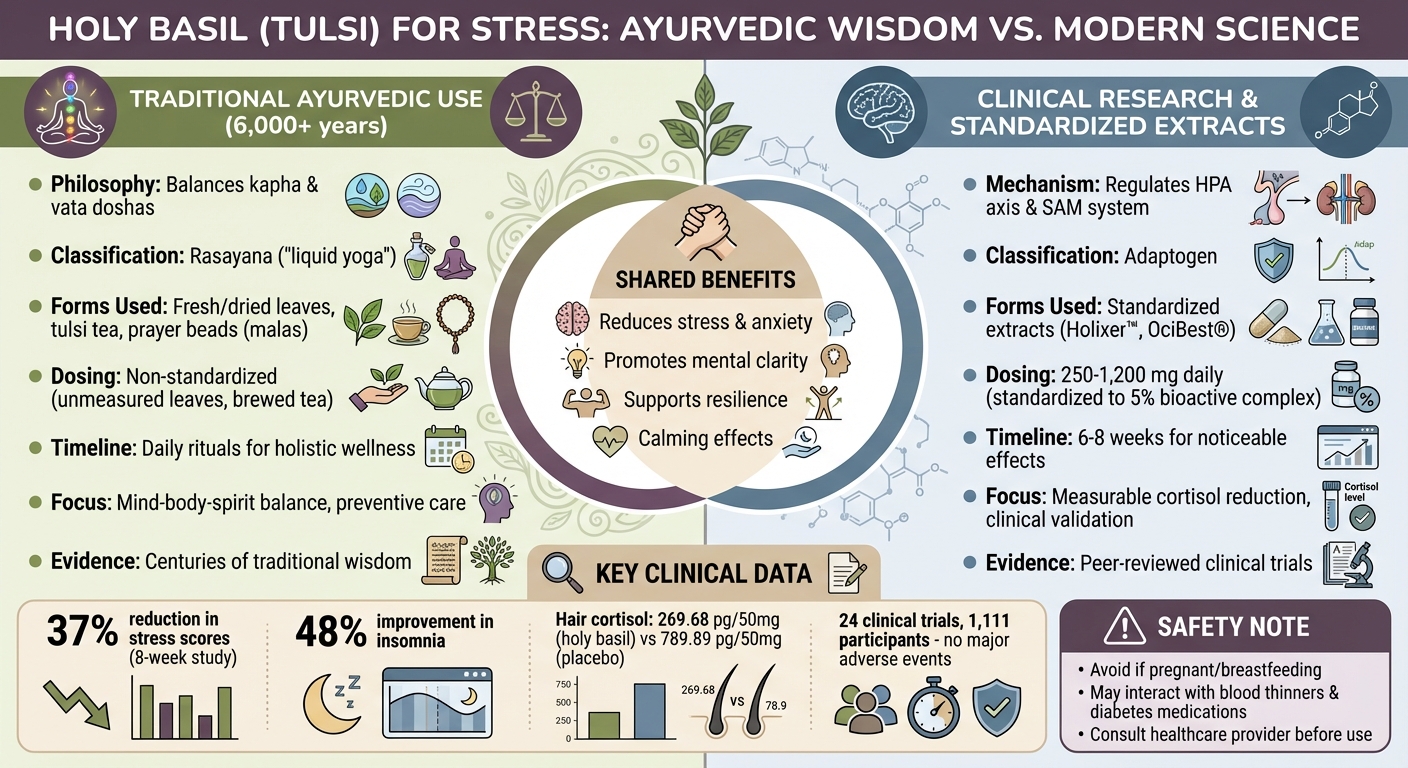
In Ayurveda, holy basil is believed to balance kapha and vata doshas. When these doshas are out of sync, they can lead to stress, anxiety, and general unease. The herb’s hot, bitter flavor is thought to penetrate deep into the body’s tissues, helping to reduce excess secretions that often accompany stress responses.
Holy basil is also categorized as a Rasayana – a term used in Ayurveda to describe substances that promote longevity and help the body adapt to stress. Sometimes referred to as “liquid yoga”, it’s known for its calming properties, which can ease tension and encourage mental clarity.
“Regular consumption of tulsi tea may be compared with the regular practice of yoga, which can be considered ‘adaptogenic’ through nurturing and nourishing the body — mind — spirit while fostering a sense of relaxation and wellbeing.” – Marc Maurice Cohen, School of Health Sciences, RMIT University
This deep-rooted understanding of holy basil’s benefits has shaped its practical and spiritual applications over centuries.
Practical Applications
Building on these stress-relief mechanisms, holy basil has become a staple in daily self-care routines. A popular way to use it is by brewing the fresh or dried leaves into a tea. Steeping the leaves in boiling water for up to 10 minutes creates a calming beverage that supports stress management when consumed regularly.
Holy basil’s uses extend beyond tea. For instance, tulsi malas – prayer beads made from the plant’s wood or seeds – are often used during meditation or chanting. These beads help focus the mind and strengthen the connection between body and spirit. Additionally, many households grow holy basil near their entrances. Its distinct clove-like aroma not only repels insects but also creates a purifying and serene environment.
Scientific studies are beginning to validate these traditional practices. In one 6-week randomized study, participants who incorporated holy basil into their routines reported notable reductions in stress, forgetfulness, and fatigue. This blend of ancient wisdom and modern research highlights the herb’s potential for holistic stress management.
sbb-itb-23f89d4
2. Scientific Research on Holy Basil
Stress Relief Mechanisms
Holy basil has been shown in early studies to help manage stress by influencing key biological systems. It appears to influence the hypothalamus-pituitary-adrenal (HPA) axis, which regulates the body’s long-term stress response. Research indicates that holy basil can lower cortisol levels – your main stress hormone – measured in both saliva and hair samples. This aligns with Ayurvedic principles, which emphasize balancing internal stressors.
Additionally, holy basil affects the sympathoadrenal medullary (SAM) system, which controls the “fight or flight” response. During stress tests, participants who took holy basil showed reduced salivary alpha-amylase levels (p = 0.001) and lower blood pressure compared to those on a placebo. This dual-action mechanism helps the body handle both immediate stress and chronic tension. These effects are linked to a unique set of bioactive compounds, discussed below.
Key Compounds and Effects
Holy basil’s stress-relieving properties come from its bioactive compounds. Ocimumosides A and B are key components that help regulate stress by normalizing hyperglycemia, plasma corticosterone, and adrenal hypertrophy, while also increasing dopamine and serotonin levels in the brain.
Other important compounds include eugenol, rosmarinic acid, ursolic acid, and β-caryophyllene. These substances enhance antioxidant activity by boosting glutathione, superoxide dismutase, and catalase levels. Additionally, eugenol and linoleic acid may have mild anti-inflammatory effects by inhibiting COX and LOX pathways.
Evidence for Efficacy
Clinical studies suggest holy basil may support stress reduction. In an 8-week trial conducted by Clinical Research Australia, 100 stressed adults saw a 37% reduction in Perceived Stress Scale scores, compared to a 19% reduction in the placebo group. Participants also reported a 48% improvement in insomnia, and hair cortisol levels dropped to 269.68 pg/50 mg in the holy basil group, compared to 789.89 pg/50 mg in the placebo group.
“The results from this trial suggest that 8 weeks of supplementation with an Ocimum tenuiflorum extract (Holixer™) may reduce objective and subjective measures of stress, and improve subjective measures of sleep quality.” – Adrian L. Lopresti, Managing Director, Clinical Research Australia
Another study in 2012 led by R.C. Saxena gave 150 stressed adults 400 mg of OciBest extract three times daily for six weeks. Participants reported reduced fatigue, better sleep, and fewer sexual health issues compared to a placebo group. Similarly, a 2008 study involving 35 adults with Generalized Anxiety Disorder found that taking 500 mg of ethanolic holy basil extract twice daily for eight weeks significantly reduced anxiety, stress, and depression scores.
Practical Applications
Clinical research has identified effective doses of holy basil ranging from 250 mg to 1,200 mg per day of standardized extract. Notable stress relief typically occurs after 6 to 8 weeks of consistent use. When selecting supplements, look for products standardized to at least 5% of the “Ocimum Bioactive Complex” or containing verified levels of eugenol, rosmarinic acid, and ocimumosides.
Standardized extracts offer more consistent results compared to traditional teas. Effective dosages usually fall between 100 and 500 mg of extract taken two or three times daily. Holy basil is generally well-tolerated, with reviews of 24 human clinical trials showing benefits for stress, metabolic health, and immunity, and generally well tolerated in short-term studies.
Holy Basil: The Sacred Herb of Ayurveda
Pros and Cons
Holy basil, or Tulsi, has been celebrated for its stress-relieving properties in both Ayurvedic traditions and modern scientific studies. However, each perspective brings its own set of benefits and challenges worth considering.
Ayurvedic tradition views holy basil as a time-honored remedy, used for thousands of years to support overall well-being and balance the mind, body, and spirit. It’s often praised for its preventive qualities, believed to help ward off illness and promote longevity. The downside? Traditional methods often involve non-standardized dosing – like using unmeasured amounts of leaves or brewing tea – which can result in inconsistent effects when managing stress.
Modern science, on the other hand, offers a more structured approach. Standardized extracts like Holixer™ and OciBest® have been shown to reduce cortisol levels and improve stress scores in studies. While promising, these studies are often short-term, ranging from just 2 to 13 weeks. This leaves questions about long-term safety, especially beyond 90 days. There are also potential risks to consider, such as slowed blood clotting (important to note before surgery), thyroid function in some cases (though data is limited), and interactions with medications for diabetes or blood thinning.
Here’s a quick comparison of the two approaches:
| Aspect | Advantages | Limitations |
|---|---|---|
| Ayurvedic Approach | Focuses on holistic wellness with centuries of traditional use | Relies on non-standardized dosing and lacks clinical validation for some uses |
| Scientific Approach | Provides measurable stress reduction with standardized extracts | Limited to short-term studies; long-term safety and drug interactions remain concerns |
| Safety Profile | Generally well-tolerated in culinary amounts | Risks include thyroid effects and bleeding concerns. Use with caution before surgery and always consult with your medical provider. |
A systematic review of 24 human clinical trials involving 1,111 participants reported positive outcomes with no major adverse events. However, only 12.5% of these studies met high-quality research standards, emphasizing the need for more rigorous, long-term investigations – especially for vulnerable groups like pregnant women, individuals with thyroid issues, or those on multiple medications.
Conclusion
Holy basil holds a special place in both Ayurveda and modern science as a tool for managing stress. In Ayurveda, it’s celebrated as the “elixir of life”, believed to promote longevity and balance. On the other hand, modern research classifies it as an adaptogen, known for helping regulate the body’s stress response through mechanisms like the HPA axis. Despite their differences, both perspectives highlight its ability to soothe the mind, build resilience, and shield the body from the harmful effects of chronic stress.
The main distinction lies in how each tradition approaches its use. Ayurveda leans on fresh leaves, teas, and daily rituals to achieve balance, while modern science focuses on standardized extracts. For instance, studies show that a daily dose of approximately 250 mg can reduce cortisol levels and improve stress scores within eight weeks. While Ayurveda brings centuries of wisdom, modern research offers clinical backing and safety data, which can provide reassurance for those seeking evidence-based options.
If you’re considering adding holy basil to your routine, consistency matters. Research suggests noticeable benefits may appear after around six weeks of regular use, typically at a daily dose of 250 mg (e.g., 125 mg twice a day). However, for the best results, pair it with good sleep, a nutritious diet, and other stress-relief practices.
While holy basil may support the body’s stress response, it is not a standalone solution. Sustainable stress management typically requires a broader, root-cause approach that includes sleep, nutrition, movement, and mental health care. Before starting, it’s wise to consult with an integrative care provider to determine if holy basil fits your needs.
If you’re dealing with chronic stress that isn’t improving, it may be time to look beyond just supplements and address the root causes. Modyfi Health offers psychiatric evaluations and holistic care plans that address stress at its root through lifestyle, nutrition, and mental health strategies – ensuring supplements like holy basil enhance your overall approach.
Important safety note: Holy basil should be avoided if you are pregnant, breastfeeding, or taking blood thinners. Always check with your healthcare provider before trying any new supplement, especially if you’re on medications for diabetes or blood clotting.
FAQs
How does holy basil compare to other adaptogens for managing stress?
Holy basil (Ocimum tenuiflorum), often called tulsi, has long been valued in Ayurveda for its ability to help the body handle stress and support overall wellness. Recent studies show that it can lower cortisol levels, improve sleep quality, and boost mood, making it a natural choice for managing stress.
While it’s often compared to other herbs like ashwagandha, holy basil offers some distinct benefits. It has unique effects on the immune system and influences GABA pathways, which play a key role in calming stress and anxiety. Both herbs are known for supporting adrenal health and reducing cortisol, but holy basil’s deep roots in traditional medicine, combined with modern research, make it an excellent option for promoting mental health and better sleep.
What side effects can holy basil cause?
Holy basil is typically safe for short-term use, though some individuals might notice mild side effects like nausea or an upset stomach. These issues are more common when consuming doses of around 500 mg daily over a period of 60 to 90 days. That said, the effects of using holy basil over the long term haven’t been fully researched.
If you’re thinking about adding holy basil to your routine, it’s smart to check in with a healthcare provider first – especially if you have existing health conditions or are on medication. This ensures it’s the right choice for your situation.
Can I use holy basil with other techniques to manage stress?
Holy basil, often referred to as Ocimum tenuiflorum or Ocimum sanctum, has long been a staple in Ayurveda for its stress-relieving properties. It’s classified as an adaptogen, meaning it helps the body manage stress more effectively. Modern studies back this up, showing that holy basil can help regulate cortisol (a key stress hormone) and influence neurotransmitters like GABA, dopamine, and serotonin – chemicals that play a big role in mood and stress regulation.
For a well-rounded approach, you can pair holy basil with practices like mindfulness, relaxation techniques, or regular physical activity. While holy basil helps balance the body’s physiological stress responses, these activities focus on mental and emotional well-being, working together for a more comprehensive effect. If you’re considering adding holy basil to your routine, it’s smart to consult with a healthcare professional for guidance tailored to your needs.
