


Cognitive Behavioral Therapy for Insomnia (CBT-I) is a proven, non-drug solution to chronic sleep issues. Recommended by the American College of Physicians as the first-line treatment for insomnia, CBT-I addresses the root causes of poor sleep by reshaping thoughts and behaviors. Unlike sleep medications, which can lead to dependency and rebound insomnia, CBT-I delivers long-lasting results, with 70-80% of patients experiencing major improvements and 70% maintaining benefits two years post-therapy.
Key highlights of CBT-I:
- Short-term therapy: Typically completed in 6 to 8 sessions.
- Core techniques: Includes stimulus control, sleep restriction, and cognitive restructuring.
- Long-term benefits: Reduces insomnia severity, improves sleep efficiency, and enhances overall sleep quality.
- Evidence-backed results: Studies show CBT-I outperforms medications in sustaining improvements over time.
CBT-I is accessible through in-person and virtual formats, making it easier for individuals to regain control of their sleep without relying on medication. Keep reading to learn how CBT-I works and why it’s a game-changer for better sleep.
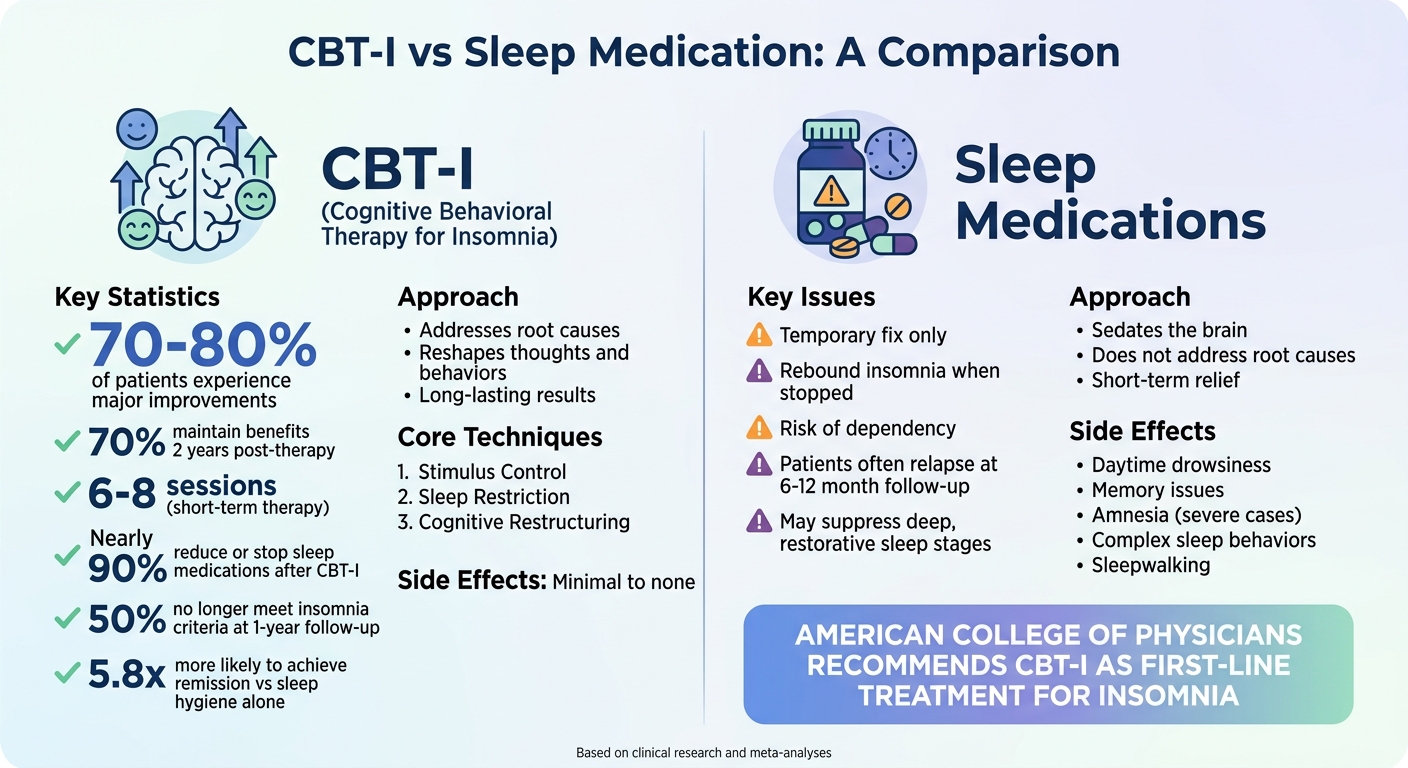
CBT-I vs Sleep Medication: Effectiveness and Long-Term Outcomes Comparison
The Problem: Understanding Insomnia and Treatment Challenges
What is Insomnia?
Insomnia is a long-term sleep disorder characterized by trouble falling asleep, staying asleep, or getting back to sleep after waking up. It’s considered chronic when these symptoms occur at least three times a week for three months or more.
This condition affects around 10% of the global population, with 1 in 3 adults in the U.S. experiencing it. In the United States alone, approximately 25 million people are impacted by insomnia.
“Insomnia is when you experience disruptions in how you feel or function because you aren’t sleeping well or sleeping enough.” – Cleveland Clinic
Chronic insomnia doesn’t just disrupt sleep – it poses serious health risks. It has been linked to high blood pressure, heart disease, diabetes, and chronic pain. Mental health is also deeply affected, as nearly half of those with chronic insomnia also face conditions like anxiety or depression. Cognitive deficits also slow overall reaction times. This delay can significantly elevate the risk of accidents during daily tasks. Common examples include driving or handling workplace machinery.
Despite its prevalence and impact, traditional treatments often fail to address the root causes of insomnia.
Why Traditional Sleep Treatments Fall Short
Sleep medications are often the go-to solution for quick relief, but they only provide a temporary fix. These drugs work by sedating the brain, yet they don’t address the deeper issue: the brain’s association of the bed with wakefulness and anxiety.
When people stop taking these medications, rebound insomnia and dependency are common. A 2015 meta-analysis revealed that while medications and Cognitive Behavioral Therapy for Insomnia (CBT-I) delivered similar short-term results, only CBT-I led to lasting improvements at 6- to 12-month follow-ups. By contrast, those relying on medications often relapsed.
Some sleep medications may increase total sleep time, but they can suppress the deep, restorative stages of sleep. Side effects are another concern, ranging from daytime drowsiness and memory issues to more severe problems like amnesia or complex sleep behaviors, including sleepwalking.
“The drug that’s supposed to help you sleep actually degrades the quality of the sleep you get. The behavioral therapy that involves spending less time in bed produces better sleep when you’re there.” – AJ Keller, CEO, Neurosity
These limitations highlight the need for alternative approaches, such as CBT-I, which focuses on reshaping behaviors and thought patterns to improve sleep naturally.
sbb-itb-23f89d4
CBT-I Explained: The Proven Method to Cure Insomnia Without Medication | Ashley Mason, Ph.D.
The Solution: How CBT-I Works
Cognitive Behavioral Therapy for Insomnia (CBT-I) helps restore natural sleep by retraining both the mind and body. It employs several techniques – stimulus control, sleep restriction, and cognitive restructuring – that work together to reshape your sleep habits.
Stimulus Control Therapy
Stimulus Control Therapy (SCT) tackles the problem of associating the bedroom with wakefulness and frustration instead of rest. When you lie awake too often, your brain starts linking the bed with alertness. SCT breaks this cycle by setting clear boundaries: the bed should be used only for sleep (and intimacy). Activities like reading, watching TV, or scrolling through your phone should happen elsewhere. If you’re unable to fall asleep within 10 to 20 minutes, leave the bed and do a quiet activity in another room until you feel drowsy. Keeping a consistent wake-up time every day – including weekends – and avoiding naps during the day also helps reestablish a healthy sleep-wake connection. Studies show that 70% to 80% of people with primary insomnia see noticeable improvements within 6 to 8 weeks.
“Stimulus control therapy means pairing sleep-related things – like your bed and darkness – with sleep.” – Cleveland Clinic
Sleep Restriction Therapy
After addressing stimulus control, Sleep Restriction Therapy takes things a step further by improving sleep efficiency. This technique limits the amount of time you spend in bed to match the actual hours you’re sleeping. For example, if you’re only getting 5 hours of sleep each night but spending 8 hours in bed, your sleep window would initially be reduced to about 5.5 hours (your average sleep time plus a 30-minute buffer). This intentional, controlled sleep consolidation dynamic naturally increases your biological sleep drive. As a result, it helps you fall asleep faster. It also allows you to stay asleep longer throughout the night. As your sleep efficiency improves, your time in bed is gradually increased in small increments of 15 to 30 minutes.
During the early stages of this therapy, it’s important to avoid activities requiring full alertness, like driving, and to keep a sleep diary to track your progress. However, this specific protocol requires vital clinical adaptations. It may not be suitable for individuals with certain medical histories. These conditions include bipolar disorder, seizure disorders, or untreated obstructive sleep apnea.
“Sleep restriction therapy (SRT) addresses the tendency for people with insomnia to make up for ‘lost’ sleep by increasing their time in bed.” – Cleveland Clinic
Cognitive Restructuring and Relaxation Techniques
The final piece of CBT-I focuses on addressing the thoughts and mental patterns that interfere with sleep. Cognitive restructuring helps you identify and challenge negative, stress-inducing thoughts, replacing them with calmer, more balanced ideas. For instance, instead of thinking, “I’ll never fall asleep”, you might tell yourself, “I’m not asleep yet, but I will be soon”. This shift can break the cycle of stress and anxiety tied to bedtime.
Relaxation techniques add another layer of support by calming both the mind and body. Progressive muscle relaxation, where you tense and release different muscle groups, activates the body’s natural relaxation response, often called “rest and digest”. Mental distraction methods like cognitive shuffling – where you pick a word like “GARDEN” and imagine related items for each letter – can also help quiet racing thoughts.
Research suggests that nearly 90% of people who complete CBT-I are able to reduce or completely stop using sleep medications. These methods not only improve sleep during treatment but also lead to lasting benefits long after therapy ends.
Research Evidence for CBT-I
Improvements in Sleep Metrics
Studies consistently highlight that CBT-I leads to noticeable improvements in key sleep metrics. For instance, a meta-analysis of 29 randomized controlled trials, encompassing 9,475 participants, demonstrated that fully automated digital CBT-I significantly reduces insomnia severity (SMD = -0.71), enhances sleep efficiency (SMD = 0.45), shortens sleep onset latency (SMD = -0.39), decreases wake after sleep onset (SMD = -0.38), and modestly increases total sleep time (SMD = 0.19). These findings are further validated by objective sleep measurements.
Take the CrEDIT Trial as an example. Conducted nationwide between 2022 and 2023, this study evaluated SleepioRx, an FDA-cleared digital CBT-I program, on 336 adults diagnosed with insomnia disorder. Results showed a statistically significant reduction in insomnia severity at 10 weeks (Cohen’s d = 0.60), which improved even further to d = 0.77 at the 24-week follow-up. Participants using digital CBT-I were 5.8 times more likely to achieve remission at 10 weeks compared to those who only received sleep hygiene education. These improvements held steady at the 6-month mark.
These early gains pave the way for sustained, long-term progress that continues well beyond the treatment period.
Long-Term Benefits of CBT-I
The benefits of CBT-I don’t just stop after the initial treatment – they often grow over time. Unlike sleep medications, which lose effectiveness once stopped, CBT-I creates lasting changes. Long-term studies show continued improvement in insomnia severity, reaching a large effect size of -0.76. Sleep efficiency also improves further (SMD = 0.61), along with reductions in sleep onset latency (SMD = -0.47) and wake after sleep onset (SMD = -0.45).
One striking example is the SHUTi OASIS Trial, conducted from 2018 to 2019. This study followed 311 older adults (ages 55 to 95) across 38 U.S. states for a full year. At the 12-month follow-up, participants using the fully automated digital CBT-I platform reported a large reduction in insomnia severity (d = -1.29 to -1.41) compared to those receiving only patient education. Nearly 50% of participants in the digital CBT-I group no longer met the criteria for insomnia at the one-year mark. Additionally, they reported using sleep medications on fewer nights compared to the control group.
“CBT-I treats insomnia by targeting psychological (eg, sleep-related worries, unhelpful beliefs about insomnia) and behavioral factors (eg, sleep-incompatible behaviors) that contribute to and maintain chronic sleep difficulties.” – Aric A. Prather, PhD
CBT-I at Modyfi Health
Virtual CBT-I Therapy at Modyfi Health
Modyfi Health provides Cognitive Behavioral Therapy for Insomnia (CBT-I) through telehealth, offering services to residents of Maryland, the District of Columbia, Virginia, and Delaware. The process begins with a thorough 60-minute evaluation that examines your sleep history, mental health, and lifestyle. Follow-up sessions, lasting 30 to 60 minutes, focus on reinforcing behavioral and cognitive improvements.
This virtual format ensures accessibility for people of all ages – whether you’re a teen managing school pressures, an adult juggling work and family, or an older individual facing sleep challenges tied to aging. Studies reveal that over 85% of individuals who try CBT-I see positive results, often within six to eight weeks. Additionally, research confirms that digital CBT-I is just as effective as in-person therapy. The online sessions follow the same evidence-based methods, addressing both behavioral and cognitive factors behind insomnia.
Combined Care for Better Sleep
Modyfi Health takes a comprehensive approach to improving sleep by combining CBT-I with functional lab testing to uncover potential biological contributors to insomnia. These tests examine factors such as nutrient deficiencies, hormonal imbalances, gut health, inflammation, and toxins.
Therapists work closely with nutritionists to tackle issues like inflammation, blood sugar irregularities, and gut-related problems. Tailored exercise therapy is also part of the plan, helping regulate the nervous system and support emotional well-being. This holistic approach addresses not just the habits and thoughts affecting sleep but also any underlying physical causes. Modyfi Health accepts most major insurance plans (except Medicare and Medicaid), making this well-rounded care more accessible for many.
Conclusion: Better Sleep Through CBT-I
CBT-I stands out as the leading treatment for chronic insomnia, endorsed by the American College of Physicians. It tackles the core issues – like conditioned hyperarousal, unhelpful thought patterns, and poor sleep routines – helping 70% to 80% of people with primary insomnia see meaningful improvements.
One of the biggest strengths of CBT-I is how long-lasting its effects are. A 2020 study in The Lancet revealed that over 70% of patients maintained significant sleep improvements even two years after completing therapy. Unlike sleep medications that often result in relapses, CBT-I offers benefits that continue well beyond the treatment period.
Dr. Courtney Bancroft, Clinical Director of BeHealth at Northwell Health, highlights this durability:
“CBT-I has durable benefits without many side effects… And it’s often effective in just six to eight weeks.”
CBT-I also promotes physical changes in the brain, improving sleep architecture by increasing sleep spindle density and enhancing deep, restorative sleep. These changes not only help people sleep longer but also improve the overall quality of their rest.
Modyfi Health’s virtual CBT-I program makes this evidence-based treatment more accessible for residents in Maryland, the District of Columbia, Virginia, and Delaware. The program combines core behavioral therapy with functional lab testing, nutrition guidance, and exercise therapy to address both sleep behaviors and potential physical contributors. With most major insurance plans accepted, getting started on the path to better sleep may be easier than you think.
👉 Schedule Your Comprehensive 60-Minute Sleep Evaluation Today
FAQs
How do I know if I have chronic insomnia?
If you find yourself having trouble falling asleep, staying asleep, or waking up too early at least three nights a week for more than three months, you might be dealing with chronic insomnia. This condition often comes with daytime exhaustion, frustration about sleep, and difficulties with mood, concentration, or everyday tasks. These signs may signal that it’s time to seek evaluation and support.
Is CBT-I safe if I have sleep apnea, seizures, or bipolar disorder?
CBT-I isn’t typically advised for people with a history of seizures or bipolar disorder, as it could potentially aggravate these conditions. Sleep disturbances can significantly impact the management of bipolar disorder and seizure-related health concerns. It’s essential to consult a healthcare provider to explore treatment options tailored to your needs.
Can I stop sleep meds during CBT-I, and how?
Yes, it’s possible to stop taking sleep medications while undergoing CBT-I, but it’s important to do so gradually and under the supervision of a healthcare provider. CBT-I focuses on changing the thoughts and behaviors that disrupt sleep, which can help reduce reliance on medication over time. A provider might recommend a gradual tapering process while you practice CBT-I techniques, ensuring a safer transition and minimizing withdrawal symptoms.