

When a panic attack hits — heart pounding, chest tight, breathing difficult, a sense that something is seriously wrong — it can feel like a medical emergency. That experience is real. The physical symptoms are real. And while panic attacks can be intensely frightening and disorienting, understanding what’s happening in the body during one can change how you respond — and responding differently is often what shortens the episode.
This post covers the physiology behind panic attacks, what the evidence shows about managing them in the moment, and when recurring panic attacks are worth evaluating professionally.
What’s Actually Happening During a Panic Attack
A panic attack is a sudden, intense activation of the body’s threat-detection system — the same system that evolved to protect us from physical danger.
The amygdala, the brain’s fear-processing center, fires an alarm signal. The hypothalamic-pituitary-adrenal axis releases adrenaline and cortisol. Heart rate spikes. Breathing becomes rapid and shallow. Blood is redirected to large muscle groups. The prefrontal cortex — the part responsible for reasoning and regulation — becomes partially less accessible.
The physical symptoms that tend to feel most alarming — racing heart, chest tightness, dizziness, tingling in the hands and face — are largely connected to changes in breathing and CO₂ levels. When breathing becomes too fast and shallow, CO₂ levels can drop. Blood vessels constrict. The tingling and lightheadedness that follow can be misread by the nervous system as further evidence of danger — which can amplify the experience.
According to NIMH, panic attacks typically peak within 10 minutes. They are distinct from cardiac events, though symptoms can overlap — which is why a first-time episode, or any episode with chest pain or neurological symptoms, should be medically evaluated.
For a clinical explanation of what panic disorder looks like — and how it differs from an isolated panic attack — the video below from board-certified psychiatrist Dr. Tracey Marks offers useful context before diving into the evidence on what actually helps:
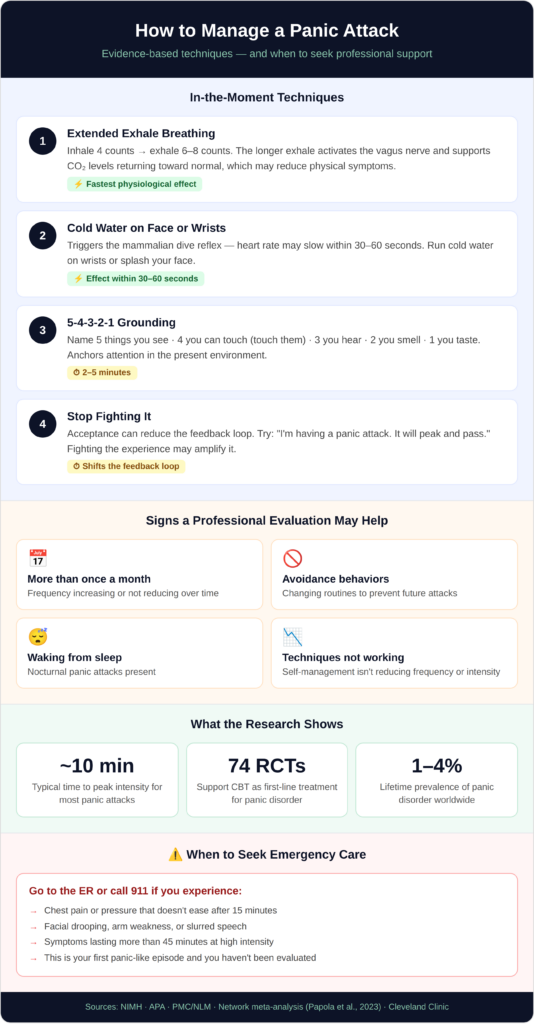
The infographic below summarizes the key in-the-moment techniques, signs that professional evaluation may help, and what the research shows about panic disorder treatment:
What Works in the Moment
The goal during a panic attack is not to stop it immediately — that’s usually not possible, and trying to force it can sometimes make the experience more intense. The goal is to stop feeding the cycle that sustains it.
1. Slow your exhale
Extended exhale breathing is the most physiologically direct technique for managing panic in the moment. When you breathe out longer than you breathe in, you activate the parasympathetic nervous system — specifically the vagus nerve — which works against the fight-or-flight response.
The mechanism: a longer exhale slows heart rate through the baroreceptor reflex and supports CO₂ levels returning toward normal, which may reduce the physical symptoms that the brain reads as danger signals.
How to practice:
- Inhale through your nose for 4 counts
- Exhale slowly through your mouth for 6 to 8 counts
- Repeat for at least 4 to 6 cycles
The ratio matters more than the exact count — exhale longer than you inhale. If you feel more lightheaded or short of breath during any breathing exercise, stop and switch to grounding instead.
2. Cold water on your face or wrists
Splashing cold water on your face or holding your wrists under cold running water may trigger what’s known as the mammalian dive reflex — a physiological response that can cause heart rate to slow. This works by stimulating the vagus nerve through facial and wrist cold receptors.
Cold temperature exposure is used as a regulation skill in Dialectical Behavior Therapy (DBT) for exactly this reason. It’s one of the more accessible immediate interventions available outside of a clinical setting.
3. Ground yourself sensorially — the 5-4-3-2-1 method
When the prefrontal cortex is less accessible during peak panic, reasoning and reassurance tend not to work well. Engaging the senses through your environment can be more effective — it gives the brain something concrete to process in the present moment.
5-4-3-2-1 method:
- Name 5 things you can see right now
- Name 4 things you can physically touch — and touch them
- Name 3 things you can hear
- Name 2 things you can smell
- Name 1 thing you can taste
Say them out loud if possible. A 2015 clinical review found that grounding techniques may significantly reduce acute anxiety and dissociative symptoms by anchoring attention to the present environment.
4. Stop fighting it
One of the most counterintuitive but well-supported approaches to panic is acceptance — deliberately reducing the effort to suppress or escape the experience.
Fighting a panic attack can amplify it. Attempts to push the experience away can signal to the threat-detection system that the experience is genuinely dangerous, which may extend the response. A more helpful approach is acknowledging what’s happening: “I’m having a panic attack. It will peak and pass.”
This is the principle behind interoceptive exposure therapy — one of the most evidence-based components of Panic-Focused Cognitive Behavioral Therapy. Deliberately tolerating the physical sensations of panic, repeatedly, tends to reduce their intensity over time.
What to Avoid
Breathing into a paper bag. This was once recommended to raise CO₂ levels during hyperventilation. It is no longer advised — it carries a risk of oxygen deprivation and is not supported by current evidence.
Trying to reason at the peak. When the amygdala is highly activated, logical reasoning is harder to access. Physiological and sensory techniques tend to work better during the peak because they engage different systems in the nervous system.
The Difference Between a Panic Attack and Panic Disorder
Having a panic attack — even several — does not necessarily mean you have panic disorder. Isolated panic attacks can occur during periods of acute stress, sleep deprivation, hormonal shifts, or as part of other anxiety conditions.
Panic disorder is characterized by recurrent, unexpected panic attacks combined with persistent concern about future attacks, and behavioral changes designed to avoid triggering them — which can gradually restrict daily life.
The distinction matters because the treatment approach differs. For panic disorder, the gold standard is Panic-Focused CBT — specifically including interoceptive exposure. A 2023 network meta-analysis of 74 randomized controlled trials with 6,699 participants confirmed that CBT — delivered in person, in groups, or through guided digital formats — significantly outperforms standard care.
Medication, when appropriate, tends to be most effective in combination with therapy.
Signs That Recurring Panic Attacks Are Worth Evaluating Professionally
Consider a formal evaluation if:
- Panic attacks are happening more than once a month
- You’re changing behavior to avoid situations where attacks occurred
- Fear of future attacks is affecting daily decisions
- Panic attacks are waking you from sleep
- Self-management techniques aren’t reducing intensity or frequency over time
A clinical evaluation can assess whether panic disorder is present, whether another condition — such as thyroid dysfunction, cardiac arrhythmia, or another anxiety disorder — might be contributing, and what combination of therapy, medication, and lifestyle support fits your specific pattern.
Symptoms Are Signals. Let’s Find the Source.
If panic attacks are becoming more frequent, more disruptive, or harder to manage on your own — that pattern deserves more than a breathing exercise. At Modyfi, our Root-Cause Psychiatry approach brings psychiatry, therapy, nutrition, and exercise together to understand what’s driving the pattern and build a care plan around it.
👉 Explore Providers to Book an Appointment and Start Your Care Plan
(Note: Modyfi proudly accepts most major commercial insurance plans. We do not accept Medicare or Medicaid.)
Conclusion: Managing Panic Starts With Understanding It
Panic attacks are among the most physically convincing experiences a person can have — the body is doing exactly what it would do in a real emergency, triggered without one. That gap between how the experience feels and what’s actually happening is part of what makes them so disorienting.
The techniques that work best don’t try to stop the attack by force. They interrupt the feedback loop that sustains it — by shifting the breath, engaging the senses, or reducing the fight against the experience itself. Used consistently, these approaches can meaningfully reduce both the intensity and duration of individual episodes.
For some people, self-management is enough — particularly when panic attacks are infrequent, situational, and not shaping daily decisions. For others, particularly when attacks are recurring, unpredictable, or beginning to narrow the range of what feels safe to do, professional support tends to produce more lasting change.
The research is clear on what works for panic disorder: Panic-Focused Cognitive Behavioral Therapy, with or without medication, produces meaningful and durable improvement for most people who receive it. Getting there often starts with understanding that what’s happening is treatable — not a sign that something is fundamentally broken.
Frequently Asked Questions
How long does a panic attack typically last?
Most panic attacks reach peak intensity within 10 minutes and resolve within 20 to 30 minutes. The most intense physical symptoms — racing heart, chest tightness, shortness of breath — typically subside first. A residual sense of exhaustion or low-grade anxiety can linger afterward. If symptoms persist beyond 30 minutes at high intensity, or if this is a first episode, a medical evaluation is appropriate to rule out other causes.
Can you stop a panic attack before it peaks?
Sometimes — particularly if you recognize early warning signs and begin a technique quickly. Many people with panic disorder learn to notice subtle signals: a slight shift in breathing, a particular quality of alertness, or a sense of unreality. Beginning extended exhale breathing or cold water intervention at that early stage can sometimes prevent the episode from reaching full intensity. The earlier the intervention, the more it may help.
Is it safe to exercise during or after a panic attack?
During an active panic attack, intense exercise is generally not recommended — the cardiovascular arousal can be misread by the nervous system as additional threat signals. After the peak has passed, light movement like slow walking may help discharge residual adrenaline. Regular aerobic exercise between episodes is one of the more consistently supported lifestyle factors for reducing panic attack frequency over time, according to research published by the APA.
Why do panic attacks happen at night?
Nocturnal panic attacks — which wake people from sleep, typically during non-REM stages — are experienced by a significant portion of people with panic disorder. The mechanism isn’t fully understood, but likely involves the body’s threat-detection system responding to normal physiological changes during sleep, such as shifts in breathing rate or CO₂ levels. They respond to the same treatments as daytime attacks.
When should I seek emergency care?
If you have not previously been evaluated for panic attacks, your first episode should be assessed medically — cardiac causes of palpitations and chest tightness should be ruled out. Once panic disorder has been diagnosed, most attacks don’t require emergency care. Seek help if: symptoms are more severe than previous attacks, there is significant chest pain or pressure, the attack doesn’t resolve within 45 minutes, or you experience neurological symptoms like facial drooping, arm weakness, or slurred speech.
Does caffeine make panic attacks worse?
For some people, yes. Caffeine stimulates the central nervous system and can increase heart rate and feelings of restlessness — which may lower the threshold for panic in people who are already prone to attacks. The relationship is individual: some people with panic disorder are highly sensitive to caffeine’s effects, while others notice little difference. If you’re experiencing frequent panic attacks, reducing caffeine is a reasonable first step to evaluate its role in your pattern.