


Interpersonal Therapy (IPT) helps people improve their mental health by focusing on how relationships affect emotions and well-being. It works by addressing specific interpersonal issues like grief, conflicts, life transitions, and social isolation. Research shows IPT is effective for treating depression, anxiety, PTSD, and eating disorders.
Here’s how IPT works:
- Strengthens social support: Builds healthier relationships and trust.
- Reduces interpersonal stress: Resolves conflicts and improves communication.
- Processes emotions: Teaches patients to understand and express feelings better.
- Builds interpersonal skills: Provides tools for navigating relationships and life changes.
Studies confirm IPT leads to lasting improvements in mental health by focusing on current relational challenges, rather than digging into the past. It’s structured, time-limited, and often combined with medication and other therapies for a balanced approach.
Theoretical Foundations of Change in IPT
Relational and Attachment Theory
Interpersonal psychotherapy (IPT) is rooted in interpersonal psychology, which views psychiatric symptoms as stemming from relational challenges. This marks a departure from traditional psychoanalytic approaches, which focus on internal conflicts within the mind. Instead, IPT directs attention outward, emphasizing the role of relationships in mental health.
At the heart of this perspective is John Bowlby’s attachment theory, which underscores the importance of close human connections for emotional well-being and resilience. When these bonds are disrupted – whether through loss, conflict, or significant life changes – psychiatric symptoms often emerge. Moreover, the stress from these disruptions can deepen relational difficulties. IPT addresses these issues head-on, using them as the starting point for therapeutic intervention.
“IPT sees psychiatric disorders as precipitated and maintained by crises or predicaments in the interpersonal context.” – Joshua D. Lipsitz and John C. Markowitz
Attachment theory also highlights the lasting influence of early relationships, which shape internal working models. These patterns can lead to interpersonal sensitivities that IPT tackles in the present. By focusing on emotional bonds, IPT builds a foundation for understanding how stress and support impact mental health.
Stress and Social Support Frameworks
IPT incorporates a diathesis-stress model, which explains mental illness as a result of the interplay between biological predisposition and stressful life events. In this context, social support becomes a vital component of recovery – a concept described as a “pan-focal task” that applies across all four areas of IPT intervention.
“Relationships matter – in health, disease, coping with stress, and recovering from illness. This is the rationale for interpersonal psychotherapy (IPT).” – Paula Ravitz, Priya Watson, and Sophie Grigoriadis
IPT recognizes two distinct relational challenges: insufficient social support and active interpersonal stress. Both contribute to maintaining symptoms but require different therapeutic strategies. For instance, resolving a role dispute isn’t solely about fostering support – it’s also about addressing the ongoing conflict that drains emotional energy.
This dual focus on reducing stress and enhancing support sets the stage for IPT’s work on emotional processing.
Affect Theory and Emotional Processing
In IPT, emotions serve as social signals, helping individuals identify their needs and navigate interactions. A key aspect of therapy involves helping patients understand and effectively use these emotional cues.
“Emotions are the primary language of interpersonal relationships, and central tasks in confronting and surmounting interpersonal problems in IPT comprise identifying, processing, and expressing emotions that arise in this context.” – Joshua D. Lipsitz and John C. Markowitz
Therapists employ affect-focused exploration, guiding patients to delve into distressing interactions – a technique sometimes referred to as “micro-slicing.” By breaking down conflicts, patients can uncover the emotions driving their reactions, pinpoint communication breakdowns, and practice alternative responses. This process also strengthens mentalizing – the ability to interpret one’s own and others’ motivations – which is closely tied to improved interpersonal skills and recovery from mental illness.
Interpersonal Psychotherapy [Part 1] Theory, Principles, Concepts and Process of IPT
The Four Core Mechanisms of Change in IPT
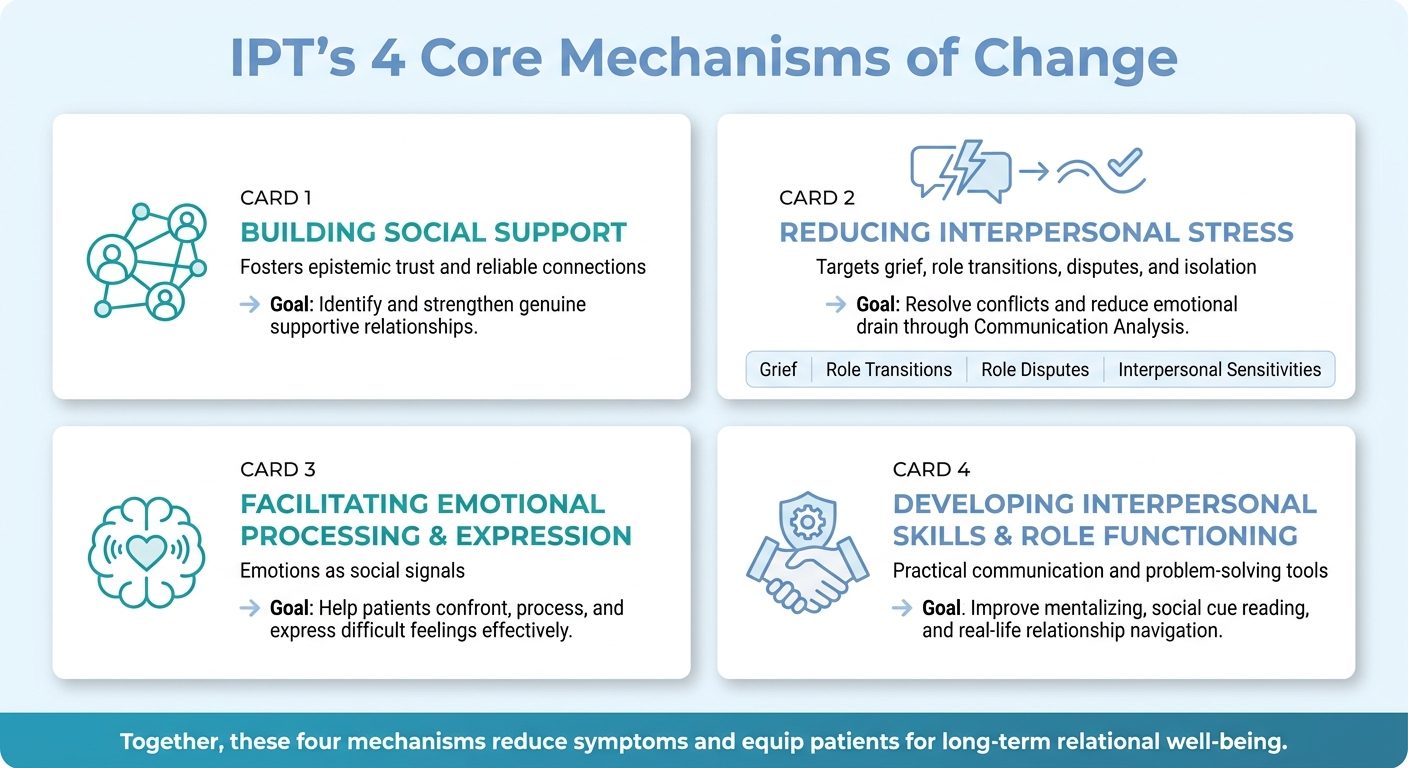
IPT Mechanisms of Change: 4 Core Pathways to Mental Health Recovery
Interpersonal Psychotherapy (IPT) works by addressing specific areas of interpersonal life, aiming to reduce symptoms and improve overall functioning. It achieves this through four key mechanisms rooted in relational and stress/support frameworks.
Building Social Support
Social support is at the heart of every IPT case, as research consistently highlights its importance. IPT helps patients identify relationships that provide genuine support and encourages them to strengthen these connections. By fostering epistemic trust – the ability to view others as reliable – patients open themselves to new ways of thinking and behaving.
While building supportive relationships is essential, addressing sources of interpersonal stress is equally critical.
Reducing Interpersonal Stress
Interpersonal stress, stemming from conflicts, unmet expectations, or unresolved disputes, can drain emotional energy and exacerbate symptoms. IPT tackles this stress by focusing on four main problem areas:
| Problem Area | Source of Stress | Goal |
|---|---|---|
| Grief | Loss of a significant person | Processing the loss and finding new sources of support |
| Role Transitions | Major life changes (e.g., divorce) | Adapting to new roles and managing associated challenges |
| Role Disputes | Conflicts from differing expectations | Resolving disputes through better communication |
| Interpersonal Sensitivities | Loneliness or social isolation | Reducing isolation and expanding social connections |
A key technique used here is Communication Analysis, which helps patients break down distressing interactions to identify where communication may have failed. Research indicates that interpersonal functioning can improve more quickly in IPT compared to Cognitive Therapy. Once stressors are addressed, the focus shifts to emotional expression.
Facilitating Emotional Processing and Expression
“IPT helps patients to understand their emotions as social signals, to use this understanding to improve interpersonal situations, and to mobilize social supports.”
Therapists use emotion-focused techniques to help patients confront and process difficult feelings, rather than avoiding them. This approach helps patients recognize their emotions in the moment and express them more effectively, ultimately improving the quality of their relationships.
Developing Interpersonal Skills and Role Functioning
IPT provides patients with practical tools for communication and problem-solving, often using role-playing exercises to practice these skills before applying them in real life. This is especially helpful during major life changes, like starting a new job or navigating a divorce, when old habits may no longer work.
Improved interpersonal skills also enhance mentalizing – the ability to understand and interpret both one’s own mental states and those of others. As patients become better at reading social cues and responding appropriately, their relationships improve, creating a positive cycle that supports long-term recovery.
Together, these four mechanisms create a structured approach that not only alleviates symptoms but also equips patients with the tools they need to thrive in their interpersonal lives. IPT’s framework can be seamlessly integrated into broader mental health care strategies.
sbb-itb-23f89d4
Research Evidence on IPT’s Mechanisms of Change
Understanding the mediators that transform interpersonal improvements into symptom relief is crucial for grasping the clinical impact of Interpersonal Psychotherapy (IPT). Researchers have worked to uncover the specific pathways through which IPT achieves its lasting effects. Below, we explore how social support, emotional processing, and condition-specific factors contribute to these outcomes.
Social Support and Interpersonal Functioning as Mediators
Studies have shown that shifts in perceived stress and social support play a key role in treatment outcomes, with notable effects becoming evident about 8 months after therapy ends. Dr. Holly A. Swartz, MD, explains this dynamic:
“Improvement of interpersonal functioning reduces symptoms, which leads to additional spontaneous improvement of interpersonal functioning, which in turn reduces depressive symptoms further.”
This positive feedback loop suggests that progress in one area reinforces progress in the other. For example, a study involving economically disadvantaged mothers found that the mediation effects of social support were more pronounced months after therapy, rather than during the initial treatment phase. This indicates that social support may be a stronger driver of long-term recovery than of immediate symptom relief.
While social support is a critical factor, emotional processing is another essential pathway in IPT’s effectiveness.
Emotional Processing as a Change Pathway
As noted by Lotte H.J.M. Lemmens et al.:
“The theorized mechanism of IPT is that as patients solve their interpersonal problems or their emotions in relation to their problems, the depression will resolve as well.”
A clinical case published in Focus (2014) illustrates this concept. A 41-year-old consultant with chronic depression and no close relationships initially avoided expressing emotions. Through therapy, he was encouraged to explore and articulate his “here-and-now” feelings. As he felt understood, his depressive symptoms steadily improved over the course of treatment.
Neuroimaging studies back this up, showing that successful IPT for major depression can normalize regional brain metabolic activity, as observed in SPECT and PET scans. These findings link emotional processing not only to behavioral improvements but also to measurable changes in brain function.
Condition-Specific Evidence
Research across various conditions underscores the durability and specificity of IPT’s mechanisms. Here’s a snapshot of findings:
| Condition | Primary Mechanism | Outcome |
|---|---|---|
| MDD (Adults) | Resolving interpersonal crises; enhancing social support | BDI-II scores dropped from 29 (severe) to 14 (mild); effect size (Cohen’s d = 1.72) |
| MDD (Adolescents) | Reducing family conflict; building communication skills | Effective in multiple controlled trials; parent involvement is key |
| Bipolar Disorder (IPSRT) | Stabilizing social and circadian rhythms using the Social Rhythm Metric | Lower relapse rates and reduced suicidal behavior |
| Eating Disorders | Addressing interpersonal factors that maintain symptoms | Outcomes comparable to CBT for bulimia and binge-eating disorder |
| PTSD | Tackling relationship stressors; activating social support | Proven effective as an alternative to exposure-based therapies |
One standout finding comes from a Dutch randomized controlled trial (RCT) involving 151 depressed outpatients. The study reported that both IPT and Cognitive Therapy achieved a 67% response rate, with 34% of patients reaching full remission. Importantly, patients who responded to IPT were just as likely to maintain their progress as those treated with Cognitive Therapy, showcasing IPT’s potential for lasting improvement.
How IPT Mechanisms Inform Integrative Mental Health Care
Tailoring Treatment to Individual Needs
IPT focuses on addressing specific relational challenges unique to each individual. Early in treatment, clinicians use an Interpersonal Inventory to explore the patient’s relationships, communication habits, and social support systems. This process helps identify which of IPT’s four key problem areas – Grief, Role Transitions, Role Disputes, or Interpersonal Sensitivities – are most relevant. By incorporating a stress-diathesis model, IPT aligns psychotherapy with psychiatric medication, addressing both biological predispositions and external stressors. As noted by the International Society of Interpersonal Psychotherapy:
“IPT’s basic principles assume that helping patients to improve problematic interpersonal relationships or circumstances that are directly associated with the current mood episode will result in symptom reduction.”
This individualized approach lays the groundwork for a cohesive, team-based treatment plan.
Combining IPT with Multidisciplinary Care
IPT’s flexible structure makes it an excellent fit for collaborative care. A variety of professionals – psychiatrists, psychologists, nurses, and social workers – can deliver IPT, which naturally supports multidisciplinary approaches. Insights gained from the Interpersonal Inventory can guide the entire care team, aligning psychiatrists, therapists, and even nutritionists around a shared understanding of the patient’s psychosocial needs.
A notable example of IPT’s integration into team-based care is Interpersonal and Social Rhythm Therapy (IPSRT) for bipolar disorder. IPSRT combines IPT’s focus on interpersonal relationships with the Social Rhythm Metric (SRM), a tool that tracks daily routines such as wake times or social interactions, alongside mood stabilizers. This approach has been shown to delay relapses and lower suicidal behaviors. Neuroimaging studies further highlight IPT’s impact, showing that successful treatment results in changes to brain metabolic activity similar to those seen with antidepressant use. This underscores the value of combining therapy with medication for greater effectiveness.
Areas for Future Research
While integrated care models have shown promise, there’s still much to learn about IPT’s mechanisms and delivery. Although over 250 randomized controlled trials support IPT’s effectiveness, researchers continue to explore which mechanisms work best for specific populations. For example, in the treatment of eating disorders like anorexia nervosa, long-term recovery rates hover around 49% for both IPT and CBT, suggesting that current methods may benefit from additional support or extended treatment durations.
Two areas, in particular, stand out for further study: biomarker tracking and telehealth delivery. Systematic research is needed to understand how IPT influences biological markers of stress regulation or how virtual formats like video or phone sessions impact therapy outcomes. Some progress has been made – IPT has already been successfully adapted for telephone-based interventions in patients with recurrent depression. However, deeper insights into how telehealth affects emotional processing and social support could significantly improve access to care and refine treatment outcomes.
Conclusion
Interpersonal Psychotherapy (IPT) uses interpersonal processes to address mental health challenges, setting off a cycle where improved relationships and emotional well-being reinforce one another. As Holly A. Swartz, MD, puts it:
“Improvement of interpersonal functioning reduces symptoms, which leads to additional spontaneous improvement of interpersonal functioning, which in turn reduces depressive symptoms further.”
In IPT, emotions are seen as social cues that help individuals gain relational insight and take meaningful action. This approach forms the foundation of a treatment strategy that connects emotional and relational recovery to broader mental health care.
In practice, IPT fits seamlessly into integrated care models. By combining its relational framework with psychiatric evaluations, medication management, and lifestyle support, practitioners can better identify and address the factors contributing to symptoms. For example, Modyfi Health employs a multidisciplinary team – including psychiatrists, therapists, and nutritionists – to tackle both biological and interpersonal aspects of mental health, aligning well with IPT principles .
Since its introduction in 1974, IPT has been backed by over 250 randomized controlled trials. Its structured, time-limited approach to resolving relational issues has consistently shown measurable and lasting emotional benefits.
At Modyfi Health, we integrate the proven mechanisms of change in interpersonal therapy directly into our multidisciplinary treatment model, ensuring that relational strain, major life transitions, and social isolation are addressed alongside biological symptoms. Your path toward healthier connections and sustained emotional well-being can begin with a complimentary 15-minute discovery call to share your needs, which naturally guides you into a comprehensive 60-to-90-minute medical-psychiatric and therapeutic evaluation.
Our collaborative team of board-certified psychiatrists, licensed therapists specialized in IPT, and clinical nutritionists works together within a single, unified virtual clinic. By combining relational therapy with expert medication management, functional testing, and targeted lifestyle support, we treat the whole person. Whether you are navigating a difficult role transition, postpartum changes, or chronic mood challenges, we design a personalized care structure tailored to your life context.
Modyfi Health operates entirely online via telehealth across Maryland, DC, Virginia, and Delaware, and accepts most major insurance plans.
👉 Schedule your complimentary discovery call with Modyfi Health today to co-create an integrated plan that supports your recovery and relationship health.
FAQs
How do I know which IPT problem area fits me?
In Interpersonal Psychotherapy (IPT), the first step involves your therapist identifying the main problem area through an interpersonal inventory. This process includes examining recent life events, your relationships, and how you interact socially. From there, the therapist pinpoints one of four categories: grief, role disputes, role transitions, or interpersonal deficits. This focus is then connected to your symptoms to develop a treatment plan specifically designed for you.
How is IPT different from CBT or psychodynamic therapy?
Interpersonal Therapy (IPT) takes a different path compared to Cognitive Behavioral Therapy (CBT) and psychodynamic therapy, focusing on relationships and social contexts rather than internal thought patterns or unconscious conflicts.
CBT works on reshaping unhelpful beliefs and thought processes that contribute to emotional struggles. On the other hand, IPT zeroes in on how interpersonal issues – such as dealing with grief, conflicts in relationships, or life transitions – play a role in emotional distress.
Psychodynamic therapy, in contrast, digs into internal conflicts and unconscious motivations to uncover the root of emotional pain. IPT, however, keeps the spotlight on present-day relationships and their influence on well-being.
Modyfi Health combines these therapies into a broader, team-based care approach, tailoring treatment to address both personal and relational aspects of mental health.
Can IPT work well through telehealth sessions?
Research shows that Interpersonal Psychotherapy (IPT) is a proven, time-limited approach that works well for treating a range of conditions. Although most research has centered on in-person sessions, the findings emphasize IPT’s flexibility in addressing the needs of different groups. Modyfi Health delivers IPT and other evidence-based therapies through a fully virtual clinic, ensuring smooth and comprehensive care for its patients.