
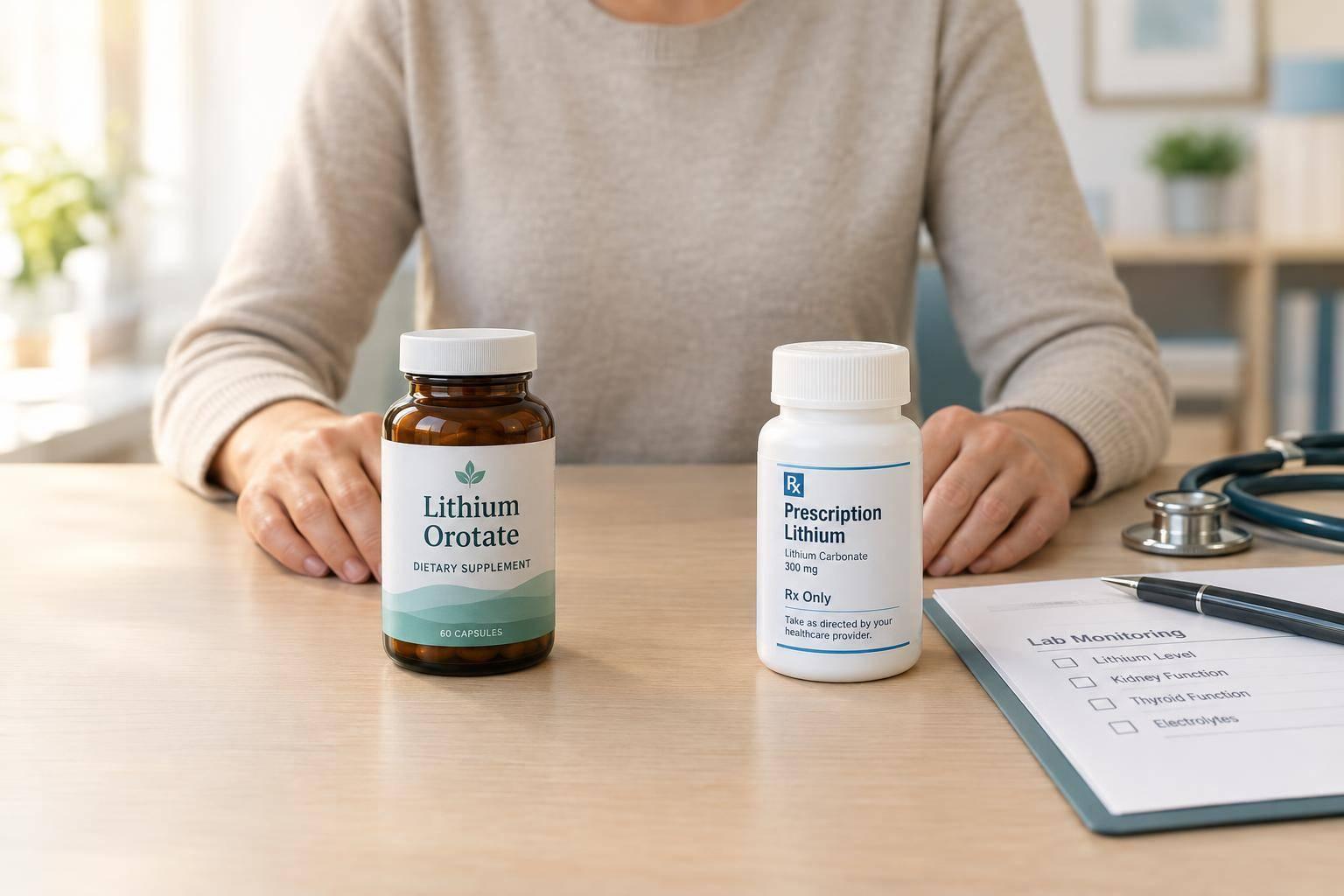

Lithium orotate is not a substitute for prescription lithium. Check whether your supplement lists elemental lithium. Talk with your prescriber before starting, stopping, or switching products.
Lithium carbonate and lithium citrate have FDA-approved uses in bipolar I disorder and require regular blood tests. Stores sell lithium orotate as a dietary supplement, and it has no approved treatment use. Human research on it remains sparse: a few small, older studies and no randomized controlled trials for psychiatric conditions.
“Low dose” does not mean risk-free. Kidney and thyroid problems, dehydration, and drug interactions still matter. Confusion, slurred speech, or poor coordination need urgent assessment. With telehealth care, confirm who will order and review your labs. Virtual visits do not replace blood testing.
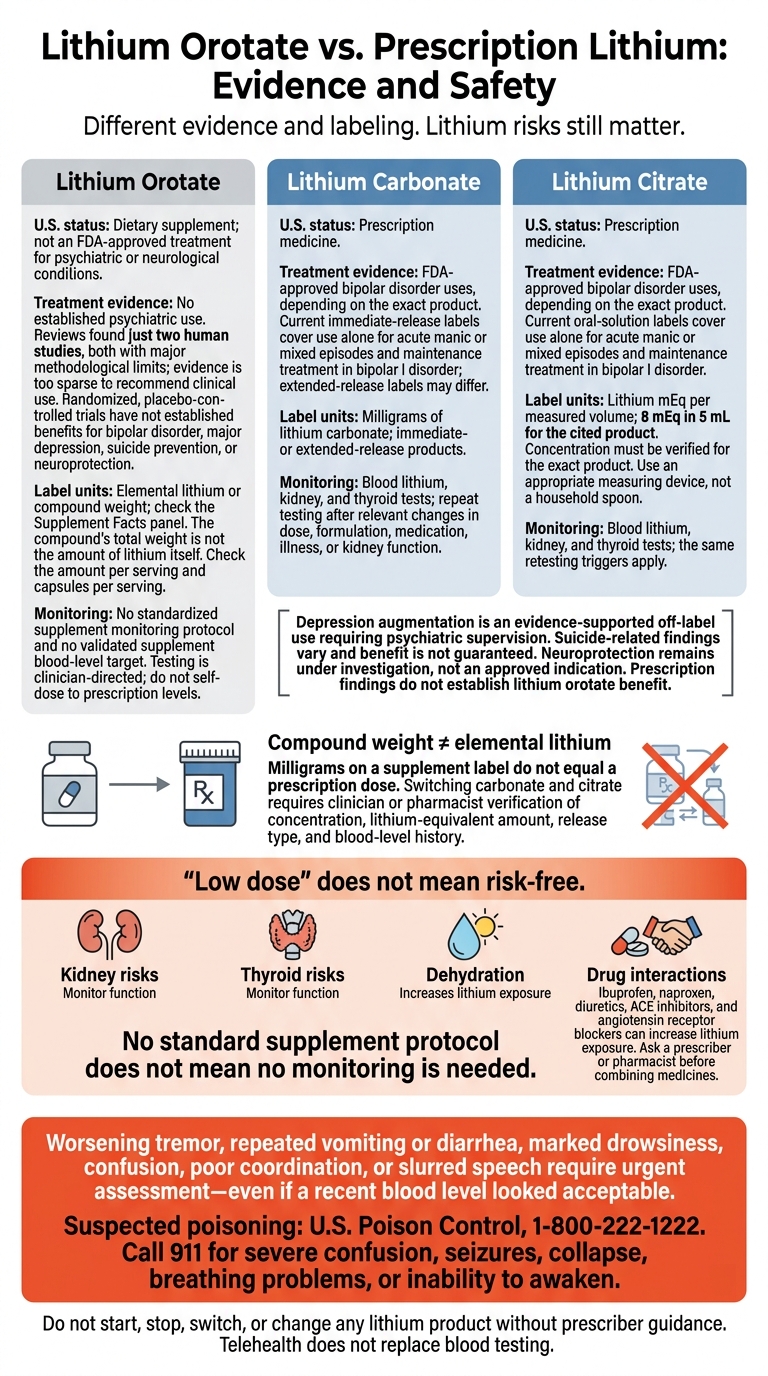
The infographic below compares lithium orotate with prescription lithium carbonate and citrate across evidence, labeling, monitoring, and safety.
sbb-itb-23f89d4
Lithium Orotate: Labeling and Research Limits
In the U.S., lithium orotate reaches store shelves as an over-the-counter dietary supplement. It is not an FDA-approved treatment for psychiatric or neurological conditions. Unlike prescription lithium, it has no standard therapeutic dose.
Elemental Lithium vs. Compound Weight
Lithium orotate contains lithium and orotic acid, so the compound’s total weight is not the amount of lithium itself. Check the Supplement Facts panel for “Lithium (as lithium orotate)” or “elemental lithium.” Note both the amount per serving and how many capsules make up a serving.
Many supplements provide about 5 mg of elemental lithium per serving. That is roughly a tenth of the lithium in a single standard tablet of lithium carbonate. If the label is unclear, ask a pharmacist rather than estimating a dose or comparing it with a prescription.
Products may differ in serving size, added ingredients, quality controls, and label reliability. Third-party testing or a Certificate of Analysis can verify identity and potency, but neither proves psychiatric benefit.
What Research Supports – and What Claims Lack
Human research on lithium orotate is thin. Reviews describe only a handful of small studies, most from the 1970s and 1980s, with major limits in design. Randomized, placebo-controlled trials have not established benefits for bipolar disorder, major depression, suicide prevention, or neuroprotection.
Laboratory and animal findings can point to mechanisms worth studying. They cannot show whether people feel better, avoid relapse, or experience fewer harms. Claims that lithium orotate reaches the brain better or works at lower doses remain unproven in people. The same goes for claims of fewer kidney and thyroid effects.
What the 2025 Harvard Study Found
In August 2025, Harvard researchers published a study in Nature that drew wide attention to lithium orotate. They found that lithium loss in the brain appears early in the path toward Alzheimer’s disease.
In mice, low-dose lithium orotate reduced amyloid plaques and tau tangles, restored synapses, and reversed memory loss. Lithium carbonate did not produce the same effects. The mice showed no signs of toxicity over long-term treatment.
These results come from mice, not people. The senior researcher cautioned that researchers must first establish safe and effective doses in humans. A clinical trial is in planning. Until human data arrive, the study does not support taking lithium orotate to prevent or treat dementia.
When checking cited research, look for studies that tested lithium orotate in people, measured clinical outcomes, and tracked adverse effects. Studies limited to cells, animals, or prescription lithium cannot answer those questions.
Prescription Lithium: Uses and Formulations
Prescription lithium has approved uses and defined monitoring rules that supplements lack. FDA labels for lithium carbonate and lithium citrate cover use alone in bipolar I disorder. That includes acute manic or mixed episodes and maintenance treatment. Approval is product-specific, so extended-release labels may differ.
Treatment decisions depend on diagnosis, past response, kidney and thyroid function, pregnancy plans, drug interactions, and access to lab testing. Lithium works within a narrow range of blood levels. Prescribers order regular blood tests, especially when starting treatment or changing the dose.
How Prescription and Supplement Evidence Compare
Off-label means using an FDA-approved medicine for a purpose outside its label. Adding lithium to an antidepressant for treatment-resistant depression has research support. That use is off-label and needs psychiatric supervision.
The evidence also depends on the treatment goal. Prescription lithium has clinical data that lithium orotate does not.
| Clinical goal | Prescription lithium evidence | Lithium orotate evidence |
|---|---|---|
| Acute bipolar mania or mixed episodes | FDA-approved for specified products and populations; supported by clinical trials. | No established treatment benefit. |
| Bipolar maintenance | FDA-approved use supported by long-term research. | No established relapse-prevention benefit. |
| Depression augmentation | Evidence-supported off-label use; requires psychiatric supervision. | Insufficient evidence for augmentation. |
| Suicide-related outcomes | Some studies report lower risk, but findings vary and benefit is not guaranteed. | Prescription findings do not establish supplement benefit. |
| Neuroprotection | Under investigation; not an approved indication. | A 2025 mouse study showed promise; no human trials or dosing guidance yet. |
Lithium Safety: Monitoring, Toxicity, and Interactions
Lithium has a narrow therapeutic window. The gap between a helpful blood level and a toxic one is small. Kidney function, dehydration, and drug interactions can push lithium levels higher. Low-dose lithium orotate still carries kidney, thyroid, and toxicity risks. Safety depends on lithium exposure, not on how the product is marketed.
Kidney, Thyroid, and Blood-Level Testing
Lithium can reduce the kidneys’ ability to concentrate urine and can affect thyroid function. People with kidney disease face higher risk, and prescribers avoid lithium in severe kidney impairment.
Supplements have no standardized monitoring protocol, but they can affect the same organs. Ask a clinician whether baseline kidney and thyroid tests make sense. This matters most with existing kidney or thyroid disease or long-term use.
Medication Interactions, Dehydration, and Sodium Changes
Ask a prescriber or pharmacist before taking ibuprofen or naproxen, including over-the-counter products. These NSAIDs can reduce the kidneys’ clearance of lithium. Thiazide and other diuretics, ACE inhibitors, and angiotensin receptor blockers can also increase lithium exposure.
Vomiting, diarrhea, heavy sweating, fever, and poor fluid intake can cause the body to retain more lithium. Major changes in sodium intake can alter levels, too. During a serious illness, seek prompt advice about the next dose and whether you need testing. Review all medicines and supplements with a prescriber or pharmacist. Do not adjust doses, salt, or fluids on your own.
Toxicity Warning Signs and Higher-Risk Groups
Worsening tremor, repeated vomiting or diarrhea, marked drowsiness, confusion, poor coordination, or slurred speech require urgent assessment. Take symptoms seriously even if a recent blood level looked acceptable.
For suspected poisoning, call U.S. Poison Control at 1-800-222-1222. Call 911 for severe confusion, seizures, collapse, breathing problems, or inability to awaken. Do not wait for routine testing or try home treatment.
People with kidney or thyroid disease, adults 65 or older, and anyone taking interacting drugs need closer monitoring. Children, teens, and anyone pregnant, planning pregnancy, or breastfeeding need specialist guidance. That applies before starting, stopping, or changing any lithium product, including lithium orotate.
Review Your Options With a Qualified Prescriber
Prescription lithium carbonate and citrate have established psychiatric uses and monitoring requirements. Lithium orotate does not. Judge any lithium product by its evidence, dose, and risks, not by where you buy it. That matters most when you’re considering a treatment change.
Check Claims Before Changing Treatment
Before making a change, check the compound, the amount of elemental lithium per serving, and the human research behind it. Were the studies randomized, controlled, and large enough? Did they track psychiatric outcomes, blood levels, kidney and thyroid lab results, drug interactions, side effects, and harms that may appear later?
Bring the container or a photo of its label, along with a complete list of your prescription drugs, over-the-counter medicines, vitamins, and supplements. Ask your prescriber to explain the dose: milligrams listed on a supplement label don’t equal a prescription dose. Do not start, stop, switch, or change any lithium product without prescriber guidance.
Prescription lithium carbonate and citrate have established psychiatric uses and monitoring requirements. Lithium orotate does not. Judge any lithium product by its evidence, dose, and risks, not by where you buy it. That matters most when you’re considering a treatment change.
Ready to Turn This Research Into a Real Plan?
Supplement claims are easy to find, but careful follow-up takes a plan. Modyfi brings psychiatry, therapy, nutrition, and exercise together in one coordinated virtual plan. Your provider can review any lithium product you take and check it against your other medications. They can also set up the lab work that safe lithium use requires and explain the results.
👉 Explore Providers to Book an Appointment and Start Your Care Plan
(Note: Modyfi proudly accepts most major commercial insurance plans. We do not accept Medicare or Medicaid.)
FAQs
What should I do if I already take lithium orotate?
Tell your healthcare provider that you take it, and bring the label. Lithium orotate is not automatically safer than prescription lithium, and the two are not interchangeable.
Your provider can check for interactions, review your kidney and thyroid health, and look at your full treatment plan. If you also take prescription lithium, do not change either product on your own.
How can I spot misleading lithium supplement claims?
Be cautious with any product that calls itself a natural alternative to prescription lithium. Other red flags include claims that it needs no blood tests, treats bipolar disorder, or prevents Alzheimer’s disease.
Look for a clear elemental lithium amount and a current Certificate of Analysis with contaminant testing. Avoid products with unclear manufacturing practices. A quality product still has not shown psychiatric benefit in people.
What should I ask my prescriber before considering lithium?
Ask about kidney and thyroid risks, possible interactions with your medications and supplements, and the evidence for your specific situation. Bring a complete list of everything you take so your prescriber can check for interactions.
Agree on how they will monitor your health and which symptoms need immediate follow-up. Ask who will order your lab work and who will review the results.
Can lithium orotate prevent Alzheimer’s disease?
Not based on current evidence. A 2025 Harvard study found that low-dose lithium orotate reversed Alzheimer’s-like changes in mice. No one has tested those results in people yet.
The researchers have said that safe and effective human doses still need study, and a clinical trial is in planning. Until then, taking lithium orotate to prevent dementia remains unproven.
How much elemental lithium is in lithium orotate?
Many lithium orotate supplements provide about 5 mg of elemental lithium per serving. The rest of the listed weight comes from orotic acid.
That amount is roughly a tenth of the lithium in a standard lithium carbonate tablet. Check the Supplement Facts panel for elemental lithium, and never compare products by total compound weight.
Do I need blood tests if I take lithium orotate?
There is no standard monitoring protocol for lithium supplements. Lithium can still affect the kidneys and thyroid, so a clinician may recommend baseline tests.
Testing matters more with kidney or thyroid disease, older age, long-term use, or medications that raise lithium levels. Ask your clinician what makes sense for you.