


Metabolic psychiatry treats metabolic health as part of psychiatric care, not as a separate problem for primary care. For PMHNPs and PAs, the strongest evidence today supports routine metabolic monitoring and active management of antipsychotic weight gain. GLP-1 medications and ketogenic diets are promising, but they sit at very different points on the evidence scale.
This guide separates what is established from what is still emerging, so clinical decisions match the strength of the evidence.
This article is educational content for clinicians. It is not medical advice for any individual patient.
What is metabolic psychiatry?
Metabolic psychiatry is a field that studies how metabolic dysfunction, such as insulin resistance, obesity and impaired glucose regulation, relates to psychiatric illness, and tests metabolic interventions as part of treatment. The term was coined by Shebani Sethi, MD, founding director of the Stanford Metabolic Psychiatry Clinic.
The idea fits a mind-body approach to psychiatry. The patient who needs mood stabilization may also need help with blood sugar, weight and cardiovascular risk, often because of the medication used to treat them.
Why does metabolic health matter in psychiatric practice?
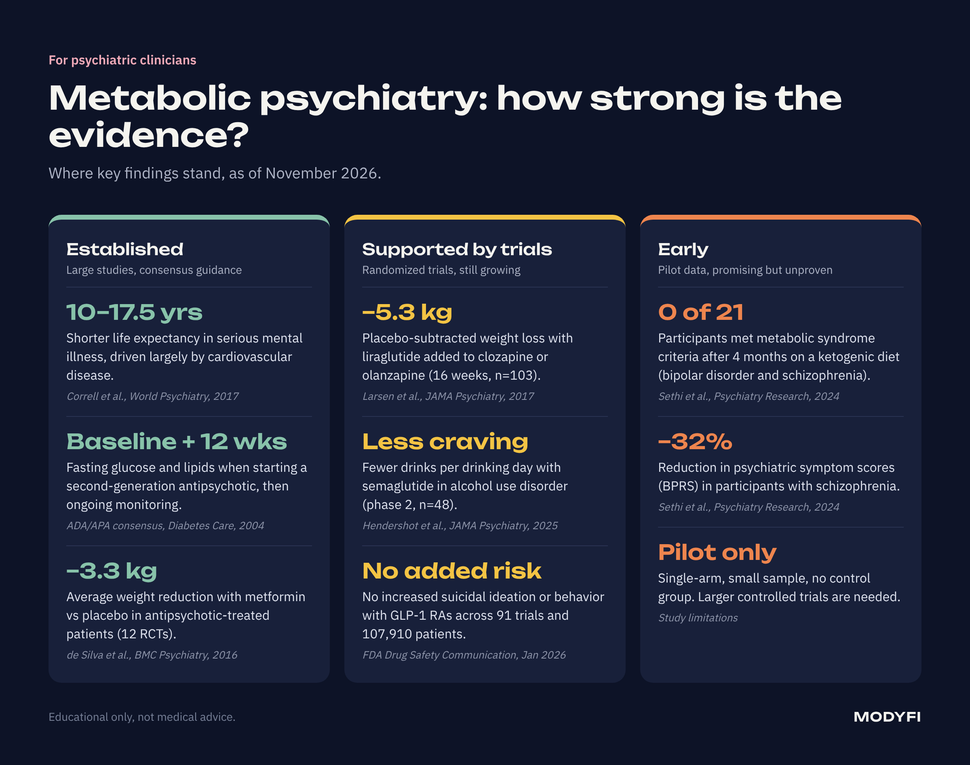
People with serious mental illness die years earlier than the general population, mostly from cardiovascular disease. A meta-analysis of more than 3.2 million patients found that people with schizophrenia, bipolar disorder or major depressive disorder have a life expectancy shortened by 10 to 17.5 years. Their risk of dying from cardiovascular disease was 85% higher than that of people of similar age, and antipsychotic use and higher BMI were among the factors linked to that risk.
For the prescribing clinician, that makes metabolic care part of the job, not an add-on.
What metabolic monitoring is recommended for patients on antipsychotics?
The reference standard is the consensus statement from the American Diabetes Association and the American Psychiatric Association, developed with endocrinology and obesity organizations: screen before starting a second-generation antipsychotic, then monitor closely in the first 12 weeks and periodically after that. The same consensus identified clozapine and olanzapine as the agents with the highest risk of diabetes.
| Measure | Baseline | Follow-up |
| Personal and family history | Yes | Annually |
| Weight and BMI | Yes | Weeks 4, 8 and 12, then quarterly |
| Waist circumference | Yes | Annually |
| Blood pressure | Yes | Week 12, then annually |
| Fasting glucose | Yes | Week 12, then annually |
| Fasting lipids | Yes | Week 12, then every 5 years |
Source: ADA/APA consensus development conference, Diabetes Care, 2004.
In practice, this monitoring often does not happen. In a study of commercially insured patients starting second-generation antipsychotics, only about 1 in 10 had baseline lipid testing, before and after the guideline was published. A standing order set or an EHR reminder at the first prescription closes most of that gap.
How can antipsychotic weight gain be managed?
Start with prevention: weigh metabolic risk when choosing an agent, and act on early weight gain instead of waiting for diabetes. When medication is needed, metformin has the longest track record and GLP-1 receptor agonists have the strongest recent trial data.
Metformin
A meta-analysis of 12 randomized trials found that metformin reduced weight by about 3.3 kg compared with placebo in patients taking antipsychotics, with improvements in BMI and insulin resistance but no significant change in fasting glucose. A later meta-analysis found that combining metformin with a lifestyle intervention reduced weight more than either approach alone.
GLP-1 receptor agonists
In a 16-week randomized trial in JAMA Psychiatry, 103 patients with schizophrenia spectrum disorders taking clozapine or olanzapine, all overweight and with prediabetes, received liraglutide or placebo. Liraglutide improved glucose tolerance, body weight and cardiometabolic markers. As Psychiatric News reported, placebo-subtracted weight loss was 5.3 kg, and 64% of patients on liraglutide moved from prediabetes to normal glucose tolerance, compared with 16% on placebo.
Who prescribes
Whether starting metformin or a GLP-1 falls within a PMHNP’s or PA’s practice depends on state law, practice agreements and the clinician’s training. Coordinating with the patient’s primary care clinician is a safe default, and shared lab monitoring keeps everyone working from the same data.
What does the evidence say about GLP-1s and mental health?
The evidence is reassuring on safety and promising for addiction, but still early for psychiatric indications.
Safety. In January 2026, the FDA concluded that its review found no increased risk of suicidal ideation or behavior with GLP-1 receptor agonists. The review included a meta-analysis of 91 placebo-controlled trials with 107,910 patients and a real-world study of more than 2.2 million users, and the agency asked manufacturers to remove the warning from the labels of Saxenda, Wegovy and Zepbound. The FDA still asks patients to report new or worsening depression or mood changes, so routine mood screening remains good practice.
Alcohol use disorder. In a phase 2 randomized trial published in JAMA Psychiatry, 48 adults with alcohol use disorder who received weekly semaglutide for 9 weeks drank less per drinking day and reported less craving than those on placebo, though the number of drinking days did not change. Semaglutide is not FDA-approved for alcohol use disorder, and larger, longer trials are needed.
Is the ketogenic diet an evidence-based treatment for serious mental illness?
Not yet. It is one of the most promising early areas in metabolic psychiatry, but the human evidence is still at the pilot stage.
In a 4-month pilot trial at Stanford published in Psychiatry Research, 21 adults with bipolar disorder or schizophrenia who were taking psychiatric medications and had metabolic abnormalities followed a ketogenic diet, with about 10% of calories from carbohydrates. By the end, none met criteria for metabolic syndrome, participants lost about 10% of body weight on average, and those with schizophrenia showed a 32% reduction in Brief Psychiatric Rating Scale scores.
The limits matter: a single study arm, no control group and a small sample. Participants also received coaching and weekly blood ketone checks, support that is hard to replicate in routine practice. The study was funded in part by a foundation that supports metabolic psychiatry research.
When patients ask about it, discuss the evidence honestly and treat a ketogenic diet as a medical intervention that needs monitoring, not a casual diet change.
For a short overview from the researchers’ own institution, Stanford Medicine summarizes what the pilot study found, and why it matters, in 90 seconds:
Video: Stanford Medicine’s 90-second summary of the ketogenic diet pilot study.
Next steps
- Audit your current patients. List everyone on a second-generation antipsychotic and check who has baseline and 12-week glucose and lipids on file.
- Build monitoring into the workflow. An order set or EHR reminder at the first prescription is the simplest way to follow the ADA/APA schedule.
- Act on early weight gain. Combine lifestyle support with metformin where appropriate, rather than waiting for diabetes.
- Agree on a GLP-1 plan with primary care. Decide who prescribes, who monitors and how labs are shared.
- Keep screening mood. The FDA found no added suicide risk with GLP-1s, but routine mood checks remain good practice.
If you’re a patient: don’t start, stop or change any medication, or begin a ketogenic diet, without talking to your prescribing clinician.
You don’t have to build this alone
Metabolic psychiatry is where mind-body, functional and integrative care meet everyday prescribing decisions. The Modyfi Fellowship curriculum covers the gut-brain axis and metabolic psychiatry, functional labs and advanced pharmacology, with case consultation and supervision from clinicians who practice this way.
Questions? Contact hello@modyfihealth.com.
FAQ
What is metabolic psychiatry?
Metabolic psychiatry is a field that looks at psychiatric illness through the lens of metabolism: how insulin resistance, obesity, impaired glucose regulation and related problems interact with mood, psychosis and cognition. In practice it covers two things. The first is protecting patients’ metabolic health, especially when psychiatric medications cause weight gain or insulin resistance. The second is testing metabolic interventions, such as GLP-1 medications or ketogenic diets, as part of psychiatric treatment. The term was coined by Shebani Sethi, MD, founding director of the Stanford Metabolic Psychiatry Clinic.
Do GLP-1 medications cause depression or suicidal thoughts?
No increased risk has been found. In January 2026, the FDA completed a review that included a meta-analysis of 91 placebo-controlled trials with 107,910 patients and a real-world study of more than 2.2 million users. It found no increased risk of suicidal ideation or behavior, or of related psychiatric effects such as anxiety, depression, irritability or psychosis, and asked manufacturers to remove the warning from the Saxenda, Wegovy and Zepbound labels. The FDA still advises patients to report new or worsening depression or unusual mood changes, so screening mood at follow-up visits remains good practice, especially for patients with a psychiatric history.
Does metformin help with antipsychotic weight gain?
Yes, with a modest but consistent effect. A meta-analysis of 12 randomized trials found that patients taking antipsychotics lost about 3.3 kg more with metformin than with placebo, with improvements in BMI and insulin resistance, although fasting glucose did not change significantly. A later meta-analysis found that combining metformin with a lifestyle intervention reduced weight more than either approach alone. Most of the trial data are short-term, so the evidence is strongest for the first months of treatment.
Is the ketogenic diet proven for bipolar disorder or schizophrenia?
Not yet. The best-known study, a 2024 Stanford pilot of 21 adults with bipolar disorder or schizophrenia, found that after 4 months on a ketogenic diet none of the participants met criteria for metabolic syndrome, and those with schizophrenia had a 32% reduction in Brief Psychiatric Rating Scale scores. But the study had no control group, a small sample and intensive support, including coaching and weekly ketone checks. Until larger controlled trials are published, a ketogenic diet is best discussed as an emerging, medically monitored option, not a standard treatment, and never as a replacement for medication.
How often should metabolic labs be checked on antipsychotics?
The ADA/APA consensus recommends a baseline assessment before starting or switching a second-generation antipsychotic: personal and family history, weight and BMI, waist circumference, blood pressure, fasting glucose and fasting lipids. Weight is then checked at weeks 4, 8 and 12 and quarterly after that. Blood pressure and fasting glucose are repeated at week 12 and then annually, and fasting lipids at week 12 and then every 5 years. The schedule is a minimum: rapid weight gain or a change of medication is a reason to repeat the assessment sooner.
Sources
- Correll CU et al. Prevalence, incidence and mortality from cardiovascular disease in patients with severe mental illness. World Psychiatry, 2017.
- American Diabetes Association et al. Consensus development conference on antipsychotic drugs and obesity and diabetes. Diabetes Care, 2004.
- Haupt DW et al. Prevalence and predictors of lipid and glucose monitoring in commercially insured patients treated with second-generation antipsychotic agents. American Journal of Psychiatry, 2009.
- de Silva VA et al. Metformin in prevention and treatment of antipsychotic induced weight gain. BMC Psychiatry, 2016.
- Combination of metformin and lifestyle intervention for antipsychotic-related weight gain. Pharmacopsychiatry, 2019.
- Larsen JR et al. Effect of liraglutide treatment on prediabetes and overweight or obesity in clozapine- or olanzapine-treated patients. JAMA Psychiatry, 2017.
- U.S. Food and Drug Administration. Drug Safety Communication on GLP-1 receptor agonists, January 13, 2026.
- Hendershot CS et al. Once-weekly semaglutide in adults with alcohol use disorder. JAMA Psychiatry, 2025.
- Sethi S et al. Ketogenic diet intervention on metabolic and psychiatric health in bipolar and schizophrenia: a pilot trial. Psychiatry Research, 2024.