


In many cases, mindfulness for kids with ADHD serves as a biological ‘pause button,’ helping to improve focus and reduce impulsive behavior It teaches kids to pause before reacting, boosting self-control and emotional regulation. Studies show mindfulness reduces ADHD symptoms, with programs like “MYmind” involving both kids and parents showing promising results. While not a replacement for medication or therapy, it complements traditional treatments by addressing areas like emotional regulation and executive functions.
Key Points:
- Focus Improvement: Mindfulness exercises like breathing and grounding techniques help kids concentrate better.
- Impulse Control: Mindfulness creates a mental “pause button”, enabling thoughtful responses instead of impulsive actions.
- Emotional Regulation: Techniques like naming emotions and measured breathing help kids manage feelings effectively.
- Research-Backed Benefits: Studies report reduced ADHD symptoms and improved self-control with consistent practice.
- Family Involvement: Programs involving parents enhance outcomes and create supportive home environments.
Mindfulness is a simple, practical tool that fits into daily life, offering kids with ADHD better ways to manage their symptoms alongside other treatments.
Mindfulness Goes to School: How Meditation Helps Students with ADHD Thrive (with Elliot Buck, M.Ed.)
sbb-itb-23f89d4
Common ADHD Symptoms in Children
ADHD shows up in three main types: Predominantly Inattentive, Predominantly Hyperactive-Impulsive, and Combined. These patterns consistently disrupt various aspects of a child’s life, including home, school, and social settings. Let’s break down the key symptom categories with some real-world examples.
Inattention often looks like daydreaming, misplacing belongings, making careless errors, and struggling to stay organized. These challenges can spill over into schoolwork, home routines, and even social interactions. For instance, a child might have trouble finishing homework, frequently lose books or supplies, forget daily tasks unless reminded, or appear to “zone out” when spoken to directly.
Hyperactivity is all about constant movement and restlessness. Kids might fidget, squirm, talk excessively, or struggle to stay seated during meals or in class. They’re often described as being in perpetual motion. Picture a child who gets up and wanders around when they’re supposed to stay seated or finds it nearly impossible to engage in quiet activities.
Impulsivity involves acting without thinking, which can lead to blurting out answers, interrupting others, struggling to wait their turn, or even risky behaviors that might result in accidents. In social settings, this could mean interrupting games or having difficulty sharing. At home, they might break rules impulsively, even when they know better.
“ADHD causes kids to be more inattentive, hyperactive, and impulsive than is normal for their age.”
– Children’s Mercy Hospital
These behavioral symptoms often go beyond external actions, affecting a child’s emotional well-being. Many kids with ADHD struggle with low self-esteem, frustration, and anxiety. They may feel like they’re constantly disappointing others or not “measuring up”, which can create additional emotional hurdles if they don’t receive proper support. Recognizing these patterns is a crucial first step in providing the help they need.
How Mindfulness Helps with ADHD Symptoms
Mindfulness training can be a game-changer for children with ADHD, helping them improve focus, think before acting, and manage impulsive behaviors. By engaging the attention networks often affected in ADHD, mindfulness allows kids to work with their brain’s natural tendencies through consistent practice. A meta-analysis of mindfulness programs for children with ADHD revealed a moderate-to-large effect size in reducing inattentive symptoms as reported by parents and teachers. Interestingly, programs conducted twice weekly or more showed better outcomes than those held just once a week. This consistent practice lays the groundwork for improvements in focus, impulse control, and emotional regulation.
Building Focus and Attention
Mindfulness exercises teach children to recognize when their mind has wandered and gently redirect their attention to a chosen focus, like their breath or a physical sensation. Over time, this practice strengthens their ability to concentrate.
“Mindful breathing is when you pay close attention to your breath… This helps children with ADHD improve attention because it trains their brains to focus on one thing at a time.” – Michael Vallejo, LCSW, Mental Health Center Kids
A systematic review of 11 studies involving 234 children and adolescents found that 6 studies reported significant improvements in hyperactivity and inattentive symptoms. One study highlighted notable gains in cognitive flexibility, as shown by the Bells Test – Accuracy score (p = .002) after mindfulness training. Techniques like grounding, which use sensory inputs such as sight, sound, and touch, can also help children stay present and manage feelings of overwhelm.
Decreasing Impulsive Behavior
Mindfulness acts as a mental “pause button”, encouraging kids to stop and reflect before reacting. By focusing on simple elements like their breath, children can identify internal triggers – such as frustration or boredom – before those triggers lead to impulsive behaviors. This practice addresses executive function challenges, helping kids improve self-control through better inhibition, working memory, and cognitive flexibility.
Small cohort studies have shown mindfulness training leads to statistically significant reductions in impulsivity (p = .01 and p = .04).
Strengthening Emotional Control
Mindfulness also helps children with ADHD manage emotional regulation, an area that can be particularly challenging. By noticing physical signs of emotional spikes – like a racing heart or clenched jaw – kids can pause and respond thoughtfully rather than reacting impulsively.
Techniques such as measured breathing stimulate the vagus nerve, helping shift the body from “fight-or-flight” mode to a calmer state. Naming emotions (e.g., “I am feeling embarrassed”) can further reduce emotional intensity by creating a sense of detachment from the feeling. Research suggests that just 30 minutes of daily movement-based mindfulness can significantly reduce behavioral issues and improve mood in children with ADHD.
Research on Mindfulness for ADHD
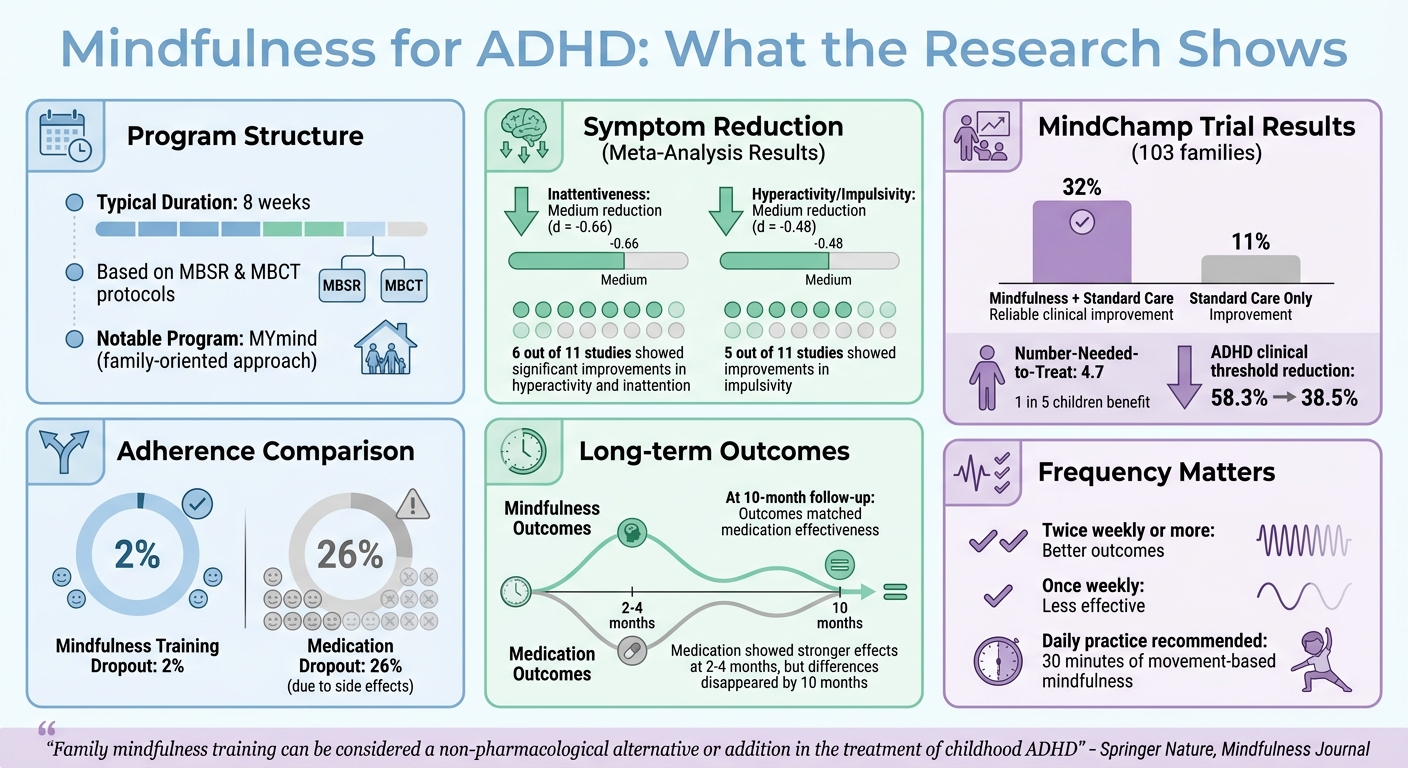
Mindfulness for ADHD: Research-Backed Benefits and Outcomes
Recent studies highlight the potential of mindfulness as a helpful treatment for children with ADHD. Many mindfulness-based interventions (MBIs) for ADHD are modeled after established methods like Mindfulness-Based Stress Reduction (MBSR) and Mindfulness-Based Cognitive Therapy (MBCT), typically structured as 8-week programs. One notable program, “MYmind,” takes a family-oriented approach, offering parallel sessions for children and their parents to promote better self-regulation and improve parental mental health.
A systematic review conducted in 2025 examined 11 studies and found that 6 studies reported significant reductions in hyperactivity and inattentive symptoms, while 5 studies showed improvements in impulsivity. Additionally, a meta-analysis of MBIs for young people revealed medium-level reductions in inattentiveness (d = -0.66) and hyperactivity/impulsivity (d = -0.48), providing specific effect sizes to support earlier findings.
The MindChamp trial
The “MindChamp” trial, carried out between January 2016 and June 2018 in the Netherlands, tested the “MYmind” protocol on 103 families. Led by Nienke M. Siebelink and Corina U. Greven, the study found that 32% of children receiving mindfulness alongside standard care showed reliable clinical improvement, compared to just 11% in the standard care-only group. The Number-Needed-to-Treat (NNT) was calculated at 4.7, meaning one child out of every five treated with mindfulness experienced meaningful improvement that would not have occurred with standard care alone. These findings underscore the potential of mindfulness in real-world treatment plans.
Adherence data further highlights mindfulness as a viable option. A February 2024 randomized clinical trial involving 91 children aged 9–18 compared the “MYmind” family mindfulness program to methylphenidate medication. While medication initially showed stronger effects at 2- and 4-month intervals based on parent and teacher assessments, evidence suggests that while medication often shows more immediate effects, the benefits of consistent mindfulness training can match those of medication by a 10-month follow-up. Notably, only 2% of families discontinued mindfulness training, compared to a 26% dropout rate for medication, largely due to side effects. After mindfulness training, the percentage of children scoring above the clinical threshold for ADHD on the Disruptive Behavior Disorder Rating Scale (DBDRS) dropped from 58.3% to 38.5%.
“Overall, although mindfulness alone might not be sufficient for some families, family mindfulness training in general can be considered a non-pharmacological alternative or addition in the treatment of childhood ADHD.” – Springer Nature, Mindfulness Journal
Mindfulness also appears to benefit areas beyond core ADHD symptoms. Research shows it can improve secondary issues like sleep quality, anxiety, and executive functioning. Parents involved in family mindfulness programs also report lasting improvements in self-compassion, better sleep, and reduced overreactive parenting behaviors. This is particularly relevant since about 20% of parents of children with ADHD also have ADHD themselves. Collectively, these findings suggest mindfulness is a promising complement to traditional ADHD treatments, offering a way to enhance focus, emotional regulation, and overall family well-being.
Mindfulness Techniques for Children with ADHD
Mindfulness can be a game-changer for children with ADHD, offering simple, engaging ways to help manage symptoms. The best part? It doesn’t require fancy tools or long sessions. These techniques are easy to weave into everyday life and can make a big difference.
Breathing Exercises
Breathing exercises are especially effective when paired with visual imagery that kids can easily relate to. For instance, the “Flower and Candle” exercise invites children to imagine smelling a flower – inhale through the nose for three counts – and then blowing out a candle – exhale through the mouth for three counts. Another fun option is “Hot Chocolate Breath.” Here, kids pretend they’re holding a warm mug of cocoa, breathing in deeply through their nose to “smell the aroma” and exhaling slowly through pursed lips to “cool it down”. These visualizations help children focus their attention, training their minds to concentrate on one thing at a time.
Body Scan Meditation
For kids who struggle to sit still, a “micro body scan” offers a more manageable approach. This version takes just three to five minutes and allows for movement. Have the child stand and focus on one body part at a time – starting with their feet, then moving up to their legs, belly, arms, and head. They can wiggle or gently shake each part before moving to the next. This method combines bodily awareness with movement, promoting relaxation without requiring long periods of stillness.
Mindful Movement
Mindful movement is often the easiest starting point for kids with ADHD. Yoga poses like Tree Pose provide instant feedback – if their attention wanders, they’ll wobble, encouraging focus naturally. Warrior II helps build mental endurance, while Child’s Pose activates the parasympathetic nervous system, helping to calm the “fight-or-flight” response. Practices like Tai Chi, which combine slow movements with controlled breathing, also help children feel more balanced and focused. These activities keep their bodies engaged while teaching their minds to stay in the moment.
Parents might also find the SEAT technique helpful for addressing impulsivity. This involves guiding children to notice Sensations (physical feelings), Emotions (naming the emotion), Actions (the urge to act), and Thoughts (the stories in their mind). Another great tool is the 5-4-3-2-1 grounding exercise, where kids name five things they see, four they can touch, three they hear, two they smell, and one they can taste. This exercise interrupts racing thoughts and anchors them in the present moment. Starting each session with a quick mood check-in – using emoji faces to describe how they feel – can also help build the self-awareness that makes mindfulness so effective.
These straightforward techniques are a valuable addition to broader ADHD management strategies, helping children develop focus and self-regulation through mindfulness.
Combining Mindfulness with Other ADHD Treatments
Mindfulness works best as part of a broader ADHD treatment plan that includes therapy, medication, and nutrition. While medication helps with focus and impulse control, mindfulness addresses areas like emotional regulation and executive functions – gaps that medication often doesn’t cover. A 2022 meta-analysis revealed that mindfulness-based interventions for children significantly reduced core ADHD symptoms, with a large effect size of g = 0.77. In the MindChamp study, 32% of children who completed an 8-week mindfulness program showed reliable improvements in executive self-control, compared to just 11% in a standard care group. These findings highlight how mindfulness can enhance a well-rounded ADHD treatment approach.
Nutrition also plays a key role alongside mindfulness. Nutrients like omega-3s, zinc, and magnesium support the production of dopamine and norepinephrine, which are critical for focus. Research shows that omega-3 supplementation can improve ADHD symptoms by 15%, while zinc and magnesium contribute an additional 12%. Establishing structured eating routines helps stabilize blood sugar levels, ensuring consistent cognitive functioning that aligns well with mindfulness practices.
Modyfi Health takes a comprehensive approach to ADHD care by integrating mindfulness into personalized treatment plans. Their process begins with a 60-minute evaluation that examines mental, physical, and lifestyle factors. From there, they create tailored care plans combining psychiatric evaluations, medication management (when needed), nutrition therapy, and mindfulness strategies. They also provide functional lab testing to uncover underlying issues like nutritional deficiencies or inflammation that may exacerbate ADHD symptoms.
Parental involvement can further enhance the benefits of mindfulness practices. When parents join their children in mindfulness activities, such as breathing exercises, they model calm behavior and reduce their own stress levels, creating a more supportive home environment. Many effective programs follow an 8-week format, with sessions lasting 60–90 minutes.
Conclusion
Mindfulness provides children with ADHD a practical way to handle key challenges like impulsivity, inattention, and emotional dysregulation. By teaching the brain to observe thoughts without judgment, mindfulness creates a pause between impulse and action, offering a valuable tool for self-regulation. Research backs its effectiveness – one trial involving 103 families found that about one-third of children who practiced mindfulness showed improved self-control. While it’s not a standalone solution, mindfulness complements other treatments like medication, therapy, and nutritional support by addressing areas such as emotional regulation and executive functioning that these methods might not fully cover.
“Mindfulness is more likely to become an add-on than a replacement for other kinds of therapies” – Dr. Samuel Wong, Director of the JC School of Public Health and Primary Care at the Chinese University of Hong Kong
Progress comes from small, consistent efforts. Starting with 5–10 minutes a day and gradually increasing as attention improves can make a big difference. For kids who find seated meditation challenging, movement-based practices like yoga or mindful walking can provide the sensory input they need while building focus. Regularity is key – practicing mindfulness at least twice a week delivers noticeably better outcomes than just once weekly.
Mindfulness also works best when the whole family gets involved. When parents participate alongside their children, they model calm behavior, reduce their own stress, and foster a more supportive home environment. This approach recognizes that ADHD impacts everyone in the family, not just the child, making mindfulness a shared journey toward better balance and understanding.
Is your child’s current ADHD plan missing a piece of the puzzle? Schedule a 60-Minute Comprehensive Evaluation to discover how Modyfi integrates biological insights with mindfulness for a truly whole-person approach.
FAQs
How long does it take mindfulness to help my child’s ADHD?
Mindfulness training usually requires around eight weeks of consistent practice to produce noticeable changes in key ADHD symptoms, such as impulsivity and inattention. Research indicates that children, in particular, tend to see improvements after maintaining regular mindfulness exercises over this time frame.
What mindfulness activities work best for kids who can’t sit still?
The best mindfulness activities for kids who find it hard to sit still are short, movement-focused exercises that hold their attention. These could include mindful breathing paired with movement, sensory-based activities, or quick guided practices. By blending mindfulness with physical activity, these exercises allow children to tune into their body sensations, emotions, and thoughts while staying active and engaged.
Can mindfulness be safely combined with ADHD medication and therapy?
Yes, mindfulness can work alongside ADHD medication and therapy without any safety concerns. Studies indicate that it’s an effective addition, showing no negative interactions. It can help reduce symptoms like impulsivity and inattention, while also promoting better mental health overall.