


Separation Anxiety Disorder (SAD) affects about 4% of children and can disrupt daily life with emotional, physical, and behavioral challenges. Parental involvement significantly influences both the development and the treatment outcomes of this condition. It can reduce symptoms, improve outcomes, and rebuild confidence in children.
Key Takeaways:
- What SAD Is: Intense fear of separation from caregivers, lasting at least 4 weeks, often causing school refusal and physical symptoms like stomachaches or nausea.
- Why Parent Involvement Helps: Parents can identify triggers, reduce behaviors that unintentionally worsen anxiety, and actively participate in therapy.
- Treatment Approaches:
- Acceptance and Commitment Therapy (ACT): Focuses on mindfulness and values-based actions.
- SPACE Program: Helps parents reduce accommodating behaviors like excessive reassurance.
- Family Cognitive Behavioral Therapy (FCBT): Engages the entire family in managing anxiety.
- Parent-Child Interaction Therapy (PCIT): Builds secure parent-child bonds and addresses anxiety through structured play and gradual exposure.
- Practical Tips for Parents:
- Stay calm during separations.
- Avoid over-reassurance or letting children avoid anxiety triggers.
- Use structured routines and gradual exposure to build resilience.
Early intervention and consistent parent participation are crucial for managing SAD effectively. Virtual care options like those from Modyfi Health make treatment more accessible by offering tailored plans, telehealth sessions, and family-centered strategies.
How Parents Can Support Separation Anxiety Treatment
Providing Emotional Support
Creating a safe and supportive environment starts with listening to your child. Encourage them to express their emotions and name what they’re feeling before jumping into problem-solving. This approach not only helps them understand their emotions but also reassures them that they’re being heard and valued.
Avoid overloading them with reassurance. According to Boston Children’s Hospital, “Avoid providing an excessive amount of reassurance since this may signal more, not less, to worry about”. Instead of repeatedly saying, “Everything will be fine”, try acknowledging their feelings with statements like, “I know this feels scary.” Then, guide them toward finding their own ways to cope. Small comfort items, like a family photo or a piece of clothing with a familiar scent, can also ease their anxiety without fostering dependency.
Celebrate small wins rather than focusing on consequences, as punishment can intensify anxiety. These techniques not only support emotional growth but also help parents demonstrate calmness effectively.
Modeling Calm and Confident Behaviors
Kids often mirror their parents’ reactions, especially in moments of uncertainty. When parents stay calm and composed during goodbyes, it signals to the child that the situation is manageable and safe. If, however, a parent appears anxious or hesitant, the child is likely to pick up on those feelings and respond similarly.
Keep goodbyes brief and confident. Dr. Heather Sever, a pediatrician at Cleveland Clinic, advises against lingering or returning after saying goodbye. Prolonging the farewell can restart the anxiety cycle for the child. Establishing consistent routines also plays a big role in helping children feel secure. Predictable routines give kids a sense of control, which makes transitions smoother and less emotionally taxing. When children know what to expect, they can better prepare themselves for separations.
Reducing Accommodation Behaviors
While it’s natural to want to shield children from distress, accommodation behaviors – like letting them skip school or constantly reassuring them – can actually make their anxiety worse. These actions unintentionally reinforce the idea that there’s something to fear. Avoidance might provide short-term relief, but it strengthens the anxiety over time, making future separations even harder.
The focus should be on teaching children how to manage separation. Dr. Sever explains, “Even though it’s really hard to separate from them, you’re doing the right thing for your child in the long run by helping them become autonomous. If you look at it that way, the short-term pain really translates into a long-term gain”.
Gradual exposure to separation combined with self-soothing techniques, like deep breathing or using positive affirmations (“I will be okay”), can help children build confidence and resilience. These small steps encourage independence while reducing the hold anxiety has on their daily lives.
sbb-itb-23f89d4
Managing Separation Anxiety I Parentalogic
Research-Supported Treatment Methods for Parents
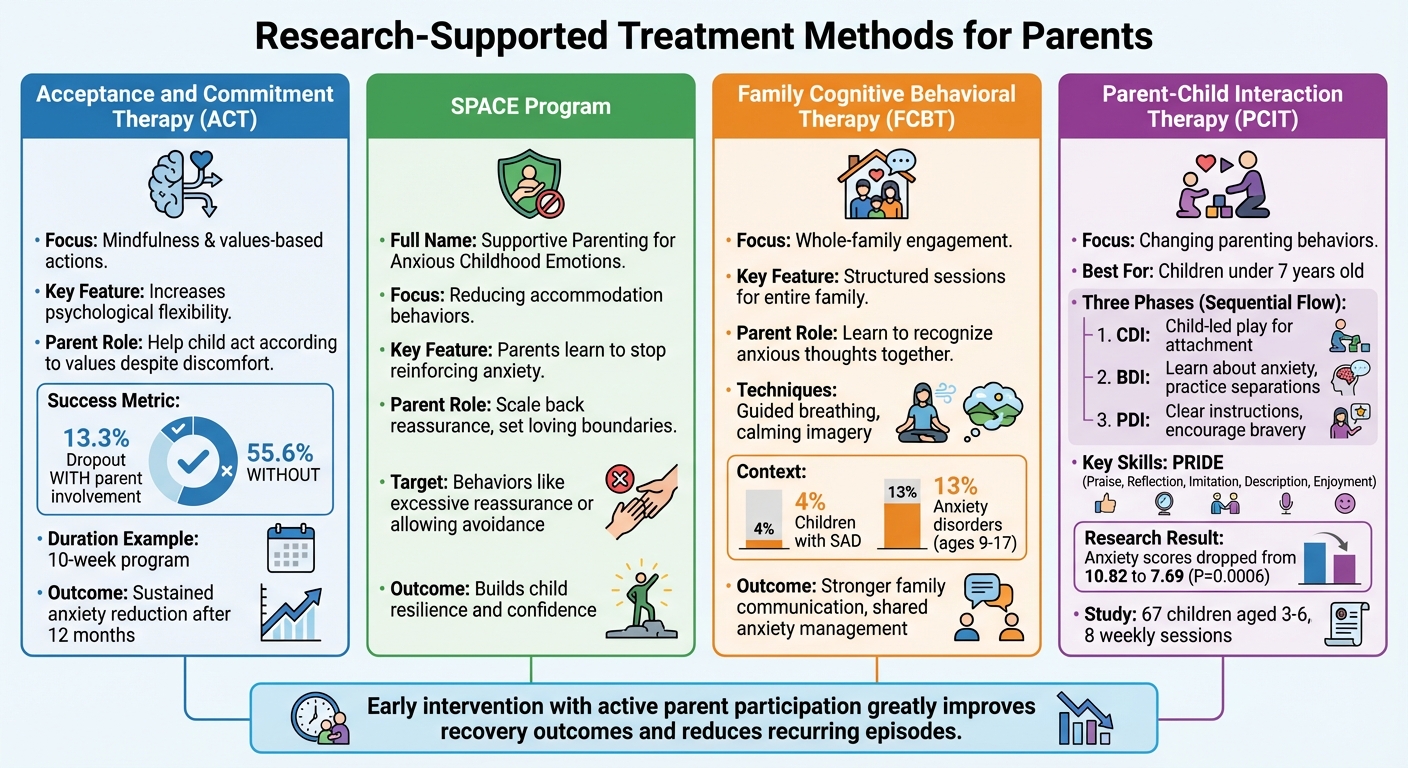
Parent-Involved Treatment Approaches for Childhood Separation Anxiety
Research highlights the important role parents play in addressing anxiety in children, with several proven approaches emphasizing their involvement.
Acceptance and Commitment Therapy (ACT)
Acceptance and Commitment Therapy (ACT) combines acceptance and mindfulness techniques to help parents and children align their actions with their values, even in the face of discomfort. According to JMIR Pediatrics and Parenting:
“Acceptance and commitment therapy (ACT) is a third-wave behavioral therapy oriented at acceptance and mindfulness and aimed at increasing psychological flexibility, defined as the ability to be present and act accordingly in line with one’s values.”
Parental participation plays a key role in ACT’s success. The data from the Swedish IMPACT Project (2018–2025) suggests that parental involvement is a key driver of treatment retention, with dropout rates at 13.3% compared to 55.6% in solo interventions. This underscores how active parent engagement can lead to long-term improvements. For example, the 10-week program “Anxiety Help for Adolescents” used videos, texts, and exercises to teach mindfulness and encourage meaningful activities. A follow-up after 12 months showed sustained reductions in anxiety and depression, along with enhanced psychological flexibility. This method encourages parents to shift their focus from eliminating fears to supporting their children in pursuing fulfilling activities.
While ACT emphasizes mindfulness and values-driven actions, SPACE takes a different approach by targeting specific parental behaviors.
Supportive Parenting for Anxious Childhood Emotions (SPACE)
The SPACE program helps parents identify and reduce behaviors that unintentionally reinforce their child’s anxiety. For instance, frequent reassurance or allowing avoidance might signal to the child that certain situations are threatening. SPACE equips parents to scale back these accommodation behaviors while setting firm but loving boundaries. By gradually exposing children to anxiety triggers, parents can help them build resilience and confidence.
Unlike ACT and SPACE, which focus on parental roles, Family Cognitive Behavioral Therapy (FCBT) involves both parents and children in structured sessions.
Family Cognitive Behavioral Therapy (FCBT)
Family Cognitive Behavioral Therapy (FCBT) engages the entire family in managing anxiety through structured sessions. These sessions teach families to recognize anxious thoughts and use calming techniques like guided breathing and imagery. This shared approach creates a common language for addressing anxiety and builds stronger communication within the family.
FCBT also helps parents understand how certain reactions – like allowing school avoidance – can inadvertently worsen a child’s anxiety. Instead, the therapy encourages gradual, manageable exposure to feared situations, enabling families to work together to overcome challenges. Statistics show that around 4% of children experience separation anxiety disorder, while approximately 13% of children aged 9 to 17 face some form of anxiety disorder. Early intervention that actively involves parents can greatly improve recovery outcomes and reduce the likelihood of recurring episodes.
Parent-Child Interaction Therapy (PCIT) for Separation Anxiety
Parent-Child Interaction Therapy (PCIT) focuses on changing parenting behaviors rather than directly addressing the child’s symptoms. It specifically targets behaviors like overprotection or unintentionally reinforcing fear – patterns that often maintain separation anxiety. This approach is especially effective for children under 7, as younger kids typically lack the cognitive skills required for traditional Cognitive Behavioral Therapy (CBT).
PCIT unfolds in three structured phases:
- Child Directed Interaction (CDI): This phase emphasizes building warmth and secure attachment through child-led play.
- Bravery Directed Interaction (BDI): Families learn about anxiety and practice gradual separations.
- Parent Directed Interaction (PDI): Parents are taught to give clear instructions, encourage brave behaviors, and manage avoidance with consistent consequences.
Together, these phases create a framework that strengthens parent-child communication and fosters a sense of security.
Building Better Communication and Connection
PCIT enhances the parent-child bond using PRIDE skills: Praise, Reflection, Imitation, Description, and Enjoyment. These skills are practiced during daily 5-minute play sessions where the child takes the lead. These short, consistent interactions help reinforce parental presence and reduce the child’s distress during separation.
When children exhibit anxiety, parents are encouraged to use CARES techniques: Coming in (staying physically close), Assisting (helping solve problems), Reassuring, Emotionally validating, and Soothing. Additionally, parents are trained to strategically ignore certain behaviors to encourage bravery. As Reza Zeighami and colleagues note:
“Improving the parent-child interactions will lead to the improved child and family performance. This training directly targets parental overconfidence behaviors identified to play a major role in causing anxiety in children.“
These methods help parents become more effective in addressing their child’s anxiety, leading to measurable improvements.
Treatment Outcomes in Preschool Children
Research underscores PCIT’s effectiveness, particularly for preschool-aged children. In 2018, a study conducted at Qazvin University of Medical Sciences in Iran examined 67 children aged 3–6 whose parents were nurses. The intervention group participated in eight weekly PCIT sessions (45–60 minutes each) led by Saedeh Zeynalzadeh and colleagues. Results revealed a statistically significant drop in separation anxiety symptoms (P = 0.0006). The intervention group’s mean anxiety scores fell from 10.82 ± 0.62 to 7.69 ± 0.52, whereas the control group’s scores slightly increased from 9.35 to 10.26. This demonstrates how improved parent-child interactions can directly reduce anxiety.
Recent studies have also explored PCIT for even younger children. Between September 2018 and November 2024, Jane Kohlhoff led a randomized controlled trial in Australia to evaluate PCIT-Toddler (PCIT-T) for 90 toddlers aged 14–24 months. At a 4-month follow-up, the PCIT-T group showed the highest levels of parenting sensitivity and the lowest levels of child internalizing problems, including anxiety, compared to both waitlist and active control groups. Early intervention is essential, as approximately 4.1% of children experience clinical separation anxiety, and symptoms persist into adolescence for 36.1% of cases if untreated.
How Modyfi Health Supports Families with Separation Anxiety

Treating separation anxiety effectively hinges on parents playing an active role, and Modyfi Health makes this possible through accessible, tailored care. By involving parents directly, the clinic ensures families are part of the solution. Serving the Mid-Atlantic region, Modyfi Health eliminates common hurdles like long commutes and tricky scheduling, which often disrupt treatment consistency. Initial psychiatric evaluations last 60 minutes, giving clinicians the time to understand the deeper causes of a child’s anxiety – not just the surface-level symptoms. This virtual-first approach helps keep parents engaged throughout the process.
Virtual Care for Convenient Access
Modyfi Health’s telehealth model removes barriers that often stand in the way of care. For instance, studies show that teens in virtual intensive outpatient programs with family involvement had an 83% completion rate, compared to just 59% for those without family participation. Virtual appointments mean parents don’t have to juggle childcare, miss work, or deal with traffic, making it far easier to stick to a treatment plan. Follow-up sessions, lasting 30–60 minutes, provide families with the flexibility they need to stay committed.
Customized Treatment Plans
Modyfi Health doesn’t believe in one-size-fits-all solutions. Instead, they work closely with families to create tailored treatment plans during in-depth evaluations. These plans address root causes of anxiety, such as nutrient deficiencies, hormonal changes, or gut health issues, identified through functional lab testing. Parent coaching is also a key component, offering actionable strategies to handle tough behaviors. Considering that 91% of children aged 30 to 36 months experience tantrums – some of which may signal separation anxiety – this guidance can be invaluable. Parents are taught to spot concerning behaviors, like tantrums lasting over 25 minutes or involving aggression, which may require professional intervention.
Combining Mental Health with Lifestyle Strategies
Modyfi Health takes a comprehensive approach, blending mental health care with lifestyle adjustments like nutrition and exercise. Their philosophy is summed up in this statement:
“Modyfi’s approach to psychiatry goes beyond medication management. We blend conventional diagnostics and medications with a root-cause lens to address nutrition, sleep, hormones, trauma, and lifestyle as part of your care.”
This integrated method matters because research shows that combining individual therapy, medication, and parent counseling is more effective than relying on any one treatment alone. By addressing factors like blood sugar imbalances and inflammation through nutrition therapy and helping regulate the nervous system with exercise, the clinic highlights how family dynamics play a central role in managing anxiety. To make care accessible, Modyfi Health works with most major insurance plans (excluding Medicare and Medicaid) and offers CareCredit for flexible payment options. This all-in-one approach emphasizes the critical role families play in helping children overcome separation anxiety.
Conclusion
Parents play a crucial role in addressing separation anxiety. Studies show that children experience noticeable improvement when their parents actively participate in the process. Without proper intervention, separation anxiety can extend into adolescence and, in some cases, lead to more severe conditions like panic disorder or agoraphobia.
To tackle this effectively, a combination of consistent parenting techniques and professional guidance is essential. As Michael Vallejo, LCSW, explains: “Knowing that a parenting style can affect a child’s anxiety shows how parents’ behaviors matter”. Parents can help by staying calm, avoiding overprotection, and encouraging gradual separations. Meanwhile, professional support is crucial for distinguishing between normal developmental stages and clinical separation anxiety disorder, which is diagnosed when symptoms persist for at least four weeks in children.
Modyfi Health takes a family-centered approach, ensuring parents stay involved throughout the treatment process. Their virtual platform integrates therapy with lifestyle changes like nutrition, exercise, and stress management to address anxiety at its core. This holistic strategy highlights the importance of early and consistent care.
If separation distress lasts longer than four weeks, seeking professional help is essential. Early intervention not only eases immediate symptoms but also lowers the risk of long-term psychological issues. One study emphasized: “Effective childhood intervention not only improves current adjustment, but also significantly reduces future psychological trauma”. The earlier families seek support, the better the outcomes for both children and parents.
FAQs
How do I know if my child’s separation anxiety is a disorder?
Separation anxiety might qualify as a disorder when it becomes intense, long-lasting, and interferes with everyday activities. This goes beyond the normal anxiety children often experience during development. A mental health professional can provide a proper evaluation to confirm the condition. Identifying it early can play a key role in finding the most effective treatment approach.
What parent behaviors unintentionally worsen separation anxiety?
Parents may unintentionally contribute to separation anxiety through certain behaviors. For instance, parental intrusiveness, such as completing tasks that children are capable of managing on their own, can hinder their independence and self-confidence. Similarly, overprotective or neglectful parenting styles have been associated with increased levels of separation anxiety. Supporting children in developing age-appropriate independence is a helpful way to ease their anxiety over time.
Which parent-involved therapy is best for my child’s age?
The best type of parent-involved therapy varies based on your child’s age and specific needs. For kids between 3 and 6 years old, Parent-Child Interaction Therapy (PCIT) can be a great option. This approach emphasizes strengthening the bond between parent and child by improving how they interact.
For children aged 6 to 12, therapies that focus on family dynamics, such as addressing attachment issues and family behaviors like accommodation, might be more effective.
It’s always a good idea to consult with a mental health professional to identify the therapy that aligns best with your child’s unique situation. At Modyfi Health, we understand that supporting a child with anxiety involves the whole family ecosystem. Our integrative approach combines specialized care for children with guidance for parents, helping you build a foundation of confidence and resilience at home. If you’d like to explore how we can support your family’s journey, we invite you to book a Discovery Call with our team and start building your personalized path forward.