


A psychiatric evaluation is more than a conversation about symptoms. It’s a structured clinical process that looks at your mental state, history, physical health, risk factors, and life circumstances together — to understand not just what you’re experiencing, but why.
Most initial evaluations run 60 to 90 minutes. That time covers five core areas: your presenting symptoms and their impact on daily life, your psychiatric and medical history, a Mental Status Examination, a risk assessment, and diagnostic tools that may include lab work or standardized screening instruments.
The goal isn’t just diagnosis. It’s building a clear enough picture to know what kind of support is most likely to help — and to start treatment from an informed foundation rather than a guess.
The five components below build on each other — each one adding a layer of clinical detail that shapes the evaluation’s final picture:
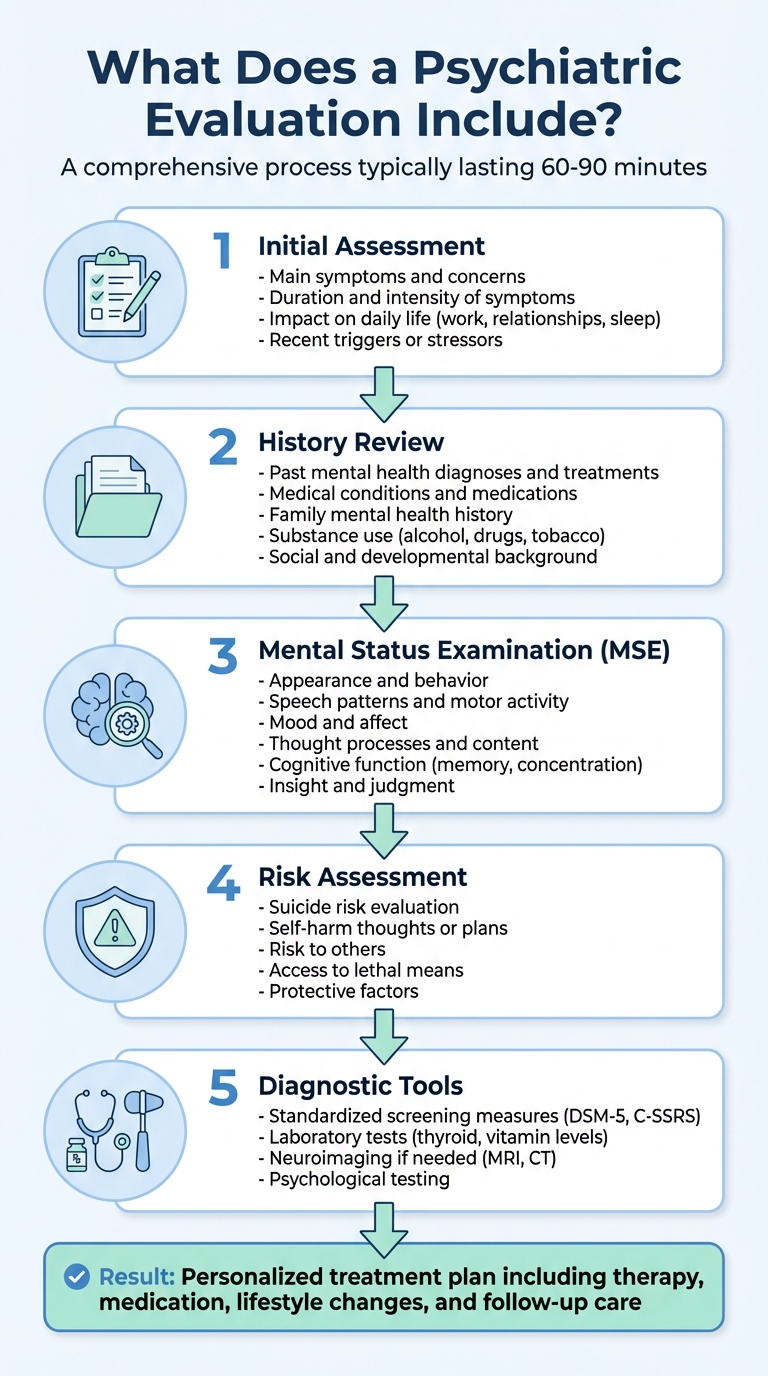
Main Components of a Psychiatric Evaluation
Initial Assessment and Reason for Visit
The evaluation begins by identifying your main symptoms – the specific thoughts, feelings, or behaviors that led you to seek help. This could include issues like anxiety, depression, mood swings, or other challenges that are disrupting your daily life. Your clinician will ask when these symptoms started, how long they’ve lasted, and how intense they are.
A key part of this process is understanding functional impairment – how these symptoms are affecting your ability to work, study, maintain relationships, or handle daily tasks. For example, your provider might ask if you’re struggling with sleep, noticing changes in appetite, or finding it harder to connect with others socially. They’ll also explore whether recent life events or stressors may have triggered or worsened your symptoms.
It’s also important to determine who initiated the evaluation.
Was it you, a family member, a teacher, or another healthcare provider? This helps paint a fuller picture, especially if there are behaviors or concerns you might not be fully aware of. If you have difficulty providing a clear history – due to communication barriers or cognitive challenges – your clinician may turn to family members, caregivers, or other sources for additional details.
This initial information sets the groundwork for diving deeper into your psychiatric, medical, and family history.
Psychiatric, Medical, and Family History
Your provider will review past mental health diagnoses and treatments to avoid misdiagnoses and better understand how you’ve responded to previous interventions. For example, a history of manic episodes alongside current depressive symptoms could help differentiate bipolar disorder from major depressive disorder.
“Focusing only on the presenting symptoms to the exclusion of past history and other symptoms may result in making an incorrect primary diagnosis (and thus recommending the wrong treatment) and missing other psychiatric or medical comorbidities.” – Michael B. First, MD, Columbia University
Medical History and Medications
The medical history review looks at any physical conditions that might contribute to or mimic psychiatric symptoms. Your clinician will ask about current illnesses, past surgeries, allergies, and medications to ensure that treatment is safe and to prevent drug interactions. Similarly, your family history can provide clues about genetic predispositions, particularly when assessing risks for behaviors like suicide or aggression.
Substance Use and Social History
Your provider will also explore substance use, including alcohol, tobacco, prescription drugs, and illicit substances. This is crucial because substance use disorders can sometimes mimic symptoms of anxiety, depression, mania, or psychosis. Additionally, your social and developmental history – which includes details about your living situation, relationships, job, and childhood environment – offers insight into factors that may influence your mental health and coping strategies.
With this comprehensive background in hand, your clinician will move on to assess your current state through the Mental Status Examination.
Mental Status Examination
The Mental Status Examination (MSE) serves as the psychiatric equivalent of a physical exam. It’s a detailed assessment of your current mental state, based on both observation and conversation, and it covers several important areas.
Appearance and behavior are observed first, including grooming, hygiene, clothing, eye contact, and level of cooperation. Motor activity is also noted, such as the speed of your movements, posture, gait, and any tics or tremors. Your speech patterns – including rate, volume, tone, and fluency – are evaluated as well.
Your mood is how you describe your emotional state, while your affect is how your emotions appear to your clinician – whether they seem flat, lively, or mismatched with what you’re saying. The MSE also looks at thought processes (how your ideas are organized) and thought content (what you’re thinking about, such as suicidal or delusional thoughts).
Perceptual experiences, like hallucinations or illusions, are assessed, along with cognitive function, which includes alertness, memory, concentration, and abstract reasoning. Lastly, your insight and judgment are evaluated – how well you understand your condition and how capable you are of making sound decisions. This thorough evaluation not only establishes a baseline but also helps track your progress and the effects of treatment over time.
Risk Assessment and Diagnostic Tools
Evaluating Risk Factors
After completing the Mental Status Examination, clinicians shift their focus to evaluating risks related to self-harm and violence. This involves a detailed exploration of suicide risk, including whether you’re experiencing suicidal thoughts, if you have a specific plan, and whether you have access to potentially lethal means – especially firearms. They’ll also discuss your motivations for suicide and identify protective factors, such as religious beliefs or responsibilities to loved ones, that might deter harmful actions.
“The clinician who conducts the initial psychiatric evaluation should document an estimation of the patient’s suicide risk, including factors influencing risk.” – American Psychiatric Association
In addition to assessing suicide risk, your provider will ask about any thoughts of harming others, past violent behavior (like domestic altercations or workplace incidents), legal issues tied to aggression, and access to weapons. By understanding these risks, they can decide on the best course of action – whether that’s immediate hospitalization, crisis intervention, or continued outpatient care. Once the risk assessment is complete, diagnostic tools come into play to further clarify your condition.
Diagnostic Tools and Functional Testing
To complement the risk evaluation, clinicians rely on diagnostic tools to build a clearer picture of your mental health. Standardized screening tools, such as the DSM-5 Cross-Cutting Symptom Measures or the Columbia-Suicide Severity Rating Scale (C-SSRS), are often used to measure symptom severity and track changes over time. Psychological testing may also be employed to evaluate cognitive abilities, personality traits, or specific symptoms, providing valuable insights into your diagnosis.
Laboratory tests are another key component, helping to identify physical factors that may affect mental health. These might include checking thyroid function, vitamin D and B12 levels, or screening for substance use.
Advanced functional testing, like neuroimaging (MRI or CT scans), sleep studies to assess the role of sleep in mental health, or pharmacogenomic testing — which analyzes how your genes may affect your response to certain medications — to guide medication choices. Together, these tools confirm treatable conditions and help refine a treatment plan tailored to your needs.
What to Expect During the Evaluation
Session Structure and Length
Initial evaluations usually run about 60 minutes, though they can be extended to 90 minutes for more complex cases. During this time, your clinician works to build rapport, understand your primary concerns, review your history, perform a Mental Status Examination, and assess any safety risks. For conditions such as ADHD or trauma, additional sessions may be needed, adding another one to three hours overall.
“The psychiatric interview should be performed by an experienced clinician. Open-ended questions should be used and sufficient time should be allotted to allow patients to feel comfortable to and elicit relevant information.” – Michael B. First, MD, Columbia University
To prepare, bring a list of your current medications, previous diagnoses, and notes on your symptoms. If possible, involve a trusted family member to provide additional context. It’s also crucial to be upfront about any substance use or trauma history, as these can impact diagnosis accuracy and medication safety.
This structured process not only clarifies your diagnosis but also lays the groundwork for a treatment plan tailored to your needs.
Personalized Treatment Plans and Next Steps
Once the evaluation is complete, your clinician will review the findings with you and collaborate to create a treatment plan that fits your specific needs. Collaborative planning has been shown to improve adherence to treatment. An integrated approach to treatment goes beyond medication — plans may also include psychotherapy, nutritional guidance, and lifestyle changes like movement and stress regulation.
“The ultimate recommendation regarding a particular assessment, clinical procedure, or treatment plan must be made by the psychiatrist in light of the psychiatric evaluation… in collaboration with the patient and family, whenever possible.” – American Psychiatric Association
Your treatment plan might also address external factors that affect mental health, such as housing stability, financial pressures, or relationship issues. Follow-up appointments, typically lasting around 30 minutes, help track your progress, adjust medications if necessary, and refine your plan as your symptoms and circumstances evolve.
Mental health care is an ongoing process, with treatments continuously adjusted to align with your needs and responses.
sbb-itb-23f89d4
“What is a Psychiatric Evaluation?” Dr. Fareha Malik
Conclusion
A psychiatric evaluation is where good mental health care begins. It takes the time to look at symptoms, physical health, history, trauma, and risk factors together — not as separate issues, but as parts of the same picture.
The findings shape a treatment plan that fits the specific person, not a generic protocol. Therapy, medication, lifestyle support, and family involvement can all be part of that plan depending on what the evaluation reveals.
If mental health challenges are affecting your work, relationships, or daily routine, seeking an evaluation early tends to lead to better outcomes. Being open about your experiences — and involving trusted people where appropriate — helps your care team build the most complete and useful picture possible.
Ready to Take the First Step?
A psychiatric evaluation is the foundation of good mental health care — and the clearest way to understand what’s actually going on. At Modyfi, our Root-Cause Psychiatry approach brings psychiatry, therapy, nutrition, and exercise together from the start, so your evaluation leads directly into a care plan built around you.
(Note: Modyfi proudly accepts most major commercial insurance plans. We do not accept Medicare or Medicaid.)
FAQs
How should I prepare for a psychiatric evaluation?
Preparing for a psychiatric evaluation can make the process smoother and more effective. Start by gathering information about your mental health history, including any past diagnoses, treatments, or medications. It’s also helpful to note any family history of mental health conditions.
Be ready to describe your current symptoms and how they affect daily life — work, relationships, sleep — and any recent stressors.
Take a moment to write down any questions or concerns you’d like to address during the session. Being open and honest about your experiences is key – it helps your provider understand your situation and create a treatment plan that aligns with your mental health goals.
Why is family history important in a psychiatric evaluation?
Family history plays a crucial role in psychiatric evaluations. It allows mental health professionals to uncover both genetic and environmental factors that could shape a person’s mental health. By looking at patterns of emotional, behavioral, or developmental conditions within a family, clinicians gain a deeper understanding of the context behind current symptoms.
This insight can highlight hereditary risks or shared experiences that might influence an individual’s mental health. It can also shed light on family stressors that could be contributing to the situation. Clinicians use this knowledge to develop care plans that fit the individual’s specific needs and circumstances.
How are treatment plans tailored after a psychiatric evaluation?
Clinicians craft treatment plans by looking closely at your symptoms, medical history, and daily impact. This thorough review helps pinpoint the therapies, medications, or interventions that might work best for you.
By considering your personal experiences, challenges, and goals, healthcare providers aim to develop a plan that supports your overall well-being while working toward lasting mental health progress.
How long does a psychiatric evaluation take?
Most initial psychiatric evaluations run between 60 and 90 minutes. That time covers the core components: presenting symptoms, psychiatric and medical history, Mental Status Examination, risk assessment, and an initial discussion of diagnostic impressions and next steps.
For more complex presentations — ADHD, trauma, or conditions requiring additional testing — the process may extend across more than one session, adding one to three hours overall.
Follow-up appointments are typically shorter — around 30 minutes. They focus on reviewing how treatment is working, adjusting medications if needed, and refining the plan as circumstances change.
Will I be prescribed medication after a psychiatric evaluation?
Not necessarily — and a good evaluation won’t assume medication is the answer before the findings are in.
Medication is one tool among several. Depending on the findings, a clinician might recommend therapy alone, medication, lifestyle interventions, or further testing before making any recommendations.
For some conditions — like mild to moderate anxiety or adjustment difficulties — non-medication approaches are often the first line of treatment.
When medication is recommended, the evaluation findings shape which medication and at what dose. A thorough history, including current medications, medical conditions, and family response to psychiatric medications, helps ensure the choice is safe and appropriate for you specifically.
Is a psychiatric evaluation the same as a psychological evaluation?
They overlap but serve different purposes — and understanding the difference helps you know which one you actually need.
A psychiatric evaluation is conducted by a psychiatrist — a medical doctor with specialized training in mental health. It focuses on diagnosis, risk assessment, medication management, and the biological factors that may be contributing to symptoms. Psychiatrists can prescribe medication and often coordinate with therapists for the psychotherapy component of care.
A psychological evaluation is conducted by a psychologist — a doctoral-level clinician whose training focuses on assessment and psychotherapy. Psychological evaluations are more likely to involve extensive standardized testing, including cognitive assessments, personality evaluations, or neuropsychological testing. They’re particularly useful for diagnosing learning disabilities, ADHD, autism spectrum conditions, or complex personality presentations.
In practice, many people benefit from both — a psychiatric evaluation to assess diagnosis and medication needs, and psychological testing to understand cognitive and personality factors in more depth. If you’re unsure which to seek first, a good starting point is a conversation with your primary care provider or a general mental health clinician who can help direct you.