


If your anxiety keeps following the same pattern — the same triggers, the same reactions, the same cycles in relationships — psychodynamic therapy is built for that question: why does this keep happening?
About 1 in 5 U.S. adults deal with anxiety each year. For many, the symptoms are manageable in isolation but seem to return in familiar forms: fear of criticism, people-pleasing, difficulty with closeness, or a persistent sense that something bad is about to happen. Addressing the symptoms alone often brings temporary relief. Psychodynamic therapy goes further — looking at where those patterns started and what keeps them going.
This approach connects present-day anxiety to older relationship patterns, early attachment experiences, and emotional habits that once served a purpose. The goal isn’t just to feel calmer in the next hard moment. It’s to understand the pattern well enough to change it.
How Psychodynamic Therapy Works for Anxiety
Linking Current Anxiety to Past Patterns
Psychodynamic therapy looks at when an anxious pattern started and what job it once did.
The idea is simple: a lot of present-day anxiety makes more sense when you trace it back. A therapist looks at early caregiving experiences and links what happened then to what is happening now. If someone grew up with constant criticism, they may lean into perfectionism and performance anxiety to avoid shame. If a parent was anxious or overprotective, that person may absorb the sense that the world is unsafe, so everyday stress feels like a real threat. People-pleasing often begins in homes where staying safe meant keeping other people happy.
These patterns are learned safety strategies. They may have helped at one point. Now, they often keep anxiety going.
Once the pattern has a name, therapy turns to the defenses that keep it in place.
Spotting Defenses, Hidden Emotions, and Relationship Triggers
Defenses are automatic ways the mind steers away from feelings that once seemed too risky. That can look like worry, avoidance, perfectionism, or numbing.
Psychodynamic therapy doesn’t treat those defenses like bad habits to shame away. It starts by recognizing that they formed for a reason. Then, by talking through real moments – a conflict at work, an argument with a partner – the therapist helps the person spot the exact point where they move from feeling something to protecting themselves. “Here’s where you start overthinking instead of feeling angry.”
Once that shift becomes easier to see, clients can start trying something else. They might name hurt, allow anger, or stay present instead of shutting down.
Relationship triggers work in much the same way. A short, blunt email from a supervisor can kick off a spiral if it echoes a critical parent. A partner going quiet for a day can stir panic in someone who grew up with inconsistent caregiving. Therapy maps these triggers by looking closely at specific episodes and asking: Who was involved? What did you fear would happen? Does this remind you of anyone from earlier in life?
Very often, those same expectations show up first in the therapy relationship itself.
Using the Therapy Relationship to Build New Patterns
In psychodynamic therapy, the relationship with the therapist is part of the treatment.
Transference happens when feelings and expectations from past relationships – especially early caregiver relationships – get carried onto the therapist. Unlike triggers in daily life, transference brings the pattern right into the room, where both people can look at it while it’s happening. A client who grew up with a critical parent may assume the therapist is silently judging them, even when the therapist is supportive. Someone whose caregivers were emotionally unavailable might read a scheduling change as proof they are being pushed away.
This matters because the therapy relationship gives those old expectations a place to become visible and be tested in real time. When a therapist gently names the pattern – “When I didn’t respond to your email right away, what went through your mind?” – the client and therapist can look at it together. Is that fear accurate here? Where did it start?
As clients try new responses in session and see the therapist stay engaged and nonjudgmental, their inner expectations can start to change.
sbb-itb-23f89d4
For a closer look at how psychodynamic theory applies to anxiety — including how early experiences shape adult emotional patterns — the video below offers a useful visual overview:
How Early Attachment and Stress Responses Shape Anxiety Today
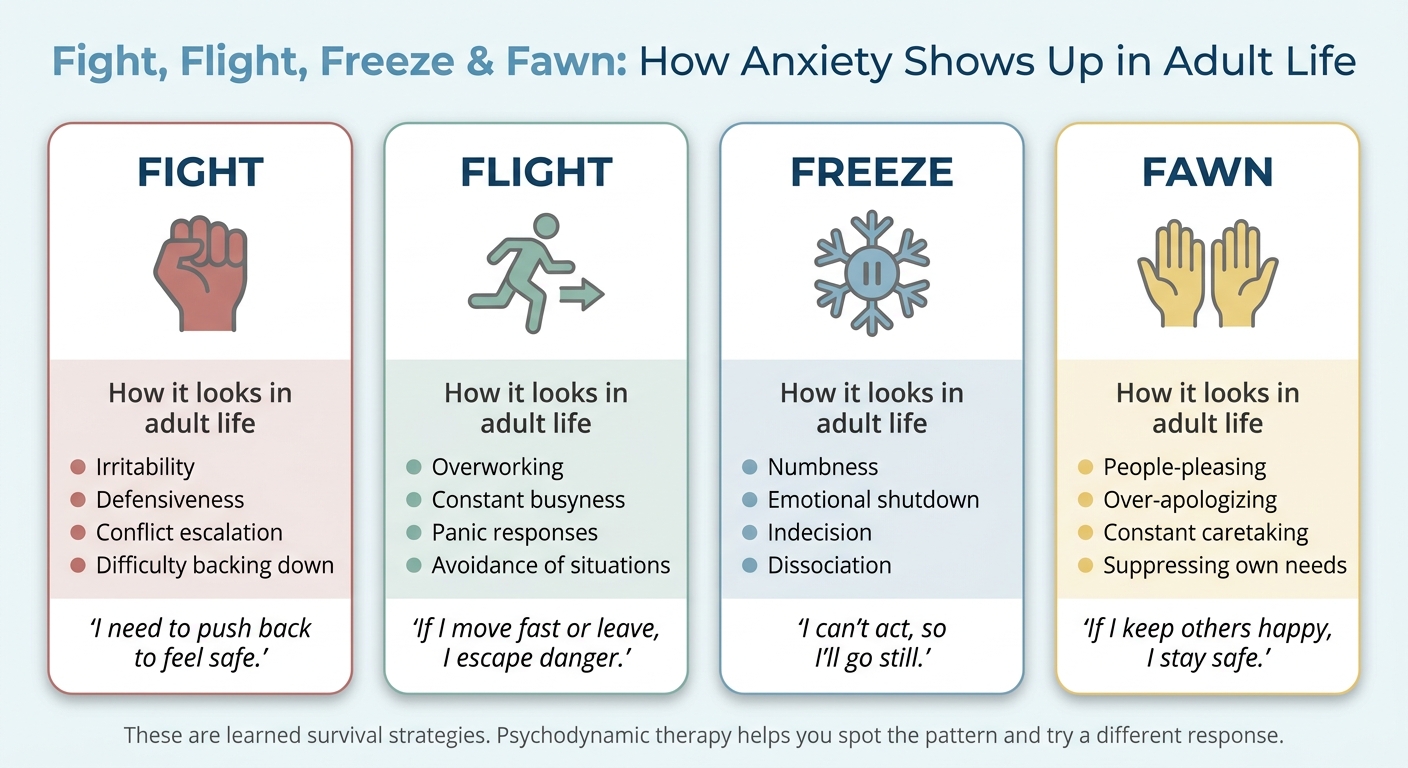
Fight, Flight, Freeze & Fawn: How Anxiety Shows Up in Adult Life
A lot of today’s anxiety doesn’t come out of nowhere. It often traces back to attachment patterns and stress responses learned early in life.
Attachment Patterns Behind Chronic Worry and Fear
Early caregiving helps shape what you come to expect from other people. Can they be trusted? Will they show up? Will your needs matter? Those early expectations can still drive how you react now, like when a partner goes quiet or a friend cancels plans.
Anxious attachment often shows up as fear of abandonment and repeated reassurance-seeking. Avoidant attachment often shows up as discomfort with closeness and emotional shutdown. Disorganized attachment, often shaped by caregivers who were both comforting and frightening, can lead to mixed reactions to closeness and safety.
A 2022 meta-analysis of 79,722 participants found that both attachment anxiety and avoidance were linked to worse mental health outcomes — with attachment anxiety showing the stronger association.
Psychodynamic therapy helps bring these patterns into view. Clients can start to notice the trigger, the feeling, and the old expectation as it happens, not just afterward.
Those expectations don’t stay in the mind alone. They also affect how the body reacts under stress.
Fight, Flight, Freeze, and Fawn in Adult Life
Research on attachment and stress responses shows that anxiously attached adults often have elevated cortisol levels in response to stressors — and in many cases, take longer to recover.
In adult life, these patterns often show up as fight, flight, freeze, or fawn responses.
| Response | How it can look in adult life | Underlying theme |
|---|---|---|
| Fight | Irritability, defensiveness, conflict escalation | I need to push back to feel safe. |
| Flight | Overworking, busyness, panic, avoidance | If I move fast or leave, I escape danger. |
| Freeze | Numbness, shutdown, indecision, dissociation | I can’t act, so I’ll go still. |
| Fawn | People-pleasing, over-apologizing, constant caretaking | If I keep others happy, I stay safe. |
These responses are learned survival strategies. The nervous system picked up that staying alert, pleasing others, or pulling away felt safest. If you grew up in an unpredictable or critical household, keeping everyone calm may have been the safest move available. Later on, that same pattern can look like chronic conflict avoidance.
Once clients can spot the pattern, therapy can help them pause, name what’s happening, and try a different response.
Signs Psychodynamic Therapy May Fit and What Progress Can Look Like
When This Approach May Be Right for Your Anxiety
If those patterns feel familiar, psychodynamic therapy may be a good fit. It tends to help most when anxiety keeps showing up through attachment patterns, defenses, and relationship triggers. That can look like fear of abandonment, fear of criticism, or the feeling that you’re “too much.” It can also show up as long-term people-pleasing or fear of conflict sitting right next to anxiety.
This approach often makes sense for people who want to understand what’s driving their anxiety, not just how to get through the next hard moment.
Once therapy starts, change often shows up first in awareness, not in the complete removal of symptoms.
Early and Longer-Term Signs of Progress
Early progress can be easy to miss if you don’t know what to look for. At first, many clients notice that they catch triggers sooner and can put clearer names to what they feel – fear, shame, anger, sadness, or loneliness – instead of just feeling flooded. Avoidance may start to loosen too, which can make hard conversations and decisions feel less overwhelming.
With time, the shifts often run deeper. Research has found improvements in anxiety intensity, boundary-setting, and flexibility under stress. Those gains tend to last after treatment ends — and in some studies, clients continued to improve even after therapy concluded. Those gains can last even after treatment ends.
What Research Says About Effectiveness
This fit in practice lines up with the research. Meta-analytic reviews found that psychodynamic therapy significantly reduces anxiety — with results comparable to other active therapies and gains that hold up at follow-up.
It seems to help most when anxiety is tied to relationship patterns and long-term emotional themes.
Conclusion: Psychodynamic Therapy as Part of Whole-Person Anxiety Care
Psychodynamic therapy aims to get at the roots of anxiety: early relationships, attachment patterns, and coping habits learned over time. As that insight grows, people may see fewer anxiety spikes, less avoidance, and fewer problems with boundaries. A review published in American Psychologist found that the effect size increased by 50% when patients were re-evaluated nine or more months after therapy ended — suggesting that psychodynamic therapy sets in motion psychological processes that continue working after treatment concludes.
Anxiety usually doesn’t come from just one source. Biology, sleep, nutrition, and stress can all shape how it shows up day to day. That’s where coordinated care can make a difference.
Coordinated care that combines psychotherapy, psychiatric evaluation, medication management, and nutritional support tends to produce more complete outcomes than any single intervention alone.
If your anxiety seems tied to old patterns, relationship triggers, or constant worry, psychodynamic therapy as part of a coordinated, whole-person care plan may be a useful next step with a qualified clinician.
The Pattern Makes More Sense Than You Think — and It Can Change.
If your anxiety keeps showing up in the same ways — in relationships, under criticism, in moments of closeness or conflict — that’s not a character flaw. It’s a pattern with roots. At Modyfi, our network of providers brings psychiatry, therapy, nutrition, and exercise together to help you understand what’s driving your anxiety and build something more stable in its place.
👉 Explore Providers to Book an Appointment and Start Your Care Plan
(Note: Modyfi proudly accepts most major commercial insurance plans. We do not accept Medicare or Medicaid.)
FAQs
How is psychodynamic therapy different from CBT for anxiety?
CBT focuses on spotting and changing negative thought patterns and behaviors that keep anxiety going.
Psychodynamic therapy goes deeper. It looks at how past patterns, attachment themes, early experiences, and relationship triggers shape present-day anxiety. The goal is to build insight into the roots of the problem, not just the symptoms.
How long does psychodynamic therapy for anxiety usually take?
The length of psychodynamic therapy for anxiety can vary from person to person. This work is personal, and it aims to shift deeply rooted patterns, so change often takes time, patience, and steady effort.
Some anxiety treatments stick to a set number of sessions. An integrated care approach combines ongoing therapy with shared decision-making and regular follow-up to support lasting progress tied to your own goals.
Can psychodynamic therapy help if my anxiety shows up in relationships?
Yes. Psychodynamic therapy can help you see how early attachment patterns, childhood experiences, and long-running emotional habits shape the way you react in relationships.
That kind of insight can make a big difference. You may start to spot your triggers sooner, react with more calm, and build better communication, deeper trust, and steadier connections.
Is psychodynamic therapy evidence-based?
Yes — and this is worth addressing directly, because psychodynamic therapy has sometimes been portrayed as lacking scientific support compared to CBT. The evidence tells a different story.
A comprehensive meta-analysis published in American Psychologist reviewed eight meta-analyses covering 160 studies of psychodynamic therapy and found effect sizes comparable to other evidence-based treatments. A separate meta-analysis of 14 randomized controlled trials found that psychodynamic therapy significantly outperformed control conditions and did not differ meaningfully from other active treatments at post-treatment or follow-up.
One consistent finding across studies is that gains from psychodynamic therapy tend to hold — and in some cases grow — after treatment ends. This “sleeper effect” suggests the approach sets psychological processes in motion that continue working beyond the active treatment period.
That said, not all research is equal, and psychodynamic therapy has fewer large-scale randomized trials than CBT for specific anxiety disorders. The evidence is strong, but the field continues to build it.
What happens in a psychodynamic therapy session?
Sessions are typically 45 to 50 minutes long and involve open-ended conversation rather than structured exercises or homework assignments. There’s no agenda to fill out or workbook to follow.
The therapist will often ask questions that slow things down and go deeper — “What was that like for you?” or “Does that feeling remind you of anything?” — rather than moving quickly toward solutions. The goal is to stay with what’s actually happening emotionally rather than jumping to coping strategies.
Over time, the therapist may name patterns they notice — in how you talk about relationships, in moments where you seem to pull back, in reactions that seem larger than the situation warrants. They’ll also pay attention to what happens between the two of you in the room, since the therapy relationship often mirrors the patterns that show up elsewhere in your life.
Sessions can feel slow at first, especially if you’re used to more structured approaches. The pace is intentional — the work is building awareness, not checking off symptoms.
Can psychodynamic therapy help with panic attacks?
It can — though the approach to panic looks different than in CBT.
CBT for panic typically focuses on identifying and changing the thoughts and behaviors that maintain the panic cycle — breathing techniques, psychoeducation about panic physiology, and graduated exposure. It tends to produce faster symptom relief for panic disorder specifically.
Psychodynamic therapy approaches panic differently. It treats panic as a signal — something the nervous system is communicating that hasn’t yet found words. Rather than focusing on managing the panic itself, it explores what the panic might be responding to: unresolved conflict, suppressed emotion, fear of loss of control, or relational dynamics that feel threatening at an unconscious level.
Research supports psychodynamic therapy for anxiety broadly, including panic, particularly when symptoms are entangled with relationship patterns, long-standing emotional themes, or histories of early adversity. For people who’ve tried symptom-focused approaches without sustained relief, or whose panic seems to carry emotional weight beyond the physical experience, psychodynamic therapy may offer a different and useful angle.