


Childhood trauma doesn’t stay in the past. It shapes how the nervous system reads safety, closeness, and threat — often for decades, and often most visibly in adult relationships.
In the U.S., 63.9% of adults report at least one adverse childhood experience, and 17.3% report four or more. When trauma leads to PTSD, the effects on relationships can be significant and confusing — both for the person living with it and for the people close to them.
PTSD symptoms and insecure attachment can look alike, overlap, and feed each other. Flashbacks can make present-day closeness feel like past danger. Hypervigilance can turn small shifts in a partner’s tone into signs of threat. Emotional numbing can look like coldness when it’s actually shutdown. Avoidance can look like disinterest when it’s fear-based withdrawal.
These reactions are survival responses — not character flaws. Understanding what’s driving them is the first step toward something different.
For a broader look at how childhood trauma affects self-worth, relationships, and PTSD symptoms — before diving into the specific patterns below — the video below offers useful context:
How Childhood Trauma Affects Adult Relationships, Self-Worth & PTSD Symptoms
The infographic below summarizes how PTSD symptom clusters and insecure attachment patterns each show up in relationships — and what may be happening underneath the surface:
PTSD Symptoms vs. Attachment Patterns in Adult Relationships
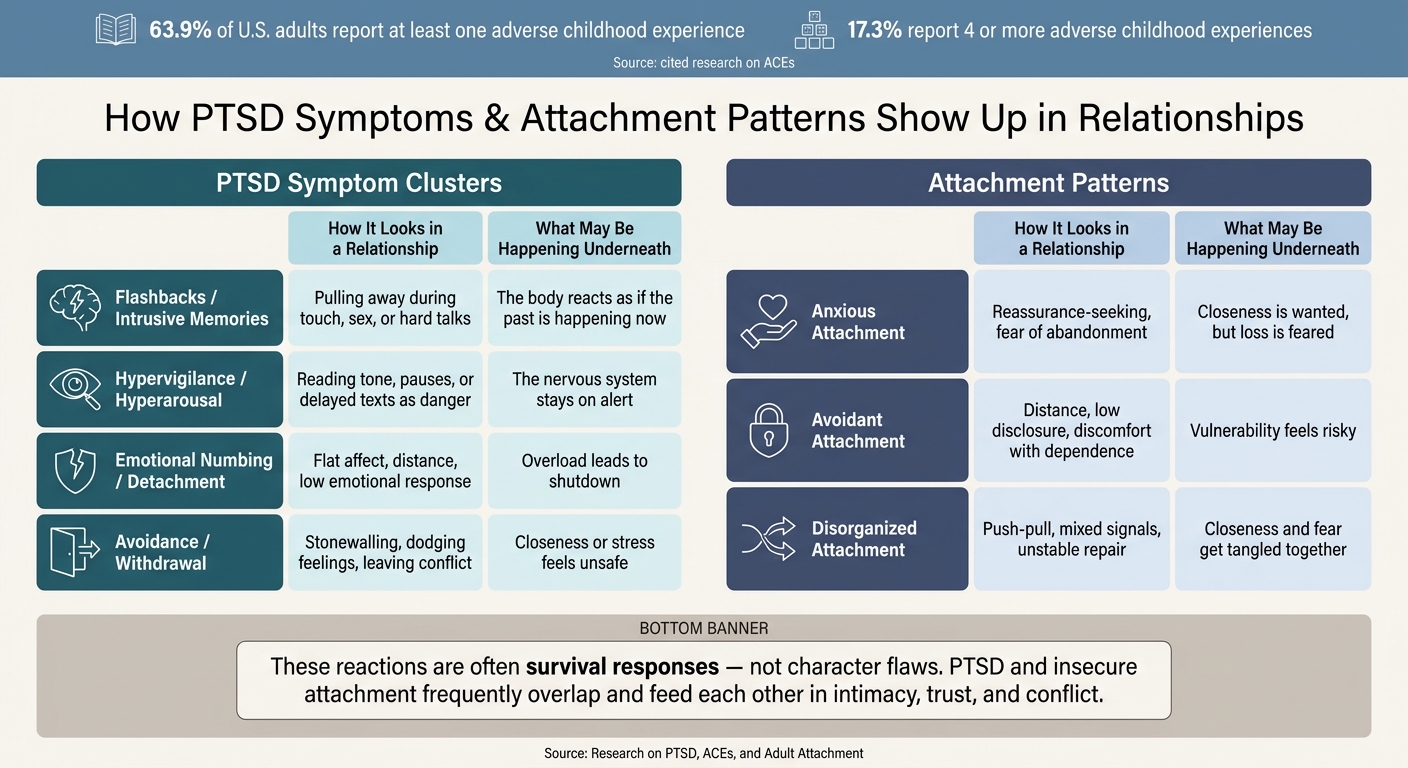
The table below shows how PTSD symptoms and insecure attachment patterns can overlap — and why they’re often confused for each other:
| Pattern | How it may look in a relationship | What may be happening underneath |
|---|---|---|
| Flashbacks / intrusive memories | Pulling away during touch, sex, or hard talks | The body reacts as if the past is happening now |
| Hypervigilance / hyperarousal | Reading tone, pauses, or delayed texts as danger | The nervous system stays on alert |
| Emotional numbing / detachment | Flat affect, distance, low emotional response | Overload leads to shutdown |
| Avoidance / withdrawal | Stonewalling, dodging feelings, leaving conflict | Closeness or stress feels unsafe |
| Anxious attachment | Reassurance-seeking, fear of abandonment | Closeness is wanted, but loss is feared |
| Avoidant attachment | Distance, low disclosure, discomfort with dependence | Vulnerability feels risky |
| Disorganized attachment | Push-pull, mixed signals, unstable repair | Closeness and fear get tangled together |
How Each PTSD Symptom Cluster Affects Relationships
1. Flashbacks and Intrusive Memories
A flashback is an involuntary replay that makes the body react as if the trauma is happening right now. It doesn’t feel like a memory. It feels present. Intrusive memories can hit in a similar way: unwanted images, body sensations, or emotional states that show up out of nowhere, set off by something as ordinary as a tone of voice or a dim room. In close relationships, that replay can turn present-day affection into a signal of past danger. If a current partner sets it off, closeness itself can start to feel unsafe.
These intrusions are physical, not just mental. Research on PTSD memory suggests flashbacks may be maintained by sensory cues and weak integration into autobiographical context — which helps explain why they feel immediate rather than remembered.
Moments of vulnerability can carry a lot of charge. Physical affection, sexual intimacy, or emotional disclosure may bring up sensory echoes of past trauma through a partner’s touch, voice, or even the setting. When that happens, a person may freeze, pull away, or dissociate. To a partner who doesn’t know the trauma history, it can look like rejection or lack of interest. But the body may be reacting to danger from the past, not the person in front of them.
Trust: Safety, Reliability, and Fear of Betrayal
When childhood trauma involved a caregiver or another trusted adult, flashbacks can blur the line between past and present. In those moments of re-experiencing, the nervous system may read even a kind partner as dangerous. That can bring up beliefs like “someone who says they care about me might still hurt me.” Research on PTSD and interpersonal functioning shows that higher levels of re-experiencing symptoms are linked with lower relationship satisfaction, more hostility, and more trouble trusting others. A 2021 study found the strongest association between childhood maltreatment and PTSD symptoms in people reporting the highest levels of both attachment anxiety and avoidance — while those with secure attachment showed no significant association.
Conflict: Escalation, Shutdown, and Repair
Conflict can be a major trigger. A mild argument may stir up intrusive scenes from the past, especially for someone who grew up around chaotic or violent conflict at home. The response can seem out of proportion from the outside: escalation, shutdown, or dissociation. Shame can make it even harder. Because intrusive memories often carry shame, survivors may dread the repair conversation afterward and expect blame or rejection. Studies on PTSD consistently link re-experiencing symptoms with more relationship aggression, poorer communication, and avoidance of conflict resolution.
When flashbacks keep the body on alert even between triggers, that state of watchfulness can turn into its own pattern: hypervigilance.
2. Hypervigilance and Hyperarousal
Building on the watchfulness that can follow flashbacks, hypervigilance keeps the body braced for the next threat. After childhood trauma, the nervous system may stay on alert, reading tone, facial expression, pauses, and body language like warning signals. Hyperarousal is the process underneath it: the autonomic nervous system stays switched on, keeping the body in a chronic fight-or-flight state even when the present moment is safe. The National Institute of Mental Health notes that these arousal symptoms are often constant, not intermittent. This is a chronic baseline state, not occasional anxiety.
Intimacy: Vulnerability, Affection, and Emotional Presence
Physical closeness and emotional openness ask a lot from the body. It has to feel safe first. When the nervous system is stuck in a state of activation, that can be hard.
A partner coming up from behind, an unexpected touch, or a direct emotional question can land like a threat. The body may stiffen, freeze, or dissociate. That doesn’t mean the person doesn’t care. It means hyperarousal is humming in the background. Sleep problems, another common hyperarousal symptom, add to the strain: chronic fatigue can make it harder to stay present, gentle, or patient during intimate moments.
Trust and Safety: When Predictability Matters Most
In close relationships, hypervigilance can turn a delayed text or a shift in tone into proof that something is wrong. These cues may register as signs of abandonment, even when no harm was meant, and reassurance from a partner may not change that belief right away.
In attachment terms, this can look like anxious scanning for rejection or a disorganized push-pull around closeness. Research also suggests that elevated sensitivity to relationship-related threat is a unique pathway through which PTSD symptoms erode relationship adjustment.
What tends to help is simple, but not always easy:
- Following through on plans
- Clear communication about delays
- Explicit repair after misattunement
Conflict: Escalation, Shutdown, and Survival Response
During conflict, hyperarousal can shove the nervous system into fight, flight, or freeze before a person has time to think. It may look like fight through a raised voice or defensiveness, flight through leaving or changing the subject, or freeze through going quiet or dissociating.
A minor disagreement can feel much bigger in the body than it looks on the surface, especially when childhood conflict involved unpredictability or danger at home. Research links hyperarousal to anger, aggression, and reduced capacity for repair. Spotting early physical cues – a tight chest, heat in the face, the urge to leave – can help both partners slow things down before the conversation spins out.
When constant alertness becomes exhausting, emotional numbing often follows.
3. Emotional Numbing and Detachment
After long stretches of hyperarousal, the nervous system can swing the other way and go flat. That flatness isn’t indifference. It’s a trauma response that dulls feeling and connection. In the short term, that blunting helps protect a person from overload. Over time, though, the same shield can get in the way of closeness.
Intimacy: Vulnerability, Affection, and Emotional Presence
Numbing often shows up in moments when someone is expected to feel, connect, and respond. A person may care very much and still feel cut off from warmth in that moment. They can be physically there but emotionally far away. To a partner, that kind of protection can look like indifference, even when it isn’t.
Trust: Safety, Reliability, and Fear of Betrayal
Trust asks for something hard: feeling safe enough to let care in. Numbing can block that, too. Even with a steady, reliable partner, a trauma survivor may stay guarded and treat dependence like danger. That reaction often reaches back to early attachment. If needing someone once led to harm, distance started to feel safer. On the surface, this can look like avoidant attachment. But the force behind it is trauma protection.
Conflict: Escalation, Shutdown, and Repair
During conflict, numbing usually looks like shutdown rather than escalation. The person may go quiet, pull back, or check out. That’s a nervous-system pause, not a planned refusal to engage. Repair tends to work only after some low-pressure time to reconnect and come back online.
sbb-itb-23f89d4
4. Avoidance and Withdrawal
If numbing shuts feeling down, avoidance does something different: it backs away from feeling altogether. It isn’t emotional blankness. It’s movement away. In PTSD, avoidance is an automatic retreat from fear, pain, or vulnerability. After childhood trauma, even everyday relational cues like tone of voice, closeness, or conflict can register as threat. The body reads them as danger, and withdrawal becomes the fastest exit.
This is different from healthy boundaries. Healthy boundaries are flexible and chosen. Trauma-driven avoidance is rigid and automatic. Over time, it can change day-to-day life in a big way, from altered routines to less social contact to stepping back from activities and relationships that once mattered.
Intimacy: Vulnerability, Affection, and Emotional Presence
Avoidance gets in the way of the very things that help people feel close: honest self-disclosure, steady emotional presence, and physical affection. Someone might keep conversations on the surface instead of getting personal, dodge questions about feelings, or resist making future plans with a partner. From the outside, that can look like indifference.
But that’s not the same as not caring. In many cases, the relationship matters deeply. The problem is that the nervous system treats vulnerability like a threat, so pulling back feels safer than staying open.
Trust: Safety, Reliability, and Fear of Betrayal
When early caregivers were unpredictable, frightening, or emotionally absent, a hard lesson often takes root: relying on other people leads to pain. Later in life, that lesson can make trust feel risky. Even with a steady, patient partner, closeness may feel less like comfort and more like the start of disappointment.
That’s why trust repair requires repeated experiences of respect, consent, and consistency.
Conflict: Escalation, Shutdown, and Repair
In romantic relationships, this pattern often turns into something mutual and repetitive. During conflict, avoidance may show up as stonewalling, walking out of the room, going quiet, or putting the talk off again and again. Instead of feeling like a problem the couple can work through, disagreement starts to feel like danger.
One common result is a demand-withdraw cycle: one partner pushes for engagement, the other pulls back, and nothing gets settled.
How These Patterns Shape Closeness, Trust, and Conflict
The four main PTSD symptom clusters – flashbacks, hypervigilance, emotional numbing, and avoidance – don’t stay neatly inside one person. They show up between people, in the middle of ordinary moments. Add anxious, avoidant, or disorganized attachment patterns that began in childhood, and it gets much harder to tell what’s coming from trauma, what’s coming from attachment, and why two people keep missing each other.
Those symptom clusters tend to affect three core parts of a relationship in distinct ways — with attachment style and relationship history shaping how each one plays out.
The table below maps how each symptom cluster tends to show up across three core relationship domains:
| Relationship Domain | Flashbacks / Intrusive Memories | Hypervigilance / Hyperarousal | Emotional Numbing / Detachment | Avoidance / Withdrawal |
|---|---|---|---|---|
| Intimacy | Shutdown during closeness | Difficulty relaxing into affection or touch | Partners may feel shut out | Limits self-disclosure and physical closeness |
| Trust | Past trauma can override current safety | Neutral behavior can feel threatening | Partners may read emotional unavailability as unreliability | Closeness can feel like the start of disappointment |
| Conflict | Past triggers can drive reactions that exceed the current argument | Quick escalation before either person can slow down | Flat affect or dissociation during conflict | Stonewalling or leaving conflict unresolved |
The same symptom can look very different depending on attachment style. Anxious patterns pull for closeness. Avoidant patterns create distance. Disorganized patterns swing between the two, sometimes fast enough to leave both people off balance.
Intimacy: Vulnerability, Affection, and Emotional Presence
Intimacy gets hard when the nervous system treats closeness like a threat. A person with anxious attachment may want closeness badly, then struggle to stay present once it’s there. Part of them is already bracing for loss. Their attention shifts from connection to scanning for signs that it won’t last.
A person with avoidant attachment may hold back in quieter ways. They may limit touch, dodge emotional talks, or keep things on the surface. That can look cold from the outside, but it’s often less about not caring and more about how exposed vulnerability feels.
With disorganized attachment – often tied to trauma involving early caregivers – the pattern can swing hard in both directions. One moment there’s deep closeness. The next, sudden withdrawal. For the partner, it can feel like the rules changed mid-game.
Trust: Safety, Reliability, and Fear of Betrayal
Trust starts to fray when trauma keeps the threat alarm switched on. PTSD keeps the nervous system ready for danger, so even a steady, caring partner can feel unsafe or hard to read when symptoms spike. The past starts talking over the present.
Anxious attachment tends to turn small lapses into tests of betrayal. A delayed reply, a change in tone, a missed detail – none of it stays small for long. Avoidant attachment moves in the other direction. Instead of testing trust, it may block dependence from the start. If relying on someone feels risky, distance can seem safer than hope.
Conflict: Escalation, Shutdown, and Repair
Conflict is often where these patterns show themselves fastest, because stress pushes trauma and attachment responses right to the surface. Hyperarousal makes the nervous system reactive. A small disagreement can turn into fight-or-flight before either person has time to slow things down.
At the other end, numbing and avoidance can flatten everything. Someone may go blank, shut down, dissociate, or walk away. To them, it may feel like overload. To their partner, it can feel like abandonment.
Repair is the part that usually takes the biggest hit. Reconnecting after an argument takes emotional regulation: being able to feel remorse, listen, stay in the room mentally and emotionally, and talk without getting swept away. PTSD symptoms wear down that exact ability.
Anxious partners may press for repair too soon, before either person is calm enough to have a decent conversation. Avoidant partners may skip repair altogether and act like nothing happened. With disorganized attachment, repair can become uneven and hard to trust, so both people are left wondering whether the rupture was ever healed at all.
Treatment Options, Trade-Offs, and Recovery Outlook
Integrative Care for PTSD and Relationship Functioning
When PTSD and attachment patterns keep getting in the way of closeness, treatment tends to work best when it deals with both trauma symptoms and relationship functioning. That matters because symptom relief alone may not fix the day-to-day patterns that strain a relationship. People often also need help with emotional regulation, communication, and trust.
Treatment tends to work best when it addresses both the trauma symptoms and the relationship patterns connected to them — not as separate tracks, but as part of the same integrated plan.
Healing Is Possible. You Don’t Have to Figure It Out Alone.
If childhood trauma is showing up in your relationships — in how you trust, how you connect, or how you respond to conflict — that’s worth exploring with someone who understands both trauma and attachment. At Modyfi, our network of providers brings psychiatry, therapy, nutrition, and exercise together to support the whole picture, not just one piece of it.
👉 Explore Providers to Book an Appointment and Start Your Care Plan
(Note: Modyfi proudly accepts most major commercial insurance plans. We do not accept Medicare or Medicaid.)
Conclusion
Taken together, these patterns show why trauma and attachment need to be read side by side, not as separate issues. Childhood trauma can shape both PTSD symptoms and adult attachment, and those effects often show up in intimacy, trust, and conflict.
Flashbacks, hypervigilance, numbing, and avoidance can disrupt relationships in ways that are hard to explain and harder to live with. They are survival responses, not character flaws.
This overlap tends to hit hardest when old attachment fears intensify current trauma reactions. PTSD and insecure attachment often feed into each other, especially in anxious, avoidant, and fearful patterns.
Recovery means treating both the trauma symptoms and the relationship patterns tied to them. That may include trauma-focused therapy to reduce intrusions and hyperarousal, attachment-based work to rebuild trust and repair conflict cycles, and when biological factors like sleep, hyperarousal, or nervous system dysregulation are part of the picture, integrative support that addresses those directly. Progress isn’t always linear, but with the right care, more secure connection is possible.
FAQs
How can I tell PTSD from an attachment issue?
PTSD usually develops after a traumatic event. It often leaves the nervous system stuck on high alert or shut down. That can look like hyperarousal, such as anxiety and racing thoughts, or hypoarousal, such as numbness and disconnection.
Attachment issues more often begin in early childhood, shaped by caregiver relationships. They tend to show up in patterns around trust, closeness, and emotional regulation. Since both can affect relationships and day-to-day life, a mental health professional can help sort through your history, symptoms, and how much they’re affecting you.
Can childhood trauma make healthy relationships feel unsafe?
Yes. Childhood trauma can change the way safety feels in relationships.
Early neglect, abuse, or inconsistent caregiving can shape insecure attachment. That can make trust, emotional regulation, and closeness harder than they should be.
Trauma can also leave the nervous system stuck in hypervigilance or numbness. In plain terms, your body may stay on guard or shut down, even when there’s no clear danger. Because of that, neutral or caring signals can feel threatening.
So healthy connection may not feel safe, even when it is.
What treatment helps with both PTSD and attachment?
Treatment that helps with both PTSD and attachment often works best when it uses an integrative, multidisciplinary approach. Why? Because trauma doesn’t just affect emotions. It can also affect the body, the nervous system, and day-to-day patterns in relationships.
Treatment that addresses both often includes trauma-focused psychotherapy, somatic regulation to help the nervous system recover, and when relevant, support for sleep, nutrition, and lifestyle factors that affect mood and stress regulation.
What is disorganized attachment, and how does it relate to childhood trauma?
Disorganized attachment develops when the person a child depends on for safety is also the source of fear. When a caregiver is frightening, unpredictable, or abusive, the child faces an impossible bind — the instinct to seek comfort and the instinct to flee danger both point toward the same person. With no way to resolve that contradiction, attachment behavior becomes disorganized.
In adult relationships, this early pattern often shows up as the push-pull dynamic described throughout this post — a deep longing for closeness paired with an equally strong fear of it. Connection may feel urgent one moment and threatening the next. Partners can find this confusing or exhausting, not because the person doesn’t care, but because the nervous system learned that closeness and danger go together.
Disorganized attachment is one of the most studied correlates of childhood trauma, particularly abuse and neglect involving caregivers. It’s also the attachment pattern most strongly associated with PTSD in adulthood. Recognizing it as a trauma response — rather than a personality trait or a relationship failing — is often an important early step in treatment.
Can PTSD affect someone who hasn’t been diagnosed?
Yes — and this is worth naming directly, because many people living with PTSD symptoms have never received a formal diagnosis.
PTSD can develop after any experience that overwhelms the nervous system’s capacity to process what happened. That includes experiences that don’t fit the popular image of trauma — chronic emotional neglect, growing up in a household with unpredictable or frightening behavior, repeated experiences of humiliation or helplessness, or witnessing harm to others. These experiences may not have felt like “trauma” at the time, especially in childhood when they were normalized.
If the patterns described in this post feel familiar — difficulty trusting, hypervigilance in relationships, emotional shutdown, or a sense that closeness is always slightly threatening — that’s worth exploring with a mental health professional, regardless of whether you’ve ever been formally diagnosed. The absence of a diagnosis doesn’t mean the experiences weren’t real or that effective treatment isn’t available.
What does trauma-focused therapy actually involve?
Trauma-focused therapy is a broad term that covers several evidence-based approaches, each with a different method but a similar goal: helping the nervous system process what happened so that trauma memories no longer carry the same immediate charge.
Some of the most researched approaches include EMDR (Eye Movement Desensitization and Reprocessing), which uses bilateral stimulation to help the brain reprocess traumatic memories; Cognitive Processing Therapy (CPT), which works directly with the beliefs that trauma leaves behind; and Prolonged Exposure (PE), which gradually reduces avoidance by helping people face feared memories and situations in a controlled, supported way.
Somatic approaches — which focus on body sensations and nervous system regulation rather than verbal processing — are often used alongside or instead of talk-based therapy, particularly when trauma is held more in the body than in explicit memory.
What most of these approaches share is pacing. Trauma therapy isn’t about forcing someone to relive experiences. It’s about moving through material at a rate the nervous system can tolerate, building regulation capacity alongside processing, so recovery is stable rather than destabilizing.