


Quiet burnout doesn’t announce itself. There’s no breakdown, no dramatic moment where everything stops. Instead, it builds slowly — in the background, while you’re still meeting deadlines, still showing up, still functioning.
The clearest sign isn’t exhaustion itself. It’s that rest stops working. A full night of sleep, a long weekend, a vacation — and you come back feeling exactly the same. That’s the difference between ordinary fatigue, which resets with rest, and quiet burnout, which doesn’t.
It can affect mood, focus, sleep, and the body. Brain fog, emotional numbness, unrefreshing sleep, decision fatigue, and a low-grade sense of dread about ordinary tasks are all common. High-functioning people are often the last to recognize it — because from the outside, everything still looks fine.
For a clinical explanation of emotional exhaustion — the core experience behind quiet burnout, and why it doesn’t always look the way people expect — the video below from Mayo Clinic Health System offers a useful starting point:
What is emotional exhaustion?
The table below shows where ordinary fatigue ends and quiet burnout begins — and why one resets with rest while the other doesn’t:
| Area | Ordinary Fatigue | Quiet Burnout |
|---|---|---|
| Rest | Usually helps | Often helps only briefly or not much |
| Energy | Low, then rebounds | Drained day after day |
| Mood | Cranky or tired | Flat, detached, numb |
| Focus | Fog clears after a break | Small tasks keep feeling heavy |
| Sleep | More sleep feels restorative | Sleep may not feel refreshing |
| Daily function | Short dip | Slow, steady strain that builds |
How Quiet Burnout Differs From Ordinary Fatigue
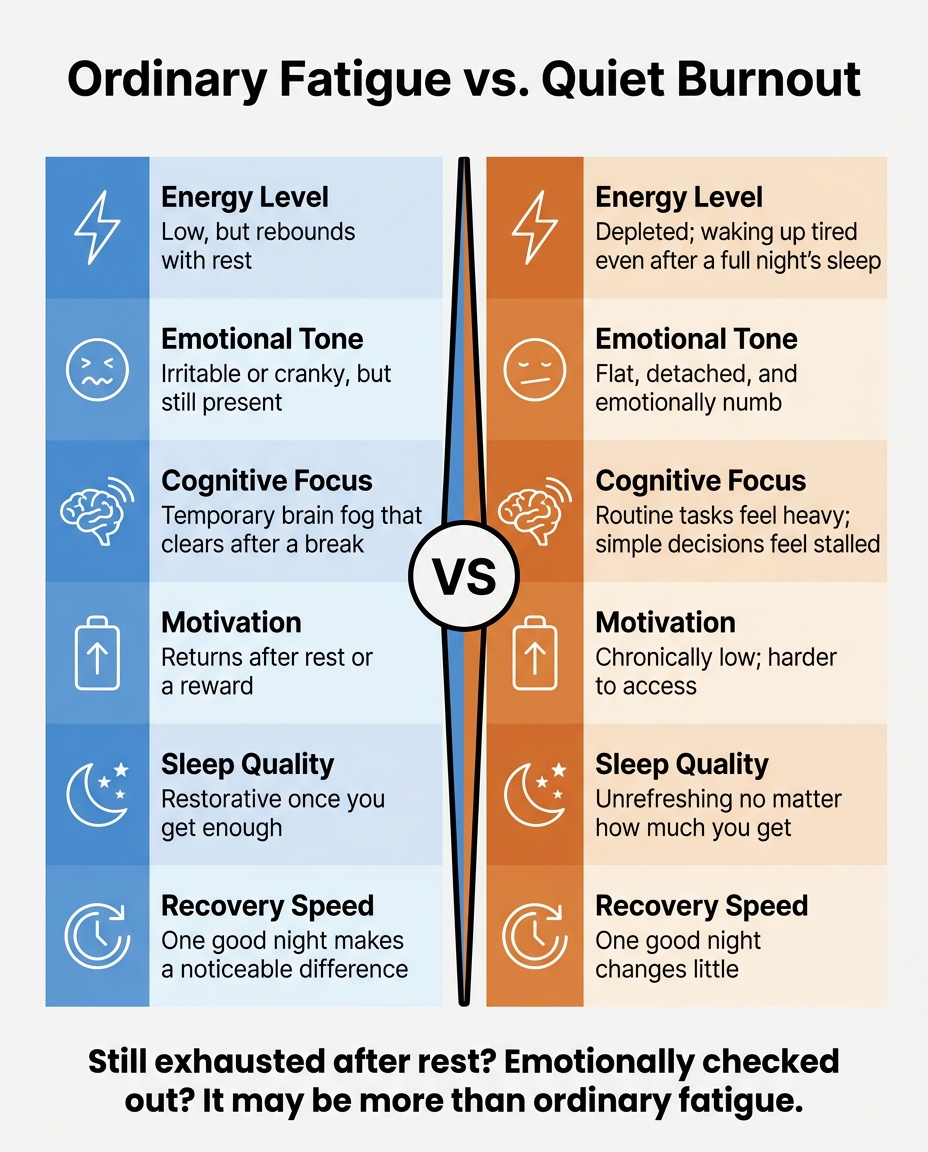
Ordinary Fatigue Usually Gets Better With Rest
Ordinary fatigue is temporary. When you rest, your energy, focus, and motivation usually come back. In short, ordinary fatigue tends to reset with sleep and downtime.
Burnout-Related Exhaustion Does Not Improve With Rest Alone
Quiet burnout works differently. You might take a long weekend, log back in on Monday, and feel exactly the same. As Patrick Brown, PMHNP-BC, explains, modern life can keep the stress response switched on while recovery stays muted.
That’s one reason high-functioning people often miss it. They’re still producing, still hitting deadlines, still looking “fine” from the outside. But under the hood, recovery is lagging. Even small choices – what to eat, how to begin a task – can feel oddly heavy.
So quiet burnout can pass for normal tiredness at first. Then it starts creeping into daily functioning.
What Quiet Burnout Looks Like in Daily Life
Emotional and Mental Signs That Are Easy to Dismiss
Quiet burnout often starts in small moments that are easy to brush off. You stare at a simple email for way too long, back out of plans you used to like, or snap at someone over something tiny. On the surface, it can seem like a mood issue, poor sleep, or a motivation slump. That’s one big reason it gets mislabeled.
Chronic stress can affect the prefrontal cortex and amygdala, which can make focus, impulse control, and prioritization harder. That can lead to brain fog, forgetfulness, and trouble managing tasks. In plain English, your system is carrying too much at once.
Some people also feel restless in a way that’s hard to pin down. They bounce between tasks, can’t sit still with boredom, and keep starting things without finishing them. It can look like plain distraction, so people often miss what’s going on. Burnout doesn’t just live in your head. It can show up in your body too.
Physical Signs That Get Blamed on Lifestyle
You might get eight hours of sleep and still wake up drained. Or maybe your appetite shifts, or you feel tired in a way that doesn’t lift even after rest. It’s easy to chalk that up to a rough routine or a few bad nights.
But stress doesn’t always clock out when the workday ends. Modern stressors can keep the body on alert long after the day is over. Research suggests that chronic inflammation may disrupt neurotransmitter production — diverting tryptophan away from serotonin synthesis — though the relationship in humans is still being studied.
That’s where things get tricky: a person can still look like they’re doing fine while dealing with all of this.
Why Capable People Often Miss the Warning Signs
Functioning is not the same as feeling okay. Someone can hit deadlines, handle responsibilities, and still feel drained underneath it all. People who are capable often lean on strong coping habits, so they stay productive even while running on empty.
From the outside – and sometimes even to themselves – everything can look normal. That’s why the warning signs often slide by until they’re much harder to ignore.
What Drives Quiet Burnout and When Rest Stops Helping
Chronic Stress, Overload, and Lack of Control
Quiet burnout often builds in the background, even while you’re still getting things done. It tends to grow from chronic stress, too much on your plate, and too little control over your time, workload, or results.
When your schedule feels packed and your work feels out of your hands, stress starts stacking up. And it stacks up fast. That’s how someone can look productive on the outside but still feel completely drained underneath.
How the Body Sustains Exhaustion: Sleep, Stress Hormones, and More
Rest doesn’t always fix burnout because the body’s stress response may stay switched on. Chronic stress can throw cortisol off balance, increase inflammation, and make it harder for the brain to recover.
So even if you sleep in, take a day off, or try to slow down, the relief may only last a short time. You rest, but your system never fully powers down.
Signs It May Be Time for a Deeper Evaluation
If rest no longer leaves you feeling restored and your day-to-day functioning starts to slip, this may be more than ordinary fatigue. And if physical symptoms keep piling up, your nervous system may be stuck in a stress state.
That’s worth taking seriously with a clinical evaluation. When rest stops helping, the next step is root-cause support.
What to Do About Quiet Burnout: A Root-Cause Care Path
Start With Assessment, Not Self-Blame
If rest doesn’t bring you back, don’t jump to self-blame. Start with a whole-person look at your mood, energy, sleep, workload, and physical symptoms. Burnout can overlap with anxiety, depression, and adult ADHD, so a full evaluation should rule out other causes that may be happening at the same time.
Targeted lab work can help rule out conditions that mimic or worsen burnout — including thyroid dysfunction, anemia, vitamin D deficiency, and B12 or folate gaps. Research links elevated homocysteine — a marker of suboptimal B12 and folate status — to higher fatigue scores in healthy adults. These aren’t diagnostic tests for burnout itself, but they can reveal biological factors that make recovery harder
Short-Term Fixes vs. Root-Cause Support:
The table below compares short-term relief strategies with a root-cause approach — and why the difference matters for lasting recovery:
| Short-Term Fixes | Root-Cause Support | |
|---|---|---|
| Primary Goal | Temporary relief or pushing through | Identifying the biological and systemic drivers of depletion |
| Common Strategies | Stimulants, occasional rest days, mood-boosting apps | Psychiatric evaluation, trauma-informed therapy, nutrition therapy |
| Biological Focus | Ignoring physical signals to meet deadlines | Targeted lab work – cortisol, homocysteine, vitamin levels |
| Nervous System | Remaining stuck in stress mode | Nervous system regulation |
The Nervous System Side of Quiet Burnout
Quiet burnout isn’t just a state of mind — it’s a state of the body. And understanding what’s happening physiologically helps explain why rest alone often isn’t enough.
The HPA axis — the hypothalamic-pituitary-adrenal system — is the body’s primary stress response circuit. Under normal conditions, it activates when stress appears and dials back when the threat passes. Cortisol rises, does its job, and returns to baseline. The system resets.
Chronic stress disrupts that reset. When stressors are persistent — a relentless workload, ongoing uncertainty, a caregiving role with no clear end — the HPA axis stays partially activated. Cortisol patterns shift. Instead of a healthy morning peak followed by a steady decline, the curve can flatten, spike at the wrong times, or lose its rhythm altogether.
The result is a nervous system that never fully powers down. The body stays in a low-grade state of alert — not acute fight-or-flight, but a sustained background hum that consumes energy, disrupts sleep architecture, and makes genuine recovery nearly impossible even when rest is available.
This is why someone with quiet burnout can sleep eight hours and wake up exhausted. The sleep is there, but the nervous system isn’t recovering during it. The body is still on guard.
Over time, this pattern can affect immune function, gut health, and the brain’s ability to regulate mood and attention — which is why quiet burnout often shows up as a cluster of symptoms that seem unrelated but share a common root.
What Recovery From Quiet Burnout Actually Looks Like
Recovery from quiet burnout rarely looks like a dramatic turnaround. It tends to be slower, more gradual, and easier to miss than the burnout itself — which is part of why it helps to know what to expect.
The first signs are usually small. Sleep starts feeling more restorative. The constant background hum of dread about ordinary tasks begins to ease. Decisions that felt impossibly heavy become manageable again. Emotional reactions stop feeling disproportionate to what triggered them.
These shifts often come before energy fully returns. Many people expect to feel energized first — and then functional. In practice, it usually works the other way: functioning improves incrementally while energy catches up behind it.
What tends to drive that shift is addressing the right layer. For some people, the most important intervention is structural — reducing workload, building genuine recovery time into the week, and creating clearer boundaries between work and rest. For others, the biological layer matters most: correcting a nutrient deficiency, stabilizing blood sugar, or supporting the nervous system’s ability to downregulate after stress.
Often it’s both — which is why integrated care tends to produce more complete outcomes than addressing just one piece.
Recovery also isn’t linear. There are better weeks and harder ones. A particularly stressful period can temporarily push things back. That’s not failure — it’s the expected shape of nervous system recovery when the original stressors haven’t fully resolved.
The clearest marker of real progress isn’t energy levels or productivity. It’s how quickly you come back after a hard day. If the recovery window is shrinking — if you’re bouncing back faster and more completely — that’s the signal that something is actually shifting.
How Modyfi Health Addresses Quiet Burnout Through Integrated Telehealth Care

You Don’t Have to Keep Running on Empty.
When quiet burnout has more than one cause, a whole-person evaluation can make the next step much clearer. At Modyfi, our Root-Cause Psychiatry approach brings psychiatry, therapy, nutrition, and exercise together — so nothing that might be driving your exhaustion gets missed.
👉 Explore Providers to Book an Appointment and Start Your Care Plan
(Note: Modyfi proudly accepts most major commercial insurance plans. We do not accept Medicare or Medicaid.)
FAQs
How do I know if this is burnout or just stress?
Stress often hits hard, but it tends to pass. Burnout goes further. It’s a deeper, longer-lasting state of mental, emotional, or physical drain that doesn’t lift much, even after rest.
You may be dealing with more than everyday stress if you notice:
- symptoms lasting more than two weeks
- trouble functioning at work, in relationships, or with daily self-care
- feeling emotionally numb, mentally stuck, or tired but wired
How long does it take to recover from quiet burnout?
There’s no single timeline — and being honest about that matters, because unrealistic expectations can make recovery harder.
For mild quiet burnout caught early, meaningful improvement in sleep quality, emotional reactivity, and daily functioning can begin within four to eight weeks of consistent changes — better boundaries, reduced workload, improved sleep hygiene, and nutritional support where needed.
For more entrenched burnout, particularly when it’s been building for months or years without being recognized, recovery typically takes longer. The nervous system doesn’t reset quickly after sustained chronic stress. Most people find that genuine recovery — not just symptom management — takes three to six months of intentional, often multi-pronged support.
What tends to slow recovery is trying to address only one layer. Rest alone rarely works when the biological drivers haven’t been addressed. Lifestyle changes alone rarely work when the psychological patterns maintaining burnout — perfectionism, difficulty with boundaries, hypervigilance — haven’t been explored. Recovery tends to move faster when multiple factors are addressed at the same time.
The clearest signal that recovery is real: how quickly you bounce back after a hard day or week — not whether hard days still happen.
Can quiet burnout happen even if I’m still functioning well?
Yes. Quiet burnout can happen even when you still seem fine on the surface. A lot of people keep meeting deadlines, showing up, and handling day-to-day tasks while running on empty underneath.
That’s what makes it easy to miss. If work is getting done and life looks normal from the outside, deeper mental, emotional, and physical exhaustion can look like simple stress or a few bad nights of sleep instead of burnout.
When should I get evaluated for quiet burnout?
Seek a professional evaluation if symptoms stick around, get worse, or start affecting work, school, relationships, or basic self-care.
If low mood, anxiety, or a loss of interest lasts more than two weeks, or rest and your usual coping tools stop helping, it’s time to talk with a clinician. An integrative evaluation can also help spot physical factors that may be adding to your exhaustion.
What makes quiet burnout different from regular burnout?
The key difference is visibility — both to others and to the person experiencing it.
Classic burnout tends to be more obvious. It often involves a clear breaking point: a dramatic drop in performance, an inability to function at work, or a crisis that makes the problem impossible to ignore. It’s the version most people picture when they hear the word burnout.
Quiet burnout operates below that threshold. The person is still showing up, still meeting deadlines, still appearing functional from the outside — and often to themselves. There’s no crisis moment, no dramatic collapse. Just a slow erosion of energy, emotional availability, and the ability to recover.
That invisibility is what makes it both easier to miss and harder to address. Without a clear signal that something is wrong, people tend to attribute the symptoms to normal stress, poor sleep, or a difficult season — and push through rather than seek support. By the time quiet burnout is recognized, it’s often been building for months.
The three-part Maslach framework for burnout — emotional exhaustion, depersonalization or cynicism, and reduced sense of effectiveness — applies to both. What distinguishes quiet burnout is that the functioning facade remains largely intact, masking how significant the underlying depletion has become.
Can quiet burnout turn into depression?
Yes — and this is one of the most important reasons to take quiet burnout seriously rather than waiting it out.
Quiet burnout and depression share overlapping symptoms — emotional numbness, fatigue, loss of motivation, difficulty concentrating, disrupted sleep. In the early stages, it can be genuinely difficult to tell them apart. But they’re not the same condition, and the distinction matters for how they’re treated.
What the research shows is that sustained burnout creates biological conditions that increase vulnerability to depression: chronic cortisol dysregulation, neuroinflammation, disrupted sleep architecture, and social withdrawal. Over time, these factors can tip what started as occupational or lifestyle-driven exhaustion into a clinical depressive episode.
This doesn’t mean burnout always becomes depression — it doesn’t. But when symptoms persist beyond two to four weeks, affect multiple areas of life, and don’t respond to rest or lifestyle adjustments, a clinical evaluation is the right next step. A thorough assessment can differentiate between the two, identify any overlap, and ensure the right kind of support is in place.