

When it comes to understanding your mood, one rough night doesn’t tell the whole story. What matters is the pattern — how your sleep behaves over a week or more. That’s where sleep tracking comes in.
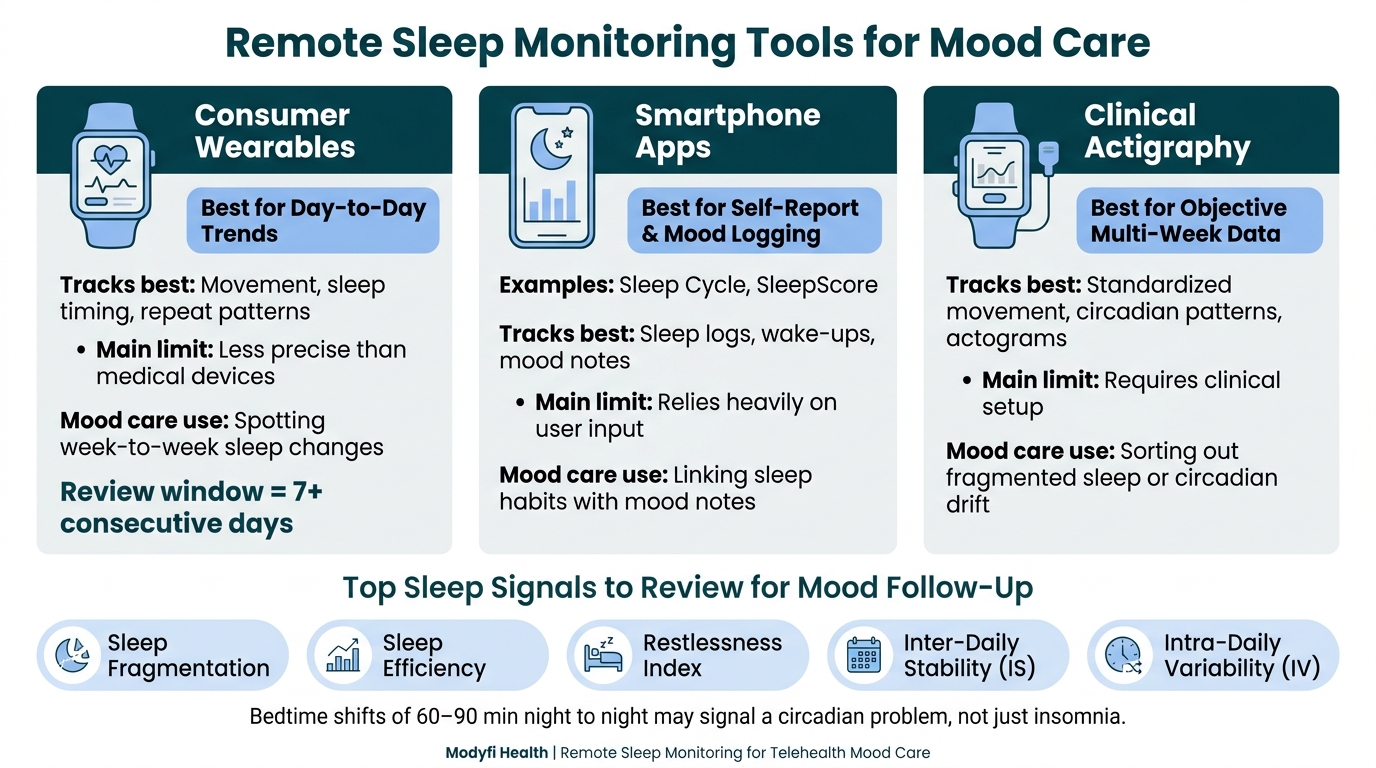
There’s no single “best” tool. Consumer wearables are great for spotting day-to-day trends. Smartphone apps let you pair sleep timing with how you’re actually feeling. And clinical actigraphy gives your provider the most standardized, multi-week view when the picture isn’t clear. The right choice depends on the question you’re trying to answer.
The Science Behind Wearable Sleep Monitoring
sbb-itb-23f89d4
Quick Comparison
| Tool | Best for | What it tracks best | Main limit | Best use in mood care |
|---|---|---|---|---|
| Consumer wearables | Easy home tracking | Movement, sleep timing, repeat patterns | Less precise than medical devices | Spotting week-to-week sleep changes |
| Smartphone apps | Low-effort self-report | Sleep logs, wake-ups, mood notes | Heavily based on user input and phone estimates | Linking sleep habits with mood notes |
| Clinical actigraphy | Multi-week assessment | Standardized movement data, circadian patterns, sleep-wake charts | Usually needs clinical setup | Sorting out fragmented sleep or circadian drift |
Bottom line: I would use the device data next to mood symptoms, daily routine, meds, and sleep habits. That is what turns numbers into a useful care plan.
Consumer Wearables: Sleep Tracking at Home
Consumer wearables track your movement and sleep timing overnight, right from your wrist. Their real strength isn’t judging a single rough night — it’s showing whether your sleep stays steady, gets broken up, or turns restless across several nights.
What Wearables Track Best
Wearables are strongest at movement-based tracking, which is why a week of data tells you far more than any one night. An off night can happen for all kinds of reasons — stress, travel, late caffeine, a noisy room. A pattern across several nights tells a much clearer story.
The Signals That Matter Most for Mood
The signal that tends to matter most is sleep fragmentation — how often your sleep gets interrupted. When sleep is broken up night after night, it can line up with mood that feels less steady. Timing matters too: if your bedtime and wake time keep drifting, that can point to circadian disruption — a body-clock rhythm closely tied to how stable your mood feels.
How Wearable Reports Support Telehealth Visits
A simple trend report gives you an easy way to share your sleep patterns before a telehealth visit — helping your provider spot sleep-related triggers behind mood symptoms and adjust your care plan with real information. For those who need a closer look, apps and actigraphy add another layer.
Smartphone Apps and Clinical Actigraphy: Choosing the Right Level of Monitoring
When a wearable doesn’t give enough detail, two tools can fill the gap in different ways. One offers low-effort self-tracking; the other offers more objective measurement across several weeks. Each fits a different job.
Smartphone Sleep Apps
Apps like Sleep Cycle and SleepScore use your phone’s sensors and your own sleep logs to track timing, awakenings, and mood notes. In telehealth, those summaries give your provider a quick snapshot of recent sleep and mood between visits. App data works best as a starting point rather than a final measure — its real value is in self-report, sleep timing, and mood logging.
Clinical Actigraphy
A medical-grade sensor records your movement continuously over several weeks, producing standardized data that apps can’t match. It helps most when your provider needs objective evidence of fragmented sleep or a drifting body clock, and it’s often used for follow-up in insomnia, bipolar disorder, and anxiety-related sleep problems.
Using Remote Sleep Data in Telehealth Mood Follow-Up
The goal is simple: start your visit with a clear picture of what might be driving changes in both your sleep and your mood. And the most useful question isn’t about any single night — it’s which patterns keep showing up across a full week.
That’s why your provider usually looks at about a week of data before a follow-up. Shorter stretches make the trends harder to trust; a full week shows whether your sleep timing is steady or all over the place.
How Sleep Patterns Can Guide Your Care
Different patterns often point to very different next steps — and this is where the data earns its keep.
Trouble falling asleep, with only mild awakenings, often fits sleep-onset insomnia — frequently tied to anxiety or pre-bed habits. Care here may lean toward calming strategies and a better wind-down routine.
Waking often through the night, with broken, restless sleep, points to a different pattern — one where a medication review or a check for sleep-disordered breathing may move up the list.
When your sleep timing is very irregular from night to night, the issue may be more about your body clock than classic insomnia. That can shift the plan toward fixed wake times, morning light, and easing off late-night stimulation.
And if your sleep steadily improves over several weeks after starting a therapy like CBT-I, that’s a strong sign the plan is working — so the visit can focus on keeping it going rather than changing course too soon.
This is where Modyfi’s model helps. Because psychiatry, therapy, nutrition, and movement work together under one plan, providers can read the same sleep summary and coordinate your care — instead of each working in a separate lane.
A quick but important note: tracking your own sleep can reveal helpful patterns, but reading that data isn’t the same as a diagnosis. These tools are a starting point for a conversation with your provider — not a reason to change your treatment, or start a new one, on your own.
The Bottom Line: Choosing the Right Sleep Tracking Tool
No single tool fits every person or every question. The right choice depends on what needs tracking — and on how easily you can stick with it. Wearables suit low-effort, day-to-day trends. Apps help when sleep diaries and how you feel about your sleep matter most. Actigraphy is the most structured choice when your provider needs a multi-week view.
One thing matters more than any single night: consistency over several weeks. Movement-based signals — restlessness, awakenings, broken sleep, and regular timing — often say more than total hours slept alone.
But the real value comes when that data is read next to your mood, your routine, and your treatment. On its own, sleep data doesn’t say much. Alongside the rest of your picture, it helps explain why your sleep changed — and whether it’s worth a closer look.
Understanding Your Sleep, Together
Sleep and mood are closely connected — and you don’t have to untangle the pattern on your own. At Modyfi, your provider can review your sleep data alongside your symptoms, routines, and goals to build a care plan that fits you, not a template.
👉 Explore Providers to Book an Appointment and Start Your Care Plan
Modyfi proudly accepts most major commercial insurance plans in MD, DC, and VA; currently, we do not accept Medicare or Medicaid.
FAQs
Which sleep tool should I start with?
Start with a professional evaluation rather than picking a device on your own. That kind of review can help uncover the root cause — whether it’s a circadian rhythm issue, a nutrition gap, or a mental health pattern affecting your sleep. Data only helps if you’re tracking the right thing.
At Modyfi, clinicians begin with an initial evaluation of your medical history and daily habits, then build a plan that may include sleep monitoring and evidence-based care like CBT-I.
How many nights of sleep data are enough?
There’s no single number that works for everyone. What matters most is tracking your sleep on a regular basis so your provider can spot patterns in your sleep, total hours, and nighttime disruptions over time.
That kind of steady tracking can bring trends into focus, including issues that show up at least three nights a week. If that keeps happening, it may point to a chronic condition and the need for a professional evaluation and a personalized care plan.
When is actigraphy better than a wearable or app?
When clinical precision matters — when your provider needs to check whether your sleep report matches what your body is actually doing. Unlike consumer apps, actigraphy measures movement objectively, which helps show whether a sleep issue is tied more to habits and behavior or to your underlying body-clock rhythms.
Can sleep tracking replace a sleep study?
No. Wearables, apps, and even actigraphy track patterns over time, but they don’t diagnose conditions like sleep apnea. If your data points to disrupted breathing — for example, broken sleep alongside loud snoring — your provider may recommend a formal sleep study for a proper diagnosis.