


When therapy is helping but something still feels off — persistent fatigue, brain fog, anxiety that won’t settle, or a sense of being stuck despite real effort — the issue is often not motivation. It’s that the care plan is missing pieces.
Sleep disorders, hormone shifts, nutrient deficiencies, undiagnosed ADHD, and chronic inflammation can all blunt the effects of therapy. They can also mimic depression and anxiety closely enough that even a skilled clinician working only from symptom reports might not catch them. When that happens, more therapy sessions rarely solve the problem.
Research links iron deficiency with about twice the odds of depression and nearly twice the odds of anxiety. Thyroid dysfunction, low vitamin D, and blood sugar instability can produce nearly identical symptom profiles. These aren’t rare edge cases — they’re common, treatable, and frequently missed in standard mental health evaluations.
Stalled progress doesn’t mean the therapy has failed. It often means the plan needs a broader review.
The table below shows where therapy tends to have the most impact — and what it typically can’t address on its own:
| What therapy may help most | What it may miss on its own |
|---|---|
| Thought patterns | Sleep disorders |
| Coping skills | Iron or vitamin problems |
| Boundaries and habits | Thyroid or hormone issues |
| Trauma work | ADHD or bipolar spectrum symptoms |
| Emotional processing | Medication needs |
For a brief, accessible explanation of what integrative medicine actually means in practice — and how it differs from conventional care — the video below from Mayo Clinic offers a useful starting point:
What is integrative health and how can it help?
sbb-itb-23f89d4
Why therapy alone may stop working
Therapy can seem productive on paper while sleep, energy, focus, and day-to-day function barely change. That disconnect matters. Sleep problems, hormone shifts, nutrient issues, medical conditions, and chronic stress can all blunt the effect of therapy. When that gap sticks around, it’s time to ask what else may be driving the symptoms.
If symptoms or daily function barely shift after several weeks of steady therapy, the plan needs a closer look. Often, the problem isn’t effort. It’s that something key is missing.
Signs it is more than a temporary plateau
A temporary plateau usually means progress slows for a bit, but the skills you’ve built still mostly hold up, and a few changes can get things moving again. It becomes more than that when the signs are clear and persistent.
One of the biggest red flags is ongoing sleep disruption: trouble falling asleep, trouble staying asleep, or sleeping a lot and still waking up wiped out. Abnormal sleep patterns have been linked with poorer response to CBT and interpersonal therapy, along with higher recurrence after treatment ends. Sleep isn’t just part of the symptom picture. It can be part of the reason therapy isn’t landing.
Other signs matter too:
- Frequent panic that disrupts daily life, such as multiple attacks per week or avoiding ordinary places like grocery stores
- Persistent fatigue that doesn’t line up with emotional stress, where your body feels drained but your mind stays stuck in overdrive
- Losing jobs or falling behind in school despite making a real effort to use the tools therapy has given you
That last pattern can point to unaddressed ADHD, a sleep disorder, or a medical issue.
The most concerning sign is worsening symptoms over several weeks. If low mood is getting deeper, you’re missing more work, or substance use is climbing even while you’re showing up to therapy, the answer usually isn’t to just wait longer. The plan needs to be reassessed.
Common reasons progress stalls
One of the most common and least talked-about reasons therapy stalls is an incomplete diagnosis. Adult ADHD, bipolar II, cyclothymia, and trauma can all be mistaken for anxiety or depression. If the main condition hasn’t been fully identified, even a skilled therapist is working with only part of the picture.
Another common issue is a mismatch between the therapy type and the clinical need. Someone with OCD or panic disorder may be in loosely structured, insight-oriented therapy and spend session after session learning why they worry without ever facing fears in a direct, steady way. When the method doesn’t fit the problem, sessions can start to feel repetitive, and progress stays limited.
If the therapy method isn’t the issue, the next place to look is the body and the daily routine. Medical and biological factors are often the missing piece that no one has checked. Thyroid dysfunction, low iron, low vitamin D, hormone shifts during perimenopause or the postpartum period, and chronic inflammation can all cause or worsen fatigue, low mood, and cognitive fog.
Then there are lifestyle patterns. They don’t always look dramatic, but they can quietly undercut progress. Chronic stress, irregular routines, poor sleep habits, and physical inactivity can all affect mood, energy, and follow-through. If those factors stay in place, they can put a ceiling on how far therapy alone can take someone.
When progress stalls in any of these areas, it’s a sign that psychiatric, medical, and lifestyle review may be needed.
What a whole-person mental health plan includes
A whole-person mental health plan brings together psychiatric care, therapy, lifestyle support, and labs and measurements to look for what’s driving symptoms, not just how to quiet them down. In day-to-day care, that usually means working from four connected parts: psychiatric care, therapy, lifestyle support, and labs and measurements. Each part affects the others.
Psychiatric evaluation and treatment planning
A full evaluation looks at the full picture: symptoms, treatment history, medical history, family history, substance use, sleep, trauma, stress, and daily functioning.
Medication may be part of the plan when symptoms are moderate to severe, or when therapy and lifestyle changes aren’t enough on their own. When that happens, the plan should fit your goals, your concerns, and the kind of follow-up you’ll need.
Therapy matched to diagnosis and goals
Therapy tends to work best when it fits both the diagnosis and the main symptoms. In plain terms, the treatment should match the problem: CBT for depression and many anxiety disorders, trauma-focused therapy for PTSD, and DBT skills for emotion regulation.
What ties it all together is coordination. When care is coordinated, therapy stays in step with medication, sleep, and daily habits instead of working in separate lanes.
Nutrition, exercise, sleep, and stress regulation
From there, the plan moves into the routines that shape mood and energy every day. Sleep, movement, nutrition, and stress regulation affect symptom control. They aren’t side notes. They’re part of care.
Blood sugar stability is often a smart place to begin. Big swings in blood sugar can mimic anxiety or make anxiety and irritability worse. A simple starting point can help:
- Eat three structured meals per day
- Include a source of protein at each meal, such as eggs, Greek yogurt, beans, chicken, or fish
- Limit excess added sugar
That kind of routine can cut down on afternoon crashes and make behavioral work easier to stick with.
Movement matters too. Even 10–20 minutes of brisk walking on most days has measurable antidepressant and anti-anxiety effects for many people, and exercise can meaningfully reduce depressive symptoms.
Sleep is often the most underestimated part of the plan. A steady wake time seven days a week, a 30–60 minute wind-down routine, and stopping caffeine after early afternoon are practical first steps. Stress regulation can also be simple and short: paced breathing, mindfulness, or brief breaks between tasks can help regulate the body’s stress-response system, which affects energy, mood, and immune function.
Using testing and coordinated care to find missing drivers
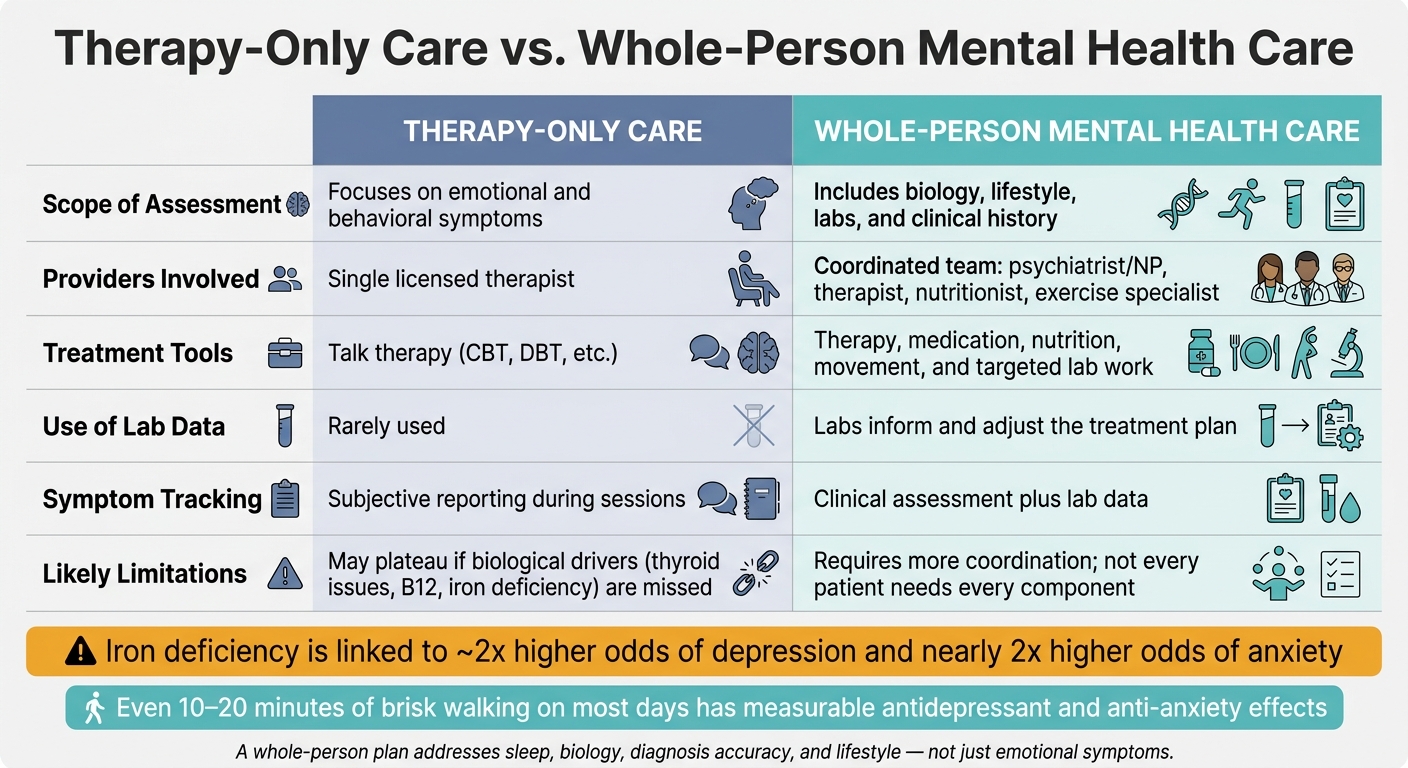
When symptoms stop budging, even with good therapy and better daily habits, it often means something else may still be in the mix. Therapy can be a strong fit. Sleep, food, and routines can improve. And still, a person may feel stuck.
That’s where targeted lab work can help. Not as a replacement for clinical assessment, but as a way to sharpen it. Normal results can rule out some causes. Abnormal results can point to treatable drivers. Either way, the numbers only mean something when they’re read in context.
Lab tests that may matter for mood, anxiety, focus, and energy
The right tests depend on the symptom pattern and the person’s history. Commonly considered tests include CBC and iron studies, vitamin D, B12, folate, TSH with or without free T4, and, in some cases, sex hormones, cortisol-related testing, or inflammatory markers such as CRP or ESR. Cortisol results need careful reading because timing, collection method, and clinical context can change what the results mean.
Iron deficiency without anemia is a good example of why a routine CBC may not tell the whole story. A full iron panel – ferritin, serum iron, TIBC, and transferrin saturation – gives a clearer view. Research has found that people with iron deficiency have about twice the odds of depression and nearly twice the odds of anxiety compared with those without it.
For people who haven’t done well with multiple medications, pharmacogenomic (PGx) testing may be worth discussing with a prescriber. It looks at gene differences that affect how some medications are metabolized, which may help explain side effects or poor response. It’s not a first-line tool. Still, a 2024 umbrella review and meta-analysis found that patients receiving PGx-guided antidepressants were 41–78% more likely to achieve remission than those receiving treatment as usual — though the magnitude of benefit varies across studies
How coordinated telehealth care works in practice
Once testing points to possible drivers, care tends to work best when providers are looking at the same picture at the same time. That’s the point of integrated care: one shared plan, not mixed messages.
The psychiatrist or psychiatric nurse practitioner, therapist, and other specialists review labs, sleep, medications, stress load, and symptom changes together. Then they adjust treatment without pulling the patient in different directions. This kind of care can happen virtually, and it can be shaped for different age groups when the team is working from shared information.
What this looks like for real people and what to do next
Hypothetical examples of when broader care makes sense
When those missing drivers come into view, the treatment plan often shifts in practical, everyday ways. The following are hypothetical examples — not real patient cases — that illustrate where a broader evaluation tends to change the direction of care:
- Anxiety plus severe insomnia. Someone has made solid progress in CBT for generalized anxiety. Their worry feels more under control, but they still spend two or three hours awake most nights before they finally fall asleep. Then the next day, they’re drained, and that lack of sleep makes everything feel heavier. In a case like this, the missing pieces may include a psychiatric evaluation, sleep treatment, and steady sleep support.
- Low mood plus iron deficiency and low vitamin D. Someone is getting help from therapy on the emotional side, but the brain fog and fatigue keep hanging around week after week. Lab work then shows iron deficiency and low vitamin D. Once those factors are treated alongside therapy, symptoms start to ease.
- Burnout that turns out to include untreated ADHD. Someone has been labeled with “burnout” for months. Therapy helps with stress management, but the focus problems, constant overwhelm, and trouble finishing tasks stay stuck. A fuller assessment changes the diagnosis and identifies ADHD. At that point, the plan expands to include medication evaluation, task structure coaching, and stress regulation strategies. Once ADHD is treated directly, progress becomes steadier.
Across these scenarios, one finding is consistent: outcomes improve when care addresses the biological, diagnostic, and lifestyle factors that standard mental health evaluations often miss.
Key takeaways
Stalled therapy does not mean the work has failed. More often, it means some underlying factors – sleep, biology, or diagnosis – still need attention. When a psychiatrist, therapist, and other supports are working from the same picture, the next steps usually become easier to see.
The next question is simple: What is still missing?
Still Stuck? The Missing Piece Might Not Be You.
When therapy isn’t producing the results you expected, the answer is rarely to try harder. It’s to look more carefully at what’s driving the symptoms. At Modyfi, our Root-Cause Psychiatry approach brings psychiatry, therapy, nutrition, and exercise together — including functional lab testing when the picture calls for it.
👉 Explore Providers to Book an Appointment and Start Your Care Plan
(Note: Modyfi proudly accepts most major commercial insurance plans. We do not accept Medicare or Medicaid.)
FAQs
How do I know if therapy alone isn’t enough?
Therapy is a core part of mental health care. But sometimes, it isn’t enough on its own.
If your symptoms keep hanging around, come back again and again, or haven’t improved even with therapy or medication, it may be time to look beyond talk-based care alone.
A broader, whole-person plan can make sense when mental health struggles show up alongside physical symptoms like fatigue, sleep problems, or weight changes. It can also help when biology or day-to-day habits may be part of the picture – like nutrient deficiencies, hormones, metabolism, inflammation, digestion, or your stress response.
What medical issues can look like anxiety or depression?
Some biological issues can look a lot like anxiety and depression, or make them hit harder. That’s a big deal, especially when talk therapy and medication don’t seem to be doing enough.
A few common examples include thyroid dysfunction, nutrient deficiencies like low vitamin B12, vitamin D, iron, zinc, or folate, gut microbiome imbalances, insulin resistance, blood sugar instability, chronic inflammation, and hormonal imbalances.
What tests or providers should I ask about next?
Ask your provider about testing for biological factors that may be tied to mental health symptoms. Sometimes, the issue isn’t just emotional. Things like blood sugar, thyroid function, and low nutrient levels can play a part too.
This may include:
- Metabolic markers: fasting insulin, HOMA-IR, HbA1c
- Thyroid labs: TSH, Free T3, Free T4
- Nutrient levels: vitamin D, B12, folate, iron, zinc, magnesium
Other options may include inflammatory markers, four-point salivary cortisol, gut microbiome analysis, and pharmacogenomic testing.
How long should I give therapy before deciding it’s not working?
There’s no universal timeline — but some general benchmarks are worth knowing.
For most evidence-based therapies, meaningful symptom improvement should be noticeable within 8 to 16 sessions when the treatment is a good fit for the condition. CBT for depression and anxiety, for example, typically produces measurable change within that range. If you’ve completed 12 or more sessions with a competent therapist using an approach matched to your diagnosis and you’re seeing little to no change, that’s worth discussing — not as a sign to give up on therapy, but as a reason to look more carefully at what might be missing.
A few things can make that timeline misleading: starting therapy during an acute crisis (which may require more sessions before you can do skill-building work), switching therapists mid-process, or having an underlying condition that hasn’t been identified. If the diagnosis is incomplete or if biological factors are blunting the effects of therapy, even excellent treatment will stall.
The most useful question isn’t “has it been long enough?” It’s “have symptoms shifted at all, and if not, has anyone looked at what else might be driving them?”
Can medication help when therapy alone isn’t enough?
Yes — and for moderate to severe symptoms, the combination of medication and therapy consistently outperforms either approach alone.
Medication doesn’t fix the same things therapy does. Therapy addresses patterns — thoughts, behaviors, relationships, and coping skills. Medication addresses the biological environment in which those patterns play out — neurotransmitter availability, sleep architecture, and stress response regulation. When both are working together, each tends to be more effective.
For people whose therapy has plateaued, a psychiatric evaluation is often the most useful next step — not because medication is the only answer, but because the evaluation itself can identify whether symptoms are being maintained by something that therapy can’t reach on its own: a mood disorder component that hasn’t been fully addressed, a biological driver that needs treatment, or a diagnosis that changes the picture entirely.
The conversation is worth having before concluding that the therapy itself has failed.
What is treatment-resistant depression?
Treatment-resistant depression (TRD) is generally defined as depression that hasn’t responded adequately to at least two antidepressant trials of sufficient dose and duration — typically 6 to 8 weeks at a therapeutic dose. It affects an estimated 30% of people treated for major depression.
TRD doesn’t mean depression is untreatable. It means the standard first-line approaches haven’t produced adequate relief — and that a more thorough evaluation is needed to find out why. In many cases, that evaluation reveals factors that weren’t addressed in earlier treatment: an incomplete diagnosis, an underlying medical condition, a medication that isn’t metabolized effectively due to genetic factors, or a lifestyle driver like chronic sleep deprivation or nutritional deficiency that’s keeping symptoms in place.
Options for TRD include augmentation strategies (adding a second medication), switching to a different medication class, pharmacogenomic testing to guide prescribing, or newer interventions like TMS or esketamine. The most important step is ensuring the diagnostic picture is complete before assuming that all standard options have been exhausted.