


Research on the ketogenic diet and memory shows some gains in small, short trials. However, no study shows that ketosis prevents dementia or reverses Alzheimer’s disease. Talk with your clinician before trying a low-carb diet, medium-chain triglycerides (MCTs), or ketone supplements. This matters most if you take diabetes medication.
Key findings from the research:
- Mild cognitive impairment: A 23-person, 6-week diet trial found better verbal memory. A 6-month MCT trial reported gains in memory, executive function, and language, but 31% dropped out.
- Early cognitive decline: Memory gains with a modified Atkins diet didn’t reach statistical significance. Only 2 participants on the diet met the study’s ketosis targets, even with caregiver support.
- Alzheimer’s disease: One diet trial found better daily functioning and quality of life, but no clear improvement in cognition.
- Treatment and safety: Diets, MCTs, and ketone supplements are not interchangeable. Side effects, medication risks, and difficulty sticking with treatment matter.
Cognitive stage, metabolic health, study length, and adherence all shape these results. New or worsening memory problems need an evaluation, not a diet change in place of care.
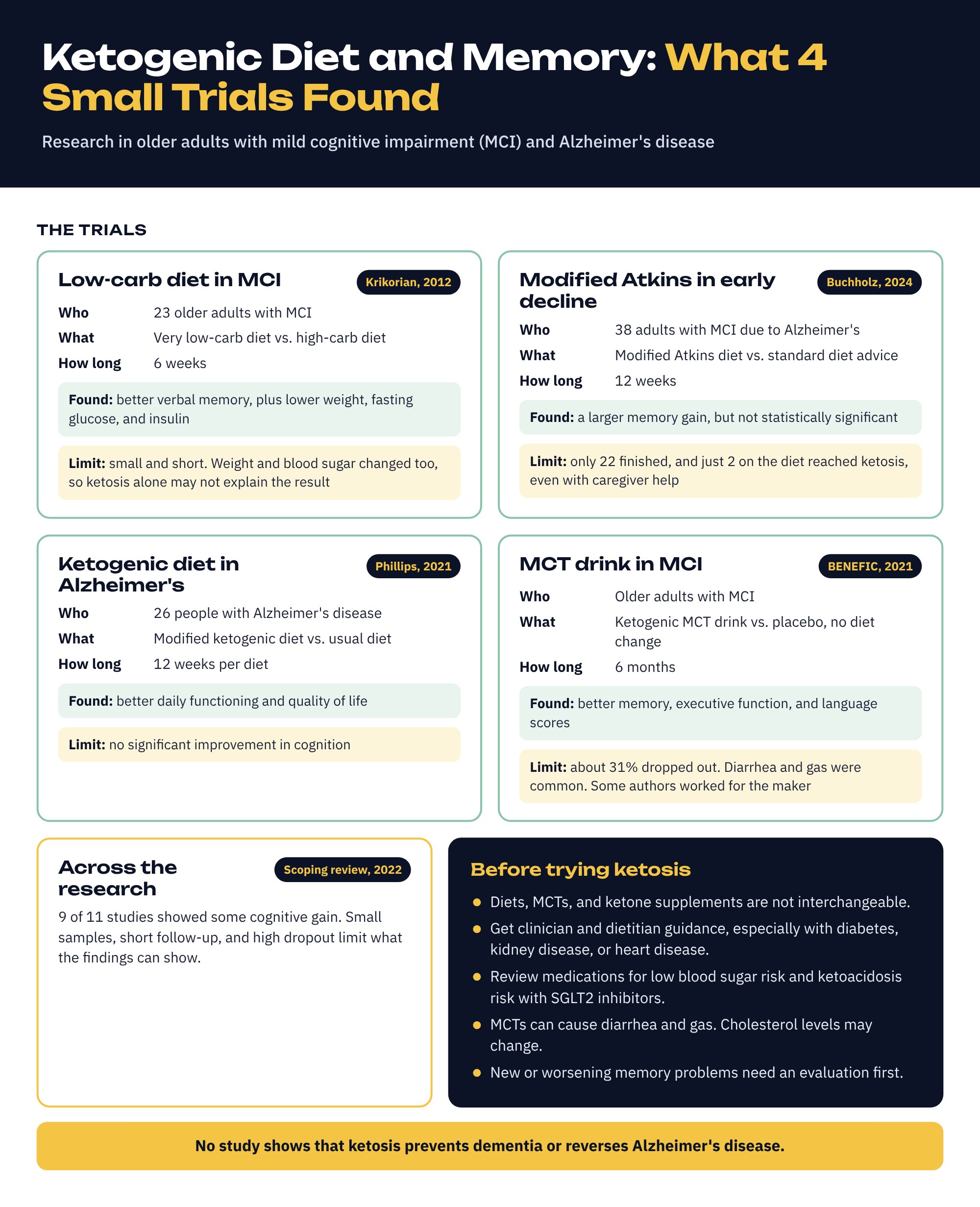
The infographic below compares four small trials on the ketogenic diet and memory in older adults.
 In the following video, neurologists Dean and Ayesha Sherzai review the research on the ketogenic diet and Alzheimer’s disease.
What Studies Show About the Ketogenic Diet and Memory
sbb-itb-23f89d4
Krikorian’s 6-Week Trial in Mild Cognitive Impairment
In a 2012 randomized trial, Robert Krikorian and colleagues studied 23 older adults with mild cognitive impairment (MCI). For 6 weeks, one group followed a very low-carbohydrate diet. The other group ate a high-carbohydrate diet. The researchers wanted to know whether ketosis would lead to a measurable change in memory.
Verbal Memory and Metabolic Results
Food diaries showed that both groups closely followed their diets. Urinary ketones increased in the low-carb group, confirming ketosis. Ketones were measured in urine, not blood.
The low-carb group showed greater improvement in verbal memory, and higher urinary ketone levels tracked with greater memory improvement. Participants in this group also lost weight and had reductions in waist circumference, fasting glucose, and fasting insulin.
Limits of a Small, Short Trial
The diet changed ketosis, body weight, and glucose-insulin control at the same time. As a result, the trial could not show that ketosis alone caused the memory improvement.
The 6-week result applies only to people with MCI.
Later trials tested similar ketosis-based approaches in early Alzheimer’s disease and with MCT supplementation.
Modified Atkins Pilot in Early Cognitive Impairment
Building on the earlier MCI trial, a Johns Hopkins team tested a modified Atkins diet. The control group followed National Institute on Aging diet guidance. The 12-week study enrolled 38 older adults with MCI due to Alzheimer’s disease. The researchers published the full results in 2024.
Memory Results and Adherence
The modified Atkins group showed a larger memory improvement than the control group. However, the difference wasn’t statistically significant. Only 22 of the 38 participants completed the study, and just 2 on the diet met the ketosis targets. The authors called it a feasibility study and urged caution in reading the memory results. The support participants received also matters when interpreting these findings.
Meal Preparation and Caregiver Support
Each participant lived with a cognitively intact partner who handled shopping, meal preparation, food records, and urine ketone testing. Both partners also received dietitian visits, manuals, sample menus, recipes, and guidance on reading food labels. Even with this support, few participants reached ketosis. That gap suggests the diet may be hard to follow in everyday life.
Other Randomized Trials and Research Reviews
Ketogenic Diet in Alzheimer’s Disease
In a 12-week crossover trial, Phillips and colleagues tested a modified ketogenic diet in 26 people with Alzheimer’s disease. Each person followed both the ketogenic diet and a usual diet, in random order. The ketogenic diet improved quality of life and daily functioning. Cognition, however, did not improve significantly.
MCT Supplementation in Mild Cognitive Impairment
The 6-month BENEFIC trial compared a ketogenic MCT drink with a placebo in older adults with MCI. Participants took 15 grams twice daily and didn’t have to restrict carbohydrates. The drink improved memory, executive function, and language scores. Some of these gains tracked with higher blood ketone levels.
About 31% of participants dropped out. Diarrhea and flatulence were the main side effects. Several authors worked for Nestlé, which makes the drink tested. Results across these trials varied for cognition, daily functioning, and how well participants could stick with treatment. That mix helps explain why research reviews remain cautious.
What Systematic Reviews Show
Systematic reviews suggest promise, not proof. A 2022 scoping review found cognitive improvement in 9 of 11 studies. However, small samples, differences in treatment, and dropout made the findings harder to interpret. Industry funded five of the studies. The trials were also short, leaving long-term benefits uncertain.
Study Limits, Safety, and Conclusions
Study Comparison and Differences in Response
The studies suggest a pattern, not a firm answer: earlier-stage disease and better adherence seem to matter most. These are different interventions, not a single treatment.
Each approach restricts food choices and carries risks, so safety deserves as much attention as the memory results.
Safety and Cognitive Evaluation
Get clinician and dietitian supervision before restricting carbohydrates or using MCTs or ketone supplements. This matters especially for older adults with diabetes, kidney disease, cardiovascular disease, or those taking glucose-lowering medication. A medication review should address low blood sugar. It should also cover the risk of ketoacidosis with SGLT2 inhibitors, a class of diabetes drugs. Ask whether starting MCTs slowly could reduce digestive symptoms. Cholesterol levels also need monitoring because ketogenic diets can raise them in some people.
New or worsening memory symptoms call for a cognitive evaluation before any diet change. Sleep problems, depression, medications, sensory loss, and vascular conditions can all affect cognition. A caregiver can help track symptoms, prepare meals, and monitor tolerance, but that support should not delay evaluation.
Ketogenic Diet and Memory: Short-Term Results Don’t Prove Prevention
Research on the ketogenic diet and memory is still early. Small samples, short follow-up, and adherence problems leave the findings uncertain. A better score over a few weeks does not necessarily mean greater daily independence or lasting changes in the disease. Individualized clinical care is a better choice than restrictive dieting without medical guidance.
Current findings do not show dementia prevention, Alzheimer’s reversal, or lasting protection after treatment ends.
Ready to Turn This Research Into a Real Plan?
Memory changes in older adults can have many causes, including depression, anxiety, sleep problems, and medication side effects. Many of these causes are treatable. Modyfi’s network of providers looks at the whole person, drawing on mind-body, functional, and integrative medicine. Your provider can review your medications and supplements, assess mood and sleep, and help you weigh dietary changes safely.
👉 Explore Providers to Book an Appointment and Start Your Care Plan
(Note: Modyfi proudly accepts most major commercial insurance plans. We do not accept Medicare or Medicaid.)
FAQs
Could my metabolic health affect memory benefits from ketosis?
It may. Some researchers think ketosis helps most when the brain has trouble using glucose, a problem called glucose hypometabolism. High insulin levels, or hyperinsulinemia, may also play a role. Ketones give the brain an alternative fuel source.
In the Krikorian trial, memory gains came with lower fasting insulin and glucose. That overlap makes it hard to separate the effect of ketosis from better metabolic health.
Have diabetes, prediabetes, or insulin resistance? Ask your clinician how a diet change could affect your medications and blood sugar.
How would I know if ketosis helps my memory?
Confirm ketosis with blood beta-hydroxybutyrate or urine ketone testing. Track memory and cognition over several weeks or months, and don’t expect immediate results. Standardized assessments, such as the MMSE or ADAS-Cog, can help measure changes.
Ask your clinician to repeat the same test before and after the change. Day-to-day shifts in focus or sleep can make a single score misleading. Also watch daily function, mood, and sleep. In one trial, daily functioning improved even though cognitive scores did not.
What should I ask my clinician before trying ketosis?
Your metabolic health, cognitive stage, and physical condition may affect how you respond to ketosis. Discuss these factors with your healthcare provider. Ask which approach best fits your needs: carbohydrate restriction, MCTs, or ketone esters.
Possible side effects include bloating or diarrhea. Ask whether a slower start could help you tolerate it better. Also discuss monitoring ketosis with blood beta-hydroxybutyrate measurements, rather than less sensitive urine tests.
Is a ketogenic diet safe for older adults?
It can be, with medical supervision. However, older adults face specific risks. Restrictive diets can lower fiber intake and cause constipation. They can also raise cholesterol in some people.
Medications add another layer of risk. Diabetes drugs can cause low blood sugar when carbohydrate intake drops. SGLT2 inhibitors also carry a risk of ketoacidosis.
A clinician and dietitian can help plan meals, review medications, and check lab work. Regular follow-up matters, especially in the first weeks.
Can MCT oil help with Alzheimer’s disease?
The evidence remains limited. Most MCT research involves people with mild cognitive impairment, not Alzheimer’s disease. In the largest trial, an MCT drink improved some memory and language scores over 6 months.
No study shows that MCTs slow or reverse Alzheimer’s disease. Diarrhea, gas, and stomach upset are common, especially at higher amounts.
Coconut oil contains some MCTs, but it differs from the purified MCT products used in trials. Talk with a clinician before adding MCTs, especially if you have liver or heart conditions.
Does a ketogenic diet help with depression or anxiety?
Research is still early. Small pilot studies have tested ketogenic diets in mood disorders, and some reported improvements. Larger, controlled trials are still needed.
This research is part of a growing field called metabolic psychiatry. It studies how blood sugar, insulin, and energy use in the brain affect mental health.
A ketogenic diet doesn’t replace therapy or prescribed medication. Anyone considering it for mood symptoms should plan it with a psychiatric provider.