


The strongest ADHD accommodations at work target a specific barrier, rather than the diagnosis alone. For example, that could mean written instructions, fewer interruptions, brief check-ins, or appointment flexibility. In adults, ADHD can affect focus, organization, and job performance.
Four steps can help:
- Match the support to the task. Explain what gets in the way and how the change would help.
- Contact HR or your supervisor. Make your request and confirm next steps in writing.
- Get documentation if needed. Ask about employer forms, then give your provider your job duties and requested supports.
- Protect your privacy and review results. Share only the medical information needed, keep records, and ask for changes if support falls short.
The federal law behind workplace accommodations, the Americans with Disabilities Act (ADA), applies to employers with 15 or more employees. Having ADHD doesn’t guarantee a specific change at work. Focus on what helps you do your job, and stay open to other options that work.
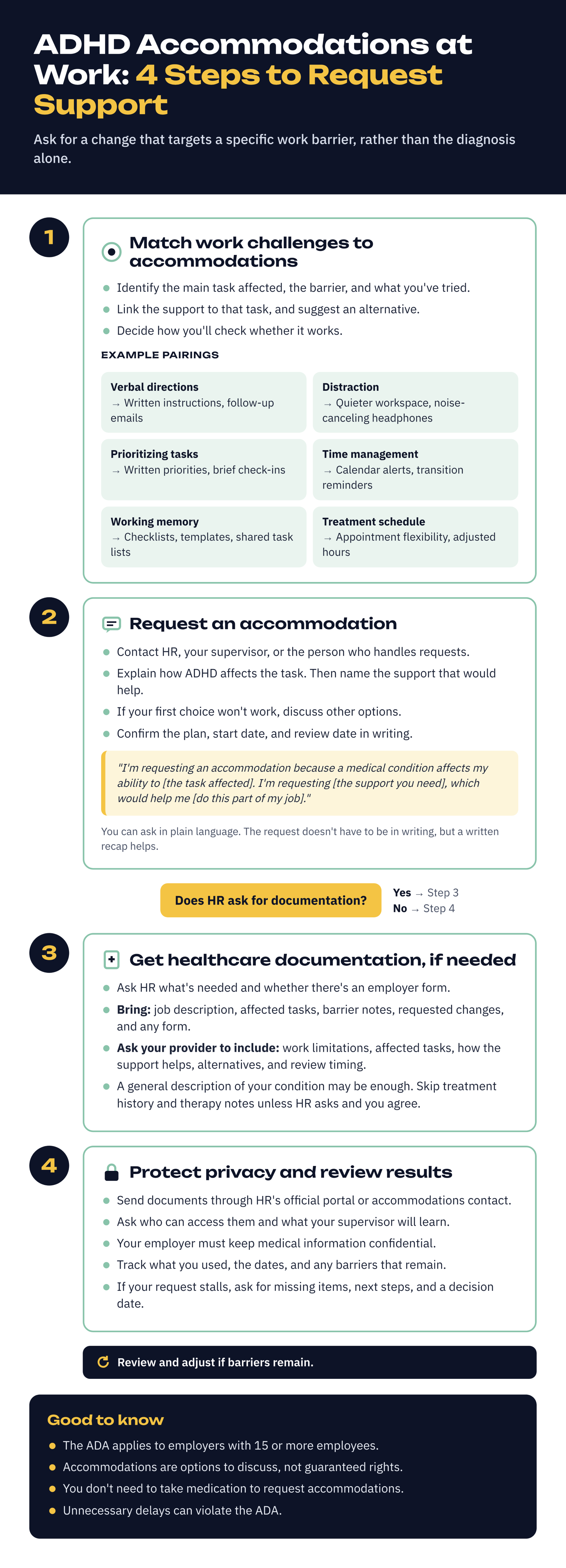
How to Request ADHD Accommodations at Work
The following Mayo Clinic video explains how ADHD can show up in adults.
sbb-itb-23f89d4
Step 1: Match Work Challenges to Accommodations
Start by turning one work barrier into a specific accommodation request.
First, review your job tasks. Then identify the main task affected, what gets in the way, what you’ve tried, and what result is at risk.
Common Work Challenges and Supports
The right fit depends on your job. Your employer may also suggest another option that works.
Match the barrier to the least disruptive support that keeps the task on track. The infographic above shows common ADHD-related challenges and supports people often request. In addition, the Job Accommodation Network lists more ideas by challenge.
These are options to discuss, not guaranteed rights. You don’t need to take medication to request accommodations. If you need appointment flexibility or leave, explain how often you’ll need it and for how long. Also explain who will cover your work while you’re away.
Prepare Your Request Checklist
Give your manager or HR contact enough detail to understand what needs to change. Keep the focus on the task, the barrier, and the support you need.
- Affected task: Name the main task and the result your employer expects.
Example: Accurate order processing. - Specific barrier: Describe when details get missed rather than listing every ADHD symptom.
Example: Verbal-only order changes during busy periods. - What you’ve already tried: Note the tools or habits you’ve used. List the barriers that remain and the supports that work.
- Requested adjustment and alternatives: Link the support to the affected task and suggest an alternative.
Example: Written order instructions to verify product numbers and quantities, or a shared order checklist. - Employer policy and contact: Find your employer’s accommodation steps, forms, and deadlines. Identify who handles requests: HR, your supervisor, or another contact.
- Medical information to share: Prepare a short description of how the limitation affects your work and what support you need. Your complete medical history isn’t necessary.
- How to check whether it works: Track the adjustment used, dates, affected duties, missed details or corrections, and remaining barriers. Use that record to discuss whether the support needs to change.
Step 2: Request an Accommodation
Connect the change you’re requesting to how your condition affects your work. Then use the match you made in Step 1 to draft your request. Under EEOC guidance, you can ask in plain language, and the request doesn’t have to be in writing. A written follow-up still helps you track the request and next steps.
- Contact the right person: Reach out to HR, your supervisor, or the person who handles accommodation requests.
- Explain the limitation and request: Describe how ADHD affects the task you chose in Step 1. Then name the support that would help.
- Discuss how it would work: Answer questions from HR or your supervisor. If your first choice won’t work, discuss other options.
- Send a written recap: Record the agreed adjustment, start date, and review date.
Use the format below to keep your request brief and specific.
Use This Sample Request
I’m requesting an accommodation because a medical condition affects my ability to [the task affected]. I’m requesting [the support you need], which would help me [do this part of my job]. I’d be glad to discuss other options and provide supporting documentation if needed.
Replace the bracketed text with your work function and requested support. Focus on the relevant work limitation and accommodation need. Ask where you can send supporting documentation privately.
Confirm the Plan and Timeline
Keep the written recap as your record of the agreement. Include the start date and the review date. At the review, check whether the original work barrier has improved.
If your employer requests supporting documents, the next step is to give your provider the job details they need.
Step 3: Get Healthcare Documentation
Before your appointment, ask HR what documentation you need and whether there’s an employer form. Under EEOC guidance, employers may ask for reasonable documentation when your condition or need for support isn’t obvious. Your healthcare provider can explain how your condition affects your work and why the requested support would help. If you don’t have a diagnosis yet, a psychiatric evaluation is usually the first step.
Your provider can write a stronger note when you bring the details below.
Bring Job Details and a Documentation Checklist
Bring your job description, affected duties, barrier notes, requested adjustments, and employer form. If your employer has a form, use it to help your provider answer the questions HR will review. The documentation must reflect your provider’s assessment of your individual needs. However, submitting it doesn’t guarantee approval.
Ask your provider to include:
- Provider name, credentials, contact details, date, and signature.
- Relevant medical facts and work limitations.
- Affected work activities and how the requested support would help.
- Recommendations, possible alternatives, and expected duration or review timing.
- Any required release authorization.
Give Your Provider a Writing Prompt
Please describe the functional limitations relevant to my job, the workplace activities they affect, and why the requested accommodation would help me perform essential duties. Please include only information necessary to evaluate the accommodation request.
Sample only: link working-memory limits during multistep verbal directions to written instructions and brief priority check-ins, with a six-month review.
Share Only the Medical Information Needed
Employers generally may not demand your full medical records or unrelated information. Leave out your diagnosis, treatment history, medication list, psychotherapy notes, and full chart unless specifically requested and authorized. If a request seems excessive, ask HR to explain in writing why the information is necessary.
Step 4: Protect Privacy and Review Results
After you submit your request and documentation, track how your employer handles the information. Also track whether the accommodation helps you do your work.
Submit Documents Privately and Keep Records
Send documents through HR’s official portal or the person who handles accommodation requests. Ask who will receive them, where HR will store them, and who can access them. Also ask what HR will tell your supervisor. Under the ADA, employers must keep medical information confidential, even from coworkers. They must also store it apart from your regular personnel file.
Tell coworkers only what they need to coordinate work. Keep a secure record of emails, start dates, changes, and review notes. Finally, store copies according to workplace policy, without removing confidential company information.
If the support isn’t working, document the problem and ask for a review.
Address Delays, Ineffective Support, or Retaliation
If your request stalls, ask HR for a written list of missing information. Ask for the next step and an estimated decision date. Also ask whether temporary support is available. EEOC guidance notes that unnecessary delays can violate the ADA.
Once support is in place, record what you used, when you used it, and which work barriers remain. Then ask for a review or an alternative that addresses those barriers. Confirm the adjustment, start date, responsible contact, and review date in writing.
If you suspect discrimination, unauthorized sharing, or retaliation for your request, save messages, dates, and other evidence. Report your concerns through HR. Get prompt advice from an employment attorney, an EEOC field office, or a disability rights organization. You generally have 180 calendar days to file a complaint, called a charge, with the EEOC. The deadline extends to 300 days when a state or local law also covers your employer. Federal employees follow a different process.
Get Accommodation Paperwork That Speaks HR’s Language
Formacist® by Modyfi Health helps you document how ADHD affects your work. Disability specialists work alongside your current providers to prepare an accommodation request HR can review. The focus stays on your tasks, your barriers, and the supports that may help.
👉 Start Your Workplace Accommodations Request
For providers: If patients ask you for accommodation paperwork, Formacist can prepare it with you. You keep the clinical judgment while Formacist handles the forms.
👉 See How Formacist Works With Providers
Need an ADHD evaluation or a treatment plan first? Modyfi’s network of providers looks at the whole person, drawing on mind-body, functional, and integrative medicine.
👉 Explore Providers to Book an Appointment and Start Your Care Plan
(Note: Modyfi proudly accepts most major commercial insurance plans. We do not accept Medicare or Medicaid.)
FAQs
Can I request ADHD accommodations after a poor performance review?
A poor performance review doesn’t prevent you from requesting accommodations. Many people only notice how ADHD affects their work after negative feedback.
Accommodations apply going forward. Your employer usually doesn’t have to erase a past review or discipline. It may still need to provide support that helps you meet expectations from now on.
Ask for support as soon as you connect the problem to ADHD. Waiting until a final warning leaves less time to show improvement.
Who can write my ADHD accommodation letter?
A licensed healthcare provider who knows your history can write it. That may include a psychiatrist, psychiatric nurse practitioner, psychologist, or primary care clinician.
Providers aren’t legally required to complete this paperwork. They use clinical judgment to decide whether it’s appropriate. Some may ask for a separate visit to review your job duties.
Bring your job description and any employer form. Clear job details help your provider explain how ADHD affects your work and which supports may help.
What if my employer has fewer than 15 employees?
The ADA’s workplace rules generally apply only to employers with 15 or more employees. That doesn’t always leave you without protection.
Many state and local laws cover smaller employers. Check your state’s fair employment agency for the rules where you work.
Even without a legal requirement, many small employers agree to simple, low-cost changes. A clear and specific request makes that easier.