


Last updated: November 10th , 2026. As of this update, the DEA has not published its final special registration rule or a fifth extension.
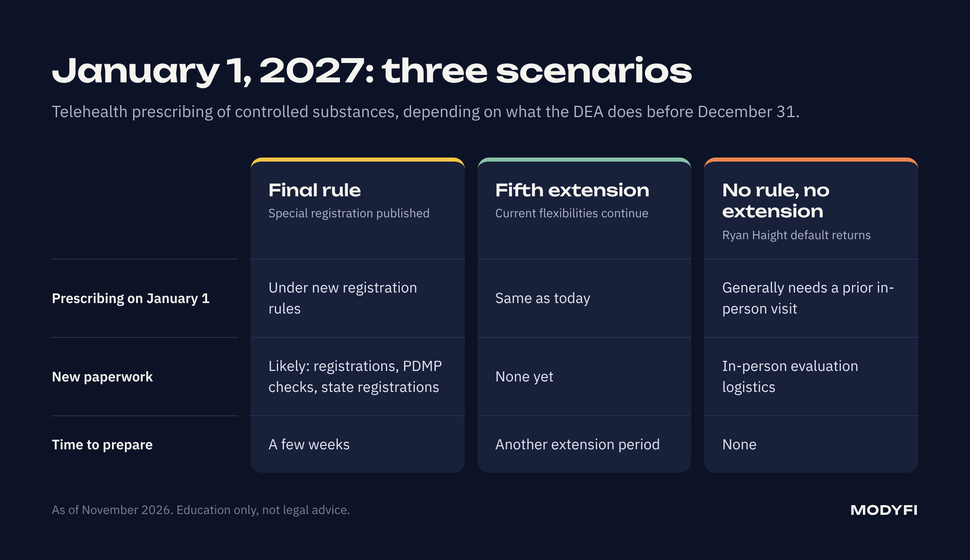
What the DEA telehealth rule looks like in 2027 depends on what happens before December 31. There are three possible scenarios: the DEA publishes its final special registration rule, it extends the current flexibilities a fifth time, or neither happens and the in-person evaluation requirement returns.
Each scenario asks something different of clinicians who prescribe by telehealth. Here is what each one would mean, and what you can do now that pays off in all three.
This article is for general information only and is not legal advice. Rules in this area can change quickly. Check the Federal Register or a health care attorney before making decisions about your practice.
Where things stand today
The current rules expire at the end of December 31, 2026, and the replacement is still not public.
- The current rule. The DEA’s fourth temporary extension runs from January 1 through December 31, 2026. It lets DEA-registered clinicians prescribe Schedule II–V medications by telehealth without a prior in-person visit.
- The proposed replacement. In January 2025, the DEA proposed Special Registrations for Telemedicine and Limited State Telemedicine Registrations. Comments closed in March 2025.
- The final version. On August 25, 2026, the DEA sent a final version to the White House for regulatory review. The federal regulatory agenda lists November 2026 for final action.
For background on the Ryan Haight Act and how we got here, read The Telehealth Cliff: what the DEA’s telemedicine rules could mean for PMHNPs and PAs.
Scenario 1: the DEA publishes the final rule
A permanent framework replaces the temporary flexibilities, likely with new registrations and new compliance steps.
The January 2025 proposal is the best preview. As proposed, it would require a special registration to prescribe by telehealth, a separate registration for each state where patients are located, and PDMP checks before prescribing. It would add tighter limits on Schedule II medications and, in some cases, registration for telehealth platforms.
What it would mean for you: a short window to read the rule, figure out what applies to your practice, and file. If the rule lands in late November, that window could be about six weeks, holidays included. The rule could also set its own effective date or a transition period. Until the text is public, every detail above is still a proposal.
Most affected: clinicians who prescribe stimulants by telehealth, see patients in several states, or prescribe through a platform that has to decide whether to register.
Scenario 2: the DEA extends the flexibilities a fifth time
The current rules stay in place for another period, and the clock resets.
The DEA has extended the flexibilities four times since 2023, and each extension came close to the deadline. A fifth extension could also arrive alongside a final rule, to give clinicians time to comply.
What it would mean for you: nothing changes on January 1. But an extension delays the rule, it does not cancel it. Clinicians who use the extra time to get their registrations, contracts and records in order will be ready for whatever comes next.
Most affected: no one immediately. The risk is treating a fifth extension as permanent, as many did with the first four.
Scenario 3: no rule and no extension
The Ryan Haight Act default returns, and prescribing a controlled substance by telehealth generally requires a prior in-person evaluation.
The DEA has sent a final rule for review and has extended the flexibilities four times, which makes this outcome less likely. It is also the most disruptive, because nothing would bridge the gap.
What it would mean for you: patients who started a controlled medication by telehealth and never had an in-person visit may need one before their next prescription. For a fully virtual practice, that becomes a scheduling and access problem.
Still in place either way: the separate final rules on buprenorphine for opioid use disorder and VA continuity of care took effect December 31, 2025. They do not depend on what happens with the broader flexibilities.
Most affected: fully virtual practices with patients on stimulants or benzodiazepines and no in-person evaluation on file.
At a glance
What to do now, whatever happens
The steps that protect your practice are the same in all three scenarios.
- Confirm the basics. Check that your DEA registration and state licenses are current, for every state where your patients are located.
- Know your patient mix. Count how many patients receive controlled medications without an in-person evaluation on file, and in which states they are.
- Ask your platform or employer for their January plan. If they prescribe through their systems, their decision shapes your schedule. Ask now, in writing.
- Know what you control. Your records, your payer contracts and the patient relationship decide how fast you can adapt. Individual credentialing commonly takes 30 to 180 days, so it pays to start before the rule lands.
- Watch the primary source. Follow the Federal Register and the DEA, not the news cycle.
Find out where you stand
How exposed is your practice? Our five-question self-audit takes about a minute, and your result appears right away. Take the self-audit →
The final rule could land any day. Get updates as it develops and the first invite to our next session. Keep me updated →
Want the full background? Watch the replay of The Telehealth Cliff, where Patrick Brown, PMHNP-BC, DipACLM, founder of Modyfi, walks through how we got here and a three-step plan you can start now.
Questions? Contact hello@modyfihealth.com.
FAQ
It depends on what the DEA does before December 31, 2026. It can publish its final special registration rule, extend the current flexibilities a fifth time, or do neither. As of November 10th, 2026, none of the three has happened.
No fifth extension has been announced. The DEA has extended the flexibilities four times since 2023, each close to the deadline. An extension could also come alongside a final rule, to give clinicians time to comply.
The federal regulatory agenda lists November 2026. The DEA sent the final rule to the White House for review on August 25, 2026. Its text will be public only once it appears in the Federal Register.
The Ryan Haight Act default returns. Prescribing a controlled substance by telehealth would generally require a prior in-person evaluation, with limited exceptions. The separate buprenorphine and VA rules stay in effect.
Confirm your DEA registration and state licenses, review which patients have no in-person evaluation on file, and ask your platform or employer about its January plan. The five-question self-audit shows how much of your practice you control today.
Talk with your prescribing clinician. They can tell you how any change would apply to your care. Don’t stop or change a medication on your own.