


When evaluating nutritional psychiatry, asking if creatine for mental health is backed by evidence reveals fascinating clinical insights. Research shows that creatine isn’t just for athletes—it plays a vital role in supporting brain energy, stabilizing mood disorders like depression, and boosting cognitive function under severe stress.
Here’s what you need to know:
- How it works: Creatine helps the brain replenish energy (ATP) quickly, which is vital for mental and emotional health.
- Mood disorders: Studies suggest creatine may enhance antidepressant effects, particularly in women, and could help with PTSD. However, it may pose risks for people with bipolar disorder.
- Cognition: Creatine can improve memory, attention, and processing speed, especially during sleep deprivation or in older adults.
- Safety: Generally safe at doses of 3–5 g/day, but consult a doctor if you have kidney issues or bipolar disorder.
While promising, creatine works best alongside treatments like therapy or medication. Always consult a healthcare provider before starting supplementation.
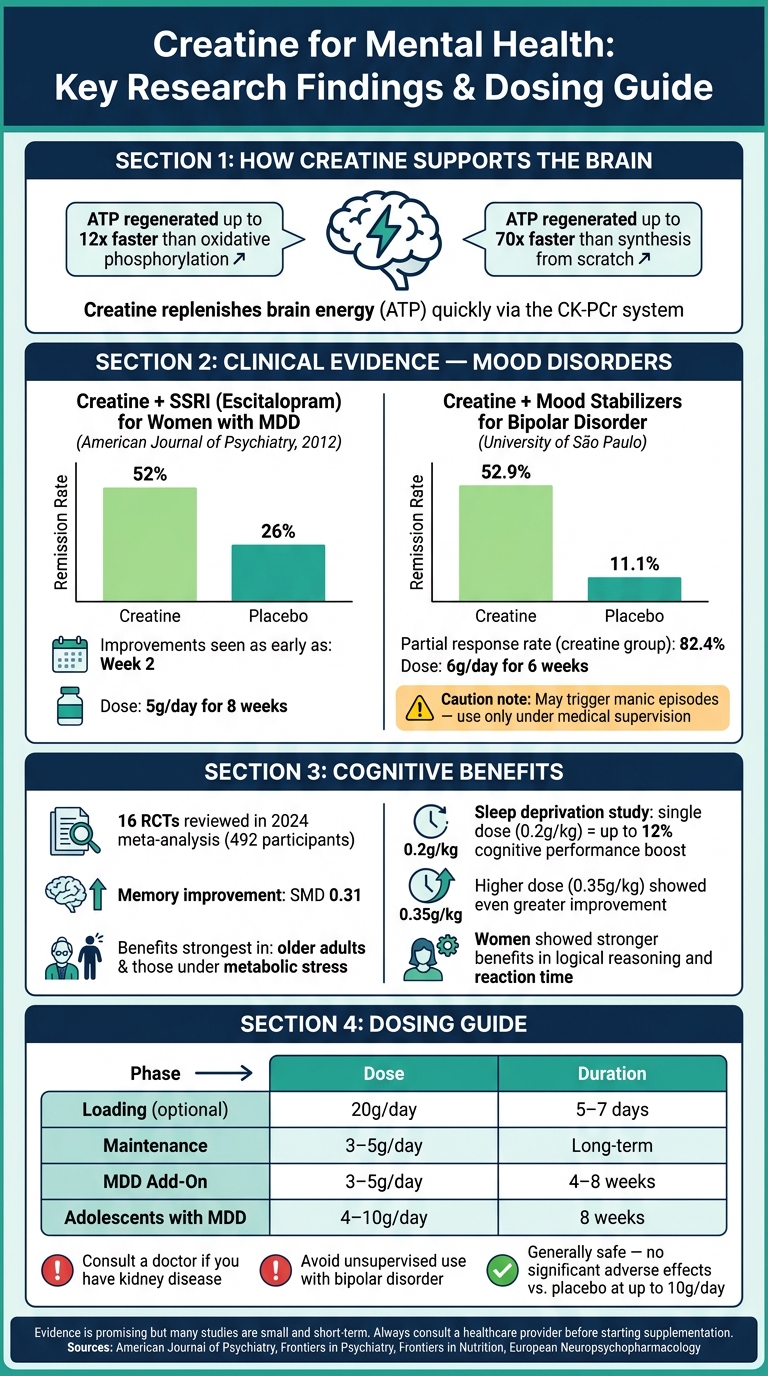
Creatine for Mental Health: Key Research Findings & Dosing Guide
Creatine and Brain Energy: The Basics
What Is Creatine?
Creatine is a compound naturally found in vertebrates. Your body primarily produces it in the liver and kidneys using three amino acids: arginine, glycine, and methionine. About half of your creatine comes from internal production, while the other half comes from dietary sources like meat and fish.
Once it’s produced or consumed, creatine is stored in two forms: free creatine and phosphocreatine (PCr). Most of it – around 95% – is stored in skeletal muscles, while the remaining 5% is distributed in the brain and bone tissue.
How the Brain Uses Energy and Where Creatine Fits In
The brain is one of the most energy-demanding organs in your body, relying almost entirely on adenosine triphosphate (ATP) to fuel all its functions. Since ATP can’t be stored in large amounts, the brain needs a quick way to replenish it when energy demands spike.
This is where creatine steps in. Through the creatine kinase-phosphocreatine (CK-PCr) system, creatine serves as an energy reserve. When ATP levels drop, phosphocreatine donates a phosphate group to regenerate ATP quickly – up to 12 times faster than oxidative phosphorylation and 70 times faster than creating ATP from scratch.
“The creatine-kinase-PCr system serves as a buffer for ATP homeostasis when rates of synthesis are greater than the rates of consumption and stores energy as PCr.” – Frontiers in Psychiatry
Since this system is essential for maintaining cellular energy, disruptions in it could play a role in mental health challenges.
The Case for Creatine as a Mental Health Support
The link between brain energy and mental health is becoming a focus in psychiatric research. Studies have shown that individuals with conditions like major depressive disorder (MDD) or PTSD often have lower levels of brain creatine or phosphocreatine. These energy deficits are increasingly associated with mental health conditions such as MDD, anxiety disorders, and PTSD.
Supplementing with oral creatine has been found to boost brain creatine levels and improve the PCr/ATP ratio, especially in areas of the brain with lower energy reserves. One clinical study demonstrated that taking 0.3 g/kg/day of creatine monohydrate significantly increased brain creatine levels in healthy individuals within just seven days. If reduced energy availability in the brain contributes to mood and cognitive issues, enhancing ATP replenishment with creatine could be a promising way to address these symptoms.
Next, we’ll dive into clinical studies that explore how creatine may help alleviate mood disorder symptoms.
sbb-itb-23f89d4
What the Research Shows: Creatine and Mood Disorders
Creatine and Major Depression
Research highlights creatine’s potential in addressing major depressive disorder (MDD). A study published in the American Journal of Psychiatry (2012) explored the effects of adding 5g/day of creatine monohydrate to escitalopram treatment in 52 women with MDD. The results were striking: the creatine group saw a 52% remission rate at 8 weeks, compared to just 26% in the placebo group. Improvements were noticeable as early as week 2.
“The current study suggests that creatine augmentation of SSRI treatment may be a promising therapeutic approach that exhibits more rapid and efficacious responses in women with major depressive disorder.” – American Journal of Psychiatry
Animal studies and clinical trials consistently show stronger responses in women. These findings are supported by changes in frontal lobe phosphocreatine (PCr) levels and significant reductions in PHQ-9 scores with doses ranging from 5g to 10g/day. A more recent study in European Neuropsychopharmacology (2025) also found that combining creatine with Cognitive Behavioral Therapy (CBT) led to a mean PHQ-9 reduction of 5.12 points by week 8, compared to CBT with a placebo.
While these results are encouraging, the research on creatine’s role in bipolar disorder presents a more nuanced picture.
Bipolar Disorder: Possible Benefits and Known Risks
Creatine may help reduce depressive symptoms in bipolar disorder, but it also presents certain risks. In a 6-week randomized trial conducted at the University of São Paulo, 35 patients with bipolar I or II disorder were given 6g/day of creatine alongside standard mood stabilizers. The creatine group achieved a 52.9% remission rate, compared to 11.1% in the placebo group, with 82.4% showing a partial response (defined as a ≥25% symptom reduction).
However, creatine’s energy-boosting effects can sometimes trigger manic or hypomanic episodes in individuals with bipolar disorder. This risk suggests that creatine could exacerbate an underlying “biphasic” energy imbalance in the brain. As a result, careful dosing and monitoring are critical when considering creatine for this population.
Beyond mood disorders, creatine’s role in managing stress-related conditions offers additional insights into its effects on brain energy regulation.
Stress-Related Conditions and PTSD
Neuroimaging studies have identified lower creatine levels in the dorsal anterior cingulate cortex (ACC) and hippocampus of individuals with PTSD. These brain regions are crucial for emotional regulation and responding to threats. A direct correlation exists between reduced creatine levels in the ACC and higher arousal scores, linking energy deficits to the hyperarousal symptoms seen in PTSD. Preclinical studies further reinforce this connection, showing that stress exposure reduces creatine levels in frontal brain regions.
Although large-scale human trials on PTSD and creatine are still limited, the neuroimaging evidence provides a strong foundation for exploring creatine’s ability to restore brain energy. These findings align with the broader understanding of how creatine supports energy metabolism in mental health.
Creatine and Mental Health
Creatine and Cognitive Function: What Studies Show
Creatine’s ability to replenish ATP doesn’t just impact mood regulation – it also shows promise in improving cognitive function. By stabilizing brain energy levels, creatine may enhance various cognitive processes across different groups and conditions.
Cognitive Effects in Healthy Adults and Older Populations
The brain is an energy-intensive organ, consuming about 20% of the body’s resting energy. This makes it particularly sensitive to changes in energy availability. Creatine, by quickly regenerating ATP, supports neuronal communication and information processing.
A 2024 meta-analysis reviewed 16 randomized controlled trials involving 492 participants and found measurable improvements in memory (SMD 0.31), attention, and processing speed. Chen Xu, a researcher from Frontiers in Nutrition, highlighted these findings:
“Creatine supplementation may confer beneficial effects on cognitive function in adults, particularly in the domains of memory, attention time, and information processing speed.” – Chen Xu
Older adults and those with certain health conditions appeared to benefit more than younger, healthy males. However, the European Food Safety Authority (EFSA) stated in 2024 that the evidence does not yet justify a formal health claim for cognitive enhancement in the general healthy population.
Interestingly, creatine’s cognitive benefits become even more noticeable when the brain is under stress.
Cognitive Performance Under Stress
When the brain faces metabolic stress – like sleep deprivation – its need for rapid ATP recycling increases. This is where creatine seems to shine.
A study conducted by Ali Gordji-Nejad at Germany’s Institute of Neuroscience and Medicine examined 29 healthy participants after 21 hours of sleep deprivation. A single dose of 0.2 g/kg of creatine monohydrate significantly reduced declines in logical reasoning, numerical tasks, language processing speed, and Psychomotor Vigilance Test (PVT) performance, providing a 12% performance boost. Even better results were observed with a higher dose of 0.35 g/kg. Gordji-Nejad and his team noted:
“Our results show that a dose of 0.2 g/kg creatine is associated with a reduced deterioration in cognitive performance during sleep deprivation. Although the effect is less pronounced than with a high dose of 0.35 g/kg, there is still an improvement of up to 12%.” – Ali Gordji-Nejad
Another study from 2006 at University College Chichester found that 19 participants who took 20 g of creatine daily for seven days before 24 hours of sleep deprivation performed better in reaction time, physical balance, and mood assessments compared to those on a placebo. Interestingly, women consistently showed stronger benefits in logical reasoning and reaction time tasks.
Traumatic Brain Injury and Neurodegeneration
Emerging research suggests that creatine might have neuroprotective effects. It appears to reduce oxidative stress caused by reactive oxygen species (ROS) and mitigate damage from glutamate and amyloid-β, both of which are linked to brain cell damage in injuries and neurodegenerative diseases. Creatine also supports mitochondrial function, often impaired in neurodegenerative conditions.
| Condition | Observed Evidence | Certainty |
|---|---|---|
| Traumatic Brain Injury (TBI) | Early clinical evidence suggests benefit | Early/Preliminary |
| Alzheimer’s Disease | May reduce amyloid-β toxicity and oxidative stress | Preliminary |
| Parkinson’s Disease | Mixed results; limited cognitive benefit in patients with MCI | Inconsistent |
| Creatine Deficiency Syndromes | Supplementation can reverse profound intellectual disability | Strong |
In cases of Cerebral Creatine Deficiency Syndromes, where the brain struggles to synthesize or transport creatine, supplementation can reverse severe intellectual disabilities. For more widespread conditions like Alzheimer’s and Parkinson’s, the evidence is still in its early stages. However, the idea of restoring ATP reserves in the brain continues to drive research in this field.
Dosing, Safety, and How Creatine Works in the Brain
How Creatine May Support Mental Health
When the brain’s energy balance is disrupted – whether by stress, illness, or poor sleep – it can take a toll on mental health. Creatine may help by restoring this balance and influencing how neurotransmitters, like glutamate, are taken up by neurons. Glutamate is closely linked to mood regulation, and phosphomonoesters (PME) along with phosphocreatine (PCr) play a role in managing its uptake. Studies using 31P-MRS imaging have shown that oral creatine supplementation boosts PCr levels in the frontal lobe, an area tied to mood control. Higher PCr levels in this region have been associated with lower depression scores.
“The creatine-kinase-PCr system plays a vital role in ensuring that neurons have sufficient energetic reserves to meet the demands of healthy brain function.” – Frontiers in Psychiatry
By understanding how creatine supports brain energy and neurotransmitter activity, we can better explore how to use it effectively for mental health.
Dosage and Supplementation Protocols
When it comes to mental health, creatine dosing differs slightly from the protocols used for athletic performance. Here’s a quick look at findings from research across various groups:
| Population | Dosage | Duration | Key Finding |
|---|---|---|---|
| Healthy Adults | 3–5 g/day | Long-term | Safe for extended use; supports cognitive and muscle function |
| Adults with MDD | 3–5 g/day | 4–8 weeks | Works well as an add-on to SSRIs; shows effectiveness over 8 weeks |
| Adolescents with MDD | 4–10 g/day | 8 weeks | Reduces symptoms significantly; raises frontal lobe PCr levels |
| Loading Phase | 20 g/day | 5–7 days | Quickly increases tissue saturation |
A typical strategy involves starting with a loading phase – 20 g/day (or 0.3 g/kg/day) for 5–7 days – to rapidly saturate tissues. Afterward, a maintenance dose of 3–5 g/day is generally recommended. For mood disorders, sticking to a low-dose regimen for at least eight weeks is key to seeing meaningful results.
Safety Profile and Special Populations
Creatine has been studied extensively and is considered safe. Even at doses as high as 10 g/day, research has found no notable differences in adverse effects, weight gain, or serum creatinine levels compared to a placebo. However, a few groups should proceed with caution:
- Individuals with kidney conditions: Those with pre-existing kidney issues should consult a healthcare provider before using creatine. Most studies have excluded participants with elevated serum creatinine or renal disease.
- People with bipolar disorder: Creatine may increase the risk of hypomania or mania in this group, so it should only be used under medical supervision.
Interestingly, women may experience a stronger benefit from creatine than men. Research suggests an inverse relationship between dietary creatine intake and depression in women, possibly due to hormonal effects on creatine kinase activity.
“Creatine supplementation may offer a safe and biologically plausible adjunct to traditional treatments for MDD, with particular relevance for women.” – Frontiers in Psychiatry
Using Creatine as Part of a Broader Mental Health Plan
Creatine as an Add-On to Standard Psychiatric Care
Creatine works alongside standard treatments rather than replacing them. When combined with selective serotonin reuptake inhibitors (SSRIs) or cognitive behavioral therapy (CBT), it can improve treatment outcomes. For instance, a pilot study revealed that adding creatine led to a reduction of 5.12 points in PHQ-9 scores compared to a placebo group. Another study found that pairing creatine with SSRIs like escitalopram resulted in noticeable improvements for some patients as early as two weeks into treatment.
“Creatine appears better than placebo in increasing the antidepressant efficacy of CBT.” – European Neuropsychopharmacology
By targeting bioenergetic deficits, creatine may help manage a variety of mental health conditions. This builds on earlier research about its role in stabilizing brain energy levels.
Personalized Assessment and Care at Modyfi Health
At Modyfi Health, we closely analyze the emerging science of creatine for mental health to identify who might benefit most from bioenergetic brain support—particularly women with treatment-resistant depression or individuals with dietary restrictions like vegans and vegetarians.
Our collaborative team of board-certified psychiatrists, specialized therapists, and clinical nutritionists operates within a unified virtual care model. Rather than implementing general supplement regimens, we perform careful renal screening, dietary history, and diagnostic reviews to ensure complete safety, especially for populations requiring strict medical monitoring, such as those with a history of bipolar disorder. We turn these precise baseline findings into a personalized care strategy that blends metabolic support with targeted psychiatric treatments.
Modyfi Health provides comprehensive telehealth services across Maryland, DC, Virginia, and Delaware, and accepts most major insurance plans.
👉 Schedule your FREE discovery call with Modyfi Health today to co-create an integrated care plan tailored directly to your biological and mental wellness needs
Research Gaps and Next Steps
Although the current evidence supporting creatine’s role in mental health is encouraging, more research is needed. Many studies so far have been small in scale and limited to short durations – typically eight weeks or less – leaving questions about long-term safety and dosing unanswered. While some studies suggest a high-dose loading phase (20 g/day for a short period), others report success with consistent lower doses (3–5 g/day over several months).
Another area requiring exploration is the development of tools to predict treatment responses. Biomarkers, such as frontal lobe phosphocreatine levels measured through MRS imaging, show promise but are not yet widely available in clinical practice. Larger, longer-term, and more diverse clinical trials will be crucial to fully understand creatine’s potential and establish its role as part of standard psychiatric care.
“Creatine appears safe and shows promise for improving mental health symptoms when paired with first-line treatments.” – Bassam Jeryous Fares, Researcher
Conclusion: Is Creatine a Viable Option for Mental Health?
The short answer is yes – but with some important considerations. While the evidence is promising, creatine isn’t a magic bullet. It’s most effective when used alongside proven treatments like SSRIs, SNRIs, or cognitive behavioral therapy (CBT).
Certain groups seem to benefit the most from creatine supplementation. Research suggests it may be particularly helpful for women dealing with treatment-resistant depression, vegetarians and vegans with naturally lower creatine levels, and individuals recovering from methamphetamine dependence. A meta-analysis of randomized controlled trials also highlights its potential beyond just improving mood. However, many studies so far have been small and short-term, so there’s still more to learn.
“Creatine supplementation may offer a safe and biologically plausible adjunct to traditional treatments for MDD, with particular relevance for women.” – Frontiers in Psychiatry
For those considering creatine, creatine monohydrate at a daily dose of 3–5 grams is the most researched and affordable option. Look for products that have third-party verification from organizations like NSF International or the U.S. Pharmacopeia.
It’s essential to consult a healthcare provider before adding creatine to your routine. This is especially important if you have kidney disease, a history of bipolar disorder, or are pregnant or breastfeeding. A personalized assessment that considers your diet, medications, and mental health history can help determine whether creatine is a good fit for your treatment plan. When used thoughtfully, creatine can be part of a broader mental health strategy.
FAQs
How fast could creatine affect mood or brain function?
Research indicates that noticeable shifts in mood or brain function from taking creatine supplements usually take about 4 to 8 weeks of regular use. Although a single large dose might temporarily raise total brain creatine levels for up to 8.5 hours, meaningful changes in specific areas of the brain typically emerge after a month of consistent supplementation. Creatine works as a steady, long-term way to support brain energy metabolism and improve neuroplasticity, rather than offering instant results.
Can creatine trigger mania if I have bipolar disorder?
Research indicates that people with bipolar disorder should approach creatine supplementation carefully. Although it’s being explored as a possible treatment for bipolar depression, some clinical trials have noted instances where participants developed symptoms of hypomania or mania. To reduce any potential risks, it’s essential to talk to a healthcare provider before starting creatine. They can evaluate whether it’s a safe and suitable option based on your mental health needs.
Should I use a loading phase or just 3–5 g a day?
When it comes to creatine, you don’t need a loading phase to see results. Taking 3–5 grams daily is a straightforward and effective method, though it takes about 3–4 weeks to fully saturate your muscles. If you’re looking for quicker results, a loading phase – consuming 20 grams per day for 5–7 days – can speed up saturation. However, this approach might be a bit rough on your stomach. Since both methods ultimately work, many people prefer sticking to the consistent 3–5 grams per day, as it’s easier to manage and gentler on the body.