


Every caregiver wants to guide their children safely through life, but the way we choose to guide them matters deeply. Research clearly shows that our day-to-day discipline methods directly affect children’s mental health and emotional development for years to come.
Studies highlight that harsh approaches—like physical punishment or constant yelling—are closely linked to higher rates of childhood anxiety, depression, and aggressive behavior. On the flip side, positive methods such as calm reasoning and emotion coaching naturally encourage long-term self-regulation and emotional resilience.
Real Insights for Modern Parenting
Navigating family life is never an exact science, but understanding the biological connection between discipline and mental health gives us a clear roadmap. Scientific data offers three core takeaways for parents:
-
The Risks of Harshness: Punitive discipline significantly increases the risk of depression, aggression, and hidden internalizing symptoms in kids.
-
The Power of Positivity: Using gentle boundaries directly improves a child’s emotional skills, daily self-control, and overall academic performance.
-
The Impact of Stress: Everyday parenting stress and external world challenges can accidentally amplify the negative effects of harsh methods.
Let’s explore how different discipline styles shape your child’s cognitive growth and long-term mental health. We will also share actionable, research-backed strategies—like Parent Management Training (PMT)—to help you create a calmer, healthier environment at home today.
Emotional Regulation and Positive Discipline
sbb-itb-23f89d4
Discipline Styles: Definitions and Overview
At its core, discipline simply refers to the everyday methods caregivers use to guide their children’s behavior. These approaches can range from gentle, non-physical strategies to more traditional or coercive methods, each carrying its own distinct goals and characteristics.
To help make sense of it all, let’s break down the major categories highlighted in modern developmental research.
Physical Discipline and Corporal Punishment
Physical discipline involves applying physical force—such as spanking, slapping, shaking, or striking with objects—to control how a child acts. Researchers often define spanking specifically as a form of physical punishment intended to cause a mild degree of pain without resulting in actual harm or physical injury.
The primary goal of this approach is immediate compliance. It relies on a direct assertion of parental authority rather than building a long-term understanding of why a rule exists.
Even though science shows the risks involved, physical punishment remains surprisingly common. In the United States, forty-nine percent of parents reported spanking a child between the ages of zero and nine within the past year. Additionally, eighty percent of mothers of six-year-olds admitted to using spanking at some point in their child’s life.
Despite how common it still is in many households, corporal punishment has already been completely banned in all settings, including the home, in over sixty countries worldwide. According to the World Health Organization (WHO) Corporal Punishment Report, these global bans are critical because physical discipline actively undermines a child’s psychological safety, emotional regulation, and healthy brain development.
Harsh Verbal and Psychological Discipline
Harsh verbal discipline includes yelling, shouting, name-calling (e.g., “lazy” or “dumb”), swearing, and other hostile responses to misbehavior. It reflects a parent’s dysregulated reaction to a child’s actions.
Psychological control, while not involving physical contact, manipulates a child’s emotions and thoughts to influence behavior. Two common tactics include:
- Guilt induction: Making the child feel responsible for a parent’s distress (e.g., “You’re making me look bad”).
- Shame induction: Undermining the child’s sense of self-worth to provoke feelings of inadequacy.
Research highlights that these strategies “hinder children’s autonomy and independent expression”.
Positive Discipline and Child Mental Health
Positive discipline takes a completely different route. Instead of relying on fear or emotional manipulation, it focuses heavily on reasoning, warmth, and positive reinforcement.
Central to this supportive method is inductive reasoning. This simply means taking the time to explain why a certain behavior is unacceptable, rather than just hand out an arbitrary punishment.
This is often paired with emotion coaching, a powerful tool where parents help children recognize, name, and process their feelings rather than suppress them. Together, these methods aim to develop long-term self-regulation and true emotional competence, rather than focusing solely on immediate compliance.
What Research Shows: Discipline Styles and Mental Health Outcomes
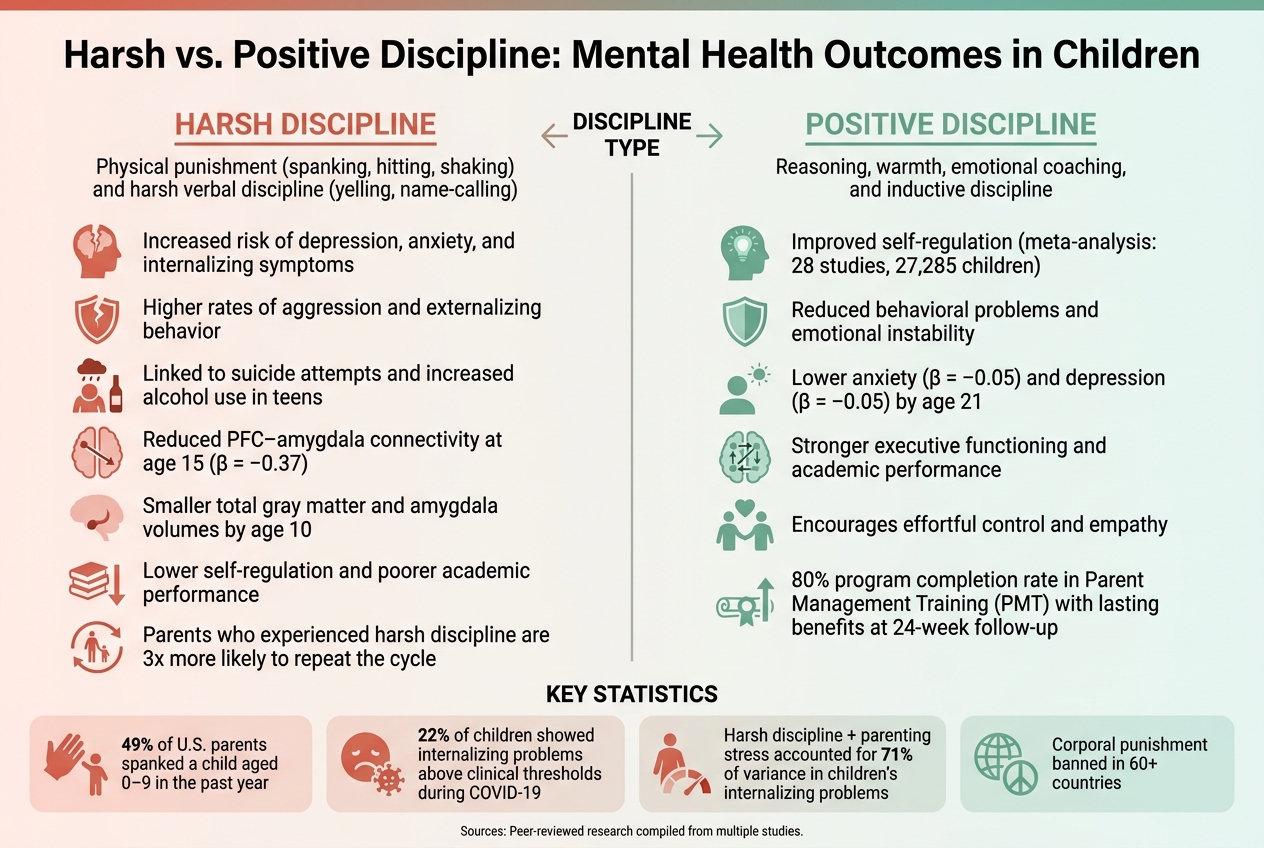
Harsh vs. Positive Discipline: Mental Health Outcomes in Children
Research highlights how parental discipline methods significantly impact children’s mental health, emotional growth, and long-term well-being. Studies across various cultures and age groups reveal consistent patterns tied to the type of discipline used. Ultimately, understanding the direct link between discipline and mental health gives us a clear roadmap for healthier parenting.
Both physical punishment and harsh verbal discipline are closely tied to internalizing symptoms like anxiety and depression. They also trigger externalizing symptoms, which include direct aggression and behavioral delinquency.
Even when a parent avoids physical contact, regular shouting or hostile responses significantly heighten a child’s risk of emotional challenges.
Mental Health Risks Linked to Physical and Harsh Discipline
Both physical punishment and harsh verbal discipline are closely associated with internalizing symptoms like anxiety and depression, as well as externalizing symptoms such as aggression and delinquency. These effects have been observed across different cultural contexts. Notably, even harsh verbal discipline—without any physical punishment—heightens a child’s risk of depression and other psychological challenges.
Understanding this direct connection between discipline and mental health became even more critical recently; for instance, the COVID-19 pandemic added another layer of stress, with 22.0% of children showing internalizing problems above clinical thresholds. In low-income households, the use of harsh discipline by both parents leads to an increase in externalizing behaviors. Even when just one parent employs harsh methods, it can counteract the benefits of positive discipline from the other parent.
Associated Mental Health Risks by Discipline Profile
-
Low Disciplinary Control (reasoning, natural consequences): Lowest risk for depressive symptoms and alcohol use.
-
Non-Physical / Harsh Verbal (yelling, insults, withdrawal of privileges): Higher depression, increased alcohol use, and suicide attempts.
-
Coercive / Physical (hitting, shaking, corporal punishment): Highest risk for aggression, depression, and suicide attempts.
These direct risk profiles are strongly backed by clinical data. According to a landmark study published in Current Psychology, the use of coercive disciplinary methods—characterized by severe physical punishment and harsh psychological control—adversely affects the long-term mental health of adolescents. The research confirms that these punitive styles are heavily tied to the development of depressive symptoms, future suicide attempts, and early alcohol consumption.
Discipline and Mental Health: Fostering Emotional Development
Unlike harsh methods, positive discipline plays a key role in fostering self-regulation and emotional resilience, which are crucial for a child’s mental health. A meta-analysis of twenty-eight studies involving 27,285 children and caregivers found that positive discipline is consistently linked to higher self-regulation in children aged two to five. This improved self-regulation reduces behavioral problems and promotes emotional stability over time.
Authoritative parenting – a style that blends warmth with clear boundaries – emerges as a particularly effective approach. A study in BMC Psychology explains:
“The authoritative style stands out as a significant protective factor against behavioral problems in preschoolers and is strongly associated with positive developmental outcomes.”
This parenting style helps children avoid negative emotional responses, such as venting or passive coping, and instead encourages effortful control—the ability to manage attention and curb impulsive reactions. These skills contribute to healthier relationships and greater emotional resilience as children grow.
Effects on Cognitive Development and Academic Performance
The connection between discipline and mental health goes beyond emotional well-being; your guiding style also shapes cognitive and academic outcomes. Early childhood, particularly between ages two and five, is a crucial period for developing self-regulation systems. During this time, the nature of parental discipline can either support or hinder a child’s cognitive readiness and academic path.
“Early childhood is essential for the rapid development of self-regulation systems, shaped by brain maturation and parental discipline. Inadequate discipline can hinder this development, leading to behavioral, social, and long-term negative outcomes.”
Harsh discipline has been repeatedly linked to lower self-regulation and poorer academic performance. In contrast, positive discipline nurtures the executive functioning skills children need to focus, follow instructions, and succeed in learning environments.
Research also shows that traits like attention span and persistence—shaped by early disciplinary practices—are strong predictors of educational success, even into adulthood.
Socioeconomic factors also come into play. Mothers with higher education levels are more likely to use non-physical disciplinary methods, which are tied to better cognitive outcomes for their children. This underscores the importance of making evidence-based parenting resources available to families across all income levels.
Long-Term and Intergenerational Effects of Discipline Practices
Discipline doesn’t just shape childhood – it leaves a mark on brain development, mental health, and even the way individuals parent their own children years down the line.
Discipline and Mental Health Outcomes in Adolescence and Adulthood
The influence of early discipline often continues into adolescence and beyond. A twenty-one-year study of 173 youths from Detroit, Toledo, and Chicago, published in the leading psychiatric journal Development and Psychopathology, highlighted this deep connection. The research found that harsh psychological aggression at age nine led to reduced PFC–amygdala connectivity at age fifteen—a crucial neural pathway for managing emotional stress.
On the flip side, warm parenting during middle childhood was linked to lower levels of anxiety and depression by age twenty-one.
Harsh discipline doesn’t just affect the brain; it also impacts behavior. Adolescents exposed to harsh discipline often show more internalizing symptoms and behavioral challenges. This can create a cycle, where harsh discipline leads to difficult behavior, which then provokes even harsher responses from parents. These patterns lay the groundwork for understanding the physiological changes tied to these experiences.
Chronic Stress, Brain Development, and the Intergenerational Cycle
How Harsh Discipline Impacts Brain Development and Mental Health
Repeated exposure to harsh environments can overstimulate a child’s stress-response systems, leading to chronic stress. This persistent stress can cause wear and tear on multiple physiological systems—often referred to as allostatic load. It can also disrupt the body’s natural stress hormone regulation (known as the hypothalamic-pituitary-adrenal, or HPA axis).
These physiological changes can have direct consequences for brain development. For instance, data from the Generation R Study in the Netherlands showed that maternal harsh parenting during early childhood was associated with smaller total gray matter and smaller amygdala volumes by age ten. These findings suggest that the emotional strain of harsh parenting can alter crucial brain structures.
Furthermore, these patterns often repeat across generations. Studies show that parents who experienced harsh discipline or neglect in their own childhoods are three times more likely to use coercive discipline practices with their own children. This highlights the intergenerational transmission of parenting styles and emphasizes the need for interventions to break this cycle.
Cultural and Socioeconomic Factors in Discipline
Discipline practices do not occur in a vacuum; they are heavily influenced by cultural and socioeconomic factors. Research shows that maternal education levels play a significant role in the choice of discipline methods. Mothers with higher education are more likely to use non-physical disciplinary methods, which are associated with better cognitive outcomes for children.
Conversely, economic hardship and parenting stress can increase the likelihood of harsh discipline. In low-income households, the negative effects of harsh discipline may be amplified, particularly when both parents use coercive methods.
However, the presence of positive parenting practices can serve as a vital buffer, helping to protect children from the risks associated with socioeconomic disadvantage. Understanding these contextual factors is essential for developing effective parenting resources that meet the needs of diverse families.
Applying Research to Parenting and Pediatric Mental Health Care
Evidence-Based Discipline and Mental Health Techniques for Parents
Research highlights actionable strategies parents can use to nurture children’s mental health and emotional growth.
Parent Management Training (PMT) stands out as an effective method to move away from harsh discipline. Based on principles of operant conditioning and social learning, PMT equips parents to reward positive behaviors while setting clear, non-violent boundaries for negative ones. A 2026 clinical study involving 52 families in an 8-week PMT program showed notable improvements in child behavior compared to a standard child-centered therapy group. Impressively, 80% of families completed the program, with benefits lasting through a 24-week follow-up. Among its core techniques are selective ignoring – deliberately not reacting to minor misbehavior to avoid reinforcing it – and other-oriented induction, which helps children understand how their actions affect others, encouraging empathy and social responsibility. These approaches directly counter the harmful effects linked to punitive discipline methods.
Mindful parenting also plays a key role in supporting children’s emotional regulation. A 2025 study of 341 parent-child pairs found that mindful parenting by both mothers and fathers reduced internalizing problems in children. Maternal mindfulness primarily aided emotion regulation, while paternal mindfulness additionally curbed mood swings and negative reactivity.
“Positive discipline fosters better outcomes, while negative discipline is associated to lower self-regulation.” – Child & Youth Care Forum
The early years, particularly ages 2 to 5, offer a critical window for parents to establish positive discipline habits. Implementing these strategies during this period can significantly lower the risk of long-term behavioral and emotional challenges.
The Role of Integrative Care in Supporting Children and Families
The complex relationship between discipline and child development highlights the need for integrative care. Rather than focusing solely on a child’s behavior, integrative approaches consider the whole family system, including parental stress, mental health history, and socioeconomic context.
Effective support often combines pediatric care, family therapy, and evidence-based interventions like Parent Management Training (PMT). By addressing these factors together, integrative care helps parents develop healthier discipline strategies while supporting the emotional well-being of both children and caregivers.
This comprehensive approach is essential for breaking negative cycles and fostering long-term resilience in families. At Modyfi, our specialized teams are built around this exact philosophy, ensuring that your family receives complete, collaborative mental health support tailored to your unique dynamic.
Are you looking for a healthier way to navigate parenting challenges and support your family’s well-being? At Modyfi, we understand that creating a nurturing home environment starts with having the right guidance. Our collaborative, integrative mental health teams are here to provide tailored support for both you and your child. Schedule a consultation with a Modyfi specialist today to take the first step toward a more peaceful and resilient family dynamic.
Conclusion: Why Discipline Style Matters for Children’s Mental Health
Research shows that the way parents discipline their children can have long-term effects on mental health. Harsh or physical punishment is linked to issues like depressive symptoms, suicide attempts, and higher alcohol use in teens. On the other hand, positive discipline fosters self-regulation, reduces aggression, and strengthens socioemotional skills.
One study revealed that a combination of harsh discipline, parenting stress, and environmental factors accounted for 71% of the variance in children’s internalizing problems. This highlights how discipline doesn’t operate in isolation – stress, instability, and parenting choices all play interconnected roles.
To illustrate this, Current Psychology reported:
“The use of coercive disciplinary methods, characterized by physical punishment and severe control, can adversely affect the mental health of adolescents, including the development of depressive symptoms, suicide attempts, and alcohol consumption.” – Current Psychology
The good news? Change is always possible. By avoiding psychological control, fostering emotional warmth, and aligning discipline strategies among caregivers, parents can create a healthier environment for their children. These are practical, research-supported steps that lead to better outcomes.
Discipline is a powerful tool for shaping not only behavior but also emotional resilience. When parents rely on evidence-based approaches, they address immediate challenges while laying the groundwork for their child’s long-term emotional well-being. This dual benefit – managing current behavior and building a strong emotional foundation – makes thoughtful discipline choices essential.
FAQs
What should I do instead of spanking or yelling?
Research highlights that supportive parenting combined with positive discipline techniques works better and causes less harm than physical punishment. Instead of resorting to physical discipline, parents can focus on approaches like reasoning with their children, showing empathy, and maintaining clear, consistent boundaries through calm and respectful communication. For example, explaining how certain actions affect others or expressing disappointment in a constructive way can encourage emotional growth. These methods not only help reduce problem behaviors but also support healthy development, even in tough situations.
How can I tell if discipline is affecting my child’s mental health?
Discipline can influence your child’s mental health, especially if you observe shifts in mood, withdrawal from social interactions, irritability, or unusually intense behavioral issues. Studies have shown that harsh approaches, like yelling or physical punishment, may contribute to problems like anxiety, depression, or even substance use later on. Similarly, emotional strategies that rely on guilt or shame can negatively affect their behavior and self-esteem. If you’re worried, reaching out to a mental health professional can help you find alternative, healthier ways to guide and support your child.
When should we get professional help for behavior or parenting stress?
If a child’s behavior or emotional challenges are creating serious stress or disrupting daily family life, it’s important to seek professional help. This is especially true if the child is dealing with ongoing disruptive behaviors or emotional difficulties, and initial steps like parent training or support programs haven’t made a difference. Getting help early can lead to better outcomes for both the child and the family.